


The Hungarian legal system provides one of the most secure frameworks for property acquisition in Europe, provided you understand the specific mechanisms that protect your capital. While many international markets rely on title insurance, Hungary utilizes a mandatory legal oversight model that places a specialized attorney at the heart of every transaction. Navigating the legal process for buying property in Hungary requires more than just a signature. It demands a clear understanding of how the Foglaló deposit functions as a binding commitment and how rigorous title searches are conducted to reveal hidden encumbrances before any funds are transferred.
It’s natural to feel a sense of hesitation when facing unfamiliar permit requirements for non-EU citizens or the nuances of local property law. This guide provides a clear, step-by-step roadmap to navigate these complexities, ensuring your international investment is secured with precision. We’ll examine the mandatory role of legal counsel, the acquisition timeline for 2026, and the strategic steps taken to ensure your title is entirely sound. By the end of this article, you’ll have the clarity needed to move forward with the quiet confidence of a seasoned global investor.
Key Takeaways
- Understand why a specialized Hungarian attorney is legally mandatory to validate your contract and secure your standing with the Land Registry.
- Master the legal process for buying property in Hungary by navigating the specific penalty structures of the “Foglaló” deposit system.
- Clear the path for international investment by following the structured permit application process required for all non-EU citizens.
- Account for essential closing costs, including the standard 4% property transfer tax and required administrative registration fees.
- Leverage a professional brokerage model that manages the entire acquisition journey, from due diligence to key handover, without additional buyer commissions.
The Legal Framework of Hungarian Real Estate in 2026
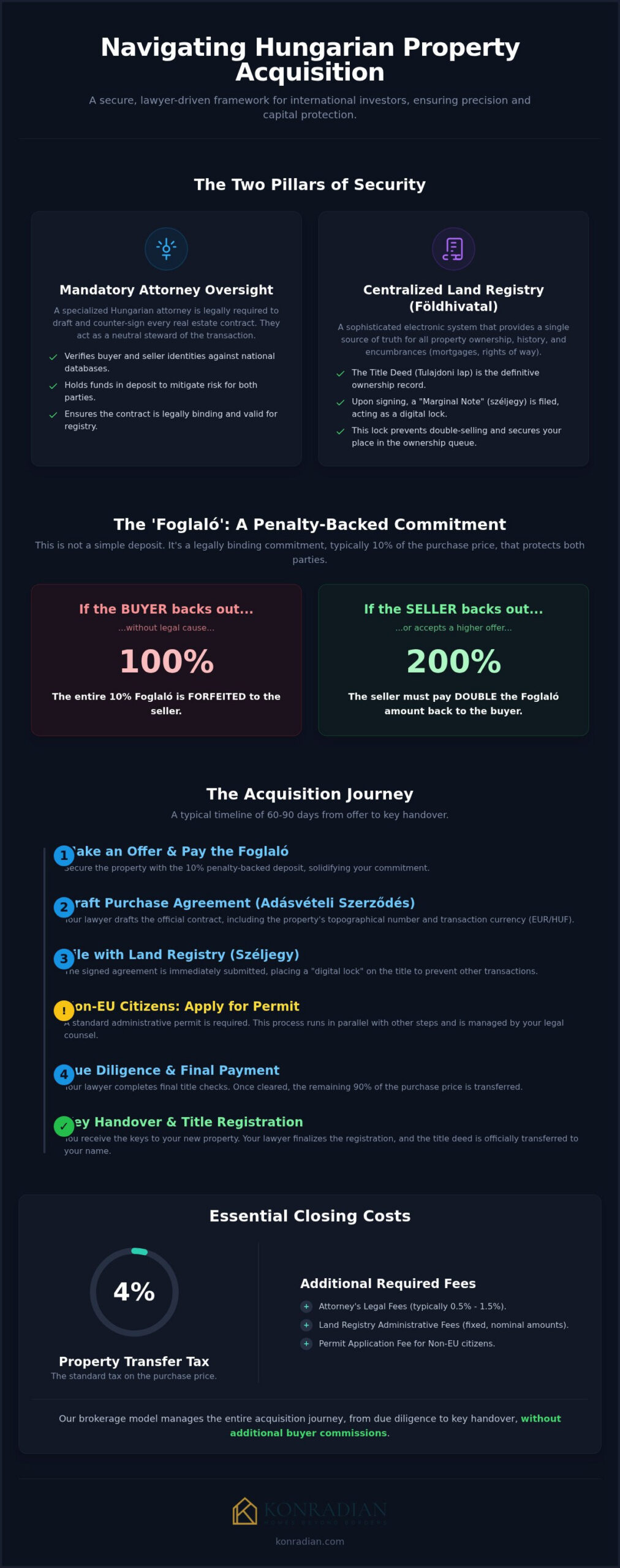
Hungary’s real estate market operates on a foundation of rigorous legal transparency and centralized control. Unlike jurisdictions that rely heavily on private title insurance, the Hungarian system centers on two primary pillars: the professional attorney and the centralized Land Registry. This structure ensures that every step of the legal process for buying property in Hungary is documented, verified, and publicly recorded, providing a level of security that is both comforting and absolute for international investors.
The definitive record of any investment is the Title Deed, known locally as the Tulajdoni lap. This document serves as the single source of truth for every square meter of Hungarian soil. It provides a comprehensive history of the property, including its exact dimensions, current ownership, and any existing encumbrances such as mortgages or rights of way. Accessing an up-to-date version of this record is the first priority in any acquisition, as it confirms the seller’s right to transfer the asset without hidden complications.
While EU and EEA citizens enjoy property rights nearly identical to Hungarian nationals, non-EU investors follow a slightly different path involving a standard administrative permit. Regardless of your country of origin, the legal framework is designed to protect the integrity of the capital you bring into the market. It’s a methodical environment where precision is rewarded with long-term peace of mind.
Mandatory Lawyer Counter-Signing
In Hungary, a real estate contract isn’t legally binding unless it’s drafted and counter-signed by a registered attorney. This professional doesn’t simply act as a document preparer. They have a statutory duty to verify the identity of both the buyer and the seller against national databases, ensuring that every party is exactly who they claim to be. The lawyer acts as a neutral steward of the transaction, often holding funds or documents in deposit to ensure that neither party is exposed to unnecessary risk. This mandatory involvement provides a sophisticated layer of protection that eliminates the common pitfalls found in less regulated markets.
The Land Registry System
The Land Registry, or Földhivatal, manages a sophisticated electronic filing system that offers real-time security for buyers. Once your purchase agreement is signed, your attorney immediately submits it to the registry. This action triggers the creation of a “Marginal Note,” or széljegy, on the property’s record. This note acts as a digital lock, signaling to any other potential buyers or lenders that a transaction is already in progress. It’s a highly effective mechanism that prevents the double-selling of a property and ensures your priority in the ownership queue is legally preserved from the moment the ink dries.
Step-by-Step: The Property Acquisition Journey in Hungary
The legal process for buying property in Hungary is a structured progression from initial intent to final ownership. It’s a journey that typically spans 60 to 90 days, depending on the complexity of the title and the buyer’s citizenship status. By following a methodical sequence, you ensure that every euro of your investment is protected by statutory safeguards. This path starts with a formal offer and concludes with the physical handover of the keys.
The Legal Power of the Foglaló
Once you’ve identified a property, the first significant legal step is the payment of the Foglaló. This isn’t a simple deposit; it’s a penalty-backed commitment that represents 10% of the purchase price. In the Hungarian system, this payment acts as a powerful deterrent against broken promises. If you, as the buyer, decide to withdraw from the transaction without legal cause, you forfeit the entire amount. Conversely, if the seller attempts to back out or accepts a higher offer elsewhere, they’re legally required to pay you double the deposit amount back. This symmetry provides a level of security that effectively eliminates the risk of gazumping.
The Purchase Agreement (Adásvételi Szerződés)
The core of your acquisition is the Adásvételi Szerződés, or Purchase Agreement. This document must be drafted by your attorney and include specific mandatory clauses, such as the exact identification of the property based on its Land Registry topographical number. You’ll also need to decide on the currency of the transaction. While many international investors prefer to settle in EUR to avoid exchange rate volatility, the contract must state the equivalent value in HUF for official tax and registry purposes. For those seeking a deeper dive into the nuances of cross-border transactions, our guide on legal support buying property abroad offers additional strategic insights.
After the agreement is signed and the final payment is cleared, the property handover occurs. This is a formal moment where a Handover Protocol is signed, documenting the meter readings and the physical state of the asset. Finally, your lawyer submits the closing documents to the Land Registry. This final act converts your Marginal Note into full, unencumbered ownership. To ensure this complex sequence is managed with precision, many investors choose to partner with an experienced brokerage that handles the administrative heavy lifting from start to finish.
Navigating Permits and Non-EU Buyer Requirements
While the legal process for buying property in Hungary is exceptionally streamlined for EU nationals, those arriving from outside the European Economic Area follow a distinct administrative path. This requirement isn’t an obstacle but rather a standard verification step managed by the local Government Office. It ensures that the acquisition aligns with public interest and local regulations, maintaining the market’s integrity for all participants. For the majority of global investors, this permit is a routine part of the acquisition journey that yields a high rate of approval.
It’s useful to understand that not every international transaction requires this oversight. For instance, if you’re acquiring property through a Hungarian business entity or if you hold specific residency status, you might bypass this step entirely. However, for the individual investor, the permit remains a central part of the 2026 acquisition timeline. It acts as a final layer of due diligence that protects both the state and your future title.
The Administrative Permit Process
The application for a purchase permit is handled by the relevant Kormányhivatal (Government Office) where the property is located. Your attorney will compile a dossier including your passport copy, a clean criminal record check from your home country, and the signed purchase agreement. In 2026, the typical processing window remains between 45 and 60 days. This period is a critical component of your financial planning, as the final payment of the purchase price is usually contingent upon the permit’s issuance. Administrative fees for this process are generally modest, typically around 50,000 HUF for a standard application, ensuring the entry cost remains accessible for serious investors.
Buying via a Hungarian Company
For professional investors managing a portfolio, acquiring real estate through a Hungarian limited liability company (Kft) offers significant strategic advantages. Since a Hungarian company is a domestic legal entity, it doesn’t require an administrative permit to purchase property. This can shave two months off your acquisition timeline, allowing for a much faster closing. Beyond the speed of the transaction, corporate ownership can offer beneficial tax structures, particularly regarding the deductibility of maintenance costs and the management of rental income. It’s a sophisticated route that aligns well with a long-term investment strategy, though it requires careful consideration of annual accounting requirements and corporate tax obligations.
Essential Due Diligence and Closing Costs
A successful acquisition rests on the meticulous verification of the property’s legal history. The legal process for buying property in Hungary involves several administrative checkpoints that ensure you aren’t inheriting the previous owner’s debts or legal disputes. While the Land Registry provides the foundation for ownership, true due diligence requires a proactive approach to verify the current status of utility accounts and local tax obligations before the final payment is released.
One of the most critical documents to secure is the “null certificate,” or nullás igazolás. This statement from the building management or utility providers confirms that the seller has no outstanding debts. In the Hungarian system, unpaid common costs or utility bills can sometimes follow the property rather than the individual, making this verification a non-negotiable step in your investment strategy. It’s these small, technical details that ensure a seamless transition of ownership.
Title Search and Encumbrances
The primary focus of your attorney’s investigation is identifying any registered burdens on the title deed. Beyond standard bank mortgages, properties may be subject to life annuities, where a third party has a legal right to reside in the home until their passing, or specific usage rights that could restrict your renovation plans. For those focusing on new-build assets, verifying the “usage permit” is essential. Without this document, the property cannot be legally occupied or registered as a residential unit. Understanding these technical requirements is a core part of property investment in Hungary, as it separates a secure asset from a potential legal liability.
Closing Cost Breakdown
Budgeting for a Hungarian acquisition requires a clear understanding of the mandatory fees and taxes that accompany the purchase price. The most significant expense is the Property Transfer Tax (Vagyonszerzési illeték), which is set at a standard rate of 4% of the property’s market value. Unlike many other costs, this isn’t paid at the time of signing. The tax authority will issue an assessment notice several months after the registration is complete.
- Legal Fees: Professional fees for drafting the contract and managing the registration typically range from 0.5% to 1.5% of the purchase price.
- Administrative Fees: Land Registry registration and permit application costs are relatively low, usually totaling under 100,000 HUF.
- Translation and Notary: If you require documents in your native language or need a power of attorney, budget for certified translation and notary fees to ensure international validity.
Securing your investment requires professional oversight to ensure no detail is missed during these final stages. If you’re ready to proceed with a secure, expert-led acquisition, contact Konradian today to manage your transaction with precision and ease.
Secure Your Hungarian Investment with Konradian
The legal process for buying property in Hungary demands a level of precision that can feel daunting from a distance. Konradian exists to bridge this gap, acting as your dedicated concierge and strategic advisor throughout the entire lifecycle of your investment. Our team, educated at the London School of Economics, brings over five years of international brokerage experience to ensure that every technical detail is handled with intellectual rigor. We don’t just find property; we curate opportunities that align with your long-term wealth objectives.
One of the most compelling aspects of our service is the “Zero-Cost” advantage. In the Hungarian market, developer and seller commissions typically fund our brokerage fees. This means you receive sophisticated, end-to-end oversight, from the initial search to the final key handover, without incurring additional costs for our representation. It’s a model that prioritizes your peace of mind while granting you exclusive access to pre-sale developer deals in Budapest that rarely reach the open market. This proactive approach ensures you’re positioned at the front of the queue for the city’s most desirable assets.
Integrated Legal and Financial Support
Managing the legal process for buying property in Hungary requires seamless coordination between multiple professional parties. We act as the central hub, working alongside vetted Hungarian lawyers to ensure your interests are protected at every turn. If you’re managing your acquisition from abroad, our remote purchase support allows you to secure assets without the need for immediate travel. We facilitate everything from power of attorney arrangements to the opening of local bank accounts and the optimization of currency exchange, ensuring your capital moves efficiently and securely through the Hungarian banking system.
The Konradian Difference
We view ourselves as more than just brokers; we’re partners in your portfolio’s growth. Our boutique approach means we handle the heavy lifting, allowing you to enjoy the rewards of international real estate without the administrative stress. Whether you’re looking for a single high-yield apartment or building a diverse collection of European assets, our global mindset ensures your investment is managed with cosmopolitan fluency. It’s time to move beyond the complexities of local law and embrace a refined investment experience. Schedule a free consultation for your Hungarian property search and discover how we can secure your international investment with precision.
Advancing Your Hungarian Investment Strategy
Navigating the legal process for buying property in Hungary requires a blend of technical precision and strategic foresight. By understanding the binding nature of the Foglaló and the absolute transparency of the Land Registry, you can position your capital with certainty. Success in this market isn’t just about finding the right asset; it’s about ensuring every administrative step is verified by experts who understand the nuances of 2026 regulations. This methodical approach transforms a complex international transaction into a secure, predictable journey.
Konradian provides the sophisticated stewardship necessary for high-stakes acquisitions. Our LSE-educated advisors bring over five years of international real estate experience to manage the heavy lifting on your behalf. We offer a comprehensive, end-to-end service that covers everything from due diligence to key handover, all at no cost to the buyer. This allows you to focus on the long-term growth of your portfolio while we secure the professional details.
Secure your Hungarian investment with a free expert consultation and take the first step toward a seamless acquisition. Your future in one of Europe’s most secure markets is within reach.
Frequently Asked Questions
Do I need to be a Hungarian resident to buy property?
No, you don’t need to be a resident to acquire real estate. EU citizens buy on equal terms with Hungarian nationals. Non-EU citizens follow a specific administrative path involving a permit from the Government Office. This step is a standard part of the legal process for buying property in Hungary. While it adds a layer of oversight, it rarely results in a rejection for legitimate investors seeking residential or commercial assets.
How long does the legal process take from offer to completion?
The journey from a formal offer to final registration typically spans 60 to 90 days. This duration accounts for the mandatory title searches and the 45 to 60 day waiting period required for non-EU buyer permits. If you’re an EU citizen or purchasing through a Hungarian company, the timeline can be significantly shorter. We manage every administrative milestone to ensure your acquisition remains on schedule and entirely secure.
Is the contract written in English or Hungarian?
All real estate contracts must be written in Hungarian to be legally valid at the Land Registry. However, international investors almost always receive a bilingual version, typically in English and Hungarian, presented in a side by side format. This ensures you understand every clause and obligation before signing. Your attorney’s role includes explaining the legal nuances of the Hungarian text, which remains the prevailing version in the event of a dispute.
What are the total closing costs when buying in Hungary?
You should budget approximately 5% to 6% of the purchase price for total closing costs. The primary expense is the 4% Property Transfer Tax, which the tax authority assesses after the transaction is complete. Additional costs include legal fees, which generally range from 0.5% to 1.5%, and modest administrative registration fees. Our brokerage model ensures that you receive expert guidance without paying additional buyer commissions in the Hungarian market.
Can I buy property in Hungary remotely without visiting?
Yes, you can complete the entire legal process for buying property in Hungary without traveling to the country. This is achieved through a Power of Attorney, which allows your Hungarian lawyer to sign documents on your behalf. The document must be notarized and, depending on your home country, may require an Apostille. We frequently manage remote acquisitions for our global clients, providing a seamless end to end experience from afar.
What is the difference between a “Foglaló” and “Vételár előleg”?
The difference lies in the legal consequences of a breach of contract. A “Foglaló” is a penalty backed deposit, usually 10%, that is forfeited if the buyer withdraws or repaid double if the seller defaults. In contrast, a “Vételár előleg” is a simple down payment that is fully refundable if the deal falls through for any reason. Most sellers insist on a Foglaló to ensure a high level of transaction security.
Do I need a local bank account to purchase a house?
You aren’t strictly required to have a Hungarian bank account to finalize the purchase, as funds can be transferred internationally. However, it’s highly practical to open one for the ongoing management of your investment. A local account simplifies the payment of monthly utility bills, common costs, and future property taxes. We assist our clients with the account opening process to ensure their financial transition is as smooth as the acquisition itself.
Is it possible to get a mortgage as a foreigner in Hungary?
It’s possible for foreigners to obtain a mortgage in Hungary, though the criteria are stricter for non residents. Banks typically require a higher down payment, often 40% to 50%, and proof of stable international income. While Konradian doesn’t provide direct mortgage lending, we can introduce you to local banking partners who specialize in international clients. This allows you to explore financing options that align with your broader investment strategy and capital requirements.