


Paying part of a Spanish property’s purchase price off the books is illegal and can lead to tax penalties and problems when you sell. Avoiding property scams in Spain means verifying the seller and ownership, documenting every payment, and having an independent lawyer review the paperwork before money changes hands.
Caution is sensible: a convincing listing or signed document alone doesn’t prove that the seller has the right to sell or that the property is free of problems. Clear checks can help you distinguish a legitimate transaction from warning signs, rather than relying only on claims from a seller or intermediary.
This guide explains how to verify a property and its seller, recognise suspicious requests, understand cash payments, and review reservation and deposit contracts. It also explains why independent bilingual legal advice from a lawyer familiar with the property’s autonomous community is an important safeguard before you commit.
Key Takeaways
- Match the seller’s identity to their legal authority to sell, and verify key property details through official records rather than relying only on listing information.
- Review the Land Registry information for ownership, mortgages, charges, and other encumbrances before committing funds.
- Keep payments traceable and documented. Paying part of a Spanish property purchase price off the books is illegal and can create tax and resale complications.
- Read reservation and deposit terms carefully, including cancellation conditions and how funds are handled, before signing or transferring money.
- Independent bilingual legal advice can help you understand local risks and review the transaction before money changes hands.
1. How do you verify property status and seller legitimacy?
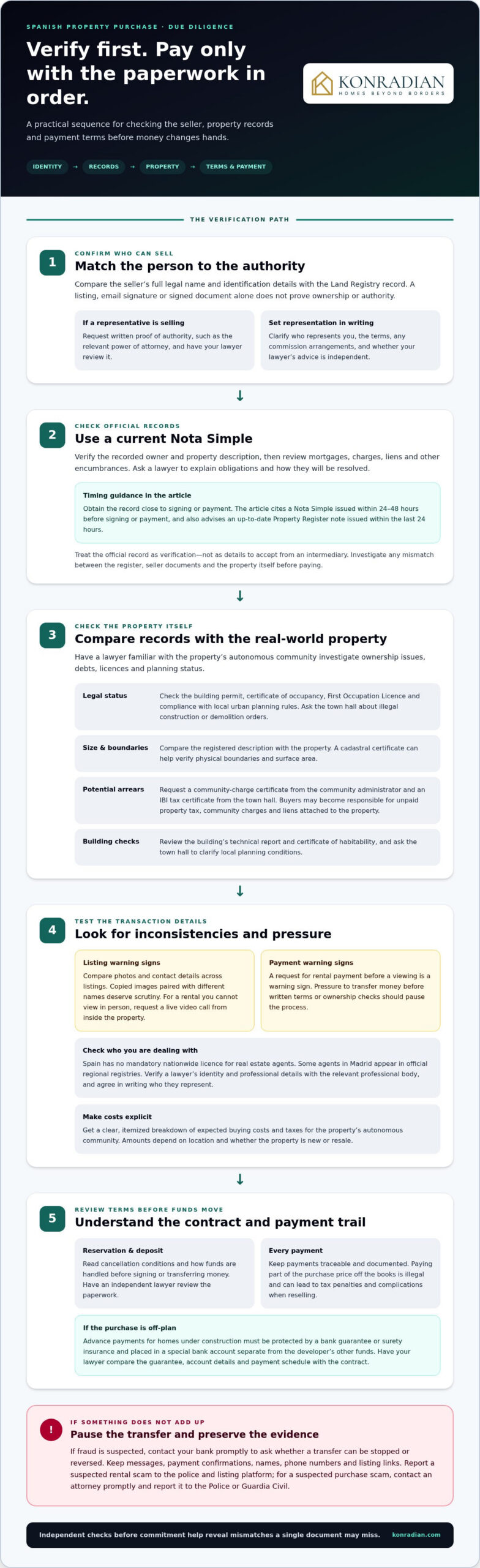
Before you buy, a lawyer should investigate ownership, debts, unresolved ownership issues, and missing licences. Request a current Nota Simple, review the property’s planning and licence status, and compare the registered owner’s details with the seller’s identification.
Compare the seller’s full legal name and identification details with the Land Registry record. If a representative is selling the property, request written evidence of their authority, such as the relevant power of attorney, and have your lawyer review it. A name on a listing or email signature does not prove ownership or authority to sell.
Request a Spanish Nota Simple and check the recorded owner, property description, mortgages, charges, and other encumbrances. The guidance advises obtaining a Nota Simple issued within 24-48 hours before signing or making any payment. It also advises buyers to obtain an up-to-date Property Register note issued within the last 24 hours to verify ownership. Treat those records as verification, not as details to accept from an intermediary.
A lawyer familiar with the property’s autonomous community can investigate debts, unresolved ownership, and missing licences. They can also compare the registered description with the property itself and review its planning status. A cadastral certificate can help verify physical boundaries and surface area, while the town hall can clarify local planning conditions.
When working with an agency, establish who represents you and get the terms in writing. Spain has no mandatory nationwide licence for real estate agents. Some agents in Madrid appear in official regional registries, providing an additional check there. For a lawyer, verify their identity and professional details with the relevant professional body. Then agree in writing who they represent and whether their advice is independent of the seller or agent.
How can buyers spot fake estate agents, rental listings, and requests for upfront payment? Compare listing photos and contact details across listings. Copied images paired with different names deserve scrutiny. For a rental, request a live video call from inside the property if you can’t view it in person. A request for payment before a viewing is a warning sign. Pressure to transfer money before written terms or ownership verification should pause the process.
Before proceeding, have your lawyer check the seller’s identity and authority alongside the property records. Reviewing them together can reveal mismatches that a listing or single document may not show.
2. How do i spot a property scam in spain?
A low asking price is a warning sign, but the paperwork matters more. Before committing, compare the property with local listings and investigate its legal status. A persuasive agent, attractive photographs, or pressure to transfer money cannot replace independent checks.
Request a current Land Registry simple note and compare the registered owner and property description with the sale documents. Review mortgages, charges, liens, and other encumbrances before signing. Ask a lawyer to explain which recorded obligations could affect the purchase and how they will be resolved. Investigate any mismatch between the register, the seller’s documents, and the property itself before proceeding with payments.
Check the property’s building permit, certificate of occupancy, and compliance with local urban planning rules. The First Occupation Licence, available from the local town hall, confirms legal habitability. Ask the town hall about planning status, including illegal construction or demolition orders, and review the building’s technical report and certificate of habitability. For community charges, request a certificate from the community administrator. The town hall can also provide an IBI tax certificate showing whether property tax is outstanding. Buyers may become responsible for unpaid property tax, community charges, and liens attached to a purchased property, so identify arrears before signing.
Before negotiations advance, establish in writing who represents you and the terms of that representation, including any commission arrangements. Get a clear breakdown of expected buying costs and taxes for the property’s autonomous community. Amounts depend on the property’s location and whether it is new or resale; request an itemized calculation before committing.
For an off-plan purchase, review payment protections before sending funds. Spanish off-plan property payments must be protected by a bank guarantee or surety insurance. According to Boletín Oficial del Estado, buyers’ advance payments for homes under construction must go into a special bank account, separate from the developer’s other funds. Have your lawyer compare the guarantee, account details, and payment schedule with the contract.
If you suspect fraud, contact your bank promptly to ask whether a transfer can be stopped or reversed. Preserve messages, payment confirmations, names, phone numbers, and listing links. Report a suspected rental scam to the police and the listing platform; for a suspected purchase scam, contact an attorney promptly and report it to the Police or Guardia Civil. A careful Spanish property purchase review can help bring these checks together before you proceed.
3. Are cash payments legal in spanish property transactions?
The key distinction is whether a payment is declared and properly recorded. Paying part of a Spanish property’s purchase price off the books is illegal and can lead to tax penalties and complications when reselling. Don’t agree to an undocumented payment, even if the seller calls it customary or says it will simplify completion. Ask your lawyer to ensure the full price and payment arrangements appear in the transaction documents.
A seller’s proposed payment method deserves particular scrutiny if it differs from the written sale terms. In one reported example, a seller asking 445k for a property insisted that 80k be paid in cash. That demand is a warning to pause, not a reason to rush. Ask for the full amount, payment dates, recipient, and method to be documented before you transfer funds.
Traceability matters for international buyers managing funds across accounts or currencies. Use a bank transfer that records the recipient and transaction details, and keep the payment confirmation with the signed paperwork. Before sending money, compare the account holder’s identity with the seller or company named in the contract. If the recipient changes unexpectedly, ask your lawyer to review the revised instructions before paying.
For funds held until completion, consider a blocked account at a notary’s office or a secure payment arrangement that releases money only when the purchase is properly formalised. Confirm in writing who controls the funds, what triggers their release, and how a failed completion is handled. The payment process should align with the contract, not depend on informal promises from an agent or seller.
Keep a clear record of every instalment: the amount, date, payer, recipient, purpose, and supporting document. When confirming a transfer, use contact details you have independently verified, rather than relying on new bank instructions in an unexpected email. This identity check can help expose altered payment details before money leaves your account.
If someone asks you to conceal part of the purchase price, stop the transfer and seek independent legal advice. Your lawyer can check that the declared consideration matches the agreed transaction and that the payment route is properly documented. Don’t sign a receipt showing a different amount or accept an undocumented side agreement. A transparent record protects your position if a tax review or resale question arises later.
4. Choosing a notary and reviewing deposit contracts
Before paying a reservation deposit, ask an independent lawyer to review the written agreement and explain how the funds will be handled. Check that it identifies the buyer, seller, property, amount, payment recipient, and cancellation conditions. Don’t send money without a signed and duly legalised contract. A request for payment before clear written terms are provided is a warning sign, not a reason to rush.
Read every clause before signing, especially those covering cancellation, unexpected expenses, completion, and delivery guarantees. Ask a professional to compare the deposit agreement with the later sale contract so important terms don’t change unnoticed. Confirm what happens if the seller withdraws, the buyer can’t proceed, or the property isn’t delivered as agreed. Keep a complete copy of each signed version and its payment evidence.
Use the notary’s authentic document as the reference for payment obligations. Refuse any payment that isn’t included in the authentic document signed before a notary. If an agent or seller requests a separate transfer, cash payment, or revised bank details, pause and have your lawyer compare the request with the signed terms. Resolve any discrepancy between the contract amount and requested payment before funds move.
For a new-build property, a buyer may pay a 20% deposit before construction starts. Verify that a valid bank guarantee exists before transferring any deposit on a new-build. Check that the guarantee covers the relevant advance payments and matches the buyer, developer, and property named in the contract. If the developer’s payment schedule or account details differ from the paperwork, ask your lawyer to review them before signing or paying.
Rental deposits need the same discipline. In Spain, renters shouldn’t transfer a deposit or rent before receiving clear written terms. Those terms should identify the landlord, rental property, payment recipient, amount, and agreement period. If you’re considering a rental in Valencia, a short-term stay of 2-3 months can provide a chance to assess the property and arrangement before making a longer commitment.
To spot a falsified contract or deed, compare names, property details, dates, and payment instructions across the documents and official records. Look for inconsistent spelling, altered figures, missing pages, or details that differ from the seller’s identification. Ask your lawyer to verify questionable documents directly through the appropriate official channel. A serious discrepancy, refusal to provide a complete signed agreement, or pressure to pay before review should halt the transaction until resolved.
5. Using independent bilingual legal advice
A Spanish property buyer should appoint an independent bilingual lawyer before any money changes hands. Independence matters: the lawyer should represent your interests, not the seller’s, developer’s, or agent’s. Agree in writing who the lawyer represents, which documents they will review, and how they will report concerns. If the property is in a particular autonomous community, choose a lawyer familiar with its local rules and planning procedures.
Set a clear review sequence before signing. Ask the lawyer to compare the seller’s identity and authority with the Land Registry record, then examine ownership, mortgages, charges, and other encumbrances. They should also assess debts, unresolved ownership issues, missing licences, and planning concerns. Request a written explanation of any mismatch, including what it means for your decision and which document could resolve it.
For a resale property, provide the Nota Simple, draft sale contract, title documents, and available certificates. Ask the lawyer to check that names, property details, payment terms, and completion conditions align across the documents. For a new build, add the reservation agreement, construction schedule, payment instructions, and bank guarantee or surety insurance. The review should link each payment to the contract and its stated protections.
Bilingual advice helps you understand the Spanish document and its practical effect, not just a translated summary. Ask for key clauses to be explained in English before signing. Focus on cancellation rights, deadlines, costs, delivery obligations, and what happens if either party fails to complete. Keep the Spanish version and any translation together, and ask which text governs if the wording differs.
A lawyer can help distinguish a serious discrepancy from ordinary administrative complexity. For example, if a contract names a different seller from the Land Registry, ask for the legal explanation and supporting authority in writing. If payment instructions change, have the lawyer confirm the recipient against the signed agreement. Scammers can exploit rushed decisions, so don’t let urgency replace document verification.
Before engaging a lawyer, verify their identity and professional details through the relevant professional body. Confirm that the engagement letter names you as the client and defines the work, communication language, and document-delivery process. Ask how the lawyer will flag urgent risks and provide written advice before you sign or transfer funds. These practical terms make the advice accountable and easier to follow.
For guidance that brings legal and transaction support into your Spanish purchase process, explore Spanish property purchase support.
Konradian: Spanish Property Acquisition
Konradian supports buyers considering Spanish Property Acquisition, from property selection through legal and financial transaction support to key handover. If you’re buying from abroad, it can help coordinate the process before you commit to a property.
Bring your priorities, preferred location, and transaction questions to the discussion. Konradian can help you assess property options and understand where legal and financial support fits, while an independent lawyer advises on your personal legal interests. Keeping these responsibilities distinct helps you move from exploring listings to reviewing a purchase with clarity.
If you’re considering a purchase in Spain, contact Konradian to discuss your next step.
Make your next property decision with clarity
A cross-border purchase is easier to assess when you define your priorities before choosing a property. Consider how you plan to use it, which trade-offs you can accept, and which decisions need independent legal advice. This framework makes avoiding property scams in Spain a practical part of a considered investment, rather than a last-minute check.
Konradian offers Spanish Property Acquisition, Croatian Real Estate Sales, and US Real Estate Investment Services. For a Spanish purchase, its role can complement your independent lawyer: property selection and transaction support help you navigate the process, while your lawyer advises on your legal interests. Keep those responsibilities distinct as you decide whether a property and its terms suit your plans.
Your next step can be a conversation about your goals, preferred property, and the support you need to make an informed decision. Explore property advice with Konradian and move forward at a pace that feels right for you.
Frequently Asked Questions
Are cash payments legal in Spanish property transactions?
A cash payment isn’t the same as concealing part of the purchase price. Paying part of a Spanish property’s agreed price off the books is illegal and can bring tax penalties and resale complications. Keep the full consideration in the transaction documents and retain evidence of each payment. If a seller proposes a separate, undocumented amount, pause and seek independent legal advice before agreeing.
How can I verify a landlord or agency?
For a rental, compare the landlord’s identity with the name on the agreement and ask for evidence that they can rent out the property. A practical way of avoiding property scams in Spain is to match the person, property, and payment recipient before sending funds. If you can’t view the apartment, request a live video call from inside it. Compare photos across listings and check relevant regional agency registers where available.
How can you ensure that your purchase in Spain is completely above board?
Keep a clear record from the first offer through completion. Ask your independent lawyer to compare the sale agreement with the property and seller records, and explain any mismatch in writing. Confirm that each payment has a documented purpose and that the contract reflects the agreed amount. For a home under construction, review the payment protections and keep copies of the supporting documents.
How do I spot a property scam in Spain?
Check whether the advertiser, seller, property records, and payment recipient all align. When avoiding property scams in Spain, focus on inconsistencies rather than relying on a polished listing or persuasive messages. Copied photos, requests for payment before a rental viewing, and pressure to send money deserve scrutiny. For a purchase, compare the asking price with local listings and have an independent lawyer investigate concerns before you commit.
How do you verify property status and seller legitimacy?
Compare the seller’s identification with the owner named in a current Land Registry simple note. If someone is acting for the owner, have a lawyer review their written authority to sell. Check that the registered property description matches the home being offered. A cadastral certificate can help compare recorded boundaries and surface area with the physical property, while planning and licence records can reveal issues not apparent during a viewing.
How should buyers handle payments and contracts safely?
Before transferring money, compare the payment instructions with the signed contract, including the recipient and stated purpose. Use a traceable transfer and save its confirmation with the agreement. If bank details change, verify the change through a previously established contact method, not only through the message announcing it. For funds held before completion, make sure the written terms explain who controls them and what happens if the sale doesn’t proceed.
Is it legal to pay part of the housing costs in cash “under the table”?
Concealing part of the agreed price in a property purchase is illegal and can cause tax and resale problems. Don’t sign documents showing a different price from the agreed amount. For a rental, keep the signed agreement and payment records together so every transfer has a clear purpose. If anyone asks you to keep a payment outside the paperwork, stop and seek independent legal advice before handing over money.
What are the most common property scams in Spain?
Warning signs include copied rental listings, requests for payment before a viewing, and sellers whose authority can’t be documented. Purchase risks also include undisclosed debts, payment demands outside the contract, and off-plan advances without the required protections. A single irregularity doesn’t prove fraud, but it should prompt a targeted check. If you suspect deception, preserve messages, listing details, and transaction records for reporting.
