


Budapest may be Hungary’s best-known property market, but it isn’t automatically the best fit for every investor. The best cities in Hungary for real estate investment depend on your priorities, whether that means tenant demand, a particular holding period, or looking beyond the capital.
It’s understandable that Budapest dominates early research. But headline asking prices and national averages can hide important differences between cities, neighbourhoods, and individual properties. Treat a city-level figure as a starting point, not a valuation or a promise of rental performance.
This guide compares Budapest, Debrecen, Szeged, Győr, and Pécs by investment fit, local demand drivers, and the evidence to check before viewing a property. It explains how to interpret asking-price and rental data, assess indicators such as student and employment demand, and identify due-diligence points that may affect a purchase. The goal is to create a focused shortlist, then assess each property on its own merits. With more than five years of local market experience, Konradian supports international buyers from city-level research and property selection through legal and financial advice to key handover.
Key Takeaways
- The best cities in Hungary for real estate investment depend on your strategy, target property, and holding period, not a single national ranking.
- Compare Budapest, Debrecen, Szeged, Győr, and Pécs using consistent evidence on local demand, employment, education, transport, and housing.
- Separate asking-price indicators from completed-sale evidence, and treat citywide figures as context rather than a valuation of a specific property.
- Build a shortlist by defining your intended use, property type, investment horizon, and preferred level of involvement before moving to property-level due diligence.
- Konradian supports buyers in Hungary from market research and property selection through legal and financial advice to key handover. Services are free for clients in Hungary; the free-service guarantee excludes the UK and Croatia.
Best cities in Hungary for real estate investment: what should you compare?
“Best” isn’t a fixed position in a national ranking. It means finding the closest fit between your investment strategy, the demand you can evidence in a location, the property type you’re considering, and your expected holding period. Budapest, Debrecen, Szeged, Győr, and Pécs are all worth comparing, but one headline figure can’t tell you which is right for your plans.
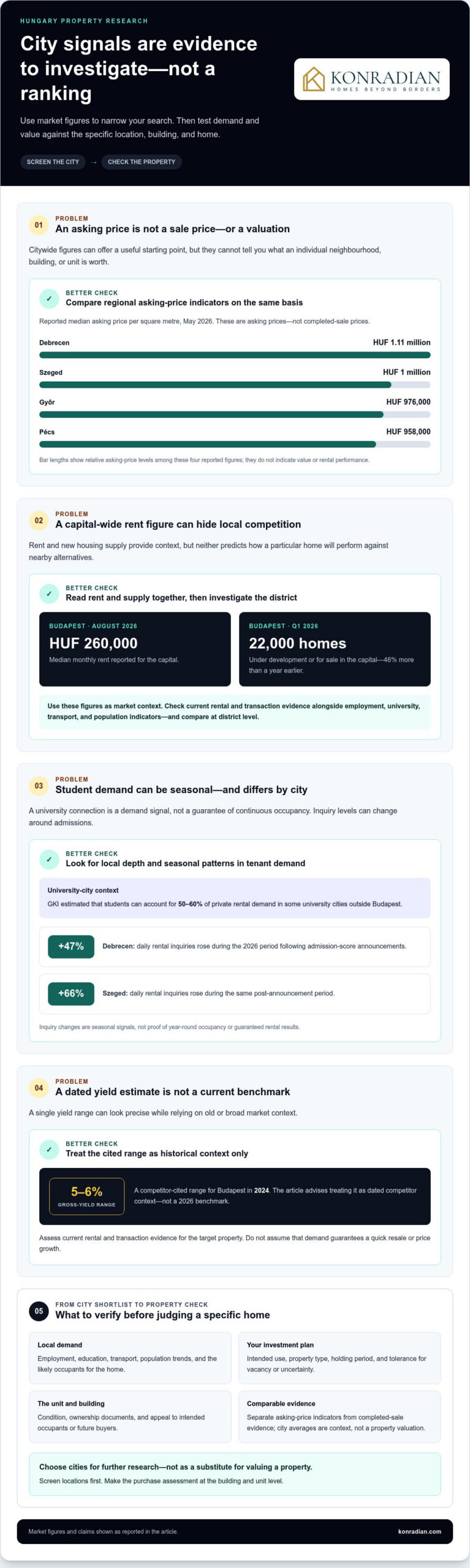
Asking-price data illustrates why it matters to check what a figure measures. In May 2026, Hungarian Conservative reported median asking prices per square metre of HUF 1.11 million in Debrecen, HUF 1 million in Szeged, HUF 976,000 in Győr, and HUF 958,000 in Pécs. These are asking prices, not completed-sale prices or valuations of individual homes. A national average can provide broad context, but it can’t show what a particular neighbourhood, building, or unit is worth.
A sound city shortlist is a small group of locations that fit your intended use, target property, holding period, and tolerance for uncertainty. Choose cities for further research, not as a substitute for valuing a property. Screening helps you decide where to look; due diligence helps you assess a specific purchase.
Which investment objectives lead to different city choices?
Start with the intended use. For long-term residential letting, look for evidence of sustained local tenant demand and consider what types of homes renters seek. A student-oriented strategy calls for closer attention to university-linked demand and its seasonal patterns. If you plan to use the property yourself, everyday convenience and your own connection to the location may matter more than rental indicators. For a resale-focused strategy, research the relevant buyer pool and comparable transactions. Don’t assume that demand guarantees a quick sale or price growth.
Your holding period matters, too. With a shorter horizon, give more weight to purchase costs, the likely resale audience, and the possibility of needing to sell at an inconvenient time. A longer horizon may give local demand patterns more time to develop, but it doesn’t remove vacancy risk. If empty periods would be difficult to manage, scrutinise the depth and stability of demand rather than relying on a city’s reputation.
Why compare cities before comparing individual properties?
City screening is an efficient first step, not a substitute for reviewing a property. It helps narrow the search by local demand, employment and education context, transport, and available housing types. A broad overview of the Economy of Hungary can help frame national conditions, but local evidence is needed to understand how those conditions relate to a chosen city.
Once you have a shortlist, focus on the building and unit. Assess condition, review ownership documents, and consider the property’s specific appeal to its intended occupants or future buyers. Citywide averages can’t answer those questions. The Hungary property investment guide provides broader context for moving from market research towards a considered acquisition.
Budapest, Debrecen, Szeged, Győr, and Pécs: what distinguishes each market?
These five cities offer different starting points for research, not a ready-made ranking. Housing figures provide an initial comparison, while employment, education, transport links, and population trends can help explain who may want to live in a particular area. The Hungarian National Bank Housing Market Report provides national housing-market context. Choosing a city or property still calls for more local evidence.
Budapest: the capital-city benchmark
Budapest offers a useful reference point for comparing Hungary’s largest residential market. In August 2026, the median monthly rent was HUF 260,000, according to Daily News Hungary. The Hungarian National Bank reported that 22,000 homes were under development or for sale in the capital in Q1 2026, 46% more than a year earlier. This supply figure adds context, but it doesn’t show how a particular property will compete.
A competitor cited a 5-6% gross-yield range for Budapest in 2024. Treat that as dated competitor context, not a 2026 benchmark. To assess the city, examine current rental and transaction evidence alongside employment, university, transport, and population indicators. District-level comparisons need their own analysis; don’t extrapolate from capital-wide figures.
Regional cities: research Debrecen, Szeged, Győr, and Pécs
Regional markets aren’t interchangeable. Student demand is especially relevant in university cities: GKI estimated that students can account for 50-60% of private rental demand in some university cities outside Budapest. Admission-period increases in inquiries also show how demand can vary by season. Debrecen’s daily rental inquiries rose 47% and Szeged’s 66% during the 2026 period following admission-score announcements, according to Debrecen Sun.
- Debrecen: Hungarian Conservative reported a median asking price of HUF 1.11 million per square metre in May 2026. Its August median monthly rent was HUF 220,000, according to Daily News Hungary. Consider how student and employment demand relates to the specific home and its location.
- Szeged: The May 2026 median asking price was around HUF 1 million per square metre, and the August median monthly rent was HUF 200,000. Student inquiry patterns are one demand indicator, not evidence of year-round occupancy.
- Győr: The reported May median asking price was HUF 976,000 per square metre; the August median monthly rent was HUF 200,000. Investigate local employers, education, transport access, and population trends rather than assuming another city’s rental drivers also apply here.
- Pécs: The May median asking price was HUF 958,000 per square metre. Daily News Hungary reported a median monthly rent of around HUF 150,000 using July 2026 data. Assess the relevant tenant pool and location-specific access before comparing it with other cities.
These figures are market snapshots, not valuations. A city profile can show what to investigate, but it can’t guarantee a property’s performance. For a Hungarian property search based on local comparison, Konradian’s Hungarian property brokerage can support research and property selection.
How do Hungarian cities compare for property investment?
For a fair comparison, apply the same questions to every location and record where the evidence is incomplete. The table separates rental indicators from asking-price data and identifies the source date and geographic scope. It doesn’t treat asking prices as completed sales or citywide indicators as valuations of individual homes.
| City | Demand evidence | Property fit and investor priority | Transport and services | Housing evidence and source scope |
|---|---|---|---|---|
| Budapest | Median rent indicator, August 2026 | Compare the intended property type with its likely tenant or buyer pool; assess supply alongside demand. | Use current transport and service-area evidence for the specific location; no comparable dataset is cited here. | City-level rental indicator, Daily News Hungary, August 2026; asking-price data should be compared separately. |
| Debrecen | Median rent indicator, August 2026; student inquiry evidence is seasonal. | Test student or employment-led demand against the unit’s location, size, and condition. | Verify local access and services against the property address; no like-for-like city comparison is cited here. | City-level rental indicator, Daily News Hungary, August 2026; median asking-price evidence, Hungarian Conservative, May 14, 2026. |
| Szeged | Median rent indicator, August 2026; admission-period inquiries provide a seasonal signal. | Check whether the selected property suits the tenant group your strategy depends on. | Confirm relevant transport and services for the neighbourhood; comparable evidence is not included here. | City-level rental indicator, Daily News Hungary, August 2026; median asking-price evidence, Hungarian Conservative, May 14, 2026. |
| Győr | Median rent indicator, August 2026. | Compare similar homes and investigate local employment demand before settling on a property type. | Review address-specific transport and services; no consistent cross-city dataset is cited here. | City-level rental indicator, Daily News Hungary, August 2026; median asking-price evidence, Hungarian Conservative, May 14, 2026. |
| Pécs | Median rent indicator, July 2026. | Assess the relevant tenant or buyer pool and the appeal of the specific home. | Verify local access and services for the property; comparable city-level evidence is not cited here. | City-level rental indicator, Daily News Hungary, July 2026; median asking-price evidence, Hungarian Conservative, May 14, 2026. |
Which indicators help compare locations fairly?
For each city, assemble current evidence on population, employment, education, transport, and housing from reliable sources. Match the period and geographic scope where possible, then compare the same property type and condition category. For broader price context, the Hungary Property Market Analysis provides historical and regional information. Check its definitions and dates against the local evidence you use. If a figure is unavailable or measured differently, mark the gap instead of filling it with an estimate.
How should investors interpret price and yield figures?
For every figure, record the data period, source, and whether a price is an asking figure or a completed transaction. Gross yield is an estimate based on stated rent and price assumptions, not a guaranteed return; it doesn’t account for every ownership cost or vacancy by itself. A national average can frame your research, but several relevant local comparables and a property-specific review are needed to assess an individual listing. This disciplined approach makes the best cities in Hungary for real estate investment easier to compare without overstating what the figures prove.
Konradian’s Hungarian property brokerage supports international buyers moving from city research to property selection and purchase review. Explore Hungarian property search support as you refine your shortlist.
How can you shortlist a Hungarian city for your investment goals?
A practical shortlist turns broad preferences into research criteria before you start comparing individual listings. Define how you plan to use the property, how long you expect to hold it, what type of home you want, and how much day-to-day involvement you’re prepared to take on. Then compare cities against those priorities rather than relying on reputation or one headline figure.
- Set the objective. Decide whether the property is primarily for long-term letting, student-oriented demand, personal use, or a future resale. Your objective determines which local demand evidence matters most.
- Set your boundaries. Record your intended holding period, preferred property type and condition, tolerance for vacancy, and acceptable level of involvement in ongoing arrangements. These boundaries help rule out locations that don’t suit your plan.
- Choose a small city shortlist. Compare Budapest, Debrecen, Szeged, Győr, and Pécs using the same priorities. Rank factors such as employment access, education, transport, lifestyle, and housing type according to how relevant they are to your intended use.
- Build an evidence record. For each city, note the source, publication date, geographic scope, and measure used for population, employment, education, transport, rents, and prices. Mark missing or mismatched information clearly. A city’s reputation isn’t proof of demand for a particular property.
- Move to property-level comparisons. Compare similar local listings by property type, size, location, and condition. Keep asking prices distinct from completed-sale evidence, and don’t infer potential returns from figures that don’t match your intended property.
Match your priorities to a city shortlist
Weight your criteria deliberately. For a home intended for student renters, education-linked demand may deserve close attention; for personal use, lifestyle and transport may matter more. If access to employment is central to your plan, research the relevant local job base and commute patterns. Record why each city remains on your shortlist and what evidence might change your view. The result should be a focused set of candidates, not a claim that one city is universally best.
Move from city research to property-specific review
Shortlisting is only the screening stage. Before forming a view on a specific home, compare it with relevant local listings and completed-sale evidence where available, taking differences in condition and location into account. Then review ownership documentation and transaction questions with appropriate professional support. Konradian supports international buyers with property selection and legal and financial advice through the purchase process. Its legal support guide for buying property abroad offers further context for that review.
In brief: screen cities against your objectives and dated local evidence, then assess each property separately through comparable analysis, document review, and legal due diligence. To develop a shortlist into a considered Hungarian property search, explore support with your Hungarian property search.
How Konradian supports an international property search in Hungary
Choosing among the best cities in Hungary for real estate investment is only the beginning. Next, turn your priorities into a focused property search and review the purchase with appropriate support. Konradian works with international buyers throughout the process, from market research assistance and property selection to legal and financial advice and key handover.
From city shortlist to property selection
An initial conversation helps clarify what you want the property to do for you. You might be comparing cities for long-term residential letting, student-oriented demand, personal use, or another investment objective. Your preferred property type, holding period, location priorities, and tolerance for vacancy can all shape the search. Free video consultations are available to discuss these criteria and establish a considered starting point.
With more than five years of local market experience, Konradian supports buyers moving from broad city research to property selection. Market research assistance provides context for the locations under consideration, while selection support focuses the search on properties aligned with the buyer’s stated objectives. This helps narrow the options, while investment decisions remain grounded in the evidence available for each property.
Konradian’s team includes members educated at the London School of Economics. That international perspective complements local market experience when assessing a search across different Hungarian cities. The process is designed to bring clarity to each stage: define the brief, evaluate relevant options, and decide which properties warrant closer review.
What support continues through the purchase?
Support continues beyond the initial shortlist. Konradian assists with property selection, legal and financial advice, and the purchase process through key handover. For an international buyer, this end-to-end guidance connects research, property review, and transaction steps, while keeping investment decisions grounded in the evidence available for each property.
Services are free for clients buying in Hungary. The free-service guarantee excludes the UK and Croatia. This applies to the Hungarian buyer service described here and is not a claim about purchases in those other markets.
A considered search still depends on your objectives and careful review of the property and transaction. Konradian provides practical support to help you move from city-level research towards an informed purchase decision; investment outcomes depend on the individual property and market conditions.
If you’re ready to discuss your location priorities, intended use, and target property type, book a free video consultation with Konradian and bring your Hungarian investment criteria into the conversation.
Turn your shortlist into a considered next step
The best cities in Hungary for real estate investment are those that fit your plans and stand up to closer scrutiny, not simply those that look strongest in a headline comparison. Turn your priorities into a focused property brief, then assess each opportunity using its own evidence.
For an international purchase, having a guide through the process can make complex decisions more manageable. Konradian brings more than five years of local market experience, with team members educated at the London School of Economics. Client testimonials also highlight the professionalism, personal attention, and end-to-end support buyers value.
Use a free video consultation to discuss your Hungarian property search and the criteria that matter to you. Book a free video consultation and take the next step with a clearer brief and a considered path forward.
Frequently Asked Questions
Which city in Hungary is best for real estate investment?
There isn’t one best city for every investor. Budapest may suit a search focused on the capital, while a regional city may better match a plan based on a particular university, employer base, or personal-use preference. To narrow the best cities in Hungary for real estate investment, start with your intended use and holding period, then compare evidence for the neighbourhood and property type you would actually consider.
Is Budapest better than regional cities for property investment?
Not necessarily. Budapest provides a capital-market reference, while regional cities have distinct employment, education, and housing conditions that may matter to a specific strategy. The practical question is whether the likely tenant or buyer pool, property type, and purchase horizon fit your objectives. For example, a student-oriented plan calls for evidence tied to local education demand, not an assumption that a city’s reputation guarantees occupancy.
What should I compare when investing in property in Hungary?
Compare location-specific demand, comparable homes, property condition, and the costs and obligations associated with ownership. Include acquisition costs in your budget: the standard property transfer tax is 4% of market value, while local building or land taxes can vary by municipality. Before drawing conclusions, check that price evidence uses the same property type and distinguishes asking prices from completed-sale data.
Are property prices in Budapest higher than in other Hungarian cities?
Available asking-price indicators suggest Budapest can be more expensive, but published figures aren’t always directly comparable. Investropa reported a Budapest average of HUF 1.45-1.55 million per square metre in October 2026, while Hungarian Conservative reported May 2026 median asking prices for regional cities. The dates and measures differ, so use these figures as broad context, then compare similar properties in the same area and condition category.
Can foreign investors buy property in Hungary?
Yes, though the process depends on citizenship and property type. EU and EEA citizens can buy residential property on the same terms as Hungarian nationals, without a special permit. Non-EU and non-EEA citizens generally need an acquisition permit, with a typical process of 30-60 days. Agricultural and forestry land is restricted for almost all foreign buyers, so confirm how the rules apply before proceeding.
How do I assess rental demand in a Hungarian city?
Look beyond one rent estimate. Compare current rental listings for homes similar to yours, note how long they remain advertised where that information is available, and investigate local tenant groups such as students or employees. In university markets, consider whether demand changes around the academic calendar. Treat inquiry spikes as seasonal signals, not proof of year-round occupancy, and assess demand for the property’s specific location and features.
Does Konradian charge buyers for property support in Hungary?
No. Konradian’s buyer services in Hungary are free to the client, and the free-service guarantee excludes the UK and Croatia. The company receives commissions from developers or sellers following a successful transaction, rather than charging buyers for its Hungarian support. Free video consultations are also available to discuss your search and priorities before you decide how to proceed.
