


The cheapest village in the Spanish countryside might actually become your most expensive retirement mistake. While rock-bottom property listings often tempt house hunters, true affordability isn’t just about a low purchase price. It requires dependable healthcare, sensible regional taxes, and a welcoming community that prevents isolation. Finding the best places to retire in Spain on a budget means looking beyond holiday brochures to evaluate where daily expenses and long-term lifestyle quality naturally align.
If you’re watching prices climb in saturated coastal hubs or feeling overwhelmed by complex residency rules, your caution is completely justified. You don’t have to deplete your hard-earned savings or compromise on quality to live well under the Mediterranean sun. This 2026 strategic guide reveals Spain’s premier value destinations, each balancing accessible housing with modern medical infrastructure, manageable legal pathways, and thriving international circles.
Ahead, we break down the leading regional hotspots, clarify essential healthcare and residency requirements, and provide a clear framework to help you secure an overseas home safely and smoothly.
Key Takeaways
- Identifying the best places to retire in Spain on a budget requires evaluating total living costs alongside healthcare access and transit links, rather than relying solely on cheap property listings.
- Regions like the Costa Cálida and Costa de Almería offer prime Mediterranean coastal living with substantial savings compared to crowded resort hubs.
- Inland historic towns deliver exceptional value, pairing significantly lower property costs with vibrant local culture and established expat networks.
- Securing residency in 2026 hinges on preparing for strict Non-Lucrative Visa scrutiny, including non-copay health insurance and verified passive income thresholds.
- Retirees can safeguard their capital by choosing regions with favorable wealth tax rules and using end-to-end property acquisition support at zero direct brokerage cost.
Evaluating Spanish Retirement Destinations: The Strategic Affordability Framework
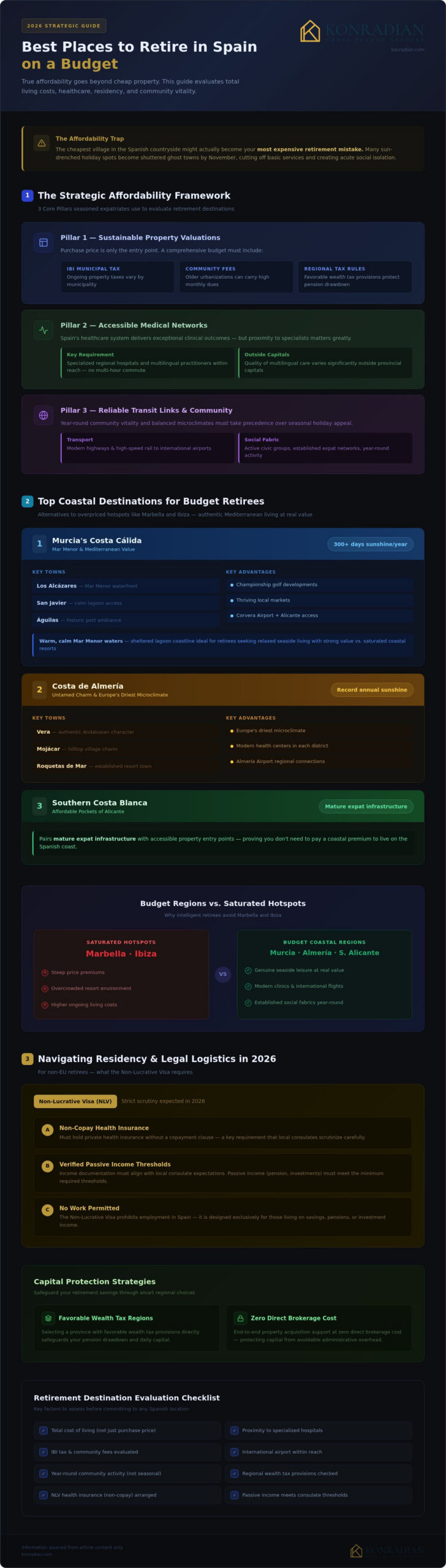
A successful retirement overseas never hinges solely on finding rock-bottom property listings. True fiscal prudence defines affordability as maximizing daily quality of life against long-term carrying costs. When assessing the best places to retire in Spain on a budget, seasoned expatriates evaluate locations through three core pillars: sustainable property valuations, accessible medical networks, and reliable transit links. Prioritizing an ultra-cheap purchase price without vetting municipal infrastructure often proves costly. Many sun-drenched holiday spots become shuttered ghost towns by November, cutting off basic services and creating acute social isolation. Year-round community vitality and balanced microclimates must always take precedence over seasonal holiday appeal.
Balancing Real Estate Value with Everyday Living Expenses
Purchase prices represent merely the entry point of your overseas balance sheet. A comprehensive budget scrutinizes ongoing municipal property taxes (IBI), community maintenance fees, and utility baselines. Community maintenance charges shouldn’t be an afterthought, as older urbanizations with expansive communal grounds frequently carry high monthly dues. Daily living expenses also follow regional lines. While local markets and dining remain accessible nationwide, autonomous communities maintain distinct tax frameworks. Selecting a province with favorable wealth tax provisions directly safeguards your pension drawdown, ensuring your capital supports your day-to-day comfort rather than avoidable administrative overhead.
Healthcare Accessibility and Public Infrastructure Criteria
Physical well-being and connectivity form the operational backbone of a fulfilling retirement. The acclaimed Spanish healthcare system delivers exceptional clinical outcomes, yet proximity to specialized regional hospitals and multilingual practitioners varies significantly outside provincial capitals. Medical care shouldn’t require an exhausting multi-hour commute. Reliable transport links are equally vital; modern highway networks and high-speed rail corridors provide direct connections to international airports for family visits. Selecting an established enclave with active civic groups allows you to settle into the best places to retire in Spain on a budget without sacrificing safety, connection, or clinical security.
The Best Coastal Havens for Budget-Conscious Retirees
Saturated hotspots like Marbella or Ibiza command steep premiums, but intelligent alternatives line the Mediterranean coastline. Discerning retirees seeking the best places to retire in Spain on a budget can target regions where genuine seaside leisure remains accessible. Micro-regions across Murcia, Almería, and southern Alicante deliver authentic coastal lifestyles alongside established social fabrics, modern clinics, and convenient international flight routes.
Murcia’s Costa Cálida: Mar Menor and Mediterranean Value
Murcia’s sheltered coastline balances maritime beauty with compelling value. Towns like Los Alcázares and San Javier surround the warm, calm waters of the Mar Menor, while Águilas provides historic port ambiance further south. The area boasts over 300 days of sunshine annually, supported by championship golf developments and thriving local markets. Seamless international access through Corvera Murcia Airport and Alicante ensures visitors arrive without logistical friction.
Costa de Almería: Untamed Charm and Sunny Microclimates
Almería offers exceptional value for buyers seeking pristine landscapes and authentic Andalusian character. Communities like Vera, Mojácar, and Roquetas de Mar benefit from Europe’s driest microclimate, yielding record annual sunshine. Modern health centers serve each district, while Almería Airport provides dependable regional connections. If you plan to relocate from outside the EU, verifying your status against the official Non-Lucrative Visa requirements ensures your income documentation aligns with local consulate expectations.
Southern Costa Blanca: Affordable Pockets of Alicante
Southern Alicante pairs mature expat infrastructure with accessible entry points, proving you don’t need to overspend to enjoy the Mediterranean. Enclaves like Torrevieja, Orihuela Costa, and Guardamar del Segura maintain vibrant year-round amenities:
- Healthcare hubs: Proximity to modern facilities like Torrevieja University Hospital with English-speaking patient services.
- Civic connectivity: Dozens of established social organizations, sports leagues, and volunteer circles.
- Seasonal balance: Bustling promenades in summer transition into tranquil, functional communities all winter long.
Evaluating these diverse coastal markets requires careful diligence to protect your capital. Consulting an experienced partner like Konradian helps you pinpoint off-market opportunities and secure the best places to retire in Spain on a budget with complete legal peace of mind.
Authentic Inland and Cultural Alternatives Offering Superior Value
Venturing away from the coast reveals Spain’s most compelling financial advantages. Inland provinces offer substantial property discounts compared to seaside resort markets, giving buyers significantly more square footage and private land for their capital. Far from isolating residents, these historic hubs feature rich gastronomy, vibrant seasonal festivals, and genuine community warmth. Practical connectivity remains strong through Spain’s extensive high-speed rail lines, linking peaceful towns directly to provincial capitals. For those evaluating the best places to retire in Spain on a budget, inland living combines deep cultural immersion with sustainable everyday affordability.
Granada’s Lecrín Valley and Mountain Foothills
Perched between the Sierra Nevada peaks and the Mediterranean coast, the Lecrín Valley offers an idyllic microclimate framed by citrus groves and olive orchards. Charming villages like Dúrcal and Nigüelas provide a tranquil pace while sitting thirty minutes from Granada city hospitals. Residents enjoy fresh regional cuisine, brisk mountain trails, and easy highway access to both seaside coves and regional rail hubs without paying resort premiums.
Valencia’s Inland Agricultural Valleys: Júcar and Turia
Inland Valencia blends historical grandeur with practical transit efficiency. Market towns like Alzira, Xàtiva, and Ontinyent showcase grand architecture, vibrant municipal squares, and established healthcare facilities. Modern commuter trains link these centers directly to Valencia’s international airport and metropolitan cultural attractions in under an hour. Helpful community overviews, such as the International Living retire in Spain guide, frequently note that these traditional agricultural valleys welcome foreign residents while maintaining remarkably lower dining and property expenses than coastal districts.
Castilla-La Mancha and Extremadura: The Ultimate Value Frontier
Retirees prioritizing long-term fiscal preservation find extraordinary value across Extremadura and Castilla-La Mancha. Historic destinations like Mérida, Trujillo, and Talavera de la Reina boast UNESCO World Heritage sites, spotless modern clinics, and nationwide fiber-optic connectivity. Total living costs in these regions rank among Europe’s lowest. Prospective buyers must plan for seasonal temperature swings, as hot summer months give way to crisp winters. Verifying proper central heating systems and energy insulation ensures your home remains comfortable year-round in these historic enclaves.
Prioritizing well-connected historic towns unlocks the best places to retire in Spain on a budget, preserving your pension assets while anchoring your retirement in authentic Spanish culture.
Navigating Financial and Legal Logistics for Spanish Retirement in 2026
Relocating smoothly to the Mediterranean requires masterclass preparation across immigration and tax law. Securing real estate in the best places to retire in Spain on a budget only pays dividends if your underlying legal status remains rock-solid. Non-EU applicants must structure their documentation precisely, meeting heightened consular scrutiny while safeguarding personal assets against unexpected regional tax liabilities or historical encumbrances.
Residency Pathways: The Non-Lucrative Visa Framework
Following the abolition of the real estate Golden Visa, the Non-Lucrative Visa (NLV) serves as the primary route for retirees moving to Spain. Consulates evaluate applications with strict standards. For 2026, the primary applicant must demonstrate guaranteed passive income or verified savings of at least €28,800 per year (€2,400 monthly), reflecting 400% of the statutory €600 monthly IPREM indicator. Each accompanying dependent requires an additional €7,200 annually.
Consulates also demand explicit proof of formal retirement or complete cessation of employment to ensure applicants won’t work remotely. Furthermore, your dossier requires an authorized Spanish private health insurance policy issued with zero deductibles and no copayments (sin copagos). Once your visa is granted at your local embassy, you must enter Spain and complete fingerprints for your Foreigner Identity Card (TIE) within your first month. Maintaining this residency requires spending more than 183 days per calendar year in the country, which also triggers domestic tax residency.
Tax Considerations, Property Due Diligence, and Closing Checks
Tax efficiency depends heavily on where you put down roots. Spain maintains comprehensive double taxation treaties that protect foreign pension income from unlawful double levies, though distributions are subject to Spanish progressive savings or general income rates. Autonomous communities govern regional wealth taxes; selecting jurisdictions like Andalusia or Murcia shields your estate with 100% tax credits.
Property due diligence requires equal precision. Purchasing unvetted rural property or urban flats can saddle buyers with hidden debts, unpaid community fees, or building irregularities. Relying on dedicated legal support buying property abroad ensures an exhaustive land registry (Registro de la Propiedad) review, urban planning audits, and title verification long before public deed signing before the notary.
To eliminate risk and navigate local municipal fees securely, partner with our advisors at Konradian to structure your Spanish acquisition with institutional-grade diligence.
Securing Your Spanish Retirement Home with Professional Advisory
Executing an overseas purchase shouldn’t involve fragmented communication, commercial conflicts of interest, or language barriers. While discovering the best places to retire in Spain on a budget represents an exciting lifestyle transition, completing a cross-border acquisition demands institutional-grade diligence. Konradian’s dedicated Spanish Property Acquisition service delivers end-to-end representation designed specifically for international retirees. Operating under an established continental structure where brokerage compensation is funded by the seller, our advisory services provide full fiduciary representation at zero direct cost to the buyer.
The Advantage of an International Buyer’s Representative
Traditional listing agents represent the seller’s commercial goals, creating natural friction for prospective buyers. Retaining a dedicated international representative realigns the transaction entirely in your favor. Konradian’s advisory team combines London School of Economics training with deep local market relationships, applying analytical precision to every property evaluation. We screen every title deed, check municipal zoning compliance, inspect physical infrastructure, and curate bespoke portfolios aligned with your long-term goals.
From Initial Consultation to Key Handover: The Konradian Journey
A methodical, end-to-end process protects your capital from initial search through final signature:
- Strategic Consultation: An introductory video session defines your geographic criteria, medical accessibility needs, and residency timeline.
- Priority Sourcing: Direct relationships with established Spanish developers unlock pre-sale allocations, off-market opportunities, and high-value resale properties.
- Comprehensive Execution: Our advisors coordinate with vetted legal counsel, manage notary scheduling, and streamline banking logistics for an effortless completion.
Finding a peaceful sanctuary across the best places to retire in Spain on a budget is within reach when backed by disciplined guidance. Schedule an introductory consultation with Konradian today to begin your retirement journey with total confidence.
Taking Your Next Strategic Step Toward Spain
Retiring comfortably abroad doesn’t require compromising on quality, medical security, or everyday peace of mind. By balancing initial property prices against modern healthcare networks, regional tax benefits, and vibrant year-round communities, you can identify the best places to retire in Spain on a budget without fiscal friction. Whether you favor the tranquil shores of Murcia or the cultural heritage of an inland agricultural valley, strategic foresight turns your overseas transition into an enduring success.
Executing an international acquisition demands institutional precision. Backed by over five years of cross-border real estate experience, Konradian delivers London School of Economics educated advisory leadership to manage property selection, legal compliance, and notary closing. Under Spain’s established transaction model, our comprehensive buyer representation operates at zero direct cost to buyers in Spain. When you’re ready to move forward with complete clarity and professional stewardship, schedule a consultation for your Spanish retirement search. The enriching Mediterranean lifestyle you’ve envisioned is well within your grasp.
Frequently Asked Questions
Can non-EU citizens retire in Spain on a budget in 2026?
Yes, non-EU citizens can comfortably retire in Spain by utilizing the Non-Lucrative Visa while choosing high-value autonomous regions. Living costs across emerging Mediterranean coastal towns and inland provinces remain roughly thirty percent below US metropolitan baselines. Securing residency requires proving steady passive income and securing private medical coverage, but everyday expenses like groceries, local rail transit, and municipal services remain exceptionally affordable compared to northern Europe or North America.
How much passive monthly income is required for the Spanish Non-Lucrative Visa?
For 2026, the primary applicant must demonstrate at least €2,400 per month, which equals €28,800 annually in verified passive income or liquid savings. This threshold is calculated as 400% of Spain’s statutory IPREM indicator, set at €600 per month. If you’re relocating with family, you must prove an additional €600 monthly (€7,200 annually) for each dependent. Consulates strictly prohibit remote employment to meet this requirement.
What is the cheapest region to retire in Spain with good healthcare?
Murcia and coastal Almería stand out as premier value destinations that retain excellent clinical infrastructure. Both regions offer some of the best places to retire in Spain on a budget, combining sub-national property costs with modern public hospitals in cities like Cartagena, Lorca, and Almería. Residents benefit from dedicated regional health centers and English-speaking medical personnel while enjoying significantly lower daily living expenses than neighboring coastal provinces.
Is private health insurance mandatory for retirees moving to Spain?
Yes, non-EU retirees applying for Spanish residency must hold comprehensive private health insurance from an authorized domestic provider. Consulates reject policies containing deductibles, copayments, or waiting periods. Once you establish legal residency for a continuous twelve-month period and register on your municipal padrón, you gain access to the Convenio Especial, Spain’s public healthcare buy-in scheme, offering affordable monthly enrollment for individuals aged sixty-five and older.
How do property taxes and purchase fees vary across Spanish autonomous communities?
Property purchase costs fluctuate substantially by region because autonomous governments independently regulate Property Transfer Tax (ITP) on resale homes. Rates generally range between six and ten percent, alongside notary and land registry registration fees. Holding costs like regional wealth taxes also differ drastically. For example, Andalusia and Madrid provide a complete 100% tax rebate, whereas other autonomous regions enforce progressive levies above the standard state threshold.
Why should retirees use a dedicated international property brokerage like Konradian?
Konradian provides international retirees with complete fiduciary representation across Spain at zero direct cost to the buyer. Backed by over five years of cross-border real estate experience and London School of Economics training, our advisory team screens property titles, evaluates municipal zoning, and accesses off-market developer allocations. We coordinate legal due diligence and notary closings, shielding your capital from commercial conflicts and ensuring you secure the best places to retire in Spain on a budget safely.
What are the common hidden costs when buying a budget retirement home in Spain?
Hidden purchase expenses often include municipal capital gains levies (plusvalía), unexpected communal maintenance debts, and rural structural non-compliance penalties. Buyers must also budget between ten and thirteen percent above the purchase price for legal due diligence, title registration, and regional transfer taxes. Working with independent legal advisors prevents inheriting historical utility arrears or municipal planning fines attached to unvetted rustic properties.
