


A listed building can be bought from overseas; the more important question is what ownership will require. Buying a listed building in the UK as a foreigner is legally possible, but heritage protections, the property’s condition and transaction rules all deserve careful attention before you make an offer.
It’s understandable to wonder whether listed status will limit renovations or routine repairs, and whether the process changes depending on where the property is located. Listing categories and consent procedures differ across England, Scotland, Wales and Northern Ireland. Overseas buyers may also need to consider registration, tax and financing requirements.
This guide explains what listed status means, how to approach heritage and building due diligence, and which jurisdiction-specific points to factor into your purchase. You’ll also learn how to compare properties with a clearer view of their obligations and the legal and financial considerations involved. With focused property sourcing and buyer-side transaction guidance, you can assess a building’s character alongside the practical commitments of owning it.
Key Takeaways
- Buying a listed building in the UK as a foreigner is possible. Distinguish the right to own property from residency, tax and any company-registration requirements.
- Compare the property’s heritage designation and consent framework across England, Wales, Scotland and Northern Ireland before assessing renovation plans.
- Review the official listing, condition, alteration history and evidence of past consent as separate due-diligence checks.
- Plan a purchase sequence that covers identity and transaction documents, specialist surveys, legal enquiries and jurisdiction-specific costs before completion.
- Assess each property against your intended use, heritage obligations and priorities. Buyer-side sourcing and transaction guidance can help bring those considerations together.
Can a foreigner buy a listed building in the UK? Start with the essentials
Yes. As of October 2026, foreign nationality or overseas residence does not, by itself, prevent someone from buying property in the UK, including a listed building. Historic homes can offer distinctive architecture, a strong sense of place and original features that are rare in newer properties. Those qualities come with stewardship responsibilities, however, and proposed changes may need heritage consent.
Owning a listed property does not automatically give you permission to alter its protected features. That distinction matters whether you’re planning a substantial renovation or a smaller update. The listing categories, heritage bodies and consent processes depend on whether the property is in England, Wales, Scotland or Northern Ireland.
What does listed status mean for a property buyer?
Listing recognises a building’s special architectural or historic interest and provides legal protection for the features that contribute to that interest. Depending on the property and designation, protections may apply to the exterior, interior, and structures or features associated with the building. The Listed building in the UK overview introduces the different national systems.
Listed status doesn’t mean every repair automatically needs consent. Routine care and like-for-like maintenance can differ from work that alters protected fabric. The details and consent route depend on the proposal and jurisdiction. Before planning changes, establish what is protected and whether the work requires approval. Listed status, by itself, does not prevent you from living in or selling the building.
Does foreign nationality prevent you from buying UK property?
No general nationality or residency restriction prevents a foreign buyer from purchasing UK property. But ownership is separate from immigration permission to live in the UK, tax residence and eligibility for UK finance. These questions can have different answers, so buying a home should not be treated as permission to reside or as a guarantee that a lender will offer finance.
Purchase arrangements also matter. If an overseas entity buys or intends to buy UK land, current rules require it to register its beneficial owners with Companies House. Registration is a prerequisite to registering the title at the Land Registry, and ongoing updates may apply. Verify the current requirements for the buyer, ownership structure and UK nation before committing. In practice, buying a listed building in the UK as a foreigner means assessing ownership eligibility separately from heritage obligations and transaction requirements.
Listed building grades and consent rules differ across the UK
The same heritage principle applies across the UK, but each nation has its own designation terms and consent arrangements. A grade or category indicates the building’s recognised significance; it isn’t a simple measure of which alterations are permitted. For buyers, the practical questions are how a proposed change could affect the building’s special character and which authority handles the relevant application.
How listing categories work in England, Wales, Scotland and Northern Ireland
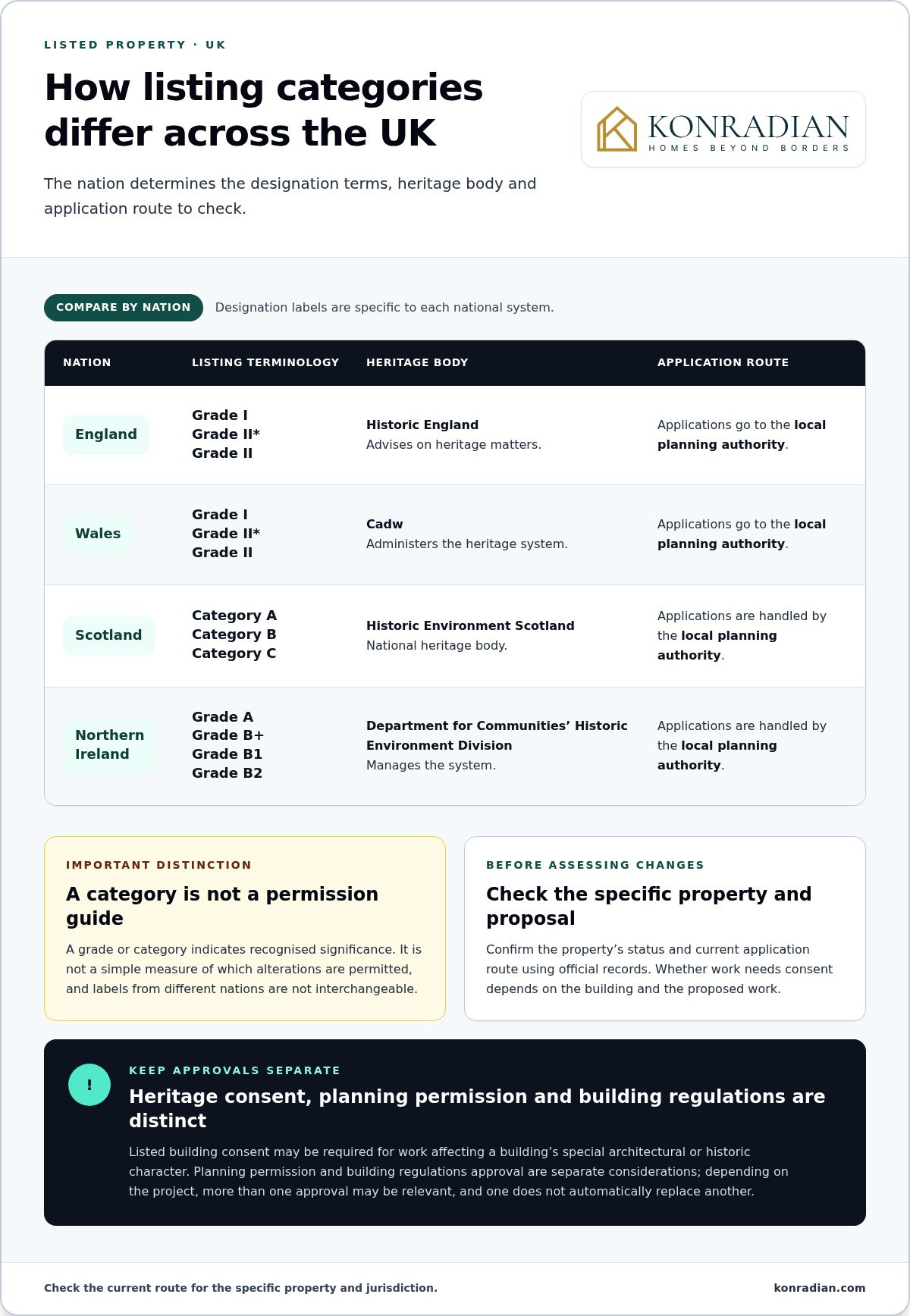
Start with the property’s nation to identify the correct system and decision-making route. The bodies below provide heritage expertise or administer the system; applications are generally handled by the relevant local planning authority. Authority roles and procedures can vary, so verify the current route for the specific property.
| Nation | Listing terminology | Heritage body and application route |
|---|---|---|
| England | Grade I, Grade II* and Grade II | Historic England advises on heritage matters; applications go to the local planning authority. |
| Wales | Grade I, Grade II* and Grade II | Cadw administers the heritage system; applications go to the local planning authority. |
| Scotland | Category A, B and C | Historic Environment Scotland is the national heritage body; the local planning authority handles applications. |
| Northern Ireland | Grade A, B+, B1 and B2 | The Department for Communities’ Historic Environment Division manages the system; the local planning authority handles applications. |
These labels aren’t interchangeable. A Grade II property in England and a Category B property in Scotland belong to different national frameworks, so don’t infer one property’s consent requirements from the other’s designation. Confirm the property’s status and applicable process using current official records before proceeding.
When might listed building consent be needed?
Listed building consent may be required for work that affects a listed building’s character as a building of special architectural or historic interest. The assessment depends on the specific property and proposed work. Don’t assume an interior change, removal of a feature or exterior alteration is automatically allowed. Equally, don’t assume every repair needs consent.
Heritage consent is distinct from planning permission, which considers planning matters such as development and land use. Building regulations approval is a separate consideration too. Depending on the project, more than one approval may be relevant; one does not automatically replace another. Establish the likely consent route before committing to works, and verify current statutory details with the relevant authorities.
If you’re buying a listed building in the UK as a foreigner, understanding the nation-specific framework helps you factor heritage obligations into your property comparison from the outset. UK property sourcing guidance can help you assess a property’s fit and acquisition considerations alongside its heritage status.
How to compare listed properties before making an offer
A useful comparison looks beyond period features and asking price. For each property, record its designation, conservation area status, setting and the features identified in its listing description. Check authoritative heritage records alongside local planning records, since the listing entry alone may not show the full history of proposed or completed work.
Then assess condition and ownership history separately. A building may have attractive historic fabric yet need careful investigation of damp, structural movement or repairs that may not suit traditional materials. Compare maintenance records, previous alterations and evidence of relevant consent. Missing paperwork is a question to investigate, not proof that work was unauthorised.
What should a listed-building survey and records review cover?
A general building survey helps identify condition concerns and areas that need closer attention. A conservation-focused assessment considers how historic fabric has been maintained, whether repairs suit the building’s materials, and how proposed work might affect its character. These assessments answer different questions, so choose a survey suited to the property’s age, construction and visible condition.
Review the listing description, planning history and available local records for alteration applications, decisions and any recorded enforcement matters. Compare those records with what you can see on site. For example, a replacement window or changed internal layout may warrant further enquiry if its history is unclear. For an overseas buyer, arranging this review before an offer becomes unconditional can help bring practical risks into sharper focus.
How do intended works affect the property comparison?
Write down your plans before comparing homes. Include interior changes, extensions, accessibility improvements and any alterations needed for your intended use. A property that suits your lifestyle today may be less suitable if essential future work depends on consent that hasn’t been obtained.
- Designation and setting: Note protected features, conservation area status and the surrounding context.
- Condition: Record repair needs and any areas requiring specialist investigation.
- Alteration history: Compare visible changes with available applications, decisions and consent records.
- Future plans: Identify work that may need heritage or other approvals, and treat uncertain permissions as unresolved due-diligence questions.
This structured review makes buying a listed building in the UK as a foreigner a more informed comparison of character and obligations. For wider acquisition context, read the guide to UK property sourcing.
A practical purchase checklist for overseas buyers
A clear sequence helps you coordinate property, heritage and transaction checks from the first review through completion. Requirements vary by UK nation and buyer circumstances, so verify tax, identity and registration details for the specific purchase. For broader transaction context, see this guide to legal support for buying property abroad.
What should you establish before offering on a listed property?
Before making an offer, clarify what you’re buying, how you intend to use it and what you may want to change. Prepare identity and funding information early, particularly if the purchase involves an overseas account or company structure.
- 1. Confirm the jurisdiction and designation. Identify whether the property is in England, Wales, Scotland or Northern Ireland, then check its listing details, conservation area status and title information.
- 2. Define intended use and planned works. List potential changes, from internal alterations to an extension or accessibility improvements. Treat heritage feasibility as part of the property decision, not a later assumption.
- 3. Prepare buyer and funding documents. Organise identity records, evidence of source of funds and information about the proposed ownership structure. Verify current identity, disclosure and registration requirements for your circumstances.
- 4. Map the financial arrangements. Consider how funds will be transferred and converted, whether finance is needed, and how your tax residence and the property’s location may affect the transaction. Don’t assume finance eligibility or a particular tax outcome.
Which checks matter between offer and completion?
Use the period after an offer to review the property’s legal position, physical condition and heritage history together. Before exchange or another binding commitment under the relevant transaction process, make sure the findings are clear enough to inform your decision.
- 5. Coordinate due diligence. Review title information, survey findings, planning history, listing records and available evidence of consent for past work. A visible alteration is not proof of approval, while an incomplete record is not proof of wrongdoing.
- 6. Verify transaction obligations. Check applicable property taxes, non-resident rules, company registration duties and transaction documents against the correct jurisdiction and buyer structure. Requirements can change, so confirm current details before proceeding.
- 7. Resolve or price the uncertainties. Summarise outstanding repair, consent, title or funding questions. Decide whether to proceed, seek clarification or renegotiate rather than allowing unresolved risks to carry silently into completion.
For overseas buyers, buying a listed building in the UK as a foreigner calls for coordinated decisions, not just a heritage check. Explore buyer-side UK property sourcing and acquisition guidance to bring property fit, heritage obligations and transaction considerations into one assessment.
How Konradian supports a foreign buyer sourcing a listed UK property
Buying a historic property from overseas involves more than finding an appealing building. Location, intended use, heritage designation, condition and transaction requirements all influence whether a property fits your plans. Konradian’s UK property sourcing and buyer-side acquisition support brings these considerations together, helping you assess options against your priorities rather than viewing character in isolation.
What does buyer-side sourcing support cover?
The process starts with your objectives and property criteria. These can include preferred locations, budget, intended use and the features or heritage responsibilities you’re prepared to take on. Strategic property selection narrows the search around that brief, with heritage status and acquisition considerations considered alongside the property itself.
Support can extend from initial discussion and property selection through transaction coordination and handover. Konradian provides guidance on legal and financial transaction considerations, but this is not legal representation or mortgage lending. The UK buyer-side advisory service is fee-based, with fees payable by the buyer.
How can an overseas buyer take the next step?
Begin by setting out your budget, preferred locations and intended use. Be clear about your heritage-property priorities too. You might value original interiors, or be considering future alterations and want to understand those obligations before committing. A focused initial conversation about your acquisition objectives and the buyer-side advisory process can help establish a practical brief.
Konradian brings more than five years of international property experience, with team members educated at the London School of Economics. This international perspective supports cross-border decisions, where local property details and transaction considerations need to be considered together.
If you’re considering buying a listed building in the UK as a foreigner, frame the search around both the property you want and the responsibilities you’re ready to take on. Explore Konradian’s UK property sourcing service to learn how buyer-side sourcing and acquisition guidance can support your plans.
Make your next move with clarity
Buying a listed building in the UK as a foreigner is possible, but a sound purchase depends on looking beyond the title and the building’s character. First, understand the heritage system that applies in its UK nation. Then assess the designation, condition, past work and your plans together, and make sure legal and financial checks inform your decision before you commit.
Konradian brings more than five years of international property experience to UK property sourcing and buyer-side acquisition support. Team members educated at the London School of Economics contribute an international perspective, while transaction guidance helps buyers consider legal and financial factors alongside property fit. UK buyer-side advisory is fee-based.
Set out your priorities, from location and intended use to the heritage features you value, and take the next step with a clear brief. Explore Konradian’s UK property sourcing service to discuss your acquisition objectives and buyer-side support.
Frequently Asked Questions
Can a foreigner buy a listed building in the UK?
Yes. Foreign nationality or overseas residence does not, by itself, prevent you from buying a listed building in the UK. Buying a listed building in the UK as a foreigner is separate from permission to live in the country, tax residence and eligibility for finance. If you buy through an overseas entity, registration and beneficial ownership disclosure requirements may apply. Verify current rules for your ownership structure and the property’s UK nation before proceeding.
Do I need listed building consent to renovate a listed property?
It depends on the proposed work and whether it affects the building’s special architectural or historic character. Some routine maintenance may not require consent, but alterations to protected fabric can. Don’t assume a renovation is exempt because it’s internal or appears minor. Before committing to work, establish which features are protected and confirm the relevant consent requirements for the property’s jurisdiction. Planning permission or building regulations approval may also be needed separately.
Are listed building rules the same across the UK?
No. The heritage principle is shared, but listing terminology and procedures differ across England, Wales, Scotland and Northern Ireland. England and Wales use Grade I, Grade II* and Grade II; Scotland uses Categories A, B and C; Northern Ireland uses Grades A, B+, B1 and B2. The relevant heritage bodies and local planning authorities also vary. Check current official records and the consent route for the nation where the property is located.
What should a foreign buyer check before buying a listed building?
Confirm the property’s designation, title details, conservation area status and intended use. Review its condition with a survey suited to an historic building, and examine available planning records, alteration history, maintenance information and evidence of relevant consent. Prepare identity and source-of-funds documents, and verify applicable taxes, registration duties and financing requirements for your circumstances. Resolve significant uncertainties before exchange, so the survey, title and heritage findings can inform whether you proceed or renegotiate.
Can I change the windows or add an extension to a listed building?
Possibly, but neither work should be assumed permissible without the appropriate assessment. Replacing windows can affect historic fabric or the building’s character, while an extension may raise heritage and planning considerations. The outcome depends on the property, its protected features, the design and the rules in its UK nation. Check the relevant records and consent requirements before treating the work as part of your plans or purchase decision.
Is buying a listed building more expensive to maintain?
It can be. Historic materials, specialist repair methods and the need to protect significant features may make maintenance more involved than for a comparable modern property. The actual commitment depends on the building’s construction, present condition, previous repairs and maintenance history. A specialist survey can help identify issues such as damp, structural concerns or unsuitable alterations. Consider likely repair needs alongside the purchase price, and avoid relying on generic cost estimates.
Can I get a mortgage to buy a listed building in the UK?
Potentially, but approval isn’t guaranteed. A lender’s decision can depend on your finances and residency, the property’s condition and valuation, its construction, and the lender’s criteria for listed buildings. Overseas buyers may face additional documentation or assessment requirements. Discuss financing early and verify eligibility for the specific property and ownership arrangement before making a binding commitment. Mortgage availability is separate from the legal ability to own a UK property.
