


Could a Florida second home create tax obligations even in a state with no personal income tax? The buying a second home in Florida tax implications depend on more than the property’s location. How you own it, whether you rent it out, and your tax residency can all affect what you owe.
It’s easy to focus first on the purchase price and the home itself. But taxes can arise at closing, during ownership, from rental income, and when you sell. Florida’s tax environment may be favorable in some respects, yet federal rules still matter. Buyers who live abroad may also need to consider how their home country treats the property.
This guide covers the questions to resolve before making an offer, including purchase charges, property taxes, personal-use and rental scenarios, and possible taxes on a future sale. It also explains why occasional rentals shouldn’t be assumed to have no tax consequences, and which qualified US and home-country tax professionals to consult. Clarifying these details early can help you compare ownership options and plan your purchase.
Key Takeaways
- Understand how a second home differs from a primary residence or income-producing rental, and why ownership structure, tax residency, and actual use matter.
- When assessing buying a second home in Florida tax implications, separate one-time transaction charges from recurring property taxes, then verify which rules apply to your purchase.
- Compare personal-use and rental plans before committing. Keep clear records of rental days, income, and expenses for professional review.
- Plan ahead for a future sale or inheritance, including potential US tax and whether FIRPTA withholding applies to foreign sellers.
- Prepare your intended-use plan, ownership details, and rental assumptions, then review them with qualified US and home-country tax professionals before closing.
Buying a Second Home in Florida: Key Tax Questions
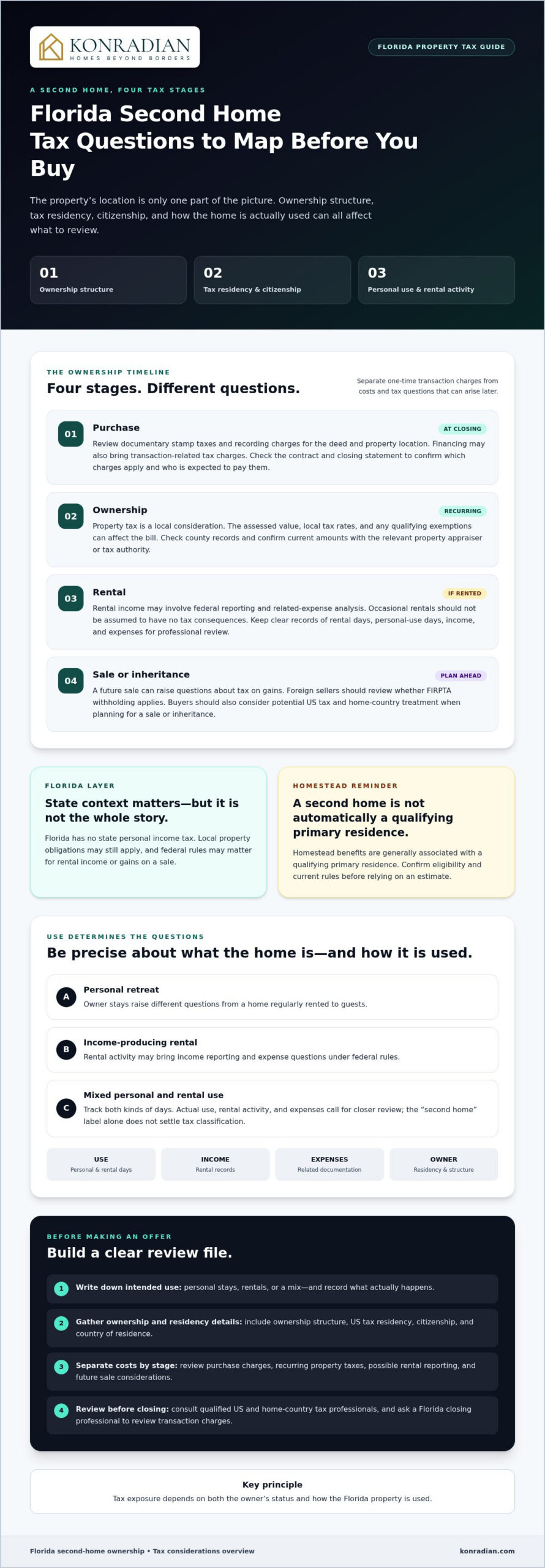
A Florida property might be a personal retreat, a primary residence, or a home held partly or mainly to earn rental income. Those descriptions aren’t interchangeable for tax purposes. A home used by its owner may be treated differently from one rented to others. If you do both, personal days, rental activity, and expenses call for closer review.
The property’s location is only one part of the picture. Your ownership structure, US tax residency, citizenship status, and country of residence may affect which reporting rules apply. Florida has no state personal income tax, but local property obligations and possible US federal tax responsibilities may still apply. Buyers who live abroad may also need advice on how their home country treats ownership, rental income, or a future sale.
Four tax stages to consider:
- Purchase: Taxes or transaction charges connected with acquiring the property.
- Ownership: Recurring property taxes and other obligations while you hold it.
- Rental: Potential reporting of rental income and analysis of related expenses.
- Sale: Possible tax on gains and other requirements when ownership changes.
How can a second home be classified for tax purposes?
Start with your intended use, then record what actually happens. A home reserved for personal stays raises different questions from one regularly rented to guests. If you do both, keep a calendar of personal and rental use, along with income and expense records. Don’t assume that calling a property a “second home” settles its tax classification. The applicable treatment depends on the facts and rules relevant to your situation.
Why does a Florida property still create tax questions?
Florida’s state tax environment is just one layer. County and other local property-tax rules can apply, while federal rules may govern rental income or gains on a sale. Homestead benefits are generally associated with a qualifying primary residence, not simply any home a person owns in Florida. Confirm eligibility and current rules for your circumstances before relying on a tax estimate.
For international buyers, review ownership and tax residency together. Citizenship and residency can affect US tax obligations, while your country of residence may have its own reporting or tax treatment. A later sale can also raise federal capital-gains questions. This overview of capital gains tax in the United States outlines the distinction between short- and long-term gains. Ask qualified US and home-country tax professionals to assess your individual circumstances before committing.
Tax exposure depends on both the owner’s status and how the Florida property is used. Resolving those details early is central to understanding the buying a second home in Florida tax implications and choosing an ownership plan with clarity.
Purchase and Annual Ownership Taxes on a Florida Second Home
Budget for two timelines: charges connected with the transaction and recurring costs after closing. The buying a second home in Florida tax implications can vary with the deed, financing, the property’s county, and the purchase contract. Treat broad estimates as a starting point, not a final figure for your transaction.
What taxes and charges may arise when purchasing?
Documentary stamp taxes and recording charges are categories to review for the specific deed and closing. Financing can also bring transaction-related tax charges, so ask the closing professional to review the loan documents as well as the purchase documents. The contract and transaction may affect which party is responsible for particular charges.
Before closing, review the purchase contract and proposed closing statement with a Florida closing professional. Ask them to identify each applicable charge, who is expected to pay it, and whether the figures reflect current rules for the property’s location and financing. This helps distinguish taxes and recording charges from other closing costs without relying on a statewide assumption.
How do property tax and homestead rules affect a second home?
Property tax is an ongoing local consideration. The assessed value, applicable local tax rates, and any exemptions for which an owner qualifies can affect the bill. Check the property’s county records and contact the relevant county property appraiser or tax authority to understand the assessment and how to verify current amounts. Revisit the estimate if the purchase price, assessment, or intended use raises questions.
A second home used for personal stays doesn’t automatically qualify for homestead treatment. Florida’s homestead exemption generally relates to a qualifying permanent residence, and eligibility depends on the owner’s circumstances and applicable rules. Review the Florida Department of Revenue’s Florida homestead exemption rules, then confirm your specific situation with the county authority before including an exemption in your budget.
County property tax is a recurring local obligation, separate from federal income tax. Budget separately for non-tax ownership expenses, such as insurance, maintenance, or association charges, where applicable. These affect the cost of holding a home but are not themselves property taxes.
For an international purchase, early transaction coordination can help surface questions about the property, ownership plan, and closing documents. You can review US real estate investment support as one part of organizing the acquisition, while relying on qualified tax professionals for tax advice.
Personal Use or Rental: How Your Florida Home’s Use Changes Tax Questions
A home kept for family holidays raises different tax questions from one rented to guests, even if both are described as second homes. If you plan to use the property personally and rent it at other times, both uses matter. Your US tax residency and other circumstances can also affect reporting. Don’t assume that a particular rental pattern automatically determines your tax result.
What changes if you rent out the second home?
Rental income may create US reporting obligations, depending on the owner’s circumstances and how the property is used. Expenses may need to be allocated between rental and personal use, but the calculation isn’t the same for every owner. A qualified tax adviser can review your facts and confirm applicable federal and local requirements. For stays of six months or less, Florida sales tax and possible county surtaxes may also need review.
Keep supporting details from the start: signed rental agreements, records of income received, invoices and receipts for expenses, and a calendar showing rental and personal-use days. These records help an adviser assess the tax implications of a rental property, including which expenses may be relevant and how they should be treated. If a property is rented for 14 days or fewer during the year, rental income is generally not required to be reported to the IRS. Confirm whether that treatment applies to your circumstances.
What if the home is mostly personal but rented occasionally?
Occasional rentals still deserve attention. Mixed use can affect whether income must be reported and how expenses are treated under current federal rules. Track every day the home is used, who used it, why it was used, and whether it was offered or rented to others. A calendar and complete records give your adviser a clearer basis for evaluating the facts.
Use this comparison to prepare questions for a tax professional. It isn’t a substitute for an individual tax assessment.
| Use pattern | Questions to verify |
|---|---|
| Personal use | How do owner residency and ownership structure affect tax reporting? |
| Rental use | What income reporting, expense treatment, or local rental taxes may apply? |
| Mixed use | How should personal days, rental days, income, and shared expenses be documented and assessed? |
The practical takeaway for buying a second home in Florida tax implications is to decide how you expect to use the property, then update your records if that plan changes. A tax adviser familiar with US rules and, where relevant, your country of residence can assess the details before rental activity begins.
Selling or Inheriting a Florida Second Home: Tax Risks to Review
A future sale or transfer can bring tax questions that are worth considering before you choose how to hold the property. US federal tax on a sale depends on factors such as the owner’s status, holding period, use of the home, and any rental history. A gain on a property held longer than one year may be subject to long-term capital-gains rates; a gain on a shorter holding period may be taxed as ordinary income. Investment income may also be subject to an additional federal surtax for taxpayers who meet the applicable income thresholds.
If the home was rented and depreciation was claimed, a sale may raise depreciation-recapture questions. Ask a qualified US tax professional to assess the potential gain, deductions, and reporting obligations using your records. Florida has no state estate or inheritance tax, but federal estate-tax rules and the rules of your home country may still matter.
What should a non-US owner know about selling?
FIRPTA, the Foreign Investment in Real Property Tax Act, can require withholding when a foreign person sells US real property. That withholding is collected as part of the sale process. It is not, by itself, a calculation of the seller’s final US tax liability. The final result depends on the seller’s circumstances and the applicable tax rules.
Before listing or accepting an offer, ask a US tax professional to review whether FIRPTA applies, what documentation may be required, and whether filing or treaty questions need attention. FIRPTA withholding at sale is not the same as the seller’s final tax liability. Clarify the process with the closing professionals involved rather than treating withholding as a definitive estimate of tax due.
Why plan for ownership transfer before buying?
Title and ownership structure can affect how a later sale or inheritance is handled. Before closing, discuss who will own the property, how that ownership fits your succession plans, and whether a proposed structure has consequences in both the US and your country of residence. Don’t assume that a general federal estate-tax exemption answers the question for a non-US owner. Eligibility and treatment can depend on individual circumstances and applicable rules.
Cross-border estate questions call for coordinated advice from qualified US and home-country legal and tax professionals. They can consider federal estate-tax exposure, local inheritance rules abroad, and how the ownership arrangement fits your plans. These are distinct issues, and Florida’s lack of a state estate tax does not resolve them all.
For buyers reviewing the buying a second home in Florida tax implications, early transaction coordination can help surface ownership and succession questions before a commitment. Explore US real estate investment support as you organize the acquisition, and confirm the appropriate legal and tax advice for your circumstances with qualified professionals.
A 2026 Tax-Readiness Plan Before You Buy a Second Home in Florida
Before making an offer, turn your plans into clear questions for your advisers. The buying a second home in Florida tax implications depend on your intended use, tax residency, ownership structure, and transaction details. A structured review can help identify issues early, without assuming that one answer applies to every buyer.
Which questions should you resolve before making an offer?
Work through these steps with your real estate and tax professionals:
- 1. Define the use. Record whether the home is for personal stays, rental income, or a mix. Note your expected personal-use days and any rental assumptions.
- 2. Confirm your residency and status. Ask how your US tax residency, citizenship, and country of residence may affect reporting or tax obligations.
- 3. Review ownership and financing. Discuss who will hold title, the proposed ownership structure, and whether financing could change the transaction or tax analysis.
- 4. Model the taxes. Ask which federal, Florida, and county-level obligations may apply at purchase, during ownership, and under your intended use. Keep recurring property taxes distinct from other ownership expenses.
- 5. Verify the advice. Request advice in writing, based on current 2026 rules and your actual facts. Confirm that your US tax professional and, where relevant, your home-country adviser have reviewed the same ownership and use plan.
Prepare a short file for these discussions: your intended-use plan, ownership details, residency information, potential rental assumptions, and available purchase or financing documents. If rental use is possible, include an estimate of how often you may rent the home and how you’ll record personal and rental days. This gives advisers a practical starting point rather than a hypothetical scenario.
How can an international buyer coordinate the next steps?
Property selection and transaction coordination can bring ownership and use questions into focus before you commit. Comparing homes with different intended uses, for example, may prompt you to confirm local property-tax details, anticipated rental activity, or how a proposed title arrangement fits your plans. These discussions support informed decisions but don’t replace individualized tax advice.
Konradian supports international buyers with US real estate investment services, including property selection and transaction coordination. Its legal and financial transaction support can help coordinate purchase-related questions. Tax conclusions should come from qualified US and, where relevant, home-country tax professionals.
To discuss your acquisition, Discuss your US property plans with Konradian and clarify how its transaction support may fit your purchase.
Plan Your Florida Purchase With Clarity
The key to buying a second home in Florida tax implications is to assess the full picture before committing: purchase and annual ownership costs, intended personal or rental use, and potential tax questions if you later sell or transfer the property. Your residency and ownership structure can also shape the analysis, particularly if you live outside the US.
Prepare your intended-use plan and ownership details, then ask qualified US and, where relevant, home-country tax professionals to review them against current rules and your circumstances. Their advice can help you make informed decisions without relying on assumptions.
Konradian supports international buyers with US real estate acquisitions, including property selection and transaction support. For purchases in the US, its services are offered at no additional cost to the buyer. Discuss your US property plans with Konradian as you organize your next steps. With the right questions addressed early, you can move toward your Florida purchase with greater confidence.
Frequently Asked Questions
Does Florida have property tax on a second home?
Yes. Florida counties assess property taxes on second homes, with the amount influenced by the property’s assessed value, local tax rates, and any applicable exemptions. Check the county property appraiser’s records for the home you’re considering and confirm how to review the assessment. Property tax is a recurring local obligation, separate from federal income tax and transaction charges due at purchase.
Can I claim a Florida homestead exemption on a second home?
Generally, no. Florida’s homestead exemption is intended for a qualifying permanent residence, not a home held as a second property. Owning or regularly using a Florida home doesn’t, by itself, establish eligibility. If your living arrangements or residency may qualify, verify the current requirements with the county property appraiser before including an exemption in your budget. Don’t assume a second home receives the same treatment as your primary residence.
Do I pay Florida income tax on rental income from a second home?
Florida has no state personal income tax, but rental income may still have federal tax implications. Whether and how it must be reported depends on your tax status and the property’s use. If you live outside the US, your residency and other circumstances may affect the analysis. Keep accurate income and expense records, and ask a qualified US tax professional whether you also need advice in your country of residence.
What happens if I rent out my Florida second home for part of the year?
Rental activity may create federal reporting obligations, and personal-use days can affect how income and expenses are treated. Record rental dates, personal stays, agreements, receipts, and income from the outset. Florida also imposes state sales tax on rentals of six months or less, and counties may add discretionary surtaxes. A separate IRS rule generally excludes rental income from reporting when the home is rented for 14 days or fewer in a year; confirm how the rules apply to your situation.
Do foreign buyers pay different taxes when buying property in Florida?
There isn’t one tax outcome that applies to every foreign buyer. Purchase-related charges depend on the transaction, deed, financing, and applicable local rules, while federal obligations may depend on the buyer’s tax status and ownership structure. Your country of residence may also have reporting or tax rules for overseas property. Before making an offer, ask a Florida closing professional and qualified US and home-country tax advisers to review your circumstances.
What is FIRPTA, and does it apply when selling a Florida home?
FIRPTA is a US law that can require withholding when a foreign person sells US real property. It may apply to a Florida home, but the seller’s status and transaction details matter. Withholding is collected through the sale process; it doesn’t determine the seller’s final US tax bill. Before selling, ask a US tax professional about applicability, required documentation, filing obligations, and any treaty questions relevant to your case.
Do I owe tax when I sell a second home in Florida?
You may owe federal capital-gains tax if the sale produces a taxable gain. The outcome depends on your circumstances, including how long you owned the home and whether it was rented. Long-term gains may be taxed at 0%, 15%, or 20%, depending on income; short-term gains are generally taxed at ordinary income rates. Florida has no state capital-gains tax, but federal rules still apply. Have a tax professional calculate your position before selling.
