


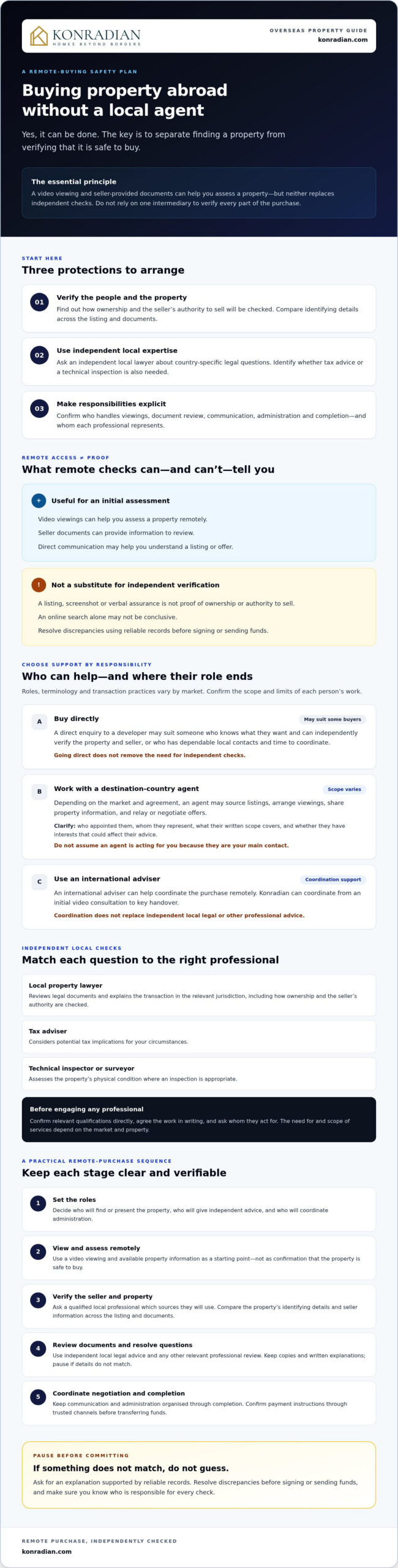
Can you buy property abroad without local agent support and still protect your interests? Yes, but you’ll need a deliberate plan for verifying the property and seller, understanding local requirements and coordinating the purchase remotely. A video viewing or seller’s documents can help you assess a property, but neither replaces independent checks.
It’s understandable to worry about confirming who owns a property, meeting legal and transaction requirements, and keeping viewings, paperwork and completion on track from another country. You don’t have to manage every detail alone, but you should never rely on a single intermediary for every check.
This guide explains which parts of a purchase you can handle remotely, where independent local legal and technical expertise matters, and how to verify the people and property involved before you commit. It also sets out a practical sequence for viewings, document reviews, negotiations and completion. An international adviser can coordinate the process, but can’t replace independent professional advice.
Key Takeaways
- You can buy property abroad without local agent support, but clarify who will verify the seller, property records and transaction documents.
- Use an independent local lawyer for country-specific legal questions, and identify any other local professionals your purchase may require.
- Compare direct buying, a destination-country agent and an international adviser by their responsibilities, local access and limitations.
- Follow a clear remote-purchase sequence, and confirm payment instructions through trusted channels before transferring funds.
- Konradian can coordinate a purchase from an initial video consultation to key handover, while independent professionals provide essential local advice.
Can you buy property abroad without local agent support?
Yes. A local agent may help you find and negotiate for a property, but their involvement isn’t essential to every purchase. Buying property abroad without local agent support can be practical if you understand the process and arrange reliable local verification and professional advice. The key is to separate finding a property from confirming it’s safe to buy.
The international real estate market spans different countries, property types and transaction practices. The term “agent” can describe different roles, and professional responsibilities, terminology and transaction steps vary by market. Don’t assume a process that worked in one country applies in another.
Finding and negotiating for a property are only part of the purchase. An agent may help communicate offers, but that doesn’t automatically include independent legal review, tax advice, a technical survey or transaction administration. Establish who is responsible for each task, and appoint appropriately qualified local professionals for country-specific advice.
What does a local property agent actually do?
Depending on the market and their agreement, an agent may source listings, arrange viewings, share property information and relay or negotiate offers. Some agents are appointed by sellers; others may advise buyers. Ask who appointed the agent, whom they represent, what their written scope covers and whether they have interests that could affect their advice. Don’t assume an agent is acting for you simply because they’re your main contact.
When might buying without one be practical?
A direct enquiry to a developer may suit a buyer who knows what they want and can independently verify the property and seller. It may also work if you have dependable local contacts and enough time to coordinate the steps yourself. Going direct, however, doesn’t remove the need for independent checks or clarify who will handle each stage.
Consider additional support if distance, language differences, unfamiliar procedures or limited time make it difficult to keep the purchase organised. Before deciding, check that you can arrange:
- Independent legal review and answers to local legal questions.
- Tax advice and any technical inspection the property may require.
- Clear communication and administration through to completion.
If those responsibilities aren’t covered, identify the right local professionals before making a commitment. The goal isn’t to use an agent at any cost. It’s to know which expertise you need, who provides it and whose interests each person represents.
Which local checks protect an overseas property purchase?
Due diligence is country-specific. Available records, the professionals involved and transaction steps can differ between markets, so treat general guidance as a starting point, not a substitute for advice on the property you’re considering. Ask an independent local lawyer to explain the relevant process and review your transaction documents. The UK government guidance on buying property abroad is also a useful reference for UK citizens, though it doesn’t replace local advice.
How can you verify the property and seller?
Ask your local lawyer or another appropriately qualified professional how ownership and the seller’s authority to sell are checked in that jurisdiction. A listing, screenshot or verbal assurance isn’t proof. Compare the property’s address or identifying details, the seller’s name and other relevant information across the listing and documents. If something doesn’t match, pause and ask for an explanation supported by reliable records before proceeding.
Ask your adviser which sources they’ll use and what their checks confirm. The records and procedures depend on the country and property, so don’t assume an online search alone is conclusive. Keep copies of documents and written explanations, and resolve any discrepancy before signing or sending funds.
Which independent professionals may be needed?
Different advisers answer different questions. A local property lawyer can review legal documents and explain the transaction in the relevant jurisdiction. A tax adviser can consider potential tax implications for your circumstances. A technical inspector or surveyor can assess the property’s physical condition where an inspection is appropriate. The need for, scope of and terminology for these services vary by market and property.
Before engaging anyone, confirm their relevant qualifications directly, agree in writing on the work they’ll undertake, and ask whom they act for. Check that their advice is independent of the seller and any other party whose interests may differ from yours. Ask what falls outside their scope, so you don’t mistake a legal review for a structural inspection or tax assessment.
A useful starting point, not a universal legal checklist, is to verify the seller’s identity and authority, confirm property details against appropriate records, obtain independent legal and tax advice, and consider a technical inspection. These checks are particularly valuable when buying property abroad without local agent support, because you’ll need to arrange each source of expertise deliberately.
For help coordinating cross-border transaction steps, explore legal and financial transaction support. An international coordinator can help organise the process, but independent local professionals should still provide the legal, tax or technical advice your purchase requires.
Agent, direct purchase, or international adviser: how do the options compare?
The right route depends on what you can organise yourself and where you need local access. A direct purchase gives you direct communication, a destination-country agent may offer local market contact, and an international adviser can help coordinate steps across borders. None of these routes automatically covers every check, so compare the agreed responsibilities rather than relying on a job title.
| Route | Responsibilities and likely advantages | Limitations | Questions to ask |
|---|---|---|---|
| Direct purchase | You contact a seller or developer, arrange discussions and manage the process. This gives you direct communication and control. | You must organise local advice, document review and transaction coordination yourself. | Who will independently verify the seller and property? Who will handle each step through completion? |
| Destination-country agent | An agent may source listings, arrange viewings and communicate offers, with local market access. | Their duties depend on their appointment and agreement. They may represent the seller, and their role may not include independent legal or technical advice. | Whom do you represent? How are you compensated? What does your written scope include? |
| International adviser | An adviser can help coordinate property selection, local contacts and remote communication across the purchase. | Coordination doesn’t replace independent local legal, tax or technical advice. Confirm the service scope and fees for your chosen market. | Which stages do you coordinate? Who provides independent local advice? What fees or referral relationships apply? |
What should you ask before appointing an agent?
Ask whom the agent represents, how they’re compensated and whether they have referral relationships with sellers, developers or other service providers. Request a written scope that identifies communication arrangements and responsibility for each transaction stage. Clarify whether recommendations are independent or connected to a seller or developer. These questions help you understand whose interests the agent serves before relying on their guidance.
When can an international adviser add practical value?
Cross-border coordination can help when you’re comparing properties remotely, communicating across languages or managing several local contacts. Konradian supports buyers in Spain, Croatia, the USA, Hungary and the UK. Its services can include property selection, legal and financial coordination, and key handover. The company coordinates the process but doesn’t replace independent professional advice.
Fee arrangements vary by market. Konradian says its service is free to buyers in most markets, while UK property sourcing involves buyer-side advisory fees. Confirm the scope and fee arrangement for your chosen country in writing. If you’re considering a property abroad without local agent support, weigh the time and local access you can provide against the coordination an adviser may offer, rather than assuming one route is universally cheaper.
How to manage an overseas purchase safely from a distance
Remote buying works best when each decision has a clear owner and a pause point. Before making an offer or transferring funds, map out the steps for your destination country and identify which local professionals will review the property and transaction. The international legal support guide can help you plan the professional support to arrange.
Use this sequence to keep the process organised:
- Define your requirements. Set your location, property and budget criteria. Note what information you need before deciding whether a listing is suitable.
- Arrange a live viewing. Ask the person showing the property to walk through rooms, access points and surroundings. Clarify listing details and ask about anything you can’t assess on screen.
- Request and verify documents. Obtain relevant materials through appropriate local channels. Ask an independent local professional to explain what they establish and what still needs checking.
- Complete professional reviews. Arrange legal and tax advice, and consider a technical inspection where appropriate. A remote viewing can help you assess a property, but it can’t replace an independent physical inspection when one is warranted.
- Review terms before signing or paying. Make sure you understand the documents and have resolved outstanding questions. Confirm payment instructions directly through a trusted, independently verified channel before sending funds.
- Plan the handover. Agree who will coordinate it, which documents remain outstanding and what practical arrangements need to be confirmed locally.
What can you assess remotely before travelling?
A live video call lets you ask the viewer to show details that need clarification, such as the condition of rooms, the route to the entrance or features around the property. Request original or professionally verified documents through suitable local channels rather than relying on screenshots or forwarded images alone. Keep a list of unanswered questions. If an important detail can’t be verified remotely, make it a decision point before proceeding.
How should you coordinate decisions and handover?
Create a written responsibility list for you, the seller, any adviser and your local lawyer. Keep dated copies of documents, written advice, decisions and agreed next steps in secure storage, with access limited to the people who need it. Schedule video calls around specific milestones, such as document review or confirming outstanding handover items, and record decisions afterwards. This gives everyone a clear reference if instructions or details change.
Buying property abroad without local agent support still requires a destination-specific plan for verification, professional review and completion. For help coordinating cross-border steps, explore support for your overseas property purchase, while retaining independent local advice for legal, tax and technical matters.
A safer way to buy property abroad without going it alone
Whether to manage a purchase yourself or bring in support depends on your local knowledge, available time, language needs and access to independent professionals. If you’re comfortable coordinating contacts and reviewing the process with local experts, you may be able to handle much of the work directly. If distance or unfamiliar procedures make it difficult to keep each step aligned, a cross-border adviser can provide useful coordination.
What should a first consultation clarify?
Before engaging an adviser, establish whether they support your destination and what their service includes there. Ask how they’re compensated, whether they have relationships with sellers or developers, and whether buyer-side advisory fees apply. Request the answers in writing, along with a clear outline of responsibilities from property selection through completion.
Clarify which professionals you should appoint independently. An adviser may help coordinate local contacts, but shouldn’t replace independent legal, tax or technical advice. Agree who will identify those professionals, whom you’ll need to engage directly and which decisions remain yours.
How can Konradian support a cross-border purchase?
Konradian supports international buyers in Spain, Croatia, the USA, Hungary and the UK. Its coordination can extend from an initial video consultation and property selection to legal and financial coordination and key handover. The company also has direct relationships with developers and agencies, which may provide access to some pre-sale opportunities, depending on the property and market.
Its role is to help organise the cross-border process, not to replace independent local advisers. Be specific about what you need, such as help comparing properties remotely or keeping local transaction steps coordinated, and confirm the service scope for your destination before proceeding.
Buyer-fee arrangements vary by market and service. Konradian says its service is free to buyers in most markets, while UK property sourcing involves buyer-side advisory fees. Confirm the arrangement for your chosen country and make sure you understand what is and isn’t included before committing.
Buying property abroad without local agent support doesn’t have to mean handling every detail alone. A first conversation can help you assess the coordination you need and the independent local expertise your purchase requires. Discuss your overseas property plans with Konradian.
Move forward with a clear plan
Buying property abroad without local agent support can be workable when you have a clear process and the right independent local professionals. The essential safeguards are to verify the seller and property through appropriate local channels, get country-specific legal and technical advice, and document remote decisions and payment instructions.
Whether you manage the purchase directly or use an adviser, confirm who represents you, what each person is responsible for and how fees are structured. An international coordinator can help organise the process, but shouldn’t replace independent local advice.
Konradian supports buyers across Spain, Croatia, the USA, Hungary and the UK. The company reports more than five years of experience, and says team members were educated at the London School of Economics.
If you’re weighing your next steps, discuss your overseas property plans with Konradian. With careful checks and the right support in place, you can approach an international purchase with greater clarity and confidence.
Frequently Asked Questions
Can I buy property abroad without a local agent?
Yes, you may be able to buy property abroad without local agent support, depending on the destination and your circumstances. Before proceeding, establish who will verify the seller and property, review documents, explain local requirements and assess the property’s condition. Identify independent local professionals for the checks you need, and confirm each person’s role. An agent can provide support, but their involvement doesn’t replace due diligence.
Is it safe to buy property abroad remotely?
Remote buying can be managed, but safety depends on independent verification and clear communication. Arrange live viewings, have relevant documents reviewed by local professionals and direct legal questions to an independent local lawyer. Don’t rely only on listing materials, verbal assurances or unexpected payment instructions. Ask advisers in the destination country which checks apply to the property and transaction, and confirm payment details independently through a trusted channel before transferring funds.
What happens if I buy overseas property without an agent?
You can manage property research, seller communication and coordination yourself, while appointing local professionals for destination-specific advice. Expect to organise the steps, documents, inspections and completion, potentially across languages and time zones. Before committing, create a responsibility list naming who handles each task. Confirm each professional’s scope and fees in writing, and agree how you’ll share documents, record decisions and track outstanding questions through to handover.
Do I need a local lawyer to buy property abroad?
Whether a lawyer is legally required depends on the country and transaction, so don’t assume one rule applies everywhere. Independent local legal advice can help you understand the documents, ownership checks and purchase process. Before appointing a lawyer, confirm their relevant qualifications, independence, written scope and fees. An international property adviser may help coordinate introductions or transaction steps, but shouldn’t replace legal counsel.
Can an international property adviser replace a local agent?
Not necessarily. An international adviser may coordinate property selection, communication and purchase stages, but their scope varies and may not include local inspections or legal advice. Ask which tasks they’ll handle, whom they represent, how they’re compensated and which professionals you should appoint independently. Compare the written scope with what a destination-country agent offers to see whether the adviser complements local representation or covers tasks you’d otherwise manage yourself.
How do I check whether an overseas property agent is trustworthy?
Start by confirming whom the agent represents, how they’re paid and what their written terms cover. Request verifiable business details and references you can contact independently. Ask whether seller or developer relationships could influence recommendations. Arrange legal and technical advice through appropriately qualified professionals rather than relying only on someone marketing the property. Verify important documents through suitable local channels, and pause if explanations remain unclear or you feel pressured to commit.
Are international property buying services free for buyers?
Not always. Fees depend on the provider, destination and service. Konradian says commissions paid by developers or sellers mean its services are provided at no additional cost to buyers in Spain, Croatia, the USA and Hungary. For UK property sourcing, the company charges buyer-side advisory fees. Confirm the arrangement for your chosen destination, including applicable fees, exceptions and the written service scope, before engaging a provider.
