


What if the apartment you love comes with obligations and rules that affect how you can use it? Buying property in a Spanish community of owners means joining the community that manages shared areas and building decisions. It does not mean buying a fractional share of your neighbours’ homes. Before you commit, look beyond the property itself to understand the costs and responsibilities attached to ownership.
It’s reasonable to want clarity first. Regular community charges are only part of the picture: approved special contributions, planned repairs, and rules on matters such as tourist rentals can also affect your plans. The community’s finances and decision-making record may reveal concerns that a viewing alone cannot.
This guide explains how a Spanish community of owners works and what to review before buying. You’ll learn which records can help clarify fees, outstanding debts, upcoming works, and community rules, as well as how to assess the building’s maintenance and governance. With a clearer view of shared responsibilities, you can compare properties on more than location and layout and make a better-informed decision.
Key Takeaways
- Understand how community membership differs from owning a fractional share of the building.
- Learn how community decisions and recorded rules can affect shared spaces and your plans for the property.
- When buying property in a Spanish community of owners, review key documents to assess finances, planned works, and ongoing obligations.
- Compare communities by their governance, facilities, maintenance needs, and rules, not just the property’s features.
- Use a clear purchase sequence that connects property selection, community due diligence, legal review, and transaction support.
What Does Buying Property in a Spanish Community of Owners Actually Mean?
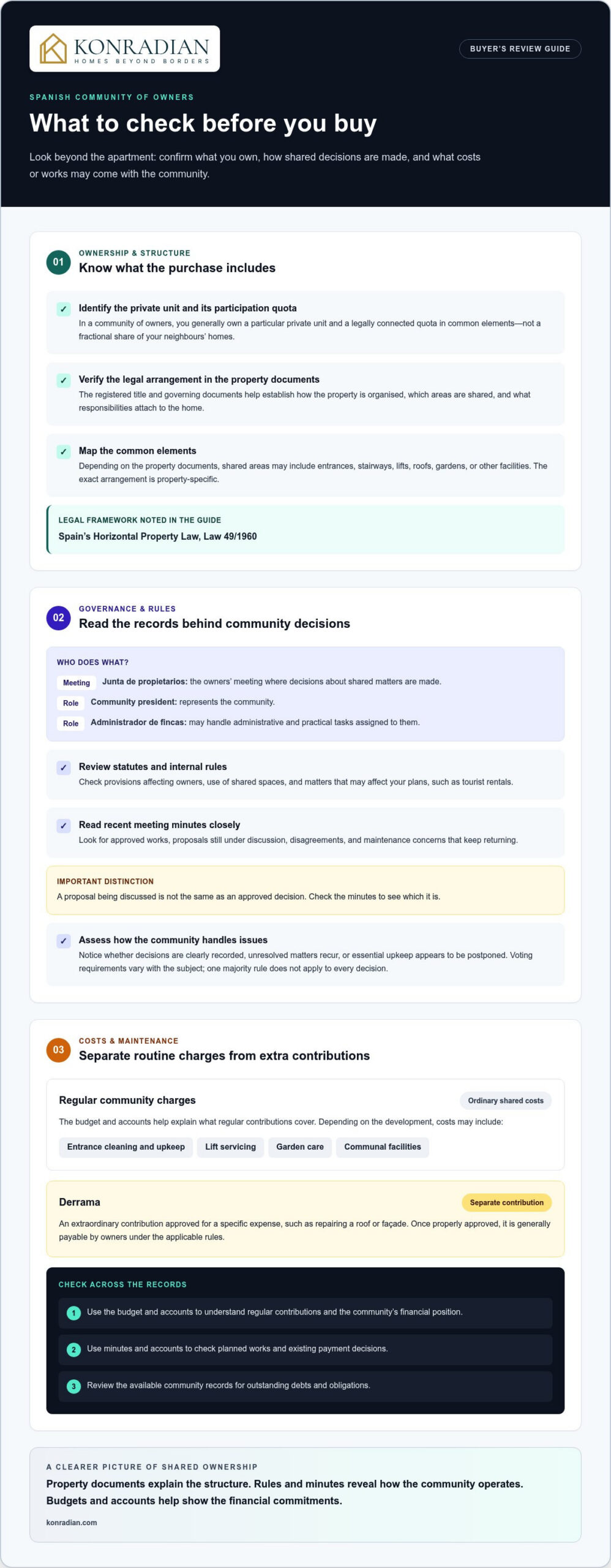
A comunidad de propietarios, or community of owners, is a shared-governance arrangement for a building or development with separately owned units and common elements. Spain’s Horizontal Property Law, Law 49/1960, provides the main legal framework. If you buy an apartment, you generally own that private unit and hold a legally connected participation quota in the common elements. You don’t automatically acquire a fractional share of every apartment in the building.
This distinction matters because owning a unit can also bring responsibilities for shared parts of the property. Depending on the building’s legal documents, these may include contributing to the upkeep of entrances, stairways, lifts, roofs, gardens, or other common facilities. The precise arrangement is property-specific. When buying property in a Spanish community of owners, establish what the unit includes and how the shared areas are governed.
Community of owners versus fractional co-ownership
In a community of owners, each owner holds a particular private unit and a participation quota relating to common elements. In fractional co-ownership, by contrast, two or more people hold defined shares in the same property. Those shares concern ownership of that property itself, rather than membership in a building community created around separately owned homes.
Imagine an apartment building with several individually owned flats. You buy one flat, not a slice of each neighbour’s home. Your legal interest may include a quota connected to the shared stairwell and lift, while each neighbour owns their own flat. In a fractional arrangement, several buyers might instead hold shares in one whole apartment. The title documents, agreements, and decision-making structures can therefore differ. A community of owners governs common elements among unit owners; fractional co-owners need to understand the terms governing their shared ownership.
Which properties may belong to a community?
A community arrangement is common in apartment buildings and can also apply to developments where homes share facilities or common areas. These might include a shared entrance, lift, gardens, or other amenities. A shared feature alone doesn’t establish the exact legal structure or the responsibilities attached to a particular home. The property’s registered title and governing documents help clarify how it is organised.
Don’t assume that every Spanish home has the same obligations. A detached home on its own plot may have a different ownership and maintenance arrangement from an apartment in a multi-unit building. Some homes form part of a wider development with shared facilities; others don’t. Even where a community exists, its common elements and rules depend on the legal documents for that property. Establishing the structure early helps you distinguish the responsibilities that come with the home from decisions made collectively.
How Spanish Owners’ Communities Govern Shared Areas and Responsibilities
Shared spaces need both maintenance and a decision-making structure. Under Spain’s Horizontal Property Law, the junta de propietarios, or owners’ meeting, is the community body where owners make decisions about shared matters. The community president represents the community, while an administrador de fincas, or community administrator, may handle administrative and practical tasks assigned to them. The exact arrangements can depend on the law and the community’s documents.
These roles matter to buyers because community decisions can shape how shared areas are maintained and used. The community’s statutes and internal rules set out provisions that apply to owners, while meeting minutes record decisions and discussions. A rule may set expectations for using a communal facility; the minutes may show that repairs are being considered or that the same building issue keeps returning. Together, the documents offer a more practical picture than either one alone.
Why meeting records matter
Read recent minutes for approved works, proposals still under discussion, disagreements, and recurring maintenance concerns. For example, a planned façade repair may affect future contributions even if work hasn’t started. Check whether a decision was approved or merely raised. The difference matters. Voting requirements vary with the subject, so don’t assume one majority rule applies to every community decision.
Meeting records can also show how the community operates. Are decisions clearly recorded? Do owners regularly revisit unresolved issues? Is there a pattern of postponing essential upkeep? These details help you assess not only the building’s condition but also how effectively owners address shared responsibilities.
Routine charges and additional contributions
Owners may contribute to common expenses according to the applicable ownership structure and governing documents. Regular community charges typically fund ordinary shared costs. Depending on the development, these might include cleaning and upkeep of an entrance, lift servicing, garden care, or maintenance of communal facilities. The budget and accounts help explain what the regular contributions cover.
Extraordinary works can lead to a derrama, a separately approved contribution for a specific expense, such as repairing a roof or façade. Once properly approved, such contributions are generally payable by the owners under the applicable rules. Review the minutes and accounts for planned works, existing payment decisions, and the community’s financial position. The regular charge alone won’t tell you the full story.
Spanish communities are also required to maintain a reserve fund of at least 10% of the ordinary annual budget. The fund is one useful financial indicator, but its existence doesn’t establish whether it will cover a particular project. For a fuller picture, connect the budget and accounts with relevant decisions and community rules. This is a practical part of Spanish property acquisition support, bringing community obligations into the wider purchase assessment.
What Community Documents Should You Review Before Buying in Spain?
Community due diligence is most useful when you read the paperwork as a connected record, not as a set of isolated documents. Rules describe the framework; minutes show how it is applied; budgets and accounts indicate what the community plans and can afford. These records complement property-register information, but answer different questions. Together, they can clarify the obligations attached to buying property in a Spanish community of owners.
Read the rules, minutes, and finances together
Review the community’s statutes and internal rules, recent meeting minutes, current budget, and available accounts. These documents may show restrictions on using shared spaces, decisions already approved, planned maintenance, and unresolved concerns. Look for consistency: a budget may allocate funds to repairs discussed in the minutes, while repeated references to a lift or façade issue may point to work still under consideration.
- Statutes and internal rules: Review provisions on shared areas, facilities, and any relevant limits on use.
- Recent meeting minutes: Note approved works, proposed projects, recurring disputes, and decisions that could affect how you use the property.
- Budget and accounts: Compare planned spending with reported income, expenses, and reserve-fund information. Check whether the figures reflect work mentioned in the minutes.
No single document tells the whole story. Minutes may record a proposal that was never approved; accounts may show expenditure without explaining the underlying decision. Read the records together, and flag unclear or inconsistent points for review during the transaction.
Check the property record and community position
A nota simple is an informative extract from Spain’s Property Registry. It can help establish registered details such as the property description, registered owner, and recorded rights or charges. It isn’t a substitute for community records: by itself, it won’t explain the community’s accounts, meeting decisions, or day-to-day rules.
Community debt needs a separate check. Under the current Horizontal Property Law, a buyer may be liable for unpaid community charges relating to the current year and the three preceding calendar years. Before completion, the seller should provide a community debt certificate, commonly called a certificado de estar al corriente de pago, confirming the payment position. Have the certificate and any qualifications or outstanding amounts reviewed as part of the purchase, rather than relying on informal assurances.
The availability and form of community records can vary, and a document’s legal effect depends on its content and circumstances. A practical review should reconcile the registered property details with community information, identify approved or pending works, and clarify any debt exposure before you commit. Professional legal review can help interpret the documents and verify the correct transaction procedure under current law.
How to Compare Spanish Properties by Their Owners’ Communities
A property’s community can add convenience, but its facilities, governance, and upkeep also shape the ownership experience. Compare each property’s documented position with your intended use, rather than treating a pool or landscaped garden as an unqualified benefit. A simple side-by-side comparison helps separate verifiable information from impressions gathered during a viewing.
Match community features to your plans
For a full-time home, reliable upkeep of shared entrances, lifts, or gardens may matter most. A second-home buyer may value facilities that are available without having to organise their individual maintenance. If you’re buying an investment property, pay close attention to documented rules on use and any relevant rental restrictions. No single set of priorities makes one community universally better; the right fit depends on your plans and the obligations attached to the home.
Keep facts from documents separate from observations. “The minutes record façade repairs as approved” is different from “the building looked well maintained during the viewing.” Both can inform your decision, but they aren’t interchangeable evidence.
| Comparison point | What to record for each property | Why it matters |
|---|---|---|
| Governance transparency | Availability and clarity of rules, minutes, budgets, and accounts | Shows how clearly decisions and shared responsibilities are documented |
| Shared facilities | Facilities included, their condition, and how upkeep is addressed | Helps weigh everyday convenience against maintenance needs |
| Planned works | Approved or proposed projects and their status in community records | Distinguishes completed decisions from possibilities still under discussion |
| Recurring obligations | Regular charges, what they cover, and any separately approved contributions | Gives a fuller picture of ongoing responsibilities than amenities alone |
Spot issues that merit closer review
Unclear records, repeated postponement of a repair, or budgets that are difficult to reconcile are reasons to investigate further, not automatic proof that a community is poorly run. Note the specific issue and compare it with the related minutes, accounts, and rules. For example, a project mentioned in successive meetings may have been delayed for a clear reason, or its current status may need clarification as part of the purchase review.
Use the same questions for every property. Does the community’s documented approach fit your intended use? Are the facilities you value maintained through a clear plan? Can you trace significant spending or decisions through the available records? Consistent comparisons make trade-offs easier to judge and prevent first impressions from carrying too much weight.
This community-level assessment is one part of a considered purchase. For a guided Spanish property search and acquisition, Konradian supports buyers from property selection through transaction support and key handover.
How to Buy Property in a Spanish Community of Owners with Confidence
A considered purchase starts with your priorities, moves through property checks, and ends with a decision grounded in what the documents show. Buying property in a Spanish community of owners adds shared governance to the usual property review. Assess the community alongside the home, rather than leaving it until the final stages.
A buyer’s sequence from shortlist to decision
- Define your requirements. Set out your preferred location, intended use, and essential features. Decide which shared amenities matter to you and consider the responsibilities that may come with them.
- Compare suitable properties. Consider how each home and its community fit your plans. Keep documented details, such as recorded rules or approved works, distinct from observations made during a viewing.
- Review community information. Examine available rules, meeting minutes, budgets, accounts, and information about outstanding charges or planned works. Note what the records establish and which points need clarification.
- Complete property-specific checks. Review the registered property information and other legal and financial matters as part of the transaction. Community records provide important context, but don’t replace a full legal review of the purchase.
- Decide with the obligations in view. Before progressing toward completion, make sure you understand the documented community responsibilities, relevant decisions, and unresolved questions that could affect your use of the property.
This sequence helps balance enthusiasm with due diligence. A home may be an excellent match for its location and layout, yet its documented community rules or planned responsibilities may call for a closer look. A question in the records isn’t automatically a reason to walk away; it’s a reason to understand the facts before committing.
Where Konradian supports the purchase journey
Konradian supports buyers in Spain from property selection through transaction support and key handover. This wider perspective helps place community information within the full acquisition process, while independent legal advice remains essential for interpreting legal rights, obligations, and documents. Buyer support in Spain carries no direct cost to the buyer, with commissions paid by sellers or developers. This commercial arrangement doesn’t replace independent legal review.
Include legal support for buying property abroad in your due diligence. Bringing property selection, community review, and transaction checks together can make the decision clearer and more deliberate.
For buyers beginning a Spanish property search, Konradian’s Spanish property search can be shaped around the home and priorities you have in mind.
Make Your Spanish Property Search a Confident Next Step
The right purchase is not simply the home that looks appealing today. It’s one whose documented responsibilities and decision-making arrangements make sense for the way you expect to use it. Treat that alignment as part of your long-term plans, and you’ll have a clearer view of what ownership involves.
If you’re considering buying property in a Spanish community of owners, Konradian supports your search from property selection through transaction support and key handover. In Spain, this end-to-end buyer support carries no direct cost to the buyer; commissions are paid by sellers or developers. Independent legal review remains an important part of a well-considered transaction.
Start your Spanish property search with Konradian, and shape it around the home, location, and ownership experience you want. Careful review can help you make an informed decision about your next move.
Frequently Asked Questions
Is a Spanish community of owners the same as fractional property ownership?
No. A community of owners concerns how separately owned homes and shared elements are governed, while fractional ownership means multiple people hold defined shares in a property. Before signing, check whether the agreement gives you title to a specific unit or a share in one jointly owned home. That distinction can affect how use, decisions, and a future sale are handled, so rely on the legal documents rather than the listing description alone.
Can a foreign buyer own property in a Spanish community of owners?
Yes. Foreign nationals can buy property in Spain, though the purchase involves identification, tax, and legal formalities that depend on the buyer and transaction. Community membership follows the property’s ownership structure, not the buyer’s nationality. For example, an overseas purchaser of an individually titled apartment would need to understand the obligations attached to that unit. Have the transaction requirements reviewed for your circumstances before making a commitment.
Does buying property in Spain automatically give the buyer residency?
No. Owning a home and having permission to live in Spain are separate matters. A property purchase shouldn’t be treated as a residence permit or permission to remain beyond the rules applicable to your nationality and circumstances. If you plan to relocate, check current official immigration guidance before relying on the purchase as part of your plans. Your eligibility and permitted stay need to be considered independently of the property transaction.
How much are community charges for a Spanish property?
There’s no single charge for every home. The amount depends on the community’s budget, the property’s applicable contribution, shared facilities, and decisions about works. A building with a lift or extensive communal areas may have different expenses from a home with fewer shared services. To understand the costs for a particular purchase, compare the current budget with recent accounts and consider how separately approved contributions affect the figures.
Can a community of owners change its rules after a property is purchased?
Community rules and decisions can change through the applicable process, but the required vote and legal effect depend on the subject, current law, and governing documents. For instance, a decision about a shared facility may follow different requirements from one affecting a particular owner’s use of their home. Review the rules and meeting records available before purchase, and have any proposed or recent changes interpreted in their legal context.
What should a buyer do if community documents are unclear or incomplete?
Don’t treat uncertainty as either harmless or proof of a problem. Identify what’s missing, such as a recent budget or a record explaining a planned repair, and address it through the transaction process. Keep open questions in writing so they can be considered alongside the property’s other checks. If records remain incomplete, have a qualified legal professional assess what that means for the purchase before you commit.
