


Can you buy UK property and secure a mortgage if you’re non-domiciled? Yes, but domicile alone won’t determine the answer. For anyone buying UK property as a non-domiciled buyer, the practical questions are how tax residence, income, deposit, lender criteria and the property’s UK location affect the purchase.
The rules changed on 6 April 2025, when the UK abolished the non-dom tax regime and moved to a residence-based system. That shift can affect how international buyers plan for UK tax, while mortgage eligibility remains a separate assessment of personal circumstances and financial evidence. Location matters too: England and Northern Ireland use SDLT, while Scotland and Wales have their own property transaction taxes.
This 2026 guide takes you through the main decisions, from assessing your circumstances and exploring mortgage eligibility to understanding key tax questions and planning for completion. It also explains where tailored legal, tax or financial advice matters. With a clear plan, you can approach UK property sourcing and acquisition with greater confidence.
Key Takeaways
- Buying UK property as a non-domiciled buyer depends on more than domicile. Clarify how residence, nationality, immigration permission and lender criteria apply to your circumstances.
- Compare cash, residential mortgage and buy-to-let finance by eligibility, documentation, repayment structure and intended use before committing.
- Identify the property’s UK nation early. The applicable transaction tax and legal process can differ across England, Northern Ireland, Scotland and Wales.
- Use a structured purchase plan to coordinate financial preparation, tax advice, legal review, due diligence and completion.
- Konradian provides buyer-side UK property sourcing and acquisition support, helping international buyers move from property selection to legal and financial transaction navigation.
Buying UK Property as a Non-Domiciled Buyer: What Your Status Actually Means
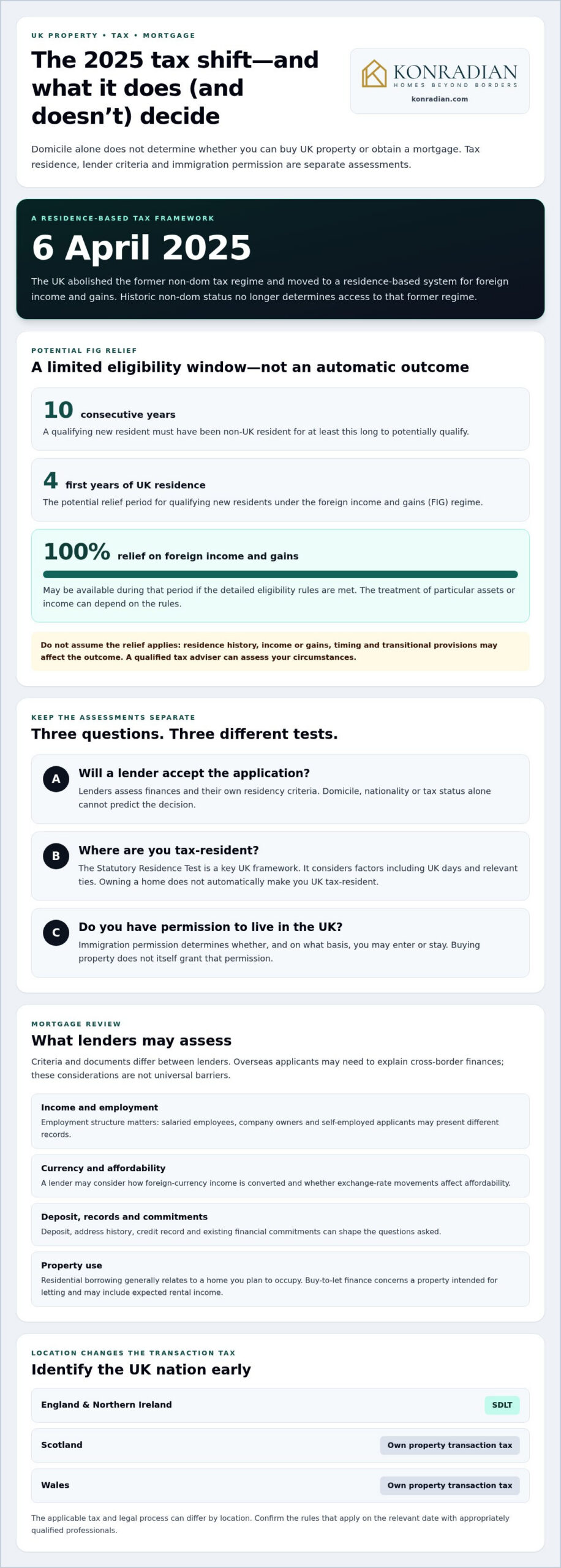
“Non-domiciled” is not a UK mortgage category, and it does not by itself prevent you from buying property. If you’re buying UK property as a non-domiciled buyer, keep three questions separate: a lender assesses your finances and its residency criteria, tax rules determine your residence position, and immigration permission governs your right to live in the UK.
These tests can interact, but none replaces another. Buying a home does not automatically make you UK tax-resident or give you permission to enter or remain in the country. However, how you use the property, whether it is available to you and how many days you spend in the UK may be relevant to tax-residence analysis. Location matters too: England and Northern Ireland, Scotland, and Wales have different property transaction tax systems.
Domicile, tax residence and nationality are different tests
Domicile is a legal concept associated with a person’s lasting home and connection to a place. Tax residence concerns where someone is treated as resident for tax purposes during a particular period. In the UK, the Statutory Residence Test is a key framework for assessing tax residence for each tax year. It considers factors such as days spent in the UK and relevant ties. Nationality refers to citizenship. None of these terms automatically determines whether a lender will accept your application.
Immigration permission is a separate matter: it determines whether and on what basis you may enter or stay in the UK. A lender’s definition of resident or non-resident is a financing criterion, not a decision about your domicile or immigration status. So “non-domiciled” is not a reliable shorthand for “non-UK resident.” Each status may need to be assessed separately, based on your circumstances and the purpose of the assessment.
What changed for non-domiciled tax treatment in 2025?
From 6 April 2025, the UK abolished the former non-domiciled tax regime and moved to a residence-based framework for foreign income and gains. Historic non-dom status no longer determines access to that former regime. It does not mean every international buyer has the same tax outcome: residence history, the type and timing of income or gains, and transitional provisions can all matter.
Under the new foreign income and gains (FIG) regime, qualifying new residents who have been non-UK resident for at least 10 consecutive years may be eligible for 100% relief on foreign income and gains during their first four years of UK residence. Eligibility and the treatment of particular assets or income depend on detailed rules. Don’t assume the relief applies without advice from a qualified tax adviser.
Domicile alone cannot determine whether you can buy UK property or obtain a mortgage. Your financing, tax and immigration positions must be assessed separately. Before committing, establish which UK nation the property is in, confirm the rules that apply on the relevant date, and have your circumstances reviewed by appropriately qualified legal, tax and mortgage professionals.
UK Mortgages for Non-Domiciled Buyers: What Lenders Assess
A mortgage decision rests on the application as a whole, not on domicile alone. For someone buying UK property as a non-domiciled buyer, a lender may consider where you live, how you earn, the currency of your income, your deposit and your existing commitments. Criteria and document requirements differ between lenders and can change, so nationality or tax status alone cannot predict the outcome.
Resident applicants may find UK-based income and credit records more straightforward to evidence. Applicants living overseas may need to explain income earned in another country, how currency movements affect affordability and how they manage finances across borders. These are underwriting considerations, not universal barriers. The property’s intended use matters as well: residential borrowing is generally assessed around a home you plan to occupy, while buy-to-let finance concerns a property intended for letting and may include an assessment of expected rental income. Lender-specific rules determine how each application is treated.
How non-resident mortgage applications may differ
Start by setting out your employment structure and income clearly. A salaried employee, company owner and self-employed applicant may need to present different records. If you’re paid in a foreign currency, a lender may consider how it converts that income and whether exchange-rate movements affect affordability. Your UK or overseas address history, credit record and financial commitments can also shape the questions asked. There is no single outcome across all lenders.
Tax status and mortgage underwriting are separate assessments. For background on the tax framework, refer to UK government guidance on non-domiciled tax, then discuss your personal position with a qualified tax adviser. Tax residence should not be treated as proof of mortgage eligibility.
Documents and finances to organise before applying
Organise a record of your financial position before progressing with a property search or application. Requirements vary, but lenders and transaction professionals may ask for evidence in several areas. If records were issued in another language or jurisdiction, translations, certified copies or additional explanations may be requested.
- Identity and address: current identity documents and records supporting your residential and address history.
- Income and employment: payslips, tax records, accounts, contracts or other evidence suited to your work structure.
- Assets and deposit: statements showing available funds and a clear trail from their origin to the account used for the purchase.
- Liabilities and credit: details of loans, ongoing financial commitments and relevant credit history.
- Property purpose: a clear explanation of whether the property is for personal occupation or letting.
Build a project-specific checklist with the relevant finance and legal professionals. This helps align lender requests with source-of-funds checks and the property transaction, while allowing for additional documents if requested.
For a joined-up view of property selection and acquisition planning, explore Konradian’s UK property sourcing support. It helps bring the search and transaction considerations into focus. Mortgage approval remains a decision for the lender.
Compare UK Property Finance and Tax Considerations Before You Commit
Choose a financing route that fits the property’s purpose, then assess tax based on its location and your circumstances. The decision is not simply about borrowing versus cash. Consider the evidence you’ll need, how repayments are structured and whether you intend to live in the property or rent it out.
Choose a financing route that matches the property’s purpose
A home for personal use, a property you may occupy after relocating and a rental investment are different purchase scenarios. Some buyers also choose to rent first while familiarising themselves with regional markets or finalising cross-border finances, reviewing local agency listings on sites like nikkihomes.co.uk to assess rental options and values. Residential and buy-to-let borrowing can have different lender criteria and permitted uses, so don’t assume one mortgage route fits every plan. If your intention changes, review the finance arrangements and tax questions before acting.
Include currency in your affordability planning. If your income or assets are held in another currency, exchange-rate movements can change the amount available in sterling. Consider how stable your income is, when funds can be transferred and whether you have a reserve for purchase costs and ongoing commitments.
Route
Purpose and eligibility
Evidence and payment structure
Cash purchase
May suit a personal home or rental investment if you have sufficient funds available.
Prepare evidence of funds and their source. There are no mortgage repayments, but ownership and property costs remain.
Residential mortgage
Generally considered for a property you intend to occupy, subject to lender criteria.
Lenders assess income, commitments and supporting documents. Repayments follow the agreed mortgage terms.
Buy-to-let finance
Designed for a property intended to be let, with underwriting and permitted use that can differ from residential borrowing.
A lender may assess the applicant and rental proposition. Repayment terms and evidence requirements vary.
Understand acquisition taxes without assuming one UK-wide rate
Property tax depends on location and buyer circumstances. England and Northern Ireland use Stamp Duty Land Tax (SDLT), Scotland uses Land and Buildings Transaction Tax (LBTT), and Wales uses Land Transaction Tax (LTT). Rates, thresholds, reliefs and surcharges are not interchangeable across these jurisdictions.
For SDLT, a non-UK-resident surcharge may apply to residential purchases in England and Northern Ireland. An additional-property surcharge may also be relevant, and the two can be cumulative. Whether either applies depends on the rules and your circumstances at the transaction date. Check current official guidance before calculating your budget, and obtain tailored tax advice.
Keep acquisition tax separate from the wider ownership picture. Rental income, ongoing ownership obligations and tax on a future disposal raise different questions. If you’re buying UK property as a non-domiciled buyer, tax residence, the property’s nation and its intended use should all inform your planning. Don’t assume one status settles every liability. Recheck official guidance and seek professional advice before committing, particularly if your plans or the applicable rules change.
Plan a UK Property Purchase from Financial Preparation to Completion
A well-planned purchase brings funding, tax, legal review and property selection into alignment before commitments become difficult to change. If you’re buying UK property as a non-domiciled buyer, prepare for cross-border documentation and currency movements early, then confirm the process for the nation where the property is located. The outline below is a practical sequence, not a fixed timetable. Requirements vary by transaction.
Prepare your brief and funding plan before viewing
Start with a clear brief: where you want to buy, whether the property is for personal use, a future relocation or rental, and which features are essential. Decide whether you expect to buy with cash or seek finance. Before viewing, map the funds you’ll use, the accounts they’ll move through and the documents that can demonstrate their source. If funds are held in another currency, consider transfer timing and how exchange-rate changes could affect your sterling budget.
Bring mortgage planning and tax advice into the early stages, rather than waiting until an offer is accepted. A lender’s affordability assessment, your tax position and the property’s intended use may raise different questions. A legal professional can also advise on ownership structure and transaction requirements. These checks help shape a realistic brief, but they do not replace individual legal, tax or mortgage advice.
Move from offer to completion with coordinated checks
Once you identify a suitable property, the transaction typically progresses through an offer, legal work, property checks, contract stages and completion. Coordinate your funding evidence with the legal process so the source and movement of purchase funds can be explained when requested. Keep your finance, tax and legal advisers informed if the purchase purpose, ownership plan or funding route changes.
- Confirm your brief and funding. Set your intended use, location, budget parameters and route to purchase, then organise supporting financial records.
- Make an offer. Ensure the proposed offer reflects your due diligence to date and aligns with your finance planning.
- Instruct legal support and review the property. Conveyancing, searches, title review and other checks help identify matters that may affect the transaction. Their scope depends on the property and jurisdiction.
- Review and agree the contract process. In England and Wales, an accepted offer is generally not legally binding until contracts are exchanged. In Scotland, the conveyancing process uses written offers and missives; conclusion of missives generally creates the binding contract. Your solicitor can explain the relevant stages and obligations.
- Prepare for completion. Coordinate the required funds, lender arrangements if applicable, final legal steps and tax planning. Completion mechanics and timing depend on the transaction.
Keep property selection, acquisition strategy and legal and financial transaction navigation connected throughout the process. Explore Konradian’s UK property sourcing support as part of planning your acquisition. This buyer-side advisory service involves fees and helps structure the search and purchase journey. It does not provide mortgage lending or individual tax advice.
How Konradian Supports International Buyers Sourcing UK Property
Buying in an unfamiliar market involves more than finding a property. Your brief, acquisition strategy and transaction steps need to work together. Konradian provides buyer-side UK property sourcing and acquisition support, helping international buyers structure the search and coordinate decisions that move a purchase forward.
What strategic UK property sourcing support covers
The process begins with an initial free video consultation to understand your objectives and shape a focused property brief. Your intended use, preferred locations and decision criteria guide the selection process. Konradian then supports property selection and acquisition strategy, helping you assess potential options against your priorities rather than treating each viewing as an isolated decision.
As the purchase progresses, support can include navigating legal and financial transaction considerations and coordinating steps that may be unfamiliar in the UK market. UK sourcing is buyer-side advisory support and involves fees. The scope and fee arrangements form part of the engagement. Mortgage approval, tax treatment and investment returns depend on individual circumstances and decisions by the relevant lender or qualified professional.
Konradian brings more than five years of international property experience, and its team is educated at the London School of Economics. This context may be useful for international buyers seeking a considered approach, but it does not guarantee a particular property, purchase outcome or investment performance.
Prepare for a focused first conversation
A clear starting brief helps make the initial discussion more productive. Before the video consultation, consider the following points:
- Purpose: whether you’re seeking a home for personal use, a future move or a rental investment.
- Location: areas you prefer, places you’re open to considering and practical priorities that will shape the search.
- Timing: your preferred purchase horizon and any important personal or financial milestones.
- Funding position: whether you expect to buy with cash or explore borrowing, and what you know about your funding arrangements.
- Decision criteria: the property characteristics that matter most, alongside factors you’re willing to compromise on.
You don’t need every detail settled before the conversation. Sharing what you know and identifying what remains undecided gives Konradian a basis to tailor property sourcing to your brief and clarify practical next steps. If you’re buying UK property as a non-domiciled buyer, that discussion can sit alongside independent tax, legal and mortgage advice, keeping the property search aligned with your wider plans.
If you’re ready to define your priorities and discuss the acquisition journey, discuss your UK property acquisition with Konradian.
Turn Your UK Property Plans Into a Clear Brief
Turn your intentions into a practical acquisition brief. Consider what you want the property to do for you, which locations fit your plans and which decisions still depend on financing or professional advice. You don’t need every answer settled. Separating confirmed priorities from open questions makes the next conversation more focused.
For buying UK property as a non-domiciled buyer, the property search is strongest when it reflects your wider circumstances and long-term goals. A buyer-side sourcing partner can help shape that search and coordinate the acquisition journey, while qualified tax, legal and mortgage professionals advise on their respective areas. For international business owners and executives balancing personal moves with commercial property requirements, resoluteglobalcre.com provides occupier-focused corporate real estate guidance through its global advisory network.
Konradian’s UK property sourcing and acquisition support is tailored to your brief and provided on a buyer-side advisory-fee basis. Share your objectives and preferred next steps to start a considered discussion about the purchase you have in mind.
Discuss your UK property acquisition with Konradian and take the next step with a clear plan.
Frequently Asked Questions
Can a non-domiciled buyer get a UK mortgage?
Yes, a non-domiciled buyer may be able to get a UK mortgage, but domicile alone won’t determine approval. A lender may examine whether your income can be evidenced consistently, how overseas currency affects affordability and whether your deposit is ready for transfer. Before making an offer, discuss the intended property and borrowing structure as well as your personal finances. An exploratory eligibility conversation isn’t a mortgage offer or a guarantee of approval.
Does non-domiciled status affect buying property in the UK?
Non-domiciled status isn’t, by itself, a general bar to purchasing UK property. The practical question is which separate rules affect your plans. Citizenship and immigration permission matter to your right to live in the UK, lender criteria concern borrowing, and tax rules concern liabilities. Map these questions separately before committing, particularly if you plan to occupy the property, relocate later or hold it as an investment.
Do non-domiciled buyers pay UK property tax?
They may have to pay property transaction tax, but the amount and applicable rules depend on the property’s UK nation and the buyer’s circumstances. SDLT applies in England and Northern Ireland, LBTT in Scotland, and LTT in Wales. A second property or non-resident status may affect the calculation under current rules. Before exchanging contracts, use the relevant official guidance and have a tax adviser review your specific ownership and purchase details.
Can I buy UK property without being a UK resident?
Yes, it may be possible to purchase property while living outside the UK. Owning a home doesn’t itself give you permission to enter, remain or work in the country, and the purchase doesn’t automatically determine your tax residence. If you’ll use a mortgage, your overseas address and financial records may affect the lender’s assessment. Clarify how you intend to use the property and plan the practicalities of signing and transferring funds from abroad.
What mortgage documents might an overseas buyer need?
Potential documents include identification, proof of address, income and employment records, bank statements, details of liabilities, evidence of the deposit and records tracing the funds’ source. For example, a business owner may need financial records that explain how income is drawn, while an employed applicant may provide employment and earnings documents. The lender may request translated or certified records. Request a tailored checklist early and allow time to obtain documents from overseas institutions.
What happens to non-domiciled tax rules after April 2025?
The UK changed its foreign income and gains framework from 6 April 2025, moving away from the previous non-dom basis towards residence-based rules. The new regime includes a four-year foreign income and gains relief for qualifying new residents, but eligibility depends on individual circumstances, including residence history. Transitional provisions may also be relevant. Before bringing overseas income or gains into the UK or changing residence plans, ask a qualified tax adviser to assess the rules that apply to you in 2026.
Should I use a property sourcing specialist when buying in the UK from abroad?
A sourcing specialist can help translate your goals into a property brief, assess potential options against your priorities and coordinate acquisition steps that may be unfamiliar from overseas. Clarify the scope of support and fees before proceeding. Konradian provides UK property sourcing and acquisition support on a buyer-side advisory-fee basis. This support can structure the search and transaction journey; mortgage decisions and individual legal or tax advice remain separate professional matters.
