


Most Croatian homes sell below asking in 2026: residential properties typically reach a serious accepted offer in about 125 days and sell for 92% to 97% of their asking price. A Dubrovnik property market analysis therefore needs to look beyond headline prices to understand what buyers are actually paying.
That gap matters whether you’re weighing a purchase, setting expectations for a sale, or comparing Dubrovnik with nearby Southern Dalmatian markets. Asking prices tell only part of the story: property type, location, rental demand, and changes in the surrounding area all affect how a listing measures up.
This analysis brings those factors together, from differences between apartments and houses to signs of rental demand and what selling times suggest about buyer activity. It also places Dubrovnik in the wider regional picture, helping you assess opportunities and trade-offs more clearly.
Key Takeaways
- Use asking prices as a starting point, then account for property type, location and the gap between asking and accepted offers.
- Separate seasonal visitor demand from longer-term rental demand to judge a property’s potential more clearly.
- Assess neighborhood change through real improvements in access, public spaces and local employment, not plans alone.
- Allow for a measured selling process: pricing strategy and buyer demand influence both the time to an offer and the final sale price.
- Compare Dubrovnik with nearby Southern Dalmatian markets to see how location and property characteristics shape value.
Croatia 2026: How strong is rental demand behind the scenes?
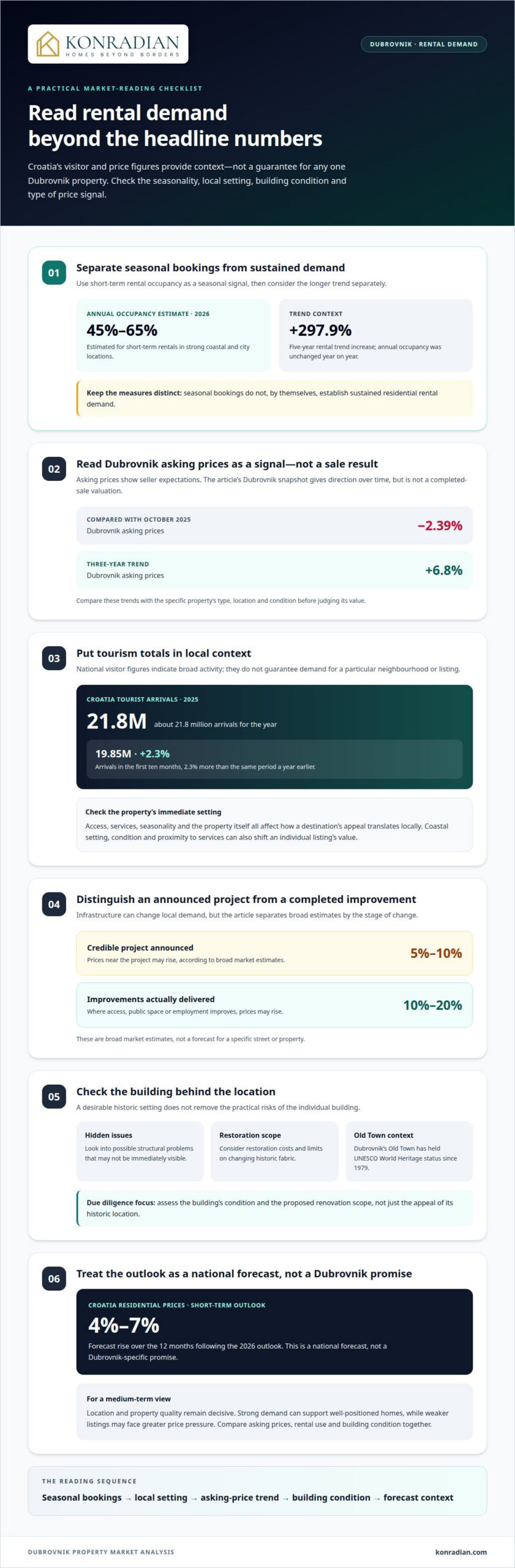
Rental demand supports interest in Croatia’s coastal real estate, but destination averages need careful interpretation. Short-term rentals in strong coastal and city locations are estimated to achieve annual occupancy of 45% to 65% in 2026. That figure was unchanged year on year, yet the five-year rental trend increased by 297.9%. A long-term investment decision should distinguish seasonal bookings from sustained residential demand.
Prices also vary considerably across Croatia. These regional ranges describe distinct markets, not interchangeable values. Coastal setting, property condition, and proximity to services can all shift the value of an individual listing.
City-level figures show why property type matters. They provide useful context, but they are not a direct valuation of a particular apartment, house, or villa.
Dubrovnik’s asking prices provide a more current snapshot. That was 2.39% lower than October 2025, while the three-year trend showed a 6.8% increase. Asking prices measure seller expectations, not completed sale prices.
Historic properties carry distinct risks. Hidden structural problems, restoration costs and limits on changing historic fabric can affect a purchase plan. Dubrovnik’s Old Town has held UNESCO World Heritage status since 1979, making the building’s condition and proposed renovation scope important due-diligence considerations. Buyers should distinguish the appeal of a historic setting from the practical work a specific property may require.
For the short-term outlook, Croatia’s residential prices are forecast to rise about 4% to 7% over the 12 months following the 2026 outlook. This is a national forecast, not a Dubrovnik-specific promise. Over a medium-term horizon, location and property quality remain decisive: strong demand can support well-positioned homes, while weaker listings may face greater price pressure. Compare asking prices, rental use and building condition together before judging value.
What property types dominate in Croatia right now?
Foreign interest spans apartments, houses and villas, with Dubrovnik among Croatia’s most popular locations for international buyers. Across the Adriatic Coast, more than 70,000 foreigners own property. That ownership reflects varied priorities: a city apartment, a coastal home or a larger villa can each serve a different use. Property type, location and intended occupancy matter more than a single national label.
Foreign buyer activity has shifted. Foreign purchasers accounted for nearly one in four Croatian property purchases during 2020 through 2024. Another market measure puts their share at 7.7% of all real estate transactions. These figures describe different measures, so they shouldn’t be treated as directly comparable. The number of transactions completed by foreign buyers dropped by more than 43%, indicating softer activity rather than the disappearance of international demand.
Dubrovnik remains a popular destination within this changing market. Its coastal setting and established international profile attract buyers considering both apartments and houses. New-build homes make up an estimated 15% to 25% of serious residential listings in Croatia in 2026. That leaves buyers weighing newer properties against existing homes, where layout, condition and renovation requirements shape suitability. A villa may offer space and privacy, while an apartment may better match a compact city-based plan.
Financing deserves early attention. In 2026, Croatian banks may offer many non-resident foreign buyers loan-to-value ratios of 50% to 70%. The borrowing share can affect the deposit a buyer needs and the range of properties they can pursue. Mortgage access depends on lender assessment and the borrower’s circumstances, so financing capacity should inform the property search rather than follow it. A cash buyer and a non-resident seeking a loan may approach the same listing differently.
Before committing to a residential property, establish exactly what is being sold and whether its records align. Review the land registry entry for ownership and recorded rights, compare the property description with cadastral information, and check building and use permits against the existing structure. A Croatian property lawyer can review title, permits, and legal status together, identify discrepancies, and explain their implications before purchase. This is especially important when additions or conversions appear in the property but not in its documentation.
Foreign buyers do not form one uniform group. A Dubrovnik apartment, an Adriatic coastal house, and a villa suit different plans, budgets, and financing arrangements. First set priorities for intended use, property condition, and funding. Then compare listings against those criteria instead of assuming that foreign ownership trends predict which property is right for you or how it will perform.
Neighborhood change and infrastructure-led demand
Tourism gives coastal demand a substantial backdrop: Croatia recorded about 21.8 million tourist arrivals in 2025. The first ten months brought 19.85 million arrivals, 2.3% more than the same period a year earlier. For property in Croatia, national visitor totals indicate broad activity, not guaranteed demand for every neighbourhood. A tourist destination’s appeal still depends on access, services, seasonality and the property itself.
Infrastructure can change that local calculation, but announcements and completed improvements are different signals. In Croatia, prices near a credible infrastructure project may rise 5% to 10% after its announcement. Where access, public space or employment actually improve, prices may rise by 10% to 20%. These are broad market estimates, not a forecast for a specific street. For buyers, the practical distinction is whether a project has moved from proposal to a visible change in daily access or amenity.
Neighbourhood performance also varies with the starting point. Improving Croatian neighbourhoods recorded estimated price growth of 15% to 30% over the past two to three years. That range doesn’t mean every area will repeat the pattern. Check what is changing around a property: transport connections, public spaces, local services and employment can support lasting interest. A planned improvement matters less to residents until it alters how they reach work, shops or the coast.
Šibenik and Pula show why each destination needs to be assessed on its own terms. In Šibenik, consider how the property relates to the waterfront, everyday amenities, and visitor activity. In Pula, weigh the neighbourhood’s established services and connections against its coastal and cultural appeal. Average prices can conceal substantial differences in street, building condition, and rental suitability. Compare a property’s likely use with local demand drivers rather than assuming that a coastal address behaves like Zagreb.
Short-term rental interest links tourism with housing, but annual visitor numbers do not show how demand is distributed. Seasonality, property condition, access, and proximity to attractions affect whether a home suits holiday guests or longer stays. Permanent residents also rely on neighbourhood services, so visitor appeal is only one part of a property’s residential value. Weigh rental potential alongside year-round convenience, not in place of it.
For short-term holiday rentals in Dubrovnik, first establish the property’s permitted use and which approvals apply to its building and rental arrangement. Resolve those requirements before factoring holiday income into a purchase assessment. This separates projected rental returns from broader neighbourhood trends: even a tourist-focused location cannot make up for a property whose use, condition, or access does not fit your plans.
Croatia residential market conditions and selling times
Croatia’s residential market combined rising prices with fewer completed transactions in 2025. The country recorded 57,095 real estate transactions in the first six months of 2025, compared with 67,415 during the same period in 2024. That was a 15.3% decline year on year. Separately, annual property sales were about 20% lower in 2025 than the previous year. These periods differ, but both show that fewer transactions can coexist with firm pricing.
For sellers, time and negotiation matter. Residential properties in Croatia take about 125 days on average to reach a serious accepted offer in 2026. Most homes sell for 92% to 97% of asking, with a typical final discount of roughly 3% to 8%. Fewer than 10% are estimated to sell above asking. A realistic initial price, property condition and buyer demand influence the result; an asking price alone doesn’t establish market value.
Dubrovnik’s longer-term movement is stronger than its recent annual direction. The average sale price trend in the municipality increased by 34.9% over five years, while its one-year trend decreased by 2.4%. That contrast shows why the selected time period matters: a short-term dip can sit within a substantial five-year rise. Compare the same property type and location across periods before interpreting the trend.
Rental returns and ownership patterns add context. Croatia’s gross rental yields averaged 4.42% in Q4 2025, while about 91% of Croatian households lived in owner-occupied homes or apartments. Yield is a broad measure, not a guarantee of an individual property’s return. Location, purchase price, occupancy and running costs affect the calculation, particularly when comparing a coastal home in Dalmatia with housing in larger cities.
Economic conditions shape purchasing capacity. Croatia’s real GDP grew by 3.8% in 2024; growth was expected at around 3.2% in 2025 and projected at approximately 2.9% in 2026. Inflation stood at approximately 3.6% in October 2025, while the ECB projected 1.7% inflation for 2026. These indicators help frame the market, but they don’t determine the value or selling time of a particular home.
These are broad guide figures, not Dubrovnik valuations. Croatia introduced a tax on second properties in 2025 at €0.60-8 per square metre, with the municipality setting the amount. The stated tax information also says a property sold after two years from acquisition does not incur income tax. Other transaction costs depend on the purchase and services involved, so distinguish them from the property price.
Nearby property markets in Southern Dalmatia
Dubrovnik is only one part of Southern Dalmatia’s residential market. Nearby Konavle, Župa Dubrovačka, Zaton, Slano, and the Elaphiti Islands offer different settings and types of listings. Comparing them shows why Croatia’s property market cannot be summed up by one coastal average. A city apartment, family house, and waterfront villa serve different purposes, even when listings share a regional label.
Konavle illustrates how asking prices can differ between properties in the same area. The larger home’s lower asking total shows why size alone does not determine value. Condition, design, location, and plot characteristics all matter when interpreting a listing.
That layout differs from a single-household home, so its appeal depends on the buyer’s intended use and the building’s configuration. A sea view and property type distinguish the example, but asking prices alone cannot establish comparable value.
Island and smaller coastal listings broaden the comparison. These examples show distinct property types in the Dubrovnik area. Island access, waterfront position, building condition, and intended use are practical factors to weigh alongside the headline price.
Slano and Orašac add further contrasts. Land and completed homes are different purchase propositions, so their asking prices should not be compared as like-for-like residential values. A useful comparison starts by separating apartments, houses, villas, and undeveloped plots.
For international buyers comparing European countries, the real estate market in Southern Dalmatia is best assessed at neighbourhood and property level. Istria can provide a broader Croatian comparison, but it is a different destination with its own local characteristics. Visitors may shape interest in coastal homes, yet access, property condition and everyday convenience also influence a location’s appeal. Compare the intended use first, then evaluate similar property types in nearby areas. Explore Southern Dalmatian property options as the next step toward a focused regional comparison.
Konradian
Konradian helps turn market comparisons into a considered property decision. If you’re comparing Dubrovnik with nearby Southern Dalmatian locations, its Croatian Real Estate Sales service can support your search and purchase. Analysis of asking prices, property types, and selling times offers a practical framework for narrowing your priorities. From there, focus on the location and property that best fit your plans.
Konradian also supports property decisions in Spain, the USA, and Hungary through its Spanish Property Acquisition, US Real Estate Investment Services, and Hungarian Property Brokerage services. For a focused discussion about Croatian property and the next steps in your search, contact Konradian.
Make your next property decision with clarity
A Dubrovnik property market analysis is a starting point, not a decision in itself. Turn broad market signals into a clear brief: define how you plan to use the property, which locations suit that purpose, and what trade-offs you can accept around condition, access, and potential rental use. A focused brief makes it easier to assess each opportunity on its merits rather than be swayed by a striking listing or headline trend.
An international purchase also means coordinating property selection with the legal and financial details of the transaction. Konradian supports Croatian property decisions alongside its work in other markets, bringing these considerations together in a single, considered process.
When you’re ready to discuss a property search or sale in Dubrovnik, contact Konradian about Dubrovnik property. A clear conversation can help you shape the next step around your plans and priorities.
Frequently Asked Questions
Are properties selling above or below asking in Croatia in 2026?
Most are selling below asking, with typical sale prices around 92% to 97% of the listing price. Fewer than 10% of homes are estimated to sell above asking. For an offer, treat the asking figure as the seller’s starting position, not a settled valuation. Compare similar properties by location, condition and property type, then account for any work or limitations that affect the home’s appeal.
Do foreigners face extra challenges in Croatia right now?
Foreign buyers may face additional practical steps, especially when arranging finance or coordinating a purchase from abroad. Non-resident mortgage applications can involve lender-specific assessments and documentation, while property records and permits need careful review. These are transaction and financing considerations, not a reason to assess every listing differently. Allow time to understand the property’s legal status, funding requirements, and the steps involved before committing.
Do people think homes are overpriced in Croatia in 2026?
Whether a home seems overpriced depends on what you compare it with, not just its asking price. A listing may appear expensive beside a national average but make more sense beside similar homes in the same neighbourhood. Compare usable space, condition, access, and property type. In Dubrovnik, a renovated apartment and a home needing substantial work are not equivalent simply because they are nearby.
How easy is it for foreigners to buy in Croatia in 2026?
Foreign buyers can purchase property in Croatia, but financing and transaction preparation shape how straightforward the process feels. Croatia joined the European Union in 2013, and the market information states that private property buyers have the same rights as Croatian citizens after that accession. Buyers using a mortgage also need to factor in lender assessment and their own funding arrangements before choosing a property.
How’s the real estate market going in Croatia in 2026?
This is a selective market, where price direction and transaction pace do not always move together. Buyers may encounter firm asking prices alongside room for negotiation, so each property’s merits matter. Condition, location, and realistic pricing help distinguish a compelling listing from one that may take longer to attract a serious offer. National trends provide context, not a substitute for local comparisons.
What are common buyer mistakes people regret in Croatia right now?
Common mistakes include judging value from photographs, assuming a coastal address guarantees rental demand, and overlooking how a property works outside peak visitor periods. Buyers may also underestimate the importance of matching its actual condition and documented use to their plans. Before making an offer, clarify intended use, likely renovation needs, access, and financing. These checks help keep a beautiful listing from overshadowing practical concerns.
What do locals and insiders say the market feels like in Croatia?
There is no single market experience across Croatia. A seller in a sought-after coastal location may attract different buyer interest than an owner of a less accessible home, while buyers may have more room to negotiate on properties needing work. Instead of relying on general impressions, make local comparisons: review similar listings, note their condition and location, and assess how long they remain available.
What kinds of residential properties can I realistically buy in Croatia?
Buyers will find apartments, houses, villas, new-build homes, and, in some locations, plots of land or multi-apartment buildings. The right shortlist depends on how you plan to use the property, its setting, and the work it needs. An apartment, for example, may suit a compact city base, while a house or villa offers a different layout and maintenance profile. Check that each option fits your intended use.