


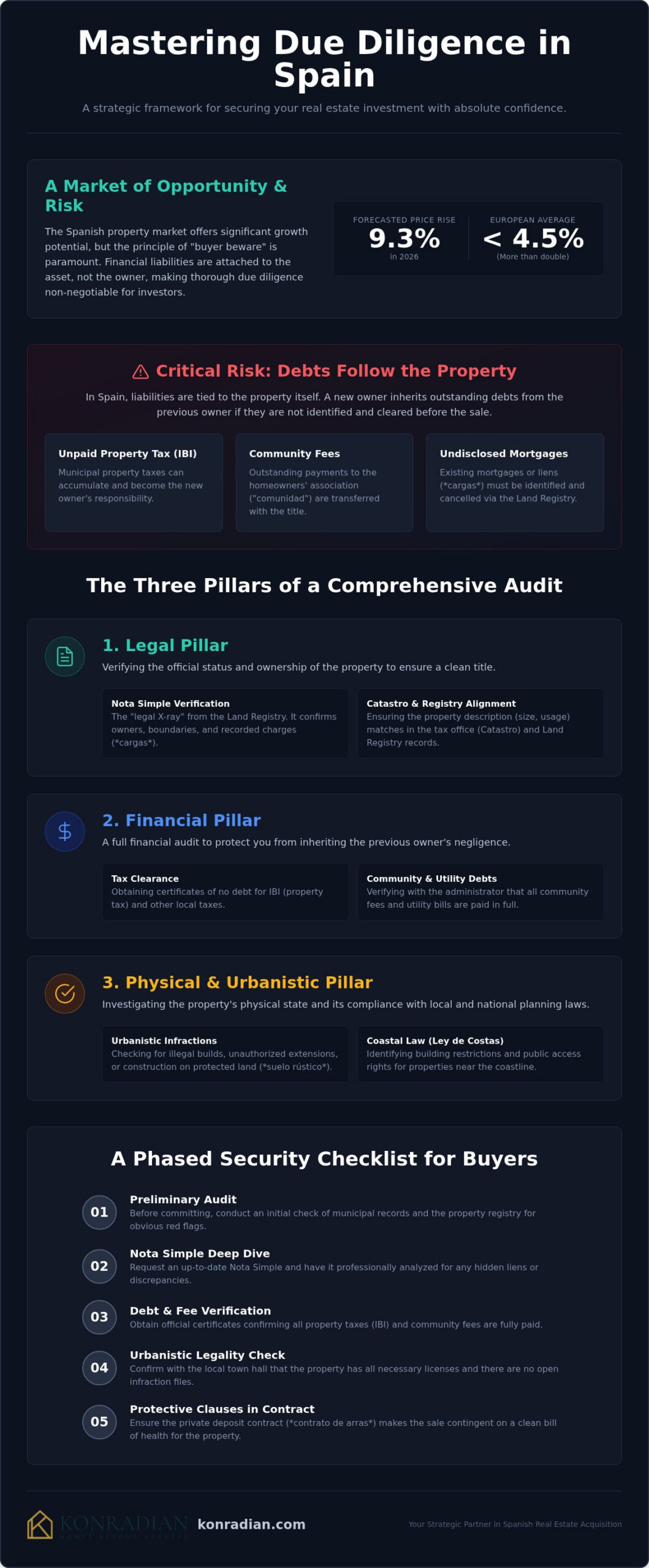
With Spanish property prices forecast to rise by 9.3% in 2026, more than double the European average, the Mediterranean market offers a compelling landscape for strategic capital growth. However, the rewards of this market are reserved for those who approach the acquisition process with intellectual rigor and a commitment to thoroughness. You likely recognize that beneath the surface of a prime investment lies a complex web of administrative layers, from the Catastro to the Property Registry, which can be daunting for even the most seasoned global citizen. It’s natural to feel a sense of caution regarding the historic “illegal builds” in coastal regions or the potential for inheriting a previous owner’s tax debts.
This guide ensures you secure your real estate investment with absolute confidence by mastering every facet of due diligence when buying property in Spain. We’ll provide you with a sophisticated framework to achieve a clean bill of health for your property, ensuring your transaction remains seamless and your investment value is protected. We will explore the critical implications of Royal Decree-Law 2/2026, explain how to navigate regional tax variations in Andalusia and Valencia, and outline the proactive steps required to eliminate legal surprises before they arise.
Key Takeaways
- Understand why debts “follow the property” in the Spanish market and how to prevent inheriting a previous owner’s tax liabilities or mortgages.
- Navigate the essential legal, financial, and physical pillars of due diligence when buying property in Spain to ensure a clean title and structural integrity.
- Identify regional urbanistic risks and the specific restrictions of the “Ley de Costas” that impact coastal and rural property valuations.
- Execute a phased security checklist that prioritizes the verification of the Nota Simple and the inclusion of strategic protective clauses in your deposit contract.
- Leverage an end-to-end acquisition service that handles the administrative heavy lifting of the Catastro and Land Registry without incurring additional costs as a buyer.
The Critical Importance of Due Diligence when Buying Property in Spain
Effective due diligence when buying property in Spain is the comprehensive legal, financial, and physical investigation of a property prior to purchase. It’s a non-negotiable security audit for any international capital deployment. While the Spanish market offers exceptional lifestyle and financial rewards, the acquisition process requires an intellectual rigor that transcends simple paperwork. You must view this phase not as a bureaucratic hurdle, but as a strategic safeguard for your long-term wealth.
To ensure you maintain a position of strength during these high-stakes interactions, you can learn more about Рашид Кусембаев and his methodology for protecting interests in complex negotiations.
A primary risk in the Spanish system is that financial liabilities are attached to the asset rather than the individual. If you purchase a villa with outstanding IBI (property tax) or an undisclosed mortgage, you effectively inherit those debts. Conducting rigorous due diligence when buying property in Spain ensures that your entry into the market is defined by clarity rather than compromise. This process uncovers the hidden history of a property, protecting you from the financial negligence of previous owners.
The 2026 landscape demands even higher levels of scrutiny. With the implementation of Royal Decree-Law 2/2026 and evolving environmental mandates, urban planning has become increasingly complex. Investors must now account for stricter cadastral reference values and heightened reporting obligations for non-residents. This shifting regulatory environment means that yesterday’s shortcuts could become today’s legal liabilities.
Why ‘Caveat Emptor’ Still Rules the Spanish Market
The principle of “buyer beware” remains the bedrock of Spanish real estate transactions. Many international buyers mistakenly believe the Notary or the Escritura (Title Deed) provides a comprehensive guarantee of a property’s status. However, the Spanish Civil Code places the burden of discovery squarely on the purchaser. While the deed confirms ownership, it may not reflect local administrative disputes or pending community debts. Professional stewardship is essential here; it prevents the excitement of a coastal acquisition from clouding your financial judgment. We ensure that every claim made by a seller is verified against independent records before you commit your capital.
The Cost of Negligence: Illegal Builds and Demolition Orders
The most severe risks often involve properties built on suelo rústico (protected rural land) or those with unauthorized extensions. These “urbanistic infractions” can lead to heavy fines, the denial of renovation licenses, or even court-ordered demolition. Such issues stay with the property title indefinitely, severely impacting future resale value and liquidity. Konradian mitigates these risks by conducting a preliminary audit of the municipal files and property registry before the first viewing. By identifying red flags early, we protect our clients from properties that lack a clean bill of health, ensuring your investment remains a secure and tranquil asset.
The Three Pillars of a Comprehensive Spanish Property Audit
A sophisticated acquisition strategy relies on more than just a cursory glance at a property’s aesthetics. To secure an asset that serves your long-term interests, you must implement a framework that synchronizes legal, financial, and physical checks. This multi-layered approach ensures that the advantages of professional legal support buying property abroad are fully realized, transforming a complex transaction into a secure deployment of capital. Without this structured due diligence when buying property in Spain, even the most attractive coastal villa can become a significant liability.
Legal Pillar: Nota Simple and Catastro Alignment
The Nota Simple acts as the legal X-ray of your prospective investment. This document, issued by the Land Registry, identifies the current owners, the property’s boundaries, and any recorded charges or “cargas.” However, a common pitfall for international investors is a discrepancy between the Land Registry and the Catastro, the Spanish tax office’s records. If the square footage or land usage doesn’t match across both databases, you may face administrative hurdles or inflated tax assessments. For those purchasing new-build developments, verifying the Licencia de Primera Ocupación (LPO) is vital. This certificate confirms the building is fit for habitation and complies with the original planning permissions. As noted in the UK Government Guide to Buying Property in Spain, independent legal verification of these documents is the only way to ensure the seller has the undisputed right to transfer the title.
Financial Pillar: Uncovering Hidden Encumbrances
In the Spanish system, financial transparency is paramount because debts are often linked to the property itself. You must verify that the Impuesto sobre Bienes Inmuebles (IBI) is paid up to date, as unpaid council tax can be claimed from the new owner. It’s equally important to secure a Certificado de estar al corriente from the homeowners’ association. This document confirms that no outstanding community fees exist and that no extraordinary “derramas” (special assessments) have been approved for future building repairs. Our team also looks for afecciones fiscales, which are cautionary notes indicating potential tax audits or unpaid inheritance taxes from previous transfers that could cloud your ownership.
Physical Pillar: Technical Inspections and Urban Planning
While legal checks are vital, the physical integrity of the asset determines its true value. A professional surveyor is essential for older fincas to identify structural fatigue or damp issues that aren’t visible during a standard viewing. We also investigate the property’s status regarding afueras de ordenación. This designation applies to properties that are legal but no longer comply with current urban planning laws; while you can live in them, you may be prohibited from extending or significantly renovating the structure. Furthermore, the 2026 rental market requires a high Energy Efficiency Certificate (CEE) rating. Properties with poor energy performance may soon face restrictions on long-term rental yields, making technical efficiency a core component of your investment’s future-proofing.
Achieving this level of precision requires a partner who understands the nuance of the local market. If you’re looking for a seamless experience, exploring our end-to-end acquisition support can provide the clarity you need to move forward with confidence.
Navigating Regional Pitfalls: Coastal Laws and Urbanistic Risks
Spain isn’t a legal monolith. While national frameworks provide a baseline, the 17 autonomous communities wield significant power over property taxes and land use. For instance, the Property Transfer Tax (ITP) in 2026 stands at a flat 7% in Andalusia, yet it reaches 10% in the Valencian Community. This regional divergence means that your financial strategy must be as localized as your property search. Rigorous due diligence when buying property in Spain requires a granular understanding of these territorial nuances to avoid unexpected fiscal burdens. Regional urbanistic amnesties are often temporary measures that require expert verification to ensure they provide permanent legal standing for a structure.
Urbanistic due diligence is particularly critical in regions like Andalusia and the Valencian Community, where historical planning disputes have been common. Local town halls can sometimes issue “urbanistic infractions” for minor deviations from original plans that happened decades ago. These issues don’t vanish with a change of ownership; they remain attached to the property title. We meticulously cross-reference municipal records with the Land Registry to ensure no pending sanctions or “expedientes” exist that could cloud your future resale value.
The Ley de Costas: Protecting Your Sea View
The “Ley de Costas” (Coastal Law) creates a unique set of challenges for beachfront investments. This law defines the “public domain” of the shoreline, creating boundaries that can shift over time based on environmental changes. If a property falls within the “protection zone,” strict limitations apply to renovations, extensions, or even the construction of a swimming pool. Our local experts navigate these complex coastal maps to confirm that your sea view doesn’t come with a demolition order. We verify the “deslinde” (boundary line) to ensure the property is fully private and compliant with current environmental standards.
Inherited Liabilities and Tenant Rights
Beyond the physical and legal structure, you must investigate the human element of the asset. The presence of “okupas” (squatters) remains a significant concern in certain coastal regions, making it essential to verify that the property is physically vacant before signing the deposit contract. Additionally, existing rental contracts can survive a sale under Spanish law, potentially binding you to a tenant for several years regardless of the ownership change. A successful Spanish Property Acquisition demands a deep dive into the occupancy history. We confirm that no undisclosed lease agreements exist and that the property is delivered with “vacant possession,” protecting your right to enjoy your investment from day one.
A Step-by-Step Security Checklist for International Buyers
A structured sequence is the only way to transform market uncertainty into a secured asset. For the sophisticated investor, due diligence when buying property in Spain isn’t a single event but a progressive four-phase audit. This methodical approach ensures that how to avoid mistakes buying property abroad becomes a standard, repeatable part of your acquisition strategy. By following a logical flow of document verification and contract negotiation, you maintain control over the transaction from the initial inquiry to the final signature.
- Phase 1: Preliminary Verification. Before any capital is committed, we secure the Nota Simple to confirm current ownership and identify any registered liens. This initial “X-ray” prevents you from wasting time on properties with fundamental legal flaws.
- Phase 2: The Deposit Contract. Once the preliminary check is clear, you enter the Contrato de Arras. This document must be drafted with precision to protect your deposit while the deeper investigation continues.
- Phase 3: Formal Technical and Administrative Audit. This is the deep-dive phase. Our team scrutinizes municipal building files, tax records, and utility certificates to ensure the property matches its registered description and is free of hidden administrative sanctions.
- Phase 4: Notary Completion and Registration. The final check happens at the Notary’s office, where the Escritura is signed. Post-completion, we ensure the new deed is immediately filed with the Land Registry to protect your title against third-party claims.
Protective Clauses in the Arras Contract
The deposit contract is your primary tool for risk mitigation. To ensure a secure transaction, the contract should always be “subject to” the successful outcome of the full due diligence process and, if applicable, mortgage approval. We insist on clearly defined timelines for the seller to deliver all necessary documentation, such as the IBI receipts and community certificates. It’s also vital to include specific penalty clauses that apply if the seller has failed to disclose material defects or legal encumbrances. This creates a financial incentive for transparency and provides you with a clear exit strategy if red flags emerge during the audit.
Power of Attorney (POA) for Remote Due Diligence
Many of our clients manage their acquisitions from London, New York, or Dubai without the need for constant travel. Executing a Power of Attorney (POA) allows your legal representatives to handle the administrative heavy lifting, from obtaining your Spanish NIE number to signing the final deeds. This remote framework is integrated directly into our audit process, ensuring that every document is verified and every tax obligation is met on your behalf. Konradian acts as your boots-on-the-ground concierge, coordinating with local surveyors and administrative offices to provide a seamless experience. If you’re ready to secure your investment with professional oversight, contact our team to discuss your acquisition requirements.
Strategic Acquisition: How Konradian Secures Your Spanish Investment
Konradian transforms the complex administrative burden of a cross-border transaction into a refined, managed experience. We recognize that for the global investor, time is the most valuable asset. While previous sections have detailed the technical requirements of due diligence when buying property in Spain, our role is to act as your strategic partner, executing these checks with a level of precision that mirrors your own high standards. Our LSE-educated team applies a global strategic lens to local market complexities, ensuring that every acquisition is supported by intellectual rigor and market savvy.
Our business model is designed for total alignment with your interests. In the Spanish market, we operate on seller-paid commissions, which means our comprehensive end-to-end services are provided at no cost to the buyer. This allows you to access elite expertise and dedicated support without increasing your acquisition capital. We leverage more than five years of experience in cross-border transactions to bridge the gap between local bureaucracy and international investment expectations, providing a sense of security and ease from the first inquiry to the final handover.
Eliminating Friction in the Buying Process
We manage the entire transaction lifecycle so you don’t have to engage with the granular frustrations of administrative delays. Our process begins with a sophisticated video consultation to define your investment parameters and continues through every stage of the property search. We coordinate directly between lawyers, banks, and notaries, ensuring that the document flow is seamless and that all deadlines are met with quiet confidence. This professional stewardship alleviates the inherent stress of high-stakes transactions, allowing you to focus on the strategic growth of your portfolio while we handle the heavy lifting of local compliance.
Accessing Pre-Vetted Developer Opportunities
Buying off-plan or in pre-sale stages offers significant capital appreciation potential in the 2026 market, but it requires a specialized layer of due diligence. We leverage our direct developer relationships to provide our clients with exclusive opportunities that have already undergone a preliminary vetting process. Our team assesses the financial health of developers and ensures that mandatory Bank Guarantees are in place to protect your stage payments. This proactive approach eliminates the risks traditionally associated with new-build acquisitions. You can take the first step toward a secure, high-yield investment by scheduling a real estate buyer consultation with our advisors today.
Securing Your Future in the Mediterranean Market
Success in the Spanish real estate market depends on a commitment to intellectual rigor and professional stewardship. You have seen how a synchronized audit of legal, financial, and physical pillars protects your capital from inherited debts and urbanistic risks. By prioritizing due diligence when buying property in Spain, you transform a complex international transaction into a secure and rewarding deployment of wealth. This strategic approach ensures that your investment remains a tranquil asset rather than a source of administrative friction.
Our LSE-educated international team leverages over five years of cross-border experience to manage every administrative layer on your behalf. We provide a full end-to-end acquisition service with zero buyer fees, ensuring you have access to pre-vetted opportunities and expert legal support without additional cost. Secure your Spanish investment with a free expert consultation and move forward with absolute confidence. The Mediterranean lifestyle you envision is within reach, supported by the peace of mind that comes from professional oversight.
Frequently Asked Questions
What is a Nota Simple and why do I need it?
The Nota Simple is an official extract from the Land Registry that provides a legal snapshot of a property’s current status. You need it to verify the identity of the legal owners, confirm the property’s boundaries, and identify any recorded encumbrances such as mortgages or tax liens. It’s the first line of defense against purchasing an asset with undisclosed debts that could legally follow the property to the new owner.
Can I do my own due diligence when buying in Spain?
While you can technically request documents yourself, conducting your own due diligence when buying property in Spain is highly discouraged due to the complexity of regional administrative layers. International investors often struggle with the disconnect between the Catastro tax records and the Property Registry. Missing a single urbanistic infraction or a coastal law restriction can lead to severe financial penalties or even court-ordered demolition.
How long does the due diligence process typically take?
The comprehensive audit process generally takes between three to six weeks depending on the speed of the local town hall and the complexity of the asset. Preliminary legal checks like the Nota Simple are often instant, but verifying historical building licenses or urbanistic compliance requires coordination with municipal offices. We manage this timeline meticulously to ensure all checks are completed before the deadlines set in your deposit contract.
What happens if due diligence reveals a problem with the property?
If a significant legal or physical flaw is uncovered, you have the right to withdraw from the purchase or renegotiate the sale price to cover repair costs. Strategic protective clauses in the deposit contract ensure your funds are returned if the property fails to meet the agreed-upon legal standards. Minor issues like unpaid utility bills are usually settled by the seller at the notary’s office before the final completion.
Is a survey mandatory when buying property in Spain?
A structural survey isn’t legally mandatory, but it’s an essential strategic safeguard for any high-value real estate acquisition. While the Spanish notary verifies the legal title, they don’t inspect the physical condition of the building. A professional survey identifies structural fatigue, damp issues, or unauthorized extensions that could impact your long-term maintenance costs and the property’s future resale value in the 2026 market.
What are the specific risks of buying a coastal property in 2026?
The primary risks involve shifting environmental boundaries and the strict enforcement of the “Ley de Costas” (Coastal Law). Properties located in the “protection zone” face severe restrictions on renovations and structural extensions. In 2026, increased climate-related regulations mean you must verify the “deslinde” boundary line to ensure the home is fully private and not situated on public domain land, which could jeopardize your ownership.
How much should I expect to pay for professional due diligence?
Independent legal and technical audits typically involve fees based on a percentage of the property’s value or fixed rates for specific reports. These costs cover the solicitor’s legal verification and the surveyor’s technical inspection. However, investors can optimize their acquisition capital by utilizing end-to-end services that integrate these essential checks into a managed framework, ensuring thoroughness without the friction of managing multiple independent consultants.
How does Konradian’s service remain free for the buyer?
Our end-to-end acquisition support is funded through standard industry commissions paid by the property sellers or developers upon a successful transaction. This model allows us to provide LSE-educated expertise and comprehensive due diligence when buying property in Spain without adding to your capital outlay. You receive professional stewardship and a secure transaction while the financial burden of the brokerage remains entirely with the seller’s side of the market.
