


What if the most significant hurdle to your next high-yield asset isn’t the $420,000 median home price, but the invisible web of FIRPTA regulations and complex LLC structuring? You likely recognize that Florida real estate investment offers a premier hedge against global currency volatility, yet the prospect of managing a 15% withholding or the March 2026 FinCEN reporting mandates can feel overwhelming from thousands of miles away. It’s natural to seek the security of USD-denominated growth while fearing the administrative weight of US tax and legal bureaucracy.
We’re here to ensure those complexities don’t stand between you and a high-performing portfolio. This reference guide provides a sophisticated framework designed for international investors seeking a seamless, hands-off acquisition experience. We’ll analyze the current 4.7-month housing inventory, the implications of Senate Bill 264 for foreign principals, and the strategic steps required to secure stable passive income and long-term capital appreciation with absolute professional confidence.
Key Takeaways
- Understand why Florida remains a premier destination for global capital in 2026, supported by a pro-growth regulatory environment and the significant advantage of no state income tax.
- Evaluate high-yield Florida real estate investment strategies by comparing the cash-flow potential of vacation rentals with the long-term stability of urban multifamily developments.
- Navigate the complexities of US tax and legal frameworks through the strategic use of an LLC to ensure both liability protection and optimized fiscal efficiency.
- Identify the specific regions within the “Golden Triangle” and the Gulf Coast that are projected to lead the state in capital appreciation and lifestyle equity.
- Learn how a sophisticated acquisition model provides direct access to off-market and pre-sale listings, ensuring a seamless and professionally managed investment journey.
The Florida Real Estate Market in 2026: A Global Perspective
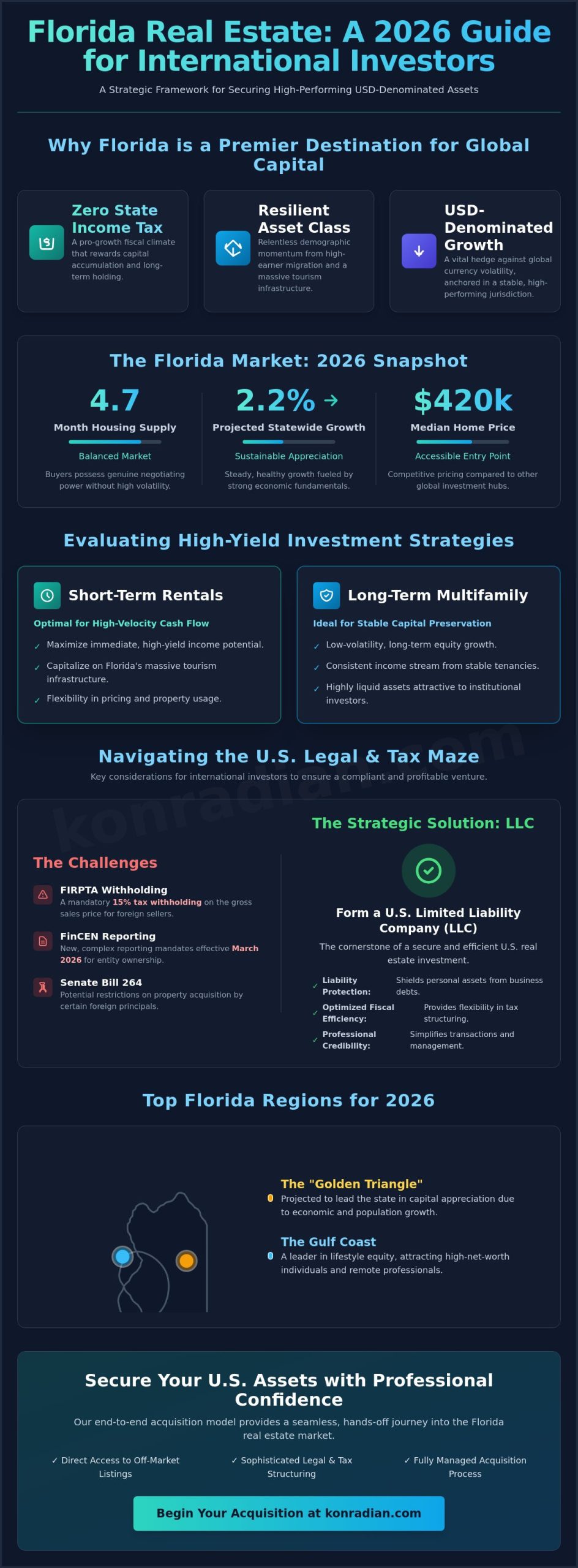
By mid-2026, Florida has solidified its position as a primary sanctuary for global capital flight and a destination of choice for domestic wealth migration. The state’s market has transitioned into a period of healthy rebalancing, moving away from the frantic pace of previous years toward a more sustainable, strategic growth environment. For the sophisticated investor, a Florida real estate investment represents more than just a residential acquisition; it’s a calculated move into a pro-business ecosystem. The state’s appeal is anchored by a 6% general sales tax and the notable absence of state income tax, creating a fiscal climate that rewards capital accumulation and long-term holding.
Success in this market requires an understanding of Florida’s economic fundamentals, which currently support a projected statewide home price growth of approximately 2.2% for 2026. This steady appreciation is fueled by a consistent influx of retirees and a maturing “remote work” culture that prioritizes lifestyle-rich environments. With housing inventory sitting at a 4.7-month supply as of April 2026, the market offers a balanced landscape where buyers possess genuine negotiating power without the volatility seen in less established regions. Holding USD-denominated assets in such a growth-oriented state provides a vital layer of diversification for any international portfolio.
Why Florida Real Estate Remains a Resilient Asset Class
The demographic momentum driving the state’s property values is relentless. High-earning professionals continue to exit high-tax jurisdictions like New York and California, seeking the stability and quality of life found in Florida’s key urban hubs. This migration isn’t merely a trend; it’s a structural shift that institutional investors have recognized by pouring significant capital into residential sectors. Furthermore, Florida’s massive tourism infrastructure acts as a permanent floor for rental demand. Whether through traditional long-term leases or strategic short-term stays, the sheer volume of visitors ensures that well-located properties rarely sit idle.
The 2026 Macro-Economic Context for International Buyers
For those looking across borders, the strength of the US Dollar against the Euro and GBP in 2026 makes Florida an attractive entry point for currency-hedged growth. If you’re currently evaluating your first cross-border transaction, reviewing a guide on how to start investing in property abroad can provide the necessary foundational strategy. Florida is particularly favored by European investors who value the state’s transparent legal framework and established property rights. It offers a seamless transition into the US market, combining familiar Western business practices with the unique growth dynamics of the American Sunbelt. This combination of security and potential makes it the premier choice for global citizens seeking to anchor their wealth in a stable, high-performing jurisdiction.
Evaluating High-Yield Strategies: Short-Term vs. Long-Term Rentals
Selecting the optimal vehicle for your Florida real estate investment in 2026 requires a nuanced understanding of how regional dynamics influence yield. While the market has entered a period of healthy rebalancing, a recent Forbes analysis of Florida’s housing market suggests that sustainability is now driven by local economic strength rather than speculative fervor. This shift favors investors who can distinguish between high-velocity cash flow and long-term equity growth. Your choice should be dictated by a clear framework: prioritize Short-Term Rentals for immediate, high-yield cash flow, or select Multifamily assets if your primary goal is liquidity and low-volatility capital preservation.
Modern investors are increasingly leveraging two primary entry points that dominate the 2026 landscape:
- Pre-sale Acquisitions: This strategy involves securing developer pricing before a project reaches the open market. It allows you to capture equity growth during the construction phase, often resulting in a lower cost basis upon completion.
- Build-to-Rent (BTR) Communities: These are purpose-built residential developments designed specifically for long-term tenants. This model provides institutional-grade stability and professional oversight, which is ideal for those seeking a hands-off experience.
The Short-Term Rental (STR) Powerhouse: Orlando and Beyond
The “Vacation Rental” model remains a cornerstone of the Florida economy, particularly in Disney-adjacent zones where tourism demand is inelastic. Navigating this sector requires strict adherence to local zoning ordinances. Many municipalities now restrict STR activities to specific “Short-Term Rental Zones” to protect residential character. For the remote owner, maintaining high occupancy rates demands a seamless management structure. Refining your strategy with an expert acquisition partner ensures you don’t get trapped by restrictive local codes or hidden management overhead.
Long-Term Residential Stability in Emerging Tech Hubs
Urban centers like Miami and Tampa are witnessing a transformation into what professionals call the “Silicon Coast.” This tech-driven migration creates robust demand for multifamily units and 12-month residential leases. These assets typically offer lower volatility than vacation rentals, providing a steady stream of USD-denominated income. This approach is often central to a broader real estate investment for expats strategy. It prioritizes capital preservation and consistent appreciation in pro-growth corridors where the housing supply remains relatively tight at a 4.7-month inventory level.
Navigating Legal and Tax Frameworks as an International Investor
The perceived complexity of the US fiscal system often acts as the greatest barrier to a Florida real estate investment. For the international investor, the intersection of federal law and state regulations can seem opaque. However, when approached with a sophisticated framework, these hurdles become manageable administrative steps. Central to this strategy is the establishment of a US Limited Liability Company (LLC). An LLC provides a vital layer of liability protection, ensuring that your personal assets remain separate from your property holdings. Beyond protection, it offers significant tax flexibility, allowing income to flow through to members while often simplifying the reporting process for non-residents.
Navigating the exit strategy is equally critical, particularly concerning the Foreign Investment in Real Property Tax Act (FIRPTA). As of 2026, the standard FIRPTA withholding rate remains 15% of the gross sales price for foreign sellers. Without proper planning, this can create a significant temporary liquidity drain. Managing this impact requires early coordination to apply for withholding certificates or ensure all tax obligations are met to expedite the refund of over-withheld funds. To participate in this system, every foreign owner must obtain an Individual Taxpayer Identification Number (ITIN). This serves as your official gateway for tax filings and is essential for opening US bank accounts or securing financing.
Structuring Your Florida Investment for Maximum Protection
A domestic LLC owned by a foreign entity provides a refined structure that balances operational anonymity with robust tax efficiency. Engaging professional legal counsel isn’t a luxury in cross-border transactions; it’s a fundamental requirement for risk mitigation. We recognize the weight of these decisions, which is why Konradian directly coordinates with specialized US tax attorneys to ensure every structure is tailored to the client’s specific home-country tax obligations.
Understanding US Tax Treaties with European Nations
Bilateral tax treaties between the US and various European nations are designed to prevent the burden of double taxation on rental income. By electing to treat property revenue as “Effectively Connected Income” (ECI), investors can deduct legitimate expenses, such as the high insurance costs currently averaging $11,759 for standard coverage, and mortgage interest from their gross receipts. This ensures you’re only taxed on net profit rather than gross revenue. Professional transaction support is non-negotiable here, as the nuances of treaty benefits require precise filing to maximize your USD-denominated growth.
Top Florida Regions for Targeted Capital Appreciation in 2026
Identifying the most lucrative corridors for a Florida real estate investment requires a move beyond general state statistics and into the “Golden Triangle.” This strategic region, formed by Orlando, Tampa, and the South Florida metropolitan area, remains the primary engine for capital appreciation in 2026. While the statewide median home price is $420,000, these specific hubs often command a premium due to their robust job markets and aggressive infrastructure development. Investors must weigh the prestige of beachfront condos against the practical yields of inland single-family homes. Coastal assets provide unmatched lifestyle equity, yet inland properties in “Path of Progress” areas often benefit from more manageable insurance costs and a steady influx of domestic residents seeking suburban tranquility.
Central Florida: The Infrastructure and Tourism Engine
The expansion of the Brightline high-speed rail has fundamentally altered the value proposition of Central Florida. By seamlessly connecting the South Florida wealth corridor to the Orlando tourism hub, the rail system has driven a surge in property values near its primary stations. Orlando remains the world’s most resilient short-term rental market, largely because its demand is independent of traditional economic cycles. We specialize in providing our clients with direct access to pre-sale opportunities in this region, allowing you to secure assets at developer pricing before they’re released to the open market. This early entry is essential for capturing equity growth during the construction phase.
The Gulf Coast: Sophistication and Equity Growth
For the “Global Citizen” buyer, the Gulf Coast markets of Naples and Sarasota offer a compelling alternative to the high-density energy of the Atlantic side. These regions are characterized by lower density, superior environmental stewardship, and a higher value proposition for high-net-worth individuals. If you’re currently comparing these markets to European coastal opportunities, our guide to Spanish Property Acquisition provides a useful benchmark for evaluating premium seaside assets. The Gulf Coast represents a sophisticated play for those seeking long-term capital preservation in a pro-growth state where the average effective property tax rate sits between 0.82% and 0.9%. To navigate these exclusive markets with precision, consult with our expert acquisition team to identify off-market listings that align with your specific portfolio goals.
Securing Your US Assets: The Konradian End-to-End Acquisition Model
Navigating a Florida real estate investment from abroad requires a partner who understands both the intellectual rigor of global finance and the practicalities of US property law. At Konradian, we position ourselves as a refined, LSE-educated advisor dedicated to handling the heavy lifting on your behalf. Our model is built on a “Zero-Cost” principle for the buyer. Because developer commissions fund our expert advice, you receive high-level strategic consulting and transaction oversight without an additional fee burden. This ensures our interests are aligned with your success as we secure USD-denominated assets that fit your long-term growth objectives.
We provide our clients with a “Direct Access” advantage that traditional listing sites cannot match. This includes viewing off-market opportunities and pre-sale listings before they reach the general public. By the time a property appears on a standard portal, the most lucrative pricing tiers are often already exhausted. Our network allows you to move with precision, securing prime units in the pro-growth corridors we’ve identified earlier. This exclusivity is a cornerstone of our service, ensuring you aren’t just buying property, but acquiring a strategic advantage.
The Concierge Journey: From Consultation to Key Handover
Our process is designed for the modern global citizen. It begins with a comprehensive video consultation to define your risk profile and liquidity needs. We then curate a bespoke portfolio selection, followed by rigorous legal due diligence to ensure every LLC structure and tax treaty benefit is correctly applied. The closing process is managed entirely remotely. You can finalize your acquisition from London, Paris, or Zurich with full legal and financial oversight. We handle the coordination with US tax attorneys and title agents, providing a level of tranquility rarely found in high-stakes international transactions. You’ll have a single point of contact for the entire journey, ensuring clarity and ease from start to finish.
Beyond the Transaction: Long-Term Partnership
Our relationship doesn’t end when the keys are handed over. We act as a proactive partner in building your multi-country property portfolio, identifying opportunities that balance your US holdings with European stability. For instance, many of our clients explore property investment Hungary options to capture growth within the EU while maintaining their Florida assets. Whether you’re expanding in the Sunbelt or diversifying across the Atlantic, we provide the intellectual authority and personalized care required for professional stewardship. We take the time to address potential concerns before they arise, creating a sense of thoroughness and reliability that lasts for years.
Ready to secure your position in the 2026 market? Book your free international investment consultation with Konradian and begin your journey toward a seamless, professionally managed property acquisition.
Strategizing for Long-Term Growth in the 2026 Market
The 2026 landscape offers a rare window of stability for the discerning global citizen. By navigating the current 4.7-month inventory and utilizing sophisticated LLC structures, you can transform a Florida real estate investment into a resilient, USD-denominated anchor for your portfolio. Success in this rebalanced environment depends on precision and proactive legal oversight, moving beyond simple property selection to embrace a comprehensive cross-border strategy. Whether you’re targeting the infrastructure-driven growth of the Golden Triangle or the high-equity lifestyle of the Gulf Coast, the focus must remain on sustainable, long-term yield.
Our LSE-educated strategic advisors are here to manage the heavy lifting of your acquisition. We leverage direct relationships with top-tier Florida developers to grant you exclusive access to off-market listings, all within an end-to-end support model that carries zero additional cost to the buyer. You don’t have to navigate US bureaucracy alone. Secure your Florida investment future with a free Konradian consultation and step into a seamless, professionally stewarded experience. Your path to transatlantic wealth preservation is ready when you are.
Frequently Asked Questions
Is Florida real estate a good investment for foreigners in 2026?
Florida real estate investment remains a compelling choice in 2026 due to the state’s healthy market rebalancing and projected 2.2% price growth. The 4.7-month housing inventory provides a stable environment for international buyers seeking a USD-denominated asset. While insurance costs are elevated, the absence of state income tax and a pro-growth regulatory framework create a robust foundation for long-term capital preservation.
Can I buy property in Florida without a US visa or residency?
You don’t need a US visa or residency to acquire property in Florida. The US legal system generally encourages foreign investment, though you must comply with Senate Bill 264. This law restricts purchases by foreign principals from specific countries, such as China and Russia, particularly near critical infrastructure. For most international investors, the process is straightforward and requires only a valid passport and an ITIN.
What is FIRPTA and how does it affect my Florida property sale?
FIRPTA stands for the Foreign Investment in Real Property Tax Act, which requires a 15% withholding of the gross sales price when a foreign owner sells US property. This isn’t a final tax but a mechanism to ensure the IRS receives any capital gains tax owed. We help our clients manage this by coordinating with tax professionals to apply for withholding certificates, which can significantly reduce the amount held at closing.
Do I need to travel to Florida to close on a real estate investment?
You aren’t required to travel to the United States to finalize your transaction. Remote closings are a standard part of our end-to-end acquisition model. We coordinate with title companies and mobile notaries to facilitate a “mail-away” closing, allowing you to sign all necessary legal documents from your home country. This ensures a seamless, hands-off experience while maintaining full legal and financial oversight of your new asset.
How much are the property taxes for non-residents in Florida?
Property taxes in Florida are based on the assessed value of the home, with average effective rates typically ranging from 0.82% to 0.9%. While residents enjoy a lower cap on assessment increases, non-homestead properties are protected by a 10% annual cap on assessed value growth. This provides a level of predictability for your carrying costs, even in high-demand regions like Orlando or the Gulf Coast where values appreciate steadily.
What is the best way to structure a Florida property purchase for a European investor?
European investors often find that a US Limited Liability Company (LLC) offers the most efficient structure for liability protection and tax management. This entity acts as a shield for your personal assets while allowing you to benefit from bilateral tax treaties that prevent double taxation. By treating rental revenue as effectively connected income, you can deduct legitimate expenses, ensuring your USD-denominated growth is optimized for your home-country tax obligations.
Can I get a US mortgage as a foreign national for a Florida investment?
Foreign national mortgage programs are readily available for international investors navigating real estate investment for expats who are seeking to leverage their Florida real estate investment. While requirements vary, many lenders offer 30-year fixed rates, which were recently verified at 6.375% as of mid-June 2026. These loans typically require a higher down payment, often 30% to 40%, but they provide a sophisticated way to manage capital while building a high-yield portfolio in a stable jurisdiction.
How does Konradian earn its commission if the service is free for the buyer?
Our service is provided at zero additional cost to the buyer because our fees are covered through developer commissions. In the US market, it’s standard practice for the seller or developer to pay the acquisition advisor’s fee. This allows us to act as your dedicated concierge and strategic consultant, providing elite expertise and direct access to off-market listings, without adding an administrative fee burden to your investment capital.
