


A Spanish mortgage isn’t a bureaucratic hurdle to be cleared. It’s a sophisticated capital allocation tool designed to preserve your global liquidity while you secure a piece of the Mediterranean. You likely recognize that getting a mortgage in Spain as a non-resident often feels like a journey through an opaque financial labyrinth. It’s natural to feel concerned about being overcharged on interest rates or overwhelmed by the complexity of cross-border applications, especially as the 12-month Euribor reached 2.855% in July 2026.
This guide provides a refined framework for securing high-leverage financing, ensuring your loan aligns with your broader investment portfolio. We’ll explore the current shift toward mixed-rate products for acquisitions over €500,000 and the 70% loan-to-value caps currently defining the market. You’ll learn how professional stewardship transforms an eight-week process into a seamless transition to ownership. Because our brokerage services are free for the buyer in Spain, you gain access to LSE-educated strategic advice without additional overhead. We’ll show you how to manage the 2026 lending environment with quiet confidence and absolute precision.
Key Takeaways
- Master the 2026 lending landscape where Spanish banks prioritize financial reliability through stricter Debt-to-Income (DTI) ratios capped at 35%.
- Understand the specific eligibility criteria for getting a mortgage in Spain as a non-resident, including the requirement to finalize all payments by age 75.
- Evaluate the strategic advantages of mixed-rate products, which have become the primary vehicle for high-value acquisitions following recent policy shifts in the banking sector.
- Navigate the eight-to-twelve-week application timeline with precision, from securing a ‘Pre-Aprobación’ to the mandatory ten-day legal reflection period.
- Leverage professional stewardship to secure competitive rates and ensure your Spanish financing integrates seamlessly with your broader global investment strategy.
The Landscape of Non-Resident Lending in Spain for 2026
Spain’s real estate sector has entered 2026 with remarkable resilience. By March 2026, the number of mortgages on dwellings rose by 9% year-on-year, reaching 46,661 according to INE data. This growth isn’t accidental. It reflects a market that has matured into a sophisticated safe haven for international capital. Getting a mortgage in Spain as a non-resident serves as the primary vehicle for this capital entry, allowing investors to hedge against inflation while securing prime Mediterranean assets. The Bank of Spain maintains a vigilant role in this ecosystem, regulating international capital flows to ensure systemic stability. This oversight provides a layer of security that global investors find deeply reassuring, even as lending criteria become more selective.
Understanding Non-Resident Status
Spanish lenders distinguish between residents and non-residents based on tax residency rather than nationality. You’re typically classified as a non-resident if you spend fewer than 183 days per year in the country and your main economic interests lie elsewhere. Your country of origin remains a critical factor; banks assess the fiscal transparency and credit reporting standards of your home nation to determine eligibility. For the sophisticated investor, this status offers a strategic advantage. It allows for the diversification of a global portfolio without the immediate tax implications of Spanish residency. By utilizing local leverage, you preserve your liquidity for other high-yield opportunities while your Spanish asset appreciates.
2026 Market Trends and Interest Rates
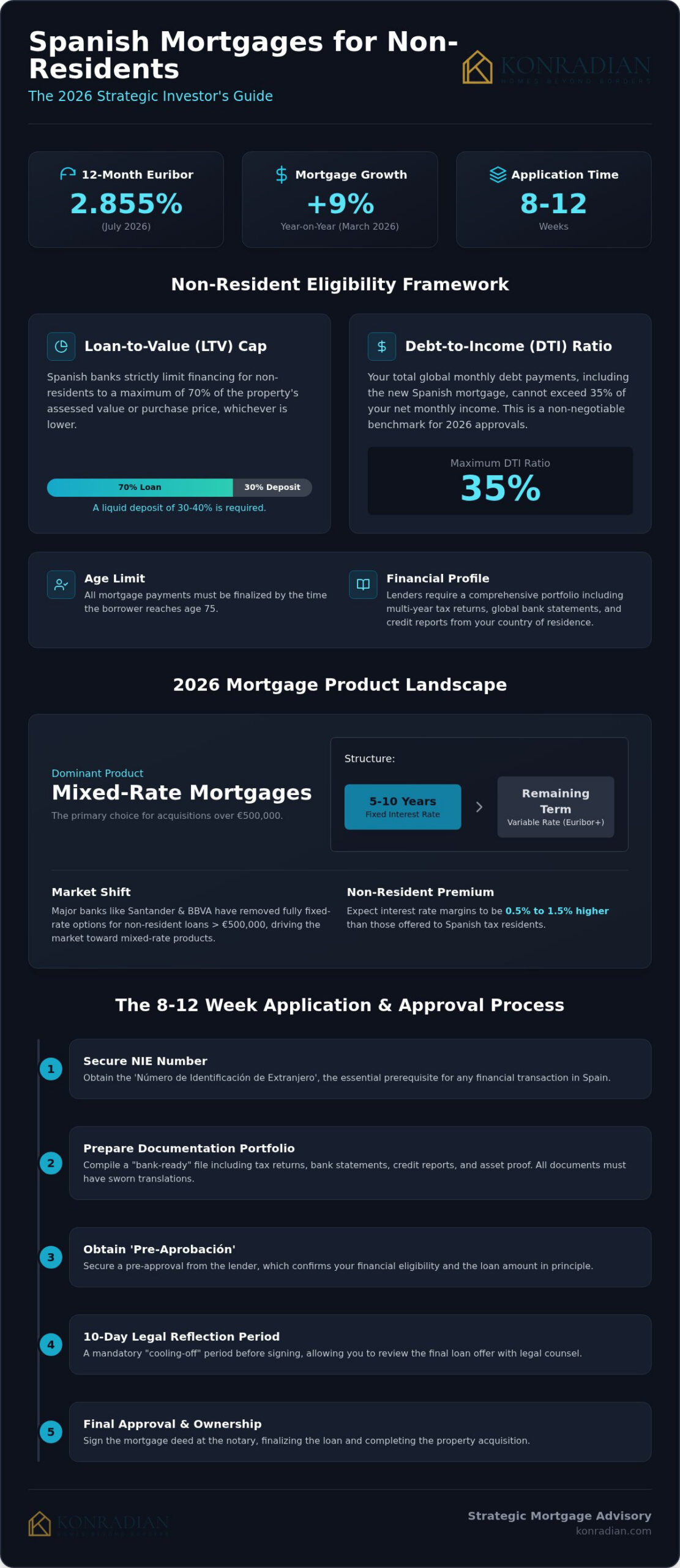
The 2026 financial climate is defined by a stabilizing but elevated Euribor, which reached 2.855% in July 2026. This rate serves as the benchmark for nearly all Spanish lending products. In January 2026, major institutions including Santander and BBVA shifted their strategies, removing fully fixed-rate options for non-resident loans exceeding €500,000. This move has pushed the market toward mixed-rate products, which offer a fixed period of five to ten years before transitioning to variable terms. While understanding mortgage basics is essential for any buyer, international clients face a specific “non-resident premium” where interest margins are typically 0.5% to 1.5% higher than those offered to tax residents. 2026 is a pivotal year for locking in financing. With the average mortgage amount sitting at €174,132 as of March 2026, the window for securing competitive leverage in a high-demand market requires precise timing and expert stewardship.
Eligibility and Financial Requirements for International Borrowers
Getting a mortgage in Spain as a non-resident requires a fundamental shift in financial perspective compared to domestic lending. While residents often secure 80% financing, international borrowers should expect a Loan-to-Value (LTV) cap strictly between 60% and 70%. This necessitates a liquid deposit of 30% to 40% of the property’s assessed value. Spanish banks also prioritize financial reliability through a rigid Debt-to-Income (DTI) ratio. Your global monthly debt obligations, including the proposed Spanish loan, must not exceed 35% of your net monthly income. This calculation is a non-negotiable benchmark for 2026 approvals, ensuring that your international investment remains sustainable and secure.
The Sophisticated Documentation Portfolio
In 2026, Anti-Money Laundering (AML) and Know Your Customer (KYC) protocols have reached a new level of rigor. Lenders look far beyond basic pay slips, requiring a comprehensive audit of your global asset base. You’ll need to provide multi-year tax returns, detailed bank statements, and official credit reports from your country of residence. All documents not in Spanish require sworn translation and legalization. This is where professional stewardship proves its worth. Preparing a “bank-ready” application ensures that your financial narrative is clear and compelling to Spanish underwriters. Reviewing official guidance on property acquisition provides a helpful baseline for the legal hurdles involved in getting a mortgage in Spain as a non-resident.
The NIE and Banking Prerequisites
The Número de Identificación de Extranjero (NIE) is the essential prerequisite for every financial action in Spain. You cannot process a mortgage offer, open a bank account, or register a property without this identification number. Securing it early in the process is vital, as it often dictates the pace of the entire transaction. Choosing between digital-first banking and traditional relationship banking is another strategic decision. While apps offer convenience, traditional banks often provide the nuanced underwriting required for high-leverage international loans. Konradian facilitates these critical banking introductions as part of our Spanish property acquisition support. We ensure you’re positioned with lenders who value international clients, managing the bureaucratic complexities so you can maintain a focus on your broader investment goals.
Comparing Mortgage Products: Fixed, Variable, and Mixed Rates
Choosing the right financial structure is a critical step when getting a mortgage in Spain as a non-resident. In the 2026 climate, the choice between fixed, variable, and mixed rates isn’t just about the monthly payment. It’s a strategic decision regarding interest rate risk and capital mobility. Fixed-rate mortgages offer the security of a constant payment, yet they have become increasingly scarce for high-value transactions. Since January 2026, major Spanish banks have largely discontinued fully fixed options for loans exceeding €500,000, nudging international investors toward more dynamic products. This shift reflects a cautious lending environment where banks prioritize flexibility over long-term rate locks for large-scale international capital.
Fixed vs. Variable: A Strategic Comparison
A 15-year or 25-year fixed term provides long-term certainty, which is ideal for investors prioritizing cash flow stability. However, variable rates track the 12-month Euribor, which stood at 2.855% in July 2026. For a global investor with a shorter exit strategy, a variable rate might offer lower initial costs and greater flexibility. In Spain, early repayment penalties for variable rate mortgages are capped at 0.25% for the first three years and zero thereafter, while fixed rates can reach 2% during the first decade. This difference is vital if you plan to refinance or sell the asset within a few years. Mixed mortgages have emerged as the 2026 favorite, providing a fixed rate for the initial five to ten years followed by a variable spread. This hybrid model offers a protective buffer while allowing you to benefit from potential future rate decreases.
Modern consumer protections have largely eliminated the opaque “Cláusula Suelo” or floor clauses that once hindered international buyers. Current regulations ensure that variable rates actually drop when the Euribor falls, providing a level of transparency that reinforces the security of your investment. This regulatory oversight allows you to manage your Spanish liabilities with the same precision you apply to your domestic portfolio.
The Impact of Linked Products (Bonificaciones)
Spanish lenders frequently offer “bonified” rates, where the interest margin is reduced if you purchase additional products like life or home insurance directly from the bank. While these discounts look attractive on paper, they can significantly impact your Annual Percentage Rate (TAE). You must evaluate whether the cost of these often-premium insurance products outweighs the interest savings. Seeking independent legal support buying property abroad is essential when reviewing these complex bank contracts. Professional stewardship ensures that getting a mortgage in Spain as a non-resident remains a profitable component of your wider portfolio, rather than a source of hidden costs.
The Step-by-Step Application and Approval Process
The journey of getting a mortgage in Spain as a non-resident is a methodical process that typically spans eight to twelve weeks. It requires a disciplined approach to timing and documentation. The first critical milestone is the ‘Pre-Aprobación’, a decision in principle that establishes your borrowing capacity before you commit to a specific property. This step is essential for global investors who need to move with speed once a prime asset is identified. Without this preliminary approval, you risk losing pre-sale access to high-demand developments.
Once your property is secured, the bank issues the FEIN (Ficha Europea de Información Normalizada) and the FiAE (Ficha de Advertencias Estandarizadas). These documents provide the binding terms of your loan. Spanish law mandates a ten-day reflection period following the receipt of these files. During this window, you must visit a Notary for a mandatory transparency meeting to verify your understanding of the contract. The process culminates in the signing of the ‘Escritura de Préstamo Hipotecario’ at the Notary, which occurs simultaneously with the transfer of the property title.
The Valuation (Tasación) Hurdle
The ‘Tasación’ is often the most sensitive stage of the application. Spanish banks lend against the lower of the purchase price or the independent appraisal value. If the valuation falls short of the market price, your required deposit will increase unexpectedly. In high-demand regions like the Costa del Sol, market prices can move faster than conservative bank appraisals. Navigating this discrepancy requires professional stewardship to ensure the appraiser has access to relevant comparable data, protecting your intended leverage and capital allocation.
Legal Formalities and the Notary
The Notary serves as a neutral guardian of the transaction’s legality. For international buyers, attending these appointments in person isn’t always practical. You can utilize a Power of Attorney (POA) to allow your legal representative to sign the mortgage and title deeds on your behalf. This ensures the transaction proceeds without delay, regardless of your physical location. Following the signing, the mortgage must be formally registered at the Spanish Land Registry to finalize the lender’s security. This final administrative step completes the legal framework of your acquisition.
To ensure your financing is secured with the precision required for high-stakes transactions, we invite you to explore our Spanish property acquisition services, where we manage these banking relationships on your behalf.
The Managed Acquisition Model: Integrating Finance and Sourcing
Konradian’s approach to the Spanish market is built on the principle of integrated stewardship. We recognize that securing the right asset is only half the task; the other half is the strategic structuring of the debt. Because our brokerage services are free for the buyer, you gain access to high-level financial advisory without increasing your acquisition costs. This seller-paid model ensures that our LSE-educated team is fully aligned with your interests, focusing on securing the most competitive terms available in the 2026 market. Getting a mortgage in Spain as a non-resident becomes a streamlined component of a larger investment strategy rather than a fragmented hurdle.
Our team leverages over five years of international property expertise to negotiate directly with Spanish lenders. We don’t just present documents; we frame your global financial profile in a way that resonates with local underwriting standards. This proactive management often leads to superior interest margins and more favorable loan conditions than a buyer might achieve independently. By integrating the sourcing and financing phases, we ensure that your loan approval is synchronized with the property’s legal status, preventing the delays that often plague cross-border transactions.
Leveraging Developer Relationships
Direct relationships with Spanish developers provide a unique advantage for financed buyers. In some cases, investors can utilize ‘subrogation’, which involves taking over the developer’s existing construction loan on a specific unit. This can simplify the process of getting a mortgage in Spain as a non-resident by utilizing a pre-approved credit line already attached to the property. We conduct rigorous due diligence on every developer’s financial health, ensuring that your mortgage is tied to a stable and reputable project. This ‘first-look’ access allows our clients to secure high-yield units in pre-sale phases, often before they’re listed on public portals.
Sophisticated Stewardship for the Global Citizen
We move beyond the transactional nature of typical real estate sales to provide a refined, intellectual partnership. Our goal is to alleviate the stress of cross-border finance by managing every detail from the initial consultation to the final handover at the Notary. This end-to-end oversight is designed for the cosmopolitan investor who values their time as much as their capital. If you’re looking to transition from a single holiday home to a high-yield property portfolio, you need a partner who understands the micro-level nuances of Spanish lending and the macro-level trends of global real estate. We act as your protective and proactive partner, handling the heavy lifting so you can focus on the rewards of your investment.
To ensure your financing is structured for maximum long-term benefit, we invite you to book a free consultation with Konradian to discuss your 2026 financing strategy.
Mastering Your Spanish Acquisition Strategy
Navigating the 2026 lending environment requires more than just a search for the lowest rate. It demands a strategic understanding of 70% LTV limits, the nuanced shift toward mixed-rate products, and rigid 35% debt-to-income benchmarks. Successfully getting a mortgage in Spain as a non-resident is a process of precision. It moves from initial pre-approval through to the mandatory notary transparency meeting. By aligning your financing with your broader global portfolio, you transform a cross-border transaction into a stable, high-yield asset.
Konradian provides the intellectual authority and personalized care needed to manage this complexity. Our team of LSE-educated advisors leverages over five years of international brokerage experience to secure superior terms. We offer exclusive direct developer access and ensure your application is bank-ready from day one. Secure your Spanish investment with Konradian’s expert financial advisory, at no cost to you. With the right stewardship, your Mediterranean lifestyle and investment goals are well within reach. We’re here to ensure your journey to ownership is as seamless as the lifestyle that awaits you.
Frequently Asked Questions
Can I get a mortgage in Spain as a non-resident in 2026?
Yes, you can secure financing as a non-resident in 2026. Spanish lenders maintain a strong appetite for international capital, provided you meet their specific solvency criteria. While the process involves distinct regulatory hurdles, getting a mortgage in Spain as a non-resident is a standard procedure for global investors. Banks typically require proof of stable foreign income and a clear credit history from your home country to approve the application.
What is the maximum LTV (Loan-to-Value) for non-residents in Spain?
Non-residents are generally capped at a Loan-to-Value ratio of 60% to 70% of the property’s appraised value. This means you must provide a cash deposit of at least 30% to 40% plus closing costs. Spanish banks are more conservative with international borrowers to mitigate the risk associated with cross-border assets. We recommend preparing for a 70% limit to ensure your capital allocation strategy remains robust throughout the acquisition.
Do I need to be in Spain in person to apply for a mortgage?
You don’t need to be physically present in Spain for the entire application process. While a mandatory 10-day reflection period exists, you can manage the signing through a Power of Attorney (POA). This legal instrument allows your representative to handle the notary appointments and land registry filings on your behalf. Our team frequently coordinates these remote transactions to provide a seamless experience for clients managing global portfolios.
What are the typical interest rates for non-resident mortgages in 2026?
In 2026, interest rates are largely influenced by the 12-month Euribor, which reached 2.855% in July. Non-residents typically pay a premium of 0.5% to 1.5% above the rates offered to tax residents. Most lenders have shifted toward mixed-rate products, offering a fixed period followed by a variable margin. Securing a competitive rate requires professional stewardship to navigate the specific margins set by major Spanish institutions for international borrowers.
What documents do Spanish banks require from international borrowers?
Banks require a comprehensive documentation portfolio to satisfy 2026 AML and KYC regulations. Essential documents include:
- Your foreign identification number (NIE).
- Last three months of pay slips or business accounts.
- Tax returns from the previous two years.
- A credit report from your country of residence.
- Six months of bank statements showing the source of your deposit.
All foreign documents must be officially translated into Spanish.
How long does the mortgage approval process take in Spain?
The approval process for getting a mortgage in Spain as a non-resident typically takes between eight and twelve weeks. This timeline accounts for obtaining your NIE, conducting the independent property valuation, and the mandatory 10-day cooling-off period required by law. Strategic preparation and early banking introductions can help prevent delays, ensuring your financing is ready in time for the scheduled property handover at the notary.
Are there any hidden costs or taxes when taking out a Spanish mortgage?
Beyond the interest, you should account for valuation fees, notary costs, and land registry fees. While the bank now covers the mortgage tax in many cases, you’ll still face property transfer taxes or VAT ranging from 7% to 10% depending on the region. There are also arrangement fees and potential early repayment penalties. We provide a transparent breakdown of these costs during our initial consultation to ensure complete financial clarity.
Can I get a mortgage for an off-plan or pre-sale property in Spain?
Yes, financing off-plan properties is a common practice in the Spanish market. You can often secure a mortgage offer during the construction phase, though the final funds are only released upon completion and title deed signing. In some instances, you may be able to subrogate the developer’s existing construction loan, potentially simplifying the approval process. Our direct relationships with developers provide unique insights into these financing structures for pre-sale acquisitions.
