


If you don’t pay your buyer’s agent directly, who does, and could that shape the advice you receive? Understanding how no-fee real estate buyer agents work starts with one important distinction: “no-fee” describes who pays the agent under an agreement. It doesn’t mean the agent works without compensation or that their interests automatically align with yours.
It’s reasonable to want clear answers before committing to representation, especially because commission arrangements and buyer services vary by country. In some markets, the seller or developer pays the agent after a successful transaction. In others, the buyer may pay for property sourcing and acquisition support. Confirm the details for your market and property before proceeding.
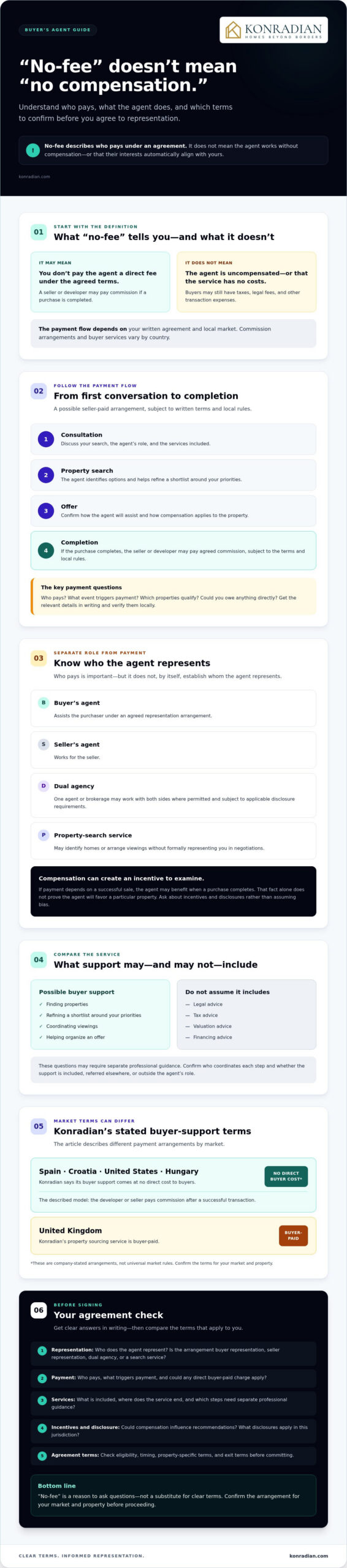
This guide explains how payment flows work, when an agent may earn commission, and what support an arrangement can include. You’ll also find practical questions to ask about representation, potential conflicts, fees, and agreement terms. For example, Konradian says its buyer support in Spain, Croatia, the United States, and Hungary comes at no direct cost to buyers, while its UK property sourcing service is buyer-paid. Use these distinctions to compare services and confirm the terms that apply to you.
Key Takeaways
- Learn how no-fee real estate buyer agents work, including what “no-fee” does and doesn’t tell you about compensation.
- Trace the payment process from your first conversation with an agent through a completed purchase, and identify which terms to confirm.
- Assess whether an agent’s compensation could affect recommendations without assuming seller payment automatically means bias.
- Use a practical checklist to compare representation, included services, possible direct charges, and exit terms before signing.
- See how Konradian’s stated terms differ by market, including buyer-paid UK property sourcing.
What does a no-fee real estate buyer agent actually mean?
“No-fee” usually means the buyer doesn’t pay the agent a direct fee under the agreed terms. It doesn’t mean the agent works without compensation. A seller or developer may pay commission if a purchase is completed, while other arrangements may involve a fee paid by the buyer. The payment flow depends on the agreement and local market.
To understand how no-fee real estate buyer agents work, clarify whom the agent represents. A buyer’s agent assists the purchaser under an agreed representation arrangement. A seller’s agent works for the seller. In dual agency, one agent or brokerage may work with both sides, where permitted and subject to applicable disclosure requirements. A property-search service, by contrast, might identify homes or arrange viewings without formally representing you in negotiations. Roles and disclosure rules differ across jurisdictions, so ask the agent to explain the arrangement in plain language.
What does the buyer agent do for the buyer?
Depending on the agreement, support may include finding properties, refining a shortlist around your priorities, coordinating viewings, and helping organize an offer. Before you start a search, ask what the agent will handle and where the service ends. A real estate broker may be compensated through commission, as described in this Real estate broker overview, but that general model doesn’t establish the terms of your own agreement.
Brokerage support isn’t automatically legal, tax, valuation, or financing advice. Those questions may require separate professional guidance. Confirm who coordinates each step and whether that support is included, referred elsewhere, or outside the agent’s role.
Does no-fee mean the service has no cost?
No direct agent invoice doesn’t mean a purchase has no costs. Buyers may still need to budget for taxes, legal fees, and other transaction expenses, which vary by property and jurisdiction. A seller-paid commission may also form part of the transaction’s broader economics, but don’t assume it affects the buyer’s price in one predictable way.
Before proceeding, check the written terms for the services included, how and when compensation is earned, and whether any buyer-paid charges could apply. The scope and cost structure depend on both the agreement and the market. “No-fee” is a reason to ask questions, not a substitute for clear terms.
How seller-paid buyer-agent commissions work from introduction to closing
A seller-paid arrangement connects the agent’s compensation to a property transaction, but the details should be clear before the search begins. In the model Konradian describes for buyers in Spain, Croatia, the United States, and Hungary, the developer or seller pays commission after a successful transaction. That is a company-specific description, not a universal rule. Its UK property sourcing service is buyer-paid.
The payment sequence can be straightforward, but confirm the terms at each stage. A typical outline may look like this:
- Consultation: Discuss your search, the agent’s role, and the services included.
- Property search: The agent identifies options and helps refine a shortlist.
- Offer: Confirm how the agent will assist and how compensation is arranged for the property you’re considering.
- Completion: If the purchase completes, the seller or developer may pay the agreed commission, subject to the written terms and applicable local rules.
This sequence describes a possible structure, not a guaranteed payment timetable. For a general overview of how real estate agent commissions work, see Forbes Advisor. For your own transaction, ask who pays, what event triggers payment, and whether the terms change by property or market. Commission rates, eligibility, and payment timing aren’t universal. Get the relevant details in writing and verify them locally.
Who pays the commission, and when?
Ask the agent to identify the payer and payment trigger in plain language. “The seller pays” is incomplete if it doesn’t say whether commission is due only after completion, which properties qualify, or whether you could owe anything directly. Seller or developer payment may mean you don’t receive a buyer invoice, but it doesn’t by itself establish whom the agent represents.
There’s also an incentive to examine: if compensation depends on a successful sale, the agent may benefit when a purchase completes. That fact alone doesn’t prove the agent will favor a particular property or price. Ask how the agent is paid, whether compensation varies between options, and how they’ll support your decision if you choose not to proceed.
What happens if the purchase does not complete?
Don’t assume a failed transaction automatically means either no fee or a fee. Check the signed terms for what happens if an offer is withdrawn, a sale falls through, or you stop working with the agent. Review any exclusivity, deposit, cancellation, or withdrawal provisions with an appropriate local professional where relevant. Your obligations depend on the agreement and applicable rules.
For more information about the services and market-specific terms involved, review Konradian’s international property support.
Is a no-fee buyer agent aligned with your interests?
Payment source is one part of representation, not a verdict on an agent’s advice. A seller-paid commission may create an incentive to complete a sale, and compensation can potentially differ between properties or sellers. But seller payment alone doesn’t prove an agent is biased. Likewise, a buyer-paid fee doesn’t guarantee that advice is high quality or aligned with your priorities.
To understand how no-fee real estate buyer agents work in practice, look beyond the label. Ask the agent to explain their role, how they’re compensated, which properties they can show, and whether their payment changes depending on the property you choose. Request clear answers in writing, especially if the agent has a relationship with a seller or developer.
What potential conflicts should buyers ask about?
Start with the relationship: does the agent represent you, the seller, a developer, or more than one party? Then ask whether compensation varies across the properties you’re considering, whether the agent can present alternatives beyond their existing listings or relationships, and how they’ll explain options that may not generate commission. Agency terminology and disclosure requirements vary by jurisdiction, so verify local rules rather than assuming one country’s standards apply everywhere.
How does a no-fee model compare with buyer-paid advice?
Compare the terms, not just who makes the payment. For either model, establish the service scope, representation, compensation, and your obligations before signing. A buyer-paid arrangement makes the payment source more direct, but doesn’t establish the quality or breadth of the service. Seller-paid terms may mean no direct agent invoice under the agreement, but they don’t confirm buyer-first representation on their own.
| What to compare | Seller-paid model | Buyer-paid model |
|---|---|---|
| Payer | Seller or developer may pay under agreed terms. | Buyer pays under agreed terms. |
| Scope | Confirm which search, offer, and transaction support is included. | Confirm which services the buyer’s fee covers. |
| Disclosure | Ask about relationships and any differences in compensation. | Ask how the fee is structured and whether other compensation applies. |
| Buyer obligations | Check for direct charges, exclusivity, and termination terms. | Check payment triggers, exclusivity, and termination terms. |
Neither arrangement is automatically cheaper or better. Evaluate the written agreement, the agent’s relevant experience, the clarity of their disclosures, and whether they can explain how they’ll help you compare alternatives. If an answer about representation or compensation stays vague, pause and ask for clarification before proceeding.
How to evaluate a no-fee real estate buyer agent before signing
Before you commit, look for precise written terms rather than relying on a “no-fee” label. The agreement should explain what the agent will do, how compensation works, and which responsibilities remain yours or belong to other professionals. This is especially useful when comparing agents or buying across borders.
Questions to ask about fees, scope, and representation
Ask who the agent represents, who pays, and what event makes compensation due. Request a written description of included services, any direct charges, and how you or the agent can end the arrangement. Clarify whether the terms apply if you purchase a property you found independently. Ask which tasks the agent coordinates and which require separate legal, tax, financing, or due-diligence advice.
Use this checklist before signing:
- Compensation: Who pays, when is it earned, and could it vary by property or seller?
- Representation: Does the agent act for you, another party, or more than one party?
- Scope and exclusions: What work is included, and what requires a separate professional or additional agreement?
- Property access: Can the agent help you assess relevant options beyond properties they already know or source?
- Ending the agreement: What are the notice, exclusivity, and termination terms?
- Communication: Who is your contact, how will updates be shared, and how will questions be handled?
Evaluate the agent’s knowledge of the specific location and property type, not just their general experience. Ask how they’ll identify suitable options, explain differences between them, and keep you informed from search to completion. Their answers should be clear and consistent with the written agreement.
Why international purchases need market-specific checks
Agency roles, transaction steps, and disclosure practices differ between countries, and sometimes between local markets. Don’t assume an agreement or representation term has the same meaning everywhere. An agent may coordinate parts of a purchase, but that doesn’t automatically make them your independent legal or tax adviser. Confirm which professionals are responsible for those matters and who will provide written advice. For more context, read this guide to legal support when buying property abroad.
These questions help you assess how no-fee real estate buyer agents work in a particular market, without mistaking the payment model for the full service. To discuss your international property goals, connect with Konradian about property acquisition and sourcing.
How Konradian’s buyer support works across different property markets
Konradian offers a practical example of why “no-fee” terms should always be tied to a specific market. The company says buyers receive support at no direct cost in Spain, Croatia, the United States, and Hungary, with commission paid by the seller or developer after a successful transaction. This is Konradian’s stated model, not a universal arrangement. Its UK property sourcing service is different: buyers pay for sourcing and acquisition services. Confirm the current terms, compensation, and any direct charges before proceeding.
The company describes support from property selection and transaction guidance through to key handover. It also says its relationships with developers and real estate agencies can provide access to listings, including pre-sale opportunities. Confirm the exact service scope and payment terms for the country and property you’re considering. That market-by-market clarity is central to understanding how no-fee real estate buyer agents work, particularly when comparing services across borders.
What buyers can clarify during an initial conversation
Arrive with a clear brief. Explain your preferred destination, intended use for the property, approximate timeline, and investment priorities. Then ask what support is included, who pays the agent, when commission is earned, and whether any market-specific buyer charges apply. Request the answers in writing so you can review the service terms before making a commitment.
Konradian’s company information refers to an initial free video consultation. Confirm whether a consultation is available for your enquiry and whether any fee applies. Use the conversation to clarify practical expectations: which stages the company supports, what falls outside the agreed scope, and which local professionals may be involved in the transaction.
Where to explore the next step
If Spain is on your shortlist, the Spanish property acquisition guide can help you explore that market. Buyers assessing Istria can consult the Croatia real estate investment guide. These resources offer a starting point, but don’t replace confirming current representation, compensation, and service terms for your own purchase.
Clear expectations make an international search easier to assess. To outline your destination, priorities, and questions about the arrangement, discuss your property search with Konradian. Use that conversation to understand the relevant service scope and terms before deciding how to proceed.
Choose representation with clarity and confidence
Knowing how no-fee real estate buyer agents work helps you assess an arrangement beyond its label. Confirm who pays, when compensation is earned, what support is included, and whom the agent represents. These details matter even more across borders, where service terms and local practices can differ.
Konradian describes buyer support at no direct cost in Spain, Croatia, the United States, and Hungary, with UK property sourcing as a buyer-paid exception. Its stated support spans property selection, transaction guidance, and key handover. Its relationships with developers and real estate agencies may also provide access to pre-sale opportunities. Confirm current market terms and the scope of any service before proceeding.
With the right questions answered, you can make a more considered choice about where to buy and whom to work with. Discuss your international property plans with Konradian and explore the next step with greater clarity.
Frequently Asked Questions
What is a no-fee real estate buyer agent?
A no-fee real estate buyer agent is an agent whose fee the buyer doesn’t pay directly under agreed terms. A seller or developer may compensate the agent after a successful transaction, but the payer and payment trigger depend on the market and contract. “No-fee” doesn’t mean a purchase has no expenses: buyers may still pay taxes, legal fees, and other transaction costs. Nor does seller payment automatically establish independent advice or buyer-first representation.
Who pays a no-fee buyer agent?
A seller, developer, or another party may pay a no-fee buyer agent, depending on the local arrangement. There isn’t one payment structure that applies to every property or country. Ask who pays, what event triggers payment, and whether the agent’s compensation differs across properties you’re considering. Then check the written agreement and the market’s disclosure requirements before relying on a general description or assuming you’ll have no direct obligation.
Are no-fee real estate agents really free for buyers?
A buyer may have no direct agent fee under a particular agreement and still face purchase-related costs. Taxes, legal fees, and other transaction expenses remain separate. The seller or another party pays agent compensation under agreed terms, and that payment can form part of the transaction economics without having one predictable effect on the buyer’s price. Request a written breakdown of the service scope, payer, payment trigger, and exclusions before committing.
Can a seller-paid buyer agent still represent the buyer’s interests?
That depends on the agency relationship, contract, and local rules, not simply on who pays. Seller-paid compensation can create incentives worth discussing, yet it doesn’t by itself show that the agent is acting improperly or prioritizing the seller. Ask whom the agent represents, whether they work with another party in the transaction, how potential conflicts are handled, and what disclosures apply in that market.
What happens if I don’t buy a property after using a no-fee buyer agent?
Your obligations depend on the signed agreement and applicable local rules. Some arrangements make commission payable only after a completed purchase, while contracts may also set obligations for exclusivity or specified services. Before signing, ask whether any fee or other obligation applies if you withdraw, an offer falls through, or you buy a property you found independently. Check cancellation and termination terms in writing, and seek local advice if they’re unclear.
Is a no-fee buyer agent available in every country?
No. Availability and terms vary by country because payment models and agency rules differ. Don’t assume a model you encountered in one location applies elsewhere. Konradian says it provides buyer support at no direct cost in Spain, Croatia, the United States, and Hungary, with seller or developer commission after successful transactions. Its UK property sourcing is buyer-paid. Confirm current service scope, payer, and any buyer charges for your destination before engaging.
What should I ask a no-fee real estate buyer agent before signing?
Ask who pays the agent, when compensation is earned, and whom the agent represents. Confirm the included services, exclusions, any direct buyer charges, and whether compensation varies by property. Clarify exclusivity, cancellation, termination, and what happens if a purchase doesn’t complete or you find a property independently. Request written answers. For questions about contract meaning or local disclosure rules, consult an independent legal professional in the relevant market.
