


EU citizenship generally means you do not need a permit to buy ordinary property in Hungary, but it does not remove every restriction. Buying property in Hungary as an EU citizen is usually straightforward from a permit perspective, while agricultural and forestry land is subject to separate rules. British citizens are treated as non-EU nationals under Hungarian property-purchase rules, so the process is different for UK buyers.
That distinction matters before you commit, especially if the property includes land classified as agricultural or forestry land. This guide explains EU citizens’ purchase rights, when permits may apply to UK buyers, and how land-use restrictions can affect a transaction. It also covers the legal and title checks to discuss with a Hungarian lawyer, so you can understand the steps ahead.
Key Takeaways
- Establish whether your citizenship places you under EU or non-EU purchase rules before making an offer.
- Check a property’s land classification early, since agricultural and forestry land follows separate restrictions.
- Use a Hungarian lawyer to review the purchase agreement, title records and registration process.
- Compare utility information and ownership history with the property’s legal records before committing.
- Keep permit requirements and property checks distinct: the rules depend on both the buyer’s status and the type of property.
Do UK Citizens Need a Permit to Buy Property in Hungary?
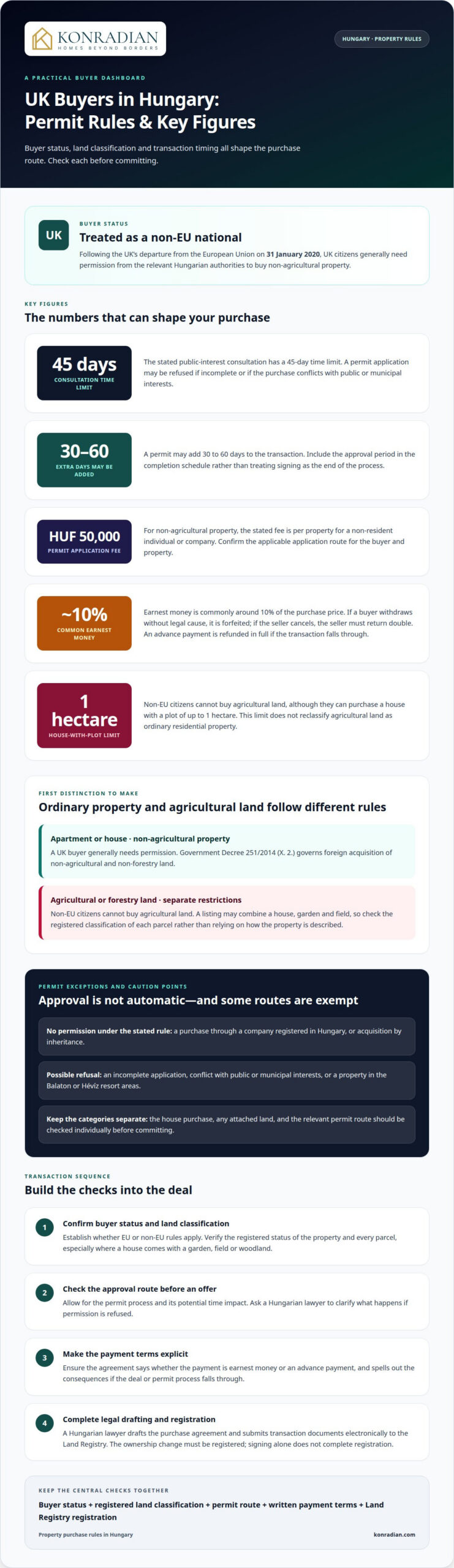
- Identify which rules apply to you. UK citizens are treated as non-EU nationals for Hungarian property purchase rules following the UK’s departure from the European Union on 31 January 2020. A UK buyer generally needs permission from the relevant Hungarian authorities to purchase non-agricultural property. Government Decree 251/2014 (X. 2.) governs foreign acquisition of non-agricultural and non-forestry land. Buying an apartment or house therefore involves a different approval route from buying agricultural land.
- Check the property and permit route before making an offer. Permission may be refused if the application is incomplete or the purchase conflicts with public or municipal interests. The stated public-interest consultation has a 45-day time limit, and a permit may add 30 to 60 days to the transaction. Authorities may also refuse permission for properties in the Balaton or Hévíz resort areas. A purchase through a company registered in Hungary does not require this permission, according to the stated rule. Inheritance is also exempt from the property-acquisition permit.
- Make an offer with the approval process in mind. Once the seller accepts, the parties agree the purchase terms and arrange the sale agreement. In Hungary, earnest money is commonly around 10% of the purchase price. Its consequences differ from an advance payment: a buyer who withdraws without legal cause forfeits the earnest money, while a cancelling seller must return double. An advance payment is refunded in full if the transaction falls through. Have the agreement explain which payment applies and what happens if permission is refused.
- Complete the agreement and registration steps. A Hungarian lawyer drafts the purchase agreement and submits the transaction documents electronically to the Land Registry. The ownership change must be registered; signing the agreement alone does not complete the registration. Include any permit period in the completion schedule, then coordinate payment and handover under the agreement. The government office’s decision may be challenged in court. Keep the signed agreement and registration records with your purchase documents.
- Confirm the land classification if buying a house with a plot. A house and its land may have different legal classifications, so check the plot’s registered status before proceeding. Non-EU citizens cannot buy agricultural land, although they can purchase houses with a plot of up to 1 hectare. That limit does not turn agricultural land into ordinary residential property. For a UK buyer, distinguish the house purchase from any agricultural land included in the transaction, and establish the applicable permit route before committing.
Agricultural land restrictions for foreign buyers
- Confirm the land classification before negotiating. A house, garden, and adjoining field may appear together in one listing, but the land’s registered classification affects what a buyer can acquire. Hungary generally restricts agricultural and forestry land ownership to Hungarian nationals or citizens of European Union Member States. Non-EU/EEA citizens cannot buy agricultural land, although they can purchase a house with a plot of up to 1 hectare. Treat the house and each parcel as separate items to verify.
- Separate permit rules from land-use restrictions. EU citizens do not need a foreign-ownership permit to acquire real estate in Hungary under the stated exemption, but agricultural land remains subject to specific acquisition rules. Non-EU buyers should distinguish an ordinary residential plot from agricultural or forestry property before paying a deposit. A residence permit does not itself change agricultural land eligibility. For non-agricultural property, foreign ownership permit applications have a 45-day administrative deadline and a fee of HUF 50,000 per property for a non-resident individual or company.
- Check the buyer’s status and supporting documents. Nationality, registered residence, and the property’s classification determine which official process applies. A foreign individual who has continuously had a registered place of residence, domicile, or accommodation in Hungary for at least 5 years, and has been employed for at least 3 years in total during that period, must submit an employment certificate from the state tax authority. Confirm that the buyer’s documents and the land records describe the same parcel before submitting an application.
- Understand the obligations attached to agricultural ownership. Buying agricultural land brings land-use duties, not simply the right to hold title. According to Nemzeti Jogszabálytár, a buyer must undertake personal use, must not let others use the land, and must meet land-use obligations. The law also specifies a commitment concerning the land for five years. Check that these obligations fit your intended use before agreeing to buy, especially if the property includes a field or woodland.
- Assess financing and transaction risks before committing. Foreign buyers can seek a Hungarian mortgage, and a Hungarian tax number may be needed to enter into a loan agreement with a bank. Eligibility depends on the lender’s assessment of the borrower and proposed security. Currency movements can affect the home-currency cost of the purchase or repayments. Legal risks may also arise from misclassified land, incomplete documents, or misunderstood use obligations. Have the land records, financing terms, and purchase agreement reviewed together.
The role of a Hungarian lawyer in property transactions
- Instruct a Hungarian lawyer to prepare the agreement. A Hungarian property transaction must be handled by a registered lawyer, who drafts the purchase agreement and files it. The agreement should identify the buyer and seller, the property, the purchase price, payment arrangements, and completion conditions. Check that the property description matches the records for the apartment, house, or plot you are buying. If the purchase depends on an approval application, the agreement should explain how that affects completion. Review every clause before signing, especially payment deadlines and the consequences of either party withdrawing.
- Have the lawyer handle Land Registry submission. The lawyer submits the transaction documents electronically to Hungary’s Land Registry; only a lawyer can make that submission. Registration is a distinct part of the transaction, so include it in your completion plan rather than treating the signed agreement as the final step. Ask which documents are being filed and how registered ownership will be evidenced. Keep the signed agreement, payment records, and registration documents together. These records help you follow the legal transfer and establish what was agreed if questions arise later.
- Budget for transfer tax and registration charges. The stated property transfer tax for buyers in Hungary is 4%, while the property registration fee is HUF 10,600. These are separate from legal fees. Legal fees for property transactions typically range from 0.5% to 1% of the purchase price. Ask for a written breakdown showing each transaction charge and its basis. For example, distinguish the transfer tax from the lawyer’s fee and Land Registry registration fee, rather than combining them as one vague closing cost. Keep the payment evidence with your purchase records.
- Map out taxes beyond the purchase. Before you invest abroad, identify the tax questions tied to buying, owning, or later selling the property. Taxes payable when buying or selling in Hungary, including capital-gains taxes, and taxes payable as an owner should be checked on Hungary’s national website. Give your lawyer the intended use and ownership structure so the transaction documents reflect the purchase accurately. A foreign buyer should also separate transaction charges from ongoing ownership obligations. This review helps you distinguish the one-time 4% transfer tax from tax questions that may arise during ownership or resale.
Checking utilities and ownership history
- Match the property to its ownership records. Ask the seller for the property’s identifying details and have a Hungarian lawyer compare them with the records used for the purchase. Check that the seller’s name and property description match across the sale documents and ownership records. If the property includes an apartment, storage unit, parking space, or separate plot, identify each item clearly. This comparison helps establish whether the proposed transfer covers everything shown during viewings, not just the main residence. Keep copies of the documents reviewed and resolve any mismatch before signing.
- Review the ownership history and registered entries. Ask the lawyer to examine the available ownership record and explain previous transfers, current owners, and any entries that could affect the planned purchase. For example, if a seller’s name differs from an earlier document, establish how ownership changed and whether the sale agreement reflects the current position. A foreign buyer should understand each entry before agreeing to transfer capital. If a permit application applies, the submitted ownership certificate must be no older than 21 days. That timing makes document coordination important.
- List every utility and confirm its status. During the property inspection, record the electricity, water, gas, heating, and waste-service arrangements. Ask the seller which providers serve the address, whose name is on each account, and how final meter readings will be recorded. Photograph the meters at handover and keep the readings with the purchase papers. For a Budapest apartment, clarify which services are billed individually and which are included in building charges. This gives both parties a practical reference when arranging account transfers after completion.
- Resolve utility balances and handover details in writing. Ask for recent account statements or payment evidence for each service, then compare the account details with the property address. Agree how outstanding charges, final meter readings, keys, and account transfers will be handled. If the seller says a service is disconnected, record that and establish what reconnection requires before planning renovations or moving in. Keep the agreed handover details with the signed purchase documents. For a home outside the capital, confirm which local services reach the property rather than assuming urban arrangements apply.
EU citizens’ property-buying rights in Hungary
Buying a home in Hungary does not by itself grant Hungarian residency. Property ownership and residence status are separate matters, so treat the purchase and any residence arrangements as distinct decisions.
- Use your EU citizenship to establish the purchase route. EU citizens have the same rights as Hungarian citizens when buying or selling property in Hungary. These rights cover a primary residence, a second or holiday home, and office property. When buying property in Hungary as an EU citizen, the key distinction is the property’s legal category, not whether you plan to live there full-time. Before proceeding, confirm that your citizenship documents match the buyer named in the agreement.
- Identify exceptions before choosing a property. Hungary’s general rules for EU buyers do not remove restrictions on every property or land type. Foreign citizens cannot purchase military or strategic objects, national monuments, or objects located in reserves. If a Budapest apartment is in a protected or restricted location, establish its status before making an offer. Check the property’s address and classification against the sale documents, and resolve any exception before arranging payment.
- Distinguish approval from ordinary ownership registration. Under the stated exemption, EU citizens do not need a foreign-ownership permit for real estate, but special property restrictions still apply. Hungarian rules are governed mainly by the Act on certain rules for the lease and disposal of flats and premises, together with a government decree covering foreign acquisitions of real estate other than agricultural and forestry land. Consider these rules alongside the Land Registry process: approval and registration are separate steps.
- Check how nationality affects a joint purchase. Dual nationals who hold Hungarian or another EU Member State nationality do not need a permit to acquire real estate. Hungarian nationals living abroad are also exempt from the permit requirement. If two international buyers will share ownership, record each buyer’s nationality and intended share accurately. The purchase structure, property category, and buyer status can affect the required documents, so align those details before signing or transferring payment.
- Keep ownership separate from residence planning. A Hungarian property can serve as a primary residence, holiday home, or office, but purchasing it does not itself grant Hungarian residency. Decide separately how you will establish or maintain residence, and avoid treating title registration as proof of residence status. If you are assessing a property purchase alongside your wider plans, explore Hungarian property brokerage for support with the property search and transaction journey.
Konradian: Spanish Property Acquisition
Konradian’s Hungarian Property Brokerage can help structure your property search and purchase process. Once you have reviewed the permit rules, land classification, ownership records, and lawyer’s role, brokerage support can connect those checks with your shortlist and transaction planning. This can be useful when comparing homes across locations or coordinating an international purchase from abroad. Keep in mind that EU buyers’ rights do not remove agricultural land restrictions, and buying a home does not grant Hungarian residency. Konradian also offers Spanish Property Acquisition, Croatian Real Estate Sales, and US Real Estate Investment Services for buyers considering those markets. To discuss your plans, contact Konradian or visit konradian.com.
Make Your Next Move With Clarity
Turn your plans into a clear purchase brief. Define how you intend to use the property, which locations suit that purpose, and what needs to be true before you commit. Write down your priorities, including the property type, ownership structure, and documents you want reviewed. This gives your legal and transaction discussions a practical starting point, rather than leaving key decisions until an offer is on the table.
Buying property in Hungary as an EU citizen can be a considered process when your search and due diligence move together. Let each decision build on the last: shortlist suitable properties, assess the relevant checks, then proceed with a clear understanding of the transaction. If you’re ready to discuss your plans, contact Konradian about buying property. Your next step can be a thoughtful one, with a clear direction for the search ahead.
Frequently Asked Questions
Is official consent required for buying real estate?
It depends on the buyer’s citizenship and the property type. EU citizens generally do not need a foreign-ownership permit for ordinary real estate, while UK citizens are treated as non-EU nationals under Hungary’s purchase rules. For non-agricultural property, the relevant permit process can involve a public-interest consultation. Check the buyer’s nationality and the property’s registered classification before committing, since agricultural land is subject to separate restrictions.
What Types of Properties Are Subject to Restrictions for Foreign Buyers in Hungary?
Restrictions can apply to agricultural and forestry land, as well as military or strategic objects, national monuments, and properties in reserves. The specific issue depends on the property’s legal classification and the buyer’s status. A listing described as a house with a garden may include land registered under a different category. Review each parcel and check for protected-site status before treating the purchase as an ordinary residential transaction.
What documents are required?
Documents depend on whether the buyer needs a permit and on the application circumstances. For a foreign-ownership permit application, the property ownership certificate must be no older than 21 days. An application may be rejected if its documents are incomplete. For a minor’s application, an officially translated birth certificate and guardian consent may be required. The purchase agreement is prepared by a Hungarian lawyer for the transaction.
What kind of taxes and fees will you need to pay?
Allow for the property transfer tax, registration fee, and legal fees as distinct transaction items. The stated transfer tax is 4%, registration costs HUF 10,600, and legal fees typically range from 0.5% to 1% of the purchase price. Taxes can also arise during ownership or a later sale. For example, capital-gains tax is a separate question from the initial transfer tax.
Can EU citizens buy residential property in Hungary without a permit?
Yes. EU citizens generally do not need a foreign-ownership permit to buy residential real estate in Hungary. The stated rights cover a primary home, a second or holiday home, and office property. The exemption does not remove restrictions on agricultural or forestry land, or protected and strategic locations. Before signing, distinguish an ordinary apartment purchase from a transaction that includes land or a restricted site.
What restrictions apply to EU citizens buying agricultural or forest land in Hungary?
EU citizenship does not make agricultural or forestry land an unrestricted purchase. These land categories are generally restricted to Hungarian nationals or EU citizens, and agricultural ownership carries land-use obligations. According to Nemzeti Jogszabálytár, the buyer must undertake personal use, must not let others use the land, and must meet land-use obligations during the stated commitment for five years. Establish the land’s classification and intended use before proceeding.
What are the steps and documents needed to buy property in Hungary?
Start by identifying the property’s registered category and confirming whether your citizenship requires a permit. Agree on the purchase terms, then have a Hungarian lawyer prepare the purchase agreement and electronically submit the transaction documents to the Land Registry. If a permit applies, prepare a complete application and use a current ownership certificate. Keep the agreement, application records, payment evidence, and final registration documents together.
What are the property purchase taxes, fees, and lawyer costs in Hungary?
The stated figures are a 4% property transfer tax, a HUF 10,600 registration fee, and typical legal fees of 0.5% to 1% of the purchase price. These charges serve different purposes, so review them as separate lines in your transaction budget. Tax questions involving ownership or a later sale, including capital-gains taxes, are distinct from the fees associated with completing the purchase.