


What if the overseas rental that looks most appealing turns out to be a poor fit once the high season ends? Learning how to buy rental property abroad means looking beyond the listing. Location, demand throughout the year, and a workable plan for tenants and maintenance all affect whether owning from a distance is practical.
It’s natural to focus first on the property and its potential income. But a sound purchase starts with an operating plan: who will handle day-to-day issues, what responsibilities come with your rental model, and how local requirements could affect your plans. Work through these details before you commit.
This practical 2026 checklist will help you compare locations, assess seasonal demand, plan for operations, and identify legal, financial, and currency questions to investigate. It also explains how acquisition support can guide you from property selection through transaction steps and key handover, so you can plan for both the purchase and responsible ownership afterward.
Key Takeaways
- Define your intended rental model and the time you can devote to ownership before comparing properties.
- Assess how seasonality, renter needs, and local demand could shape day-to-day operations.
- Compare self-management, local operational support, and a hybrid approach by control, time commitment, and coordination needs.
- Use this checklist for how to buy rental property abroad, separating evidence to gather from legal and tax questions that need qualified local review.
- Bring your rental priorities into the acquisition process, from comparing destinations and properties to preparing for the transaction.
Before You Buy Rental Property Abroad, Define the Investment and Its Real-World Demands
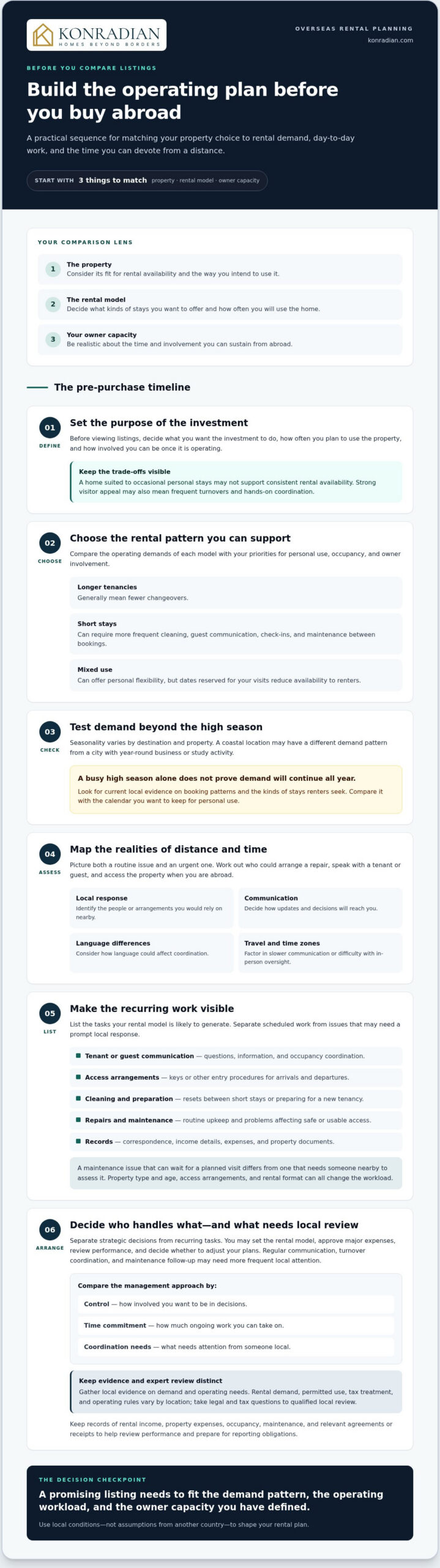
Before viewing listings, match three things: the property, the rental model, and your capacity as an owner. A home suited to occasional personal stays may not support consistent rental availability. A property with strong visitor appeal may bring frequent turnovers and hands-on coordination. Decide what you want the investment to do, how often you plan to use it, and how involved you can be once it is operating. These priorities give you a practical standard for comparing destinations and properties.
Rental-property management covers the decisions and day-to-day operations involved in preparing, letting, maintaining, and reviewing a property throughout ownership. It is an ongoing commitment, not a task that ends at purchase. The wider International Real Estate Overview introduces the range of property and investment approaches across markets, but the right rental plan depends on local conditions and your priorities.
Choose the rental model that fits your intended use
Longer tenancies generally mean fewer changeovers. Short stays can require more frequent cleaning, guest communication, check-ins, and maintenance between bookings. A mixed-use plan may give you personal flexibility, but dates reserved for your own visits reduce availability to renters. Consider what matters most: regular personal access, steadier occupancy, or the possibility of serving different types of renters at different times.
Seasonality varies by destination and property. A coastal location, for example, may have a different demand pattern from a city with year-round business or study activity. A busy high season alone doesn’t prove that demand will continue throughout the year. Look for current local evidence on booking patterns and the kinds of stays renters seek, then compare it with the calendar you want to keep for personal use. Reviewing specialized operators such as Luxury Vacation Stays can illustrate how major seasonal events and regional attractions drive short-stay travel patterns. Rental demand, permitted use, tax treatment, and operating rules vary by location, so don’t carry assumptions from one country into another.
Assess your distance, time, and involvement
Picture a routine issue and an urgent one. Who could arrange a repair, speak with a tenant or guest, and access the property when you’re abroad? Identify the local people or arrangements you would rely on, and decide how updates and decisions will reach you. Language differences, travel time, and time-zone gaps can slow communication or make in-person oversight difficult. Map these realities before deciding how much responsibility you can comfortably retain.
Separate strategic decisions from recurring tasks. You may set the rental model, approve major expenses, review performance, and decide whether to adjust your plans. Regular communication, turnover coordination, and maintenance follow-up may need more frequent local attention. The balance depends on the property and the support available, so no single arrangement suits every owner. If you’re working out how to buy rental property abroad, defining your operating capacity early helps you assess whether a promising listing is also a manageable investment.
How Rental Property Management Abroad Works After You Complete the Purchase
Completion is the start of the operating cycle, not the end of the work. A rental property must be prepared for use, marketed to suitable renters, managed during occupancy, maintained, and reviewed over time. Each stage brings decisions and tasks, from arranging access and responding to a repair to checking whether the rental plan is working as intended. How responsibilities are divided depends on the property, rental format, and local support you arrange.
Across borders, clear responsibilities and communication processes matter because distance can make routine property issues harder to resolve. Before purchase, map who makes decisions, who handles local tasks, and how information reaches you. An apartment offered for short stays may need frequent coordination around arrivals and cleaning. A home rented for longer periods may have fewer turnovers but still needs a process for maintenance and tenant communication.
Map the recurring tasks before choosing a property
List the work your rental model is likely to generate, then distinguish scheduled tasks from issues that may need a prompt local response. The list varies by property, but may include:
- Tenant or guest communication: handling questions, sharing information, and coordinating occupancy.
- Access arrangements: managing keys or other entry procedures when renters arrive or depart.
- Cleaning and preparation: arranging resets between short stays or preparing the property for a new tenancy.
- Repairs and maintenance: monitoring routine upkeep and responding to problems that affect safe or usable access.
- Records: keeping relevant correspondence, income details, expenses, and property documents organized.
For each item, decide whether it is occasional, recurring, or potentially urgent. A maintenance issue that can wait for a planned visit differs from one that needs someone nearby to assess it. The property’s type and age, its access arrangements, and the rental format can all change the workload. Build a realistic plan around those details instead of assuming one arrangement fits every investment.
Plan oversight, records, and local compliance
Keep consistent records of rental income, property expenses, occupancy, maintenance, and relevant agreements or receipts. Organized records make it easier to review performance and prepare for reporting obligations. Establish how information will be shared with you, how significant decisions will be approved, and where important documents will be stored.
Registration, licensing, safety, and tax obligations depend on the property’s location and how it is rented. Requirements can differ between destinations and rental formats, so confirm the current rules for the specific property through qualified local legal and tax review. For US purchases, state-level rules can also affect ownership. Westlaw’s discussion of Foreign Ownership Restrictions on Real Estate illustrates why jurisdiction matters. Don’t assume a framework that applies in one place applies elsewhere.
A considered acquisition plan accounts for these responsibilities before completion. If you’re shaping a purchase around a rental strategy, property acquisition guidance can help connect your intended use with property selection and the transaction process.
Compare Self-Management, Local Support, and Hybrid Approaches for a Rental Abroad
Once you understand the work your rental model involves, decide how to divide it. Self-management gives you direct control but leaves you responsible for coordinating tasks. Local operational support can provide in-person help, while a hybrid arrangement keeps selected decisions with you and assigns particular duties locally. The right fit depends on the property, rental format, your availability, and the responsibilities agreed for each arrangement.
| Approach | Control | Time commitment | Local presence | Coordination needs |
|---|---|---|---|---|
| Self-management | High owner involvement | Owner handles recurring tasks | May be limited if managed remotely | Owner coordinates communication, access, and follow-up |
| Local operational support | Owner sets priorities; local tasks are delegated | Fewer tasks handled directly by owner | Support can address in-person needs | Clear scope, approvals, and reporting are important |
| Hybrid | Shared, according to agreed responsibilities | Owner retains selected tasks | Local help covers defined needs | Responsibilities must be divided and communicated |
Use the comparison as a planning tool. The scope of local assistance and the responsibilities in an agreement can vary by country and rental type. Before relying on an arrangement, set out who handles each task, how decisions are approved, and how updates are recorded.
When direct owner involvement may be workable
Self-management may be practical if you live nearby, have a manageable task load, and can reliably access the property. An owner who is often in the destination may be better placed to coordinate appointments or address routine matters in person. Remote self-management is also possible, but distance doesn’t remove the need for timely communication and a dependable local response when an issue cannot wait. Consider your actual schedule, not just your intended level of involvement.
When local operational support may better fit
Local presence can be useful for guest turnover, repair coordination, access, and other situations that require someone at the property. Professional property managers such as GuestLee exemplify how dedicated local hospitality and property management teams handle high-standard short-term rentals and guest services. Delegation can reduce the number of tasks you handle directly, but still calls for oversight. Define the scope of work, who can authorize decisions, what information you’ll receive, and how unresolved issues will be escalated. Make sure the arrangement fits the local rental context and sets out responsibilities clearly.
A hybrid approach can divide duties around your strengths and availability. For example, you might retain financial oversight and decisions about major work while arranging local help for specific in-person tasks. Model the time and coordination involved rather than assuming delegation removes responsibility. As you consider how to buy rental property abroad, include your management approach in the acquisition assessment. Konradian’s acquisition guidance helps align property selection and transaction planning with your intended rental use.
Pre-Purchase Checklist for Rental Properties Abroad
A rental purchase calls for two kinds of due diligence: evidence you can gather about the property and its likely operation, and jurisdiction-specific questions that need qualified local legal or tax review. Work through both before committing. Confirm the rules and rental assumptions for the specific property before signing purchase documents.
Use this sequence to test whether the investment can work in practice:
- Define the rental use. Decide whether you intend to host longer-term tenants, short-stay guests, or use the property yourself for part of the year. Record your preferred availability and level of involvement.
- Gather local demand evidence. Review current, location-specific rental listings, market reports, and available booking or occupancy information. Compare properties with similar features and rental formats, and look for patterns across seasons. Treat general yield claims as a starting point, not proof of likely performance.
- Confirm the property’s suitability. Review its condition, access, maintenance needs, and fit for the renters you hope to attract. Consider whether its layout and location support your intended use rather than relying on broad descriptions of the area.
- Check the intended use and restrictions. Gather the property documents and available details on building or community restrictions. Use qualified local legal review to establish which current rules apply to the property and rental format, including any relevant registration, licensing, safety, or ownership requirements.
- Map local operations. List expected communication, access, cleaning, and repair tasks, then identify who could handle each locally. Note any task that depends on prompt in-person attention and plan how it would be addressed.
- Build your own financial model. Use verified assumptions for potential rental income, expenses, vacancy, maintenance, taxes, and currency exposure. Keep evidence for each assumption and test how your plan changes if occupancy or expenses differ from expectations.
- Confirm reporting and tax treatment. Identify how rental income and ownership may be treated in the relevant jurisdictions. Qualified local tax review can clarify which obligations apply to your circumstances.
Verify the property and intended rental use
Separate what you can inspect from what requires local legal interpretation. Your evidence file might include property details, condition reports, access information, and records supporting rental demand. Qualified local legal review can establish whether the intended rental format is permitted under current rules and property restrictions. This guide to legal support when buying abroad provides context for the legal side of an overseas acquisition.
Stress-test operations and financial assumptions
Don’t build a forecast around an ideal season or an unverified income estimate. Record where each assumption came from, then consider a less favorable scenario, such as weaker demand or an unexpected repair. Confirm that recurring tasks have a realistic local solution, and identify which decisions you’ll need to make remotely. Keep estimates distinct from confirmed figures, and include applicable reporting and tax rules in your model.
Understanding how to buy rental property abroad means connecting property selection with evidence, legal review, and an operating plan. Konradian supports buyers through property selection and acquisition guidance. Discuss your overseas property acquisition with your intended rental use and due-diligence priorities in mind.
Turn Your Rental Plan into a Supported Property Purchase Abroad
A rental strategy becomes actionable when it guides each acquisition decision. Start by defining the intended use and the owner involvement you can sustain. Then compare destinations, assess suitable properties against current local evidence, and prepare for the legal, financial, and transaction steps involved in a purchase. This sequence keeps the practical requirements of ownership in view, not just the appeal of a listing.
Connect the operating plan to destination and property selection
Your rental model can influence both where you buy and what you look for. A plan centered on longer tenancies may lead you to prioritize a different location, layout, or renter profile than a short-stay approach. Personal use, access to local support, and the property’s condition also shape the fit. Compare those priorities with current demand evidence and the local rules relevant to your intended use.
Konradian supports international property acquisitions in Spain, Croatia, the USA, Hungary, and the UK, guiding buyers through property selection and transaction stages toward key handover. Its international property acquisition support guide offers further context on the acquisition process. The initial video consultation is free, giving buyers a way to discuss their priorities and intended rental use before moving into property selection.
In most of these markets, buyer support is funded by commissions paid by sellers or developers. UK property sourcing carries buyer-side advisory fees. Knowing which arrangement applies helps you understand how acquisition support is structured.
Prepare for a clear next step
Bring a concise brief to a video consultation. Include the destinations you’re considering, your preferred rental format, how much personal use you anticipate, and the operating responsibilities you’re prepared to take on. Add questions still to resolve, such as how local requirements may affect your plan or which property features matter most. This gives the discussion a practical starting point without requiring every decision to be settled in advance.
Konradian’s direct relationships with developers and agencies can inform property selection and provide access to pre-sale opportunities. Consider each opportunity against your priorities, due diligence, and intended use. Acquisition guidance can support the process from initial discussion and property selection through legal and financial guidance to key handover.
If you’re considering how to buy rental property abroad, start with a measured conversation about the destination, property, and ownership plan you have in mind. Discuss your overseas property plans with Konradian and bring your rental objectives into the acquisition discussion.
Make Your Next Move with a Clear Acquisition Plan
The next step isn’t choosing a property at speed. It’s turning your rental objectives into a focused acquisition brief: where you’re prepared to buy, how you expect the property to be used, and what ownership should look like in practice. That clarity can keep decisions grounded as you compare opportunities and prepare for a cross-border purchase.
Knowing how to buy rental property abroad also means recognizing when a plan needs refinement. You may still be weighing destinations, balancing personal use with rental availability, or working through local obligations. A considered conversation can help bring those priorities into focus and identify the acquisition steps ahead.
Konradian supports buyers from initial discussions and property selection through legal and financial guidance to key handover. A free initial video consultation offers a starting point to discuss your objectives. In most markets, buyer support is funded by seller or developer commissions. UK property sourcing carries buyer-side advisory fees.
Discuss your overseas property plans with Konradian when you’re ready to explore the next step. A clear plan can make an international purchase more considered, manageable, and aligned with your goals.
Frequently Asked Questions
Can I manage a rental property abroad myself?
Yes, self-management can work if you have enough time, reliable local access, and a practical way to respond to problems. For example, decide in advance who can enter the property if a repair needs attention while you’re away, and how you’ll receive updates. Keep written records of tenant communications and maintenance decisions. Your ability to manage depends on the property, rental format, local requirements, and the support you can arrange.
What should I check before buying a property abroad to rent out?
Before making an offer, confirm that your intended rental use fits the property and current local rules. Compare current evidence for similar properties in the same area and rental format, and note how demand changes through the year. Review property documents, condition, access, and restrictions. To decide how to buy rental property abroad responsibly, keep observed evidence separate from assumptions and include qualified local legal and tax review for jurisdiction-specific questions.
Is buying a rental property abroad a good investment?
It can suit some buyers, but there’s no answer that applies to every property or investor. Consider whether the purchase aligns with your goals and how long you expect to hold it. Then test your income assumptions against local demand, likely periods without renters, ongoing expenses, and the practical demands of ownership. A strong advertised return alone can’t establish suitability. The evidence and your circumstances matter.
How do I manage tenants in another country?
Set up a clear communication process before a tenancy begins. Decide how a tenant reports an issue, how you’ll record the request, and who can assess it locally if you’re not nearby. For example, document the steps for arranging access when a repair is needed, while keeping final approval decisions clear. The rental format and local tenancy rules affect the arrangement, so include local legal review before letting the property.
Can foreigners rent out a property they buy abroad?
Possibly, but ownership doesn’t automatically mean every type of rental is allowed. Rules can differ by country, municipality, property, and rental format, including the distinction between longer tenancies and short stays. Before relying on rental income in your purchase plan, confirm the current rules for the specific property and intended use through qualified local legal review. Qualified local tax review can clarify relevant treatment for your circumstances.
What is the difference between self-management and local property support?
Self-management means you retain more direct responsibility for decisions and tasks. Local operational support may take on agreed duties that need someone nearby, while a hybrid arrangement divides selected responsibilities. Compare how each option handles access, maintenance updates, approvals, and record keeping. For instance, specify whether a local contact can arrange an inspection but needs your approval before authorizing further work. Responsibilities depend on the agreement and local context.
How can I estimate rental income from an overseas property?
Start with current examples of comparable properties in the same area and rental format, and check whether the evidence reflects the seasons you expect to operate. Separate advertised rates from income you can reasonably model, then account for unoccupied periods and property-specific operating expenses using verified information. Note the source of each assumption. Test a less favorable scenario as well, so your decision isn’t based on an optimistic forecast alone.
