


A plan to buy property, establish a business, or handle official matters in Croatia can bring one number into focus: the OIB. If you’re asking what a Croatian OIB number is and why you need it, it’s an 11-digit permanent identification number used in official records and information exchange. It identifies people and legal entities in Croatian legal, financial, and administrative matters, but it isn’t a residence permit or work authorization.
It’s understandable to wonder whether an OIB is a tax ID, a personal ID, or both. Croatia uses the OIB as its personal identification number, and whether you need one depends on your connection to the country and the transaction or procedure involved. This guide explains who is assigned an OIB, when a foreign person may need to apply, and how to apply in person, online, or through an authorized representative. You’ll also learn where the number is used, which documents to prepare, and how to obtain an OIB certificate, so you can approach your next step with greater clarity.
Key Takeaways
- Identify whether your Croatian connection calls for an OIB, and distinguish automatic assignment from applying yourself.
- Prepare the right application documents for your situation, including any representative’s authorization if someone applies on your behalf.
- For a property-related application, direct it to the Tax Administration office responsible for the area where the property is located.
- Keep in mind that an OIB supports official and financial processes but does not grant permission to live or work in Croatia.
- Learn which authority issues an OIB certificate and how it serves as proof of your number rather than as an identity document.
Applying for an OIB in person, online, or remotely
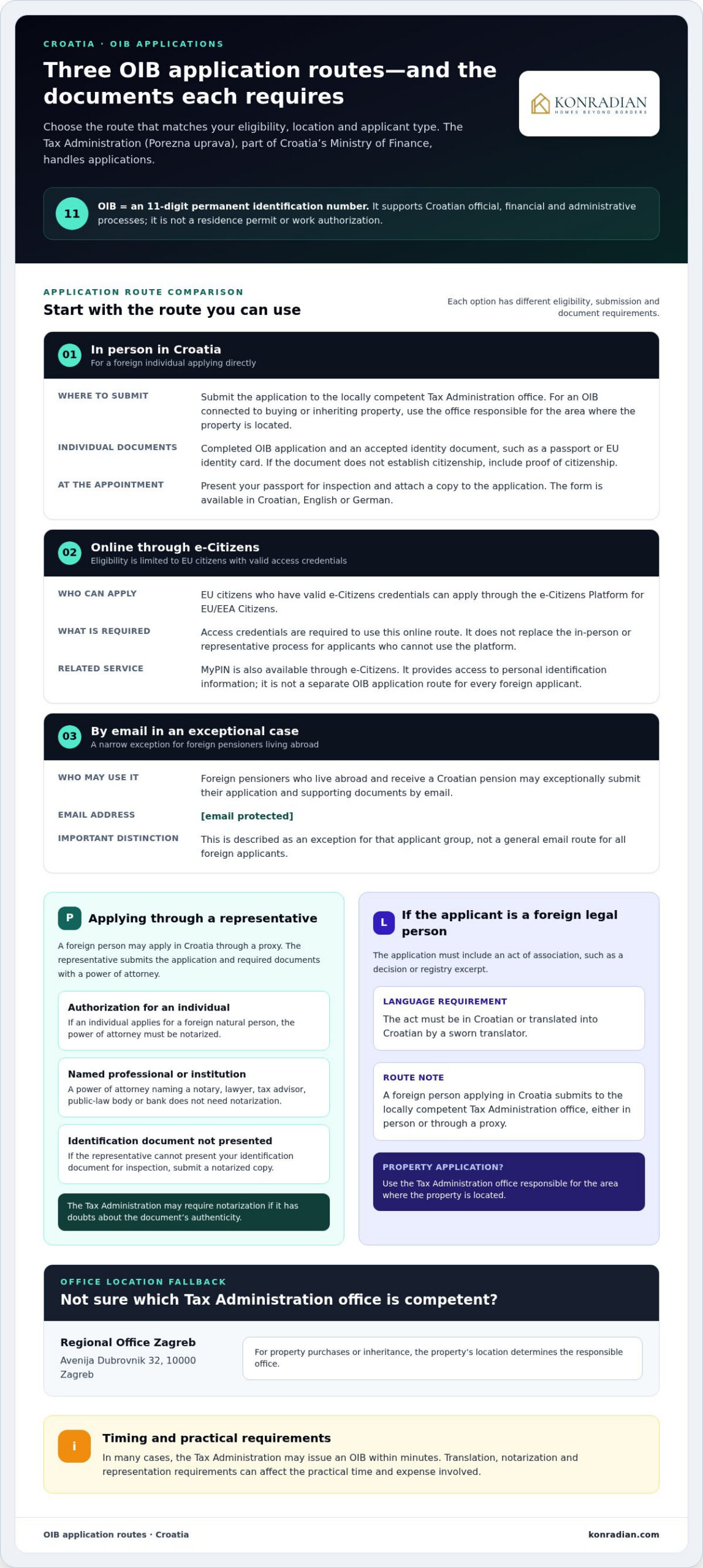
- Prepare the application and identification document. A foreign individual needs a completed OIB application and an accepted identity document, such as a passport or EU identity card. If the document does not establish citizenship, include proof of citizenship. When applying in person, present your passport for inspection and attach a copy to the application. The form is available in Croatian, English, or German. These documents support the determination and assignment of your personal identification number.
- Choose the route that matches your circumstances. A foreign person applying in Croatia submits the application to the locally competent Tax Administration office, in person or through a proxy. This office is part of Croatia’s Ministry of Finance and is also known as Porezna uprava. For an OIB connected to a property purchase or inheritance, apply to the office responsible for the area where the property is located. If you cannot determine the competent office, the Regional Office Zagreb is at Avenija Dubrovnik 32, 10000 Zagreb.
- Use online access only if you meet the eligibility requirements. EU citizens with valid e-Citizens credentials can apply through the e-Citizens Platform for EU/EEA Citizens. This route requires access credentials, so it does not replace the in-person or representative process for applicants who cannot use the platform. Croatia’s MyPIN service is also available through e-Citizens. It provides access to personal identification information, rather than serving as a separate OIB application route for every foreign applicant.
- Arrange a representative when you cannot apply yourself. An authorized representative submits the application and required documents with a power of attorney. If an individual applies for a foreign natural person, the authorization must be notarized. A power of attorney naming a notary, lawyer, tax advisor, public-law body, or bank does not need notarization. The Tax Administration may require notarization if it has doubts about the document’s authenticity. If the representative cannot present your identification document for inspection, submit a notarized copy.
- Match the documents to the applicant and route. A foreign legal person submits an application and an act of association, such as a decision or registry excerpt. The document must be in Croatian or translated into Croatian by a sworn translator. Foreign pensioners living abroad who receive a Croatian pension may exceptionally submit their application and supporting documents by email to oib@porezna-uprava.hr. In many cases, the Tax Administration may issue an OIB within minutes. Translation, notarization, and representation requirements can affect the practical time and expense involved.
Uses of the OIB for banking, property, contracts, and administration
- Use the OIB consistently in Croatian tax matters. The number identifies you or your company in official records, helping the Croatian Tax Administration connect income and filings to the right person. Use it when tracking taxable income, filing a personal or corporate tax return, or registering for VAT. For example, a foreign business earning taxable income in Croatia uses its OIB in relevant tax administration processes. Use the same number on applications and official correspondence. It remains your identifier even if your personal details change.
- Provide it for company and banking procedures. A Croatian OIB is used to register company founders and shareholders, appoint directors, and register a company with the Commercial Court. It is also used when opening a corporate bank account. When preparing company paperwork, identify each founder, shareholder, and director accurately, then enter the relevant OIB in the company’s official records. This supports clear identification throughout the establishment process, from Commercial Court registration to corporate banking.
- Use it when a Croatian property transaction requires identification. An OIB application connected with buying or inheriting real estate goes to the Tax Administration office responsible for the property’s location. For example, if you live abroad and the property is in a Croatian municipality, the property’s location determines the competent office. The OIB identifies people involved in official property procedures. Keep it available for transaction paperwork and related administration, rather than relying on your country of citizenship’s identification number.
- Enter it accurately on official forms and contracts. When a Croatian procedure asks for an OIB, provide the assigned number rather than substituting a foreign residence or tax identifier. This matters for company, property, or tax documents linked to Croatian official records. The OIB is Croatia’s personal identification number, not a replacement for every document from your home country. If a form field is unclear, distinguish the OIB from your passport number and foreign tax details before submitting the application.
Who is assigned a Croatian OIB
- Start by identifying whether you are a Croatian citizen, foreign person, or legal entity. Croatia assigns an OIB across these categories, but the basis differs. Croatian citizens receive one at birth or when they acquire Croatian citizenship. A foreign person means an individual without Croatian citizenship or a legal person headquartered outside Croatia. This distinction helps you understand whether assignment happens automatically or follows a Croatian tax, asset, or official-record connection. Your passport and citizenship help establish your category, but citizenship alone does not determine every foreign applicant’s eligibility.
- Check whether a Croatian citizen already has an assigned number. Because an OIB is assigned at birth, a Croatian citizen generally does not need to apply for a new identification number when later registering for a bank account, property transaction, or official procedure. A person who acquires Croatian citizenship is also assigned an OIB. The number identifies that person in Croatia’s official records. A change in the reason for using it, such as moving from a personal matter to a financial procedure, does not create a separate OIB.
- Assess the specific Croatian connection if you are a foreign individual. A foreign person may be assigned an OIB when becoming a Croatian taxpayer, acquiring taxable assets entered into official records, or being entered into official records for another reason. A person may also request one under a special regulation. For example, a foreign individual acquiring property in Croatia may need the number for the official transaction. The relevant trigger is the Croatian tax, asset, or administrative connection, not simply holding a foreign passport or visiting the country.
- Separate individual assignment from company assignment. A legal person headquartered in Croatia receives an OIB when established. A foreign legal person may receive one when it becomes a taxpayer, acquires taxable assets recorded in Croatia, enters official records for another reason, or requests one under a special regulation. The Croatian Tax Administration, part of the Ministry of Finance, assigns OIBs. The number provides an identification link used by Croatian public authorities for legal, financial, and administrative matters. Company establishment and a foreign entity’s Croatian activities therefore have different assignment circumstances.
- Use the assignment criteria to decide your next step. If you are a Croatian citizen, first establish whether an OIB was assigned at birth or upon citizenship. If you are a foreign individual or entity, identify the specific Croatian tax, asset, or official-record purpose. That purpose clarifies why the number may be needed and helps determine the application route. The OIB’s role is identification: it allows foreign persons involved in Croatian legal or official procedures, or becoming Croatian taxpayers, to be identified in the country’s records.
Differences between an OIB and residency or work authorization
A Croatian OIB is an identification number, not permission to live or work in Croatia. Croatia uses the OIB as its personal identification number rather than maintaining a separate tax number or civil ID alongside it. It also isn’t a substitute for a social security number issued by another country.
- Separate identification from immigration permission. The OIB identifies you in Croatian official records and information exchange. It does not grant the right to reside in Croatia, authorize employment, or serve as a residence permit. For example, having an OIB for a property transaction doesn’t, by itself, let you move to Croatia or take a job there. Treat each process separately: use the OIB when a Croatian authority or transaction requires identification, and address residence or work authorization through the applicable procedure.
- Don’t treat the OIB as a foreign tax or social security number. Croatia does not have a separate tax number or civil ID alongside the OIB. The OIB serves as an identifier in Croatian tax and administrative records, while another country may issue separate tax and social security identifiers. If a Croatian form requests an OIB, enter your Croatian number rather than substituting one issued by your country of citizenship. Keep foreign identifiers for forms that specifically request them.
- Check which authority issues your OIB in your situation. Foreigners registering habitual residence in Croatia receive an OIB from the competent police station of the Ministry of the Interior. They do not need to visit the Tax Administration to obtain it through this route. For other purposes, a foreign individual applies through the competent Croatian Tax Administration office. First determine whether your OIB is connected to habitual-residence registration or another official matter, then follow the relevant route.
- Keep supporting documents aligned with the procedure. The OIB application form is available in Croatian, English, or German. If your process requires an application, submit the completed form and accepted identification documents. A foreign legal entity’s act of association must be in Croatian or translated into Croatian by a sworn translator. Once issued, an OIB certificate proves your number but is not an identity document. Keep it separate from residence or work authorization paperwork, since each document serves a different purpose.
Getting an OIB certificate
- Establish whether you need an OIB or proof of an existing number. An OIB is permanent and doesn’t change when your name, surname, or address changes. To verify the personal information held in the OIB database, use Croatia’s My OIB service to request an electronic record and save it as a PDF. The certificate has a different purpose: the Tax Administration issues it as proof of your OIB, not as an identity document.
- Use the authority connected to your circumstances. Foreigners registering habitual residence in Croatia receive an OIB from the competent police station of the Ministry of the Interior, so they don’t need to visit the Tax Administration for the number. For other purposes, a foreign individual applies through the competent office of the Croatian Tax Administration, known locally as Porezna uprava. The route depends on whether habitual-residence registration or another official matter prompts the application.
- Prepare the application and identification documents for other purposes. The OIB application form is available in Croatian, English, or German. Applicants generally need a completed form and a valid passport or acceptable identification document. A foreign individual must present the passport for inspection and attach a copy to the application. These documents allow the Tax Administration to process the request and issue the personal identification number and its supporting certificate.
- Identify the competent office before submitting. For an application connected with Croatian real estate, contact the Tax Administration office responsible for the area where the property is located, whether the acquisition is by purchase or inheritance. If you cannot determine the local office, the Regional Office Zagreb is at Avenija Dubrovnik 32, 10000 Zagreb. Giving the application to the relevant office helps align the OIB request with the Croatian procedure requiring it.
- Keep the certificate with your transaction records. Store the issued proof alongside the documents that use your OIB, such as property or tax paperwork, and use the number consistently in official dealings in the Republic of Croatia. If you’re obtaining an OIB for a property purchase, explore Croatian Real Estate Sales as a related next step. The certificate confirms the number; your passport or other accepted identification remains the document used to establish identity.
Konradian: Spanish Property Acquisition
Konradian is a natural next step if your Croatian OIB is part of preparing for an international property purchase. Its Croatian Real Estate Sales service connects the identification process with the wider transaction, including property selection and legal and financial advice through to key handover. An OIB supports Croatian official procedures, while transaction support helps you understand how those requirements fit into your purchase. If your plans extend beyond Croatia, Konradian also offers Spanish Property Acquisition, US Real Estate Investment Services, and Hungarian Property Brokerage. The right fit depends on where you intend to buy and what support your transaction requires. Contact Konradian to discuss your property plans and transaction support needs.
Move from preparation to your property plans
Understanding what a Croatian OIB number is and why you need it is one part of preparing for a cross-border property decision. The next step is to connect administrative preparation with your wider plans: where you intend to buy, what kind of property suits your objectives, and what transaction support will help you proceed with clarity.
Konradian supports buyers through Croatian Real Estate Sales, Spanish Property Acquisition, and US Real Estate Investment Services. If you’re focused on a Croatian purchase, discuss how the property transaction fits your plans and what support you need along the way. For another destination, consider how your priorities shape the market and service that best aligns with them.
Contact Konradian about your OIB and property plans to discuss a practical next step. With the right preparation, you can move forward with greater confidence.
Frequently Asked Questions
What is a Croatian OIB?
A Croatian OIB is an 11-digit permanent personal identification number used in official records and information exchange. If you’re asking what a Croatian OIB number is and why you need it, it identifies you in Croatian administrative, legal, and financial matters. It isn’t a passport, identity document, or permission to live or work in Croatia. The number remains the same if your name, surname, or address changes.
Can someone misuse my Croatian OIB if they find out what it is?
An OIB identifies you, but the number itself is not an identity document. Don’t treat it as a substitute for proving your identity, and avoid sharing it beyond legitimate administrative or transaction needs. If you’re concerned about how your information is recorded, My OIB lets you request an electronic record of personal information held in the OIB database and save it as a PDF. Raise any specific discrepancy with the relevant institution.
Is the OIB the Same as Residency?
No. An OIB is an identification number; it does not establish residence or authorize employment in Croatia. For example, a foreign property owner may have an OIB for official procedures while living outside Croatia. Foreigners registering habitual residence receive an OIB through the competent police station of the Ministry of the Interior, but the number itself is not proof of residence. Keep OIB documentation separate from residence or work authorization paperwork.
What Is the Croatian OIB (Osobni identifikacijski broj)?
Osobni identifikacijski broj is the Croatian name for the Personal Identification Number, abbreviated OIB. It consists of 11 digits and serves as a permanent identifier in Croatian official records. The same number applies across relevant public administration procedures, rather than changing for each tax or civil purpose. For international data exchange, “HR” is placed before the eleven digits; that prefix does not replace or alter the OIB itself.
What if I somehow end up with two OIBs?
An OIB is permanent, so don’t apply for another number simply because your details or circumstances have changed. If you find two numbers in separate documents, don’t choose between them or use both in new paperwork. Note where each number appeared and contact the Croatian Tax Administration, Porezna uprava, for guidance on the discrepancy. A change of name, surname, or address does not by itself require a new OIB.
When do I need a new Potvrda o OIB-u?
A Potvrda o OIB-u is proof of your OIB, not an identity document. You don’t need a new number when your name, surname, or address changes. If an institution asks for current proof, request the certificate from the Tax Administration. To review personal information stored in the OIB database, use My OIB to request an electronic record and save it as a PDF. This record is distinct from the certificate.
Who gets an OIB?
Croatian citizens receive an OIB at birth or when acquiring Croatian citizenship, and legal persons headquartered in Croatia receive one upon establishment. Foreign individuals and entities may be assigned one for Croatian tax, taxable-asset, or official-record purposes, or under a special regulation. The Croatian Tax Administration assigns OIBs. A foreigner registering habitual residence receives the number through the competent police station of the Ministry of the Interior.
What is a Croatian OIB number and what does OIB stand for?
OIB stands for Osobni identifikacijski broj, meaning Personal Identification Number in English. The number has 11 digits: ten randomly selected digits and one control digit. The control digit follows the ISO 7064, module 11.10 standard. Croatia uses this permanent identifier in official records and information exchange, so it serves more broadly than a number limited to one tax filing or one administrative transaction.
