


Canadian citizenship doesn’t prevent you from owning a home in Spain. Property investment in Spain for Canadian citizens is possible, and as of 2026, fixed-rate non-resident mortgages are approximately 3.0% to 4.5%; variable rates are often priced at Euribor plus 0.8% to 1.5%. Buying a property doesn’t automatically give you Spanish residency or the right to live there indefinitely.
Look beyond the headline mortgage rate: your deposit, purchase taxes, ownership costs and eventual sale tax all shape the full financial picture. This guide explains ownership rules for Canadians, how Spanish mortgage rates and deposits work, and how to estimate purchase costs for new and resale properties. It also covers a proposed additional tax for non-EU buyers and tax and withholding rules that may apply when you sell. With these details in view, you can assess the commitment before choosing a property and planning the purchase.
Key Takeaways
- Estimate purchase costs by distinguishing resale homes from newly built properties and accounting for regional taxes.
- Plan your deposit and financing together, and understand the terms of an arras contract before signing.
- Separate the proposed additional tax for non-EU buyers from the mortgage and purchase costs you need to budget for.
- Account for Spain’s sale-related capital gains tax and the withholding applied when a non-resident sells a property.
- Understand the ownership rights available to Canadian citizens and how property ownership differs from Spanish residency.
What are the Real Costs of Buying Property in Spain as a Canadian?
Build your budget around the property type, region and intended use. Purchase taxes, professional fees and recurring ownership charges all contribute to the total.
1. Plan Purchase Deposits and Professional Fees
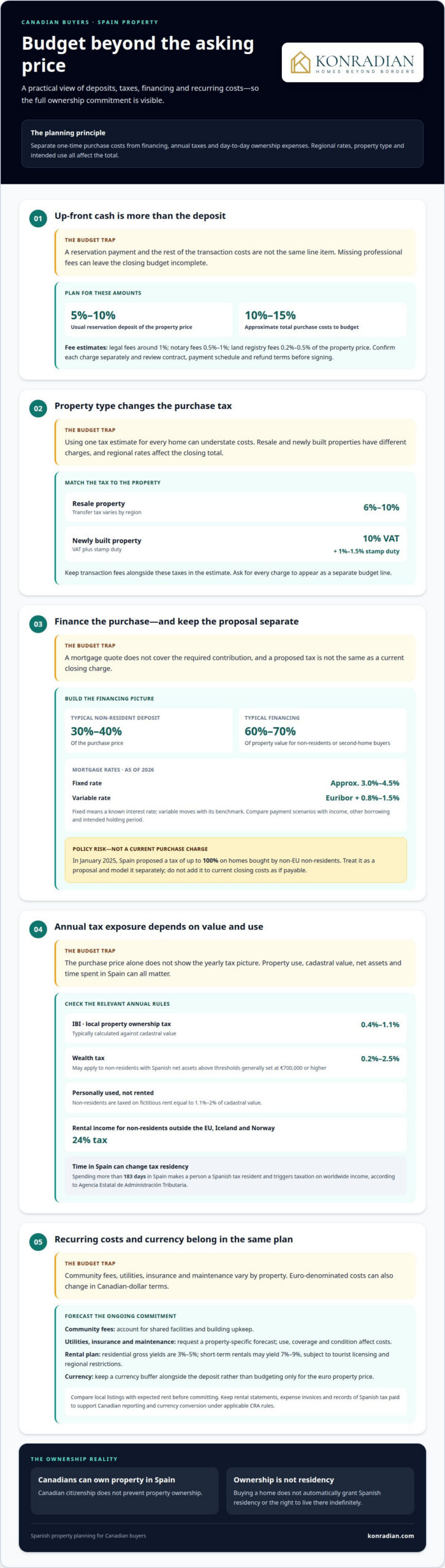
Set aside a reservation deposit, usually 5% to 10% of the Spanish property price, and budget total purchase costs of about 10% to 15%. For a preliminary estimate, allow for legal fees around 1%, notary fees of 0.5% to 1%, and land registry fees of 0.2% to 0.5% of the price. Before signing, review the contract, payment schedule and refund terms.
Reduce title and payment risks by arranging legal checks of ownership, debts, permissions, registration and payment instructions. For Canadian reporting, keep rental statements, expense invoices and records of Spanish tax paid. These documents support accurate income reporting and currency conversion under applicable CRA rules.
2. Calculate Transfer Taxes and Transaction Fees
Identify whether the purchase is resale or newly built, then calculate the relevant regional taxes. Resale property transfer tax ranges from 6% to 10%; newly built property carries 10% VAT and stamp duty around 1% to 1.5%. These charges sit alongside professional transaction fees, so compare the complete estimate rather than one headline tax.
Spanish notary fees are estimated at 0.5% to 1% of the property price, while land registry fees are 0.2% to 0.5%. Regional rates and the property category affect the closing total. Ask for each charge to appear as a separate line in the purchase budget.
3. Budget for Annual Property and Wealth Taxes
Include IBI, Spain’s local property ownership tax, in your annual budget. It typically ranges from 0.4% to 1.1% of cadastral value. Wealth tax may apply to non-residents whose Spanish net assets exceed thresholds generally set at €700,000 or higher; stated rates range from 0.2% to 2.5%.
For a property used personally and not rented, non-residents are taxed on fictitious rent equal to 1.1% to 2% of cadastral value. Rental income for non-residents outside the EU, Iceland and Norway is taxed at 24%. Spending more than 183 days in Spain makes a person a Spanish tax resident and triggers taxation on worldwide income, according to Agencia Estatal de Administración Tributaria.
4. Estimate Ongoing Property Ownership Costs
Request a property-specific forecast for community fees, utilities, insurance and maintenance. Shared facilities and building upkeep affect community charges, while utility use, the cover selected and the property’s condition shape other costs. Include these recurring commitments alongside IBI, notary and purchase costs when assessing affordability.
Residential gross yields in Spain are 3% to 5%; short-term rentals may yield 7% to 9%, subject to tourist licensing. Regional restrictions and licensing affect whether that rental plan is viable. Prices depend on location, property type and condition, so compare local listings with expected rent before committing.
Non-EU buyers and proposed additional property taxes
Canadian buyers should distinguish current financing costs from proposed tax measures. Use these steps to assess the purchase and plan payments in euros.
- Assess the proposed tax separately. In January 2025, Spain proposed a tax of up to 100% on homes bought by non-EU non-residents. Treat this as a proposal, not an existing purchase charge, when modelling a transaction. Keep it visible as a policy risk, but don’t add it to the current closing-cost total as if it were already payable.
- Set a realistic deposit target. Non-resident mortgage loans commonly require Canadian buyers to contribute 30% to 40% of the purchase price. Spanish mortgages for non-residents or second-home buyers typically finance 60% to 70% of property value.
- Compare mortgage structures. As of 2026, fixed-rate mortgages for Canadian non-residents are approximately 3.0% to 4.5%. Variable-rate mortgages are often priced at Euribor plus 0.8% to 1.5%. A fixed rate offers a known interest rate; a variable rate moves with its benchmark. Compare payment scenarios against your income, other borrowing and intended holding period.
- Plan for the Canadian-dollar exchange. A euro-denominated purchase price can change in Canadian-dollar terms. Keep a currency buffer alongside your deposit instead of budgeting only for the property price.
- Stress-test the full ownership plan. Spanish banks offer financing to non-resident buyers, but a Mediterranean lifestyle purchase still needs a clear repayment strategy. Compare the required deposit, monthly mortgage payment and euro-denominated costs with Canadian-dollar resources. Consider how exchange movements could affect each planned transfer, especially if funds will arrive in stages. For a structured view of your Spanish purchase plan, bring financing assumptions and the proposed-tax exposure into the same assessment.
Arras deposits and preliminary contracts
Before transferring funds, make sure the preliminary contract clearly records the proposed purchase. Work through these steps so the deposit, deadlines and property details are clear.
- Confirm what you are signing. Identify whether the document is a reservation agreement or a private sale contract, and record how any earlier payment is treated. Spanish purchase guidance describes a 10% down payment when signing the private sale contract, typically due within 10 calendar days of signing. Don’t assume a reservation deposit and the contract payment have identical terms.
- Check the property and named parties. Match the seller’s identity and property description against the purchase documents. Record the agreed price, included fixtures, payment instructions and anticipated completion date. If you plan to rent out the property, include that purpose in your review and consider regional restrictions before committing funds.
- Read the deposit clause closely. The contract should state the amount, recipient, payment method and how the deposit will be credited at completion. Under the described arras provision, if the seller backs out, the buyer is due twice the deposit amount. Make sure the exact provision appears in the signed contract rather than relying on a verbal explanation.
- Set out deadlines and conditions. Make sure the contract identifies the next payment date and the steps required before completion. If your purchase depends on financing, document how that condition affects the transaction and deposit. The contract should explain what happens if a deadline is missed or a stated condition is not met. Don’t infer the consequences from the word “arras” alone.
- Arrange payment records before sending funds. Obtain written confirmation of the receiving account and retain the signed contract, transfer confirmation and payment receipt. A Spanish bank account is needed to complete a property transaction, so include account arrangements in your timeline. Keep records in euros and Canadian dollars to track the amount paid and its exchange value.
- Resolve questions before signing. Ask for unclear wording about deposit returns, withdrawal, completion or seller default to be explained in writing. Review the contract alongside checks of ownership and registration, especially if you plan to rent out the property or regional restrictions may apply. A precise preliminary agreement gives both parties a clear reference for the next stage.
Capital gains tax and non-resident withholding
When a Canadian non-resident sells Spanish property, Spain applies 19% capital gains tax to the full profit. At closing, the buyer withholds 3% of the full sale price and pays it to the Spanish tax office. To transfer proceeds to Canada, arrange payment through your bank account and account for the currency exchange rate when estimating Canadian-dollar funds.
- Establish your tax position before listing. Spanish tax treatment depends on whether you are a non-resident seller, not simply on Canadian citizenship. Keep your purchase contract, payment records and ownership details together. These records help establish the property’s transaction history and support the figures used to calculate profit. Don’t treat the sale price alone as your taxable gain.
- Organize purchase and sale records. Gather the original purchase documents, sale agreement and records of amounts paid or received. Keep related paperwork together, including registry documents and any mortgage information relevant to the property. Clear records make it easier to reconcile sale proceeds with the property’s acquisition history and explain reported income.
- Budget for the closing withholding. The buyer withholds 3% of the full sale price at closing and pays that amount to Spain’s tax office. This is calculated on the sale price, while the 19% capital gains tax applies to the non-resident seller’s full profit. They use different bases, so don’t estimate one by applying its rate to the other amount.
- Calculate the expected gain separately. Start with the sale information and compare it with the documented purchase history. Apply Spain’s 19% rate to the full profit made as a non-resident seller. Keep the calculation distinct from the 3% withholding recorded at closing, which is based on the full sale price, not the profit.
- Plan the proceeds transfer and currency conversion. Confirm the receiving bank account, payment instructions and expected transfer route before completion. The amount arriving in Canada depends on the euro proceeds and the exchange rate applied during conversion. Compare the expected euro balance with its Canadian-dollar equivalent, and retain the bank’s transfer and conversion records.
- Reconcile the final sale position. Keep the signed sale contract, closing statement, withholding record and bank confirmation together. Note any mortgage balance reflected in the funds you expect to receive, and distinguish it from the property’s sale price. These records help trace the transaction from the Spanish closing to your Canadian account without confusing proceeds, withholding and taxable profit.
Canadian citizens’ ability to own property in Spain
Canadian citizenship doesn’t prevent you from owning Spanish real estate. For property investment in Spain for Canadian citizens, separate the purchase process from immigration planning before committing a deposit.
Confirm Canadian Citizens’ Property Ownership Ability
- Proceed knowing Canadians can buy. Canadian citizens face no restrictions on owning a home in Spain. This right covers the purchase itself, but it does not determine your residency status or permission to remain in the country.
- Obtain an NIE before completion. The NIE is the identification number used for a Spanish property purchase. Arranging it yourself can take 1 or 2 months, so build the application into your timeline. Keep the number with your purchase documents and provide it for transaction steps that require identification.
- Review the seller and property records. Before transferring a deposit, arrange checks of ownership, debts, permissions and registration. An independent Spanish property lawyer can review those records and the payment instructions. This helps you understand whether the seller can transfer the property and whether its registered details match the proposed purchase.
Assess Residency and Visa Implications
Buying property in Spain does not automatically give Canadian citizens residency or the right to live there indefinitely. Treat property ownership and immigration permission as separate matters, and plan your stay according to the visa rules that apply to your circumstances.
- Choose an immigration route separately. Spain’s Golden Visa program closed in April 2025, so a property purchase is not a route through that program. The non-lucrative visa has a funds requirement of around €28,800 annually. The digital nomad visa income requirement is at least €2,200 per month.
- Match your intended stay to your status. A holiday home, rental investment or future retirement plan does not itself authorize indefinite residence. Decide whether you plan short visits or a longer stay, then assess the relevant immigration requirements separately from the seller’s contract and property registration.
- Coordinate the property and residency plans. For property investment in Spain for Canadian citizens, note which steps depend on your identification number, purchase funds and intended use. To discuss the acquisition process, plan your Spanish property purchase with guidance tailored to the transaction.
Konradian: Spanish Property Acquisition
Konradian’s Spanish Property Acquisition supports Canadian buyers from property selection through legal and financial advice to key handover. Turn to Konradian when you’re ready to shortlist homes, assess a purchase and coordinate the transaction across borders.
With ownership, tax, deposit and financing considerations in view, you can approach the next stage with a clearer framework. Konradian provides end-to-end support, including legal and financial advice, tailored to the property purchase. This helps bring the practical steps together, from assessing suitable listings to progressing toward completion.
To discuss your plans for buying property in Spain, contact Konradian.
Make your next move with a clear plan
A considered approach to property investment in Spain for Canadian citizens starts with a decision that fits your objectives, finances and plans for the home. Before moving forward, bring your priorities together: the type of property you want, how you expect to use it and the role it should play in your broader financial picture. This gives each next step a practical purpose.
Konradian offers Spanish Property Acquisition and US Real Estate Investment Services. If you’re ready to explore a Spanish purchase, Konradian’s acquisition support connects property selection with the transaction process, helping you move from research toward a considered decision.
Contact Konradian about Spanish property to discuss your plans. A well-chosen next step can make an international purchase feel more structured and manageable.
Frequently Asked Questions
What Are Mortgage Rates in Spain for Non residents?
As of 2026, fixed-rate mortgages for Canadian non-residents are approximately 3.0% to 4.5%. Variable rates are often priced at Euribor plus 0.8% to 1.5%. Compare how each option affects the expected payment over your planned ownership period. Also consider the deposit and the amount borrowed, since the interest rate alone doesn’t show the full financing commitment.
Are there any restrictions on the acquisition of real estate in Spain by foreign buyers?
Canadian citizens face no restrictions on owning a home in Spain. Foreign buyers still need to complete the usual transaction steps, including obtaining an NIE identification number. Keep ownership eligibility separate from immigration permission: buying real estate does not itself grant residency or the right to live in Spain indefinitely.
How can immovable property in Spain be acquired?
Start by selecting a property, obtaining an NIE and arranging the funds needed for the transaction. Before signing a preliminary contract, review the seller’s ownership, property registration, debts and permissions. Then follow the contract’s payment schedule through completion and registration. A Spanish bank account is needed to complete the purchase, so include account setup in your timeline.
How is rental income taxed?
For non-residents who are tax residents outside the EU, Iceland and Norway, Spanish rental income is taxed at 24%. If you use the property yourself and don’t rent it, non-resident taxation can instead apply to fictitious rent based on cadastral value. Your tax position also depends on residence status, so distinguish rental activity from personal use when organizing records.
What additional expenses will the real estate transaction incur?
Budget for purchase tax, professional fees and transaction charges in addition to the agreed price. Resale purchases carry regional transfer tax of 6% to 10%; newly built homes carry 10% VAT and stamp duty around 1% to 1.5%. Legal, notary and registry costs also contribute. The property type and its location determine which tax treatment applies.
What is the safest way to transfer money for a property purchase in Spain?
Use a documented bank transfer to the account and recipient specified in the signed transaction documents. Confirm the payment instructions through a trusted, independently verified channel before sending funds, then retain the transfer confirmation and receipt. A Spanish bank account is required to complete the purchase. Traditional bank transfers can take several business days, so allow time for the funds to arrive.
What kind of returns can be expected from property investment in Spain?
Residential property in Spain has an annual gross yield of 3% to 5%. Short-term tourist rentals may yield 7% to 9%, subject to obtaining a tourist license, while commercial properties typically yield around 5% to 7% per year. These are gross yield figures, not guaranteed returns. Compare expected rent with taxes, ownership expenses, vacancy periods and the purchase price.
Can Canadian citizens buy property in Spain, and are there ownership restrictions?
Yes. Canadian citizens can buy and own property in Spain, with no restrictions on owning a home. Preparing for the purchase includes obtaining an NIE identification number and arranging payment. Ownership is separate from permission to reside: buying a property doesn’t automatically provide a visa, residency or the right to stay indefinitely.