


Foreign buyers can purchase property in Hungary, subject to applicable regulations. An explanation of property purchase fees in Hungary starts with the main costs: property transfer tax is 4% when the property price does not exceed €2.6 million, and 2% above that threshold. Estate agent commission is usually 2-3% and is generally paid by the seller, not the buyer.
It’s natural to want a clear picture of the total cost before proceeding, especially when buying from abroad. Beyond tax and commission, budget for legal work and registration, and understand which formalities apply to your circumstances.
This guide explains the key fees, how the purchase agreement and land registry process work, and what foreign buyers should expect. Use it to plan the purchase, from the initial legal checks through to registration of ownership.
Key Takeaways
- Budget for property transfer tax: the rate is 4% when the property price does not exceed €2.6 million and 2% above that threshold.
- In Hungary, estate agent commission is usually 2-3% and is generally paid by the seller, so buyers typically don’t pay it.
- A lawyer must participate in the transaction, and ownership takes effect only when the purchase is registered in the land registry.
- Build the registration fee and legal costs into your budget, and review the title and contract before signing or transferring funds.
- Compare new-build and resale costs carefully, as the costs can differ.
Estate agent commission
- Start by identifying who pays the agent. Estate agent commission in Hungary is usually 2-3% of the property sale price, and the seller generally pays it. Buyers therefore usually pay no commission to the seller’s real estate agent. Treat this as the standard market arrangement when planning an acquisition, not as an additional buyer charge. Before comparing listings, separate the seller’s agency cost from the fees that belong to your own purchase budget.
- Read the listing with the payment arrangement in mind. An estate agent’s listing may show an asking price, but that does not automatically make the buyer responsible for the agent’s commission. Ask for the sale terms to distinguish the purchase price from the seller’s agent fee. If the listing gives one asking price, don’t add a second commission amount to your estimate unless your own agreement expressly makes you responsible for it.
- Clarify the agent’s role before making an offer. Establish whether the real estate agent represents the seller or another party in the transaction. This helps you understand whose interests the agent serves and where to direct questions about the listing. Record the agreed purchase price and commission responsibility in the transaction documents. Clear wording helps prevent the seller’s agent fee from being mistaken for a buyer’s acquisition cost.
- Keep commission separate from other purchase expenses. Even when the seller pays the commission, budget separately for legal work, property transfer tax, and registration. These costs serve different purposes and may have different payment arrangements. Use separate entries in your budget rather than grouping every transaction expense under “agent fees.” This makes the cash required for the purchase easier to review.
- Check every document for a separate buyer obligation. Before signing, read any agency or purchase paperwork for language that assigns an individual fee to you. Compare that wording with the usual Hungarian arrangement: the seller generally pays the 2-3% commission. If a document appears to make you responsible, clarify what the charge covers and how it relates to the seller’s commission before proceeding.
- Confirm the final allocation before funds move. Before closing, compare the signed sale documents, payment instructions, and your cost breakdown. The seller’s commission should not be added to the buyer’s total simply because an agent facilitated the sale. Keep a record of who pays each amount and why. This final review gives you a clearer picture of the true cost of buying property in Hungary.
Land registry checks and property registration
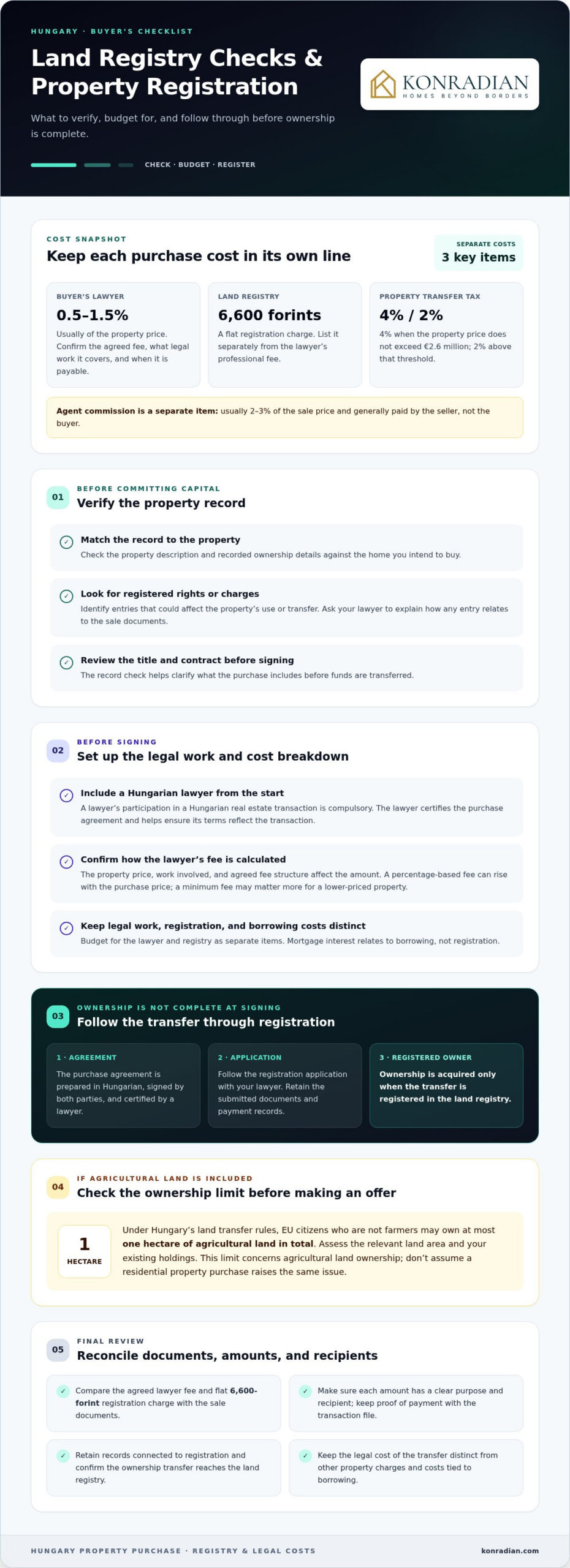
- Review the land registry record before committing capital. Match the property description and recorded ownership details to the home you intend to buy. Look for registered rights or charges that could affect its use or transfer. Ask your lawyer to explain how any entry relates to the sale documents. This check clarifies what the purchase includes before funds are transferred.
- Budget separately for lawyer fees and registration. A buyer’s lawyer fee is usually 0.5-1.5% of the property price. Keep these as distinct lines in your budget, rather than treating the registry fee as part of the lawyer’s fee.
- Ask how the lawyer’s fee is calculated. The property price, work involved, and agreed fee structure all affect the amount. A percentage-based fee can rise with the purchase price, while a minimum fee may matter more for a lower-priced property. Confirm what legal work the quoted fee covers and when it is payable. Don’t confuse this professional charge with mortgage interest, which relates to borrowing rather than registration.
- Confirm that the ownership transfer reaches registration. In Hungary, buying a property does not by itself complete the acquisition of ownership. Ownership is acquired only when the transfer is registered in the land registry. Follow the application through with your lawyer and retain the submitted documents and payment records. Registration is the formal step that makes you the registered owner.
- Check agricultural land restrictions before making an offer. Under Hungary’s land transfer rules, EU citizens who are not farmers may own at most one hectare of agricultural land in total. If the property includes agricultural land, assess the relevant land area and your existing holdings before proceeding. This limit concerns agricultural land ownership, so don’t assume a residential property purchase raises the same issue.
- Reconcile the final costs and documents. Before closing, compare the agreed lawyer fee, the flat 6,600-forint registration charge, and the sale documents. Make sure each amount has a clear purpose and recipient. Keep proof of payment with the transaction file, including records connected to registration. This final review helps distinguish the legal cost of the transfer from other charges tied to the property or any borrowing.
Legal considerations for property purchases
- Include a Hungarian lawyer from the start. A lawyer’s participation in a Hungarian real estate transaction is compulsory. Involve the lawyer before signing, so legal checks and contract preparation can inform your decisions. The lawyer certifies the purchase agreement and helps ensure its terms reflect the transaction. Treat this legal role as a required part of the purchase process, not an optional service to arrange after agreeing the sale.
- Review the agreement in its required form. A Hungarian property purchase agreement must be prepared in Hungarian, signed by both parties, and certified by a lawyer. Before signing, review the property identification, purchase terms, payment arrangements, and responsibilities in the document. If you’re buying with another person, make sure the agreement accurately records each purchaser and the intended ownership arrangement.
- Understand the deposit consequences before paying. The Hungarian contractual deposit, known as foglaló, has consequences if the transaction fails. If the buyer is responsible for the deal failing, the buyer loses the foglaló. If the seller is responsible, the seller must repay double. Before transferring a deposit, understand the contract’s conditions and how each party’s responsibilities apply to the transaction.
- Allow for the notary charge in your cost plan. Allow for notary costs as part of your purchase budget. For example, calculate this fee against the value used for the purchase, then record it separately from the lawyer’s fee and land registry charge. Keeping each professional or administrative cost in its own budget line helps you see which payment relates to legal certification and which supports other stages.
- Prepare documents if you cannot sign in person. Arrange a power of attorney when someone else needs authority to act for you during the transaction. Confirm that it covers the intended actions, such as signing the purchase agreement, and coordinate its wording with the Hungarian lawyer before it is notarised.
- Account for your status and future tax position. Foreign buyers are allowed to purchase real estate in Hungary, subject to applicable regulations. If you expect to sell at a profit, consider the income tax treatment: an individual selling Hungarian property at a profit within five years is liable for 15% income tax on the gain, with the taxable amount reducing for each year of ownership. Keep acquisition documents to support your records.
Purchase process and administrative formalities
- Set a realistic timetable before arranging payment. Buying real estate in Hungary typically takes 30 to 60 days, depending on legal checks, contract preparation, and payment arrangements. A Budapest apartment purchase follows the same broad sequence: select the property, complete checks, prepare paperwork, and finalize the transaction. Build time for each stage into your plans, especially if funds must move internationally or documents need preparation abroad.
- Establish whether you need a government permit. Buyers from outside the EU/EEA generally need a Hungarian government-office permit to purchase property. Allow several weeks for the process, and note that the permit usually takes up to 45 days. Non-EU buyers pay a 50,000-forint government fee for a foreign buyer permit. Factor this application into your schedule before treating the purchase date as settled.
- Arrange your Hungarian tax number and transaction documents. Foreign buyers purchasing property in Hungary are required to obtain a Hungarian tax number. Organize this alongside the purchase paperwork rather than waiting until the agreement is ready for signing. Keep identification and transaction records together, and ensure names and property details are consistent across documents. This preparation supports the tax and registration steps that follow completion.
- Track the transfer duty decision and payment deadline. After the competent authority issues its final NAV decision, an assessed property transfer duty can normally be paid without late-payment interest within 30 days after service of that decision. Record the date the decision is served, then schedule payment within the permitted period. The duty payment is a separate administrative step from paying the seller and completing the sale.
- Record local notification deadlines after the transaction. Hungarian municipalities may require notification of a property purchase or sale by 15 January of the following year. Keep the municipality’s reporting requirement in your post-purchase checklist, alongside your ownership and payment records. For property subject to local building tax, note that payments fall into two annual instalments, due on 15 March and 15 September.
- Plan for tax administration if the property earns rental income. Individuals pay a flat 15% tax on net rental profit in Hungary. Keep records of rental revenue and eligible expenses so the taxable profit can be calculated accurately. This is distinct from the one-off purchase formalities, but it belongs in the ownership plan from the outset. Separate rental tax records from property acquisition and permit documents.
How do property purchase fees differ for new-build and resale homes in Hungary?
- Separate the VAT question from other purchase costs. VAT on new construction in Hungary is 27% and is usually included in the property price. For a new-build, first establish whether the advertised figure already includes VAT. If it does, don’t add another 27% to your budget. Record the stated price and VAT treatment together, so your comparison reflects the amount presented for that specific property.
- Compare stated prices on the same basis. A new-build price that includes VAT and a resale asking price may present costs differently. Write down what each quoted figure covers before comparing them. For example, mark a new-build price as VAT-inclusive where stated, then compare it with the resale price as advertised. This makes the difference clear without mistaking an included amount for an extra charge.
- Read the purchase documents for the price breakdown. For a new-build, check that the sale documents identify the agreed price and its VAT treatment. For a resale, note the stated purchase price and any separately described charges. Match each figure against your transaction budget and avoid counting the same item twice. A written comparison helps distinguish the seller’s price presentation from taxes and professional expenses recorded elsewhere.
- Assess the full acquisition, not only the property type. A new-build and a resale may present the price differently, but both require careful review of the transaction documents. List the purchase price, legal expenses, registration charge, and applicable property transfer tax as separate budget lines. Then check which amounts are already included in the advertised figure. This keeps the comparison focused on payable costs rather than labels.
- Use the same questions for each property. For every new-build or resale option, record the quoted price, whether VAT is included, and the costs shown separately. Compare the completed entries side by side. If a new-build’s VAT is already inside its stated price, keep it within that line. Don’t treat the 27% rate as an additional payment unless the price presentation makes it separate.
- Choose based on the documented total and transaction fit. Once the figures are organized, compare the overall purchase commitment and the terms attached to each property. A clear breakdown can help you judge whether a new-build or resale better suits your acquisition plans. To bring the property search and transaction details into one view, compare Hungarian property purchase options.
Konradian: Spanish Property Acquisition
Konradian’s Hungarian Property Brokerage can help you move from understanding purchase costs to evaluating a property and progressing the acquisition. Turn to this support when you’re comparing Hungarian homes, weighing the practical steps, or coordinating the transaction from property selection through to key handover. Legal and financial considerations can be part of the broader purchase picture, alongside the formalities described above.
A clear cost framework helps you ask focused questions about the property, paperwork, and timing before committing. With the main fees and responsibilities in view, you can approach the next stage with a more informed perspective.
Contact Konradian to discuss Hungarian property brokerage and your purchase plans.
Make your next property decision with clarity
Having property purchase fees in Hungary explained gives you a stronger starting point, but the next decision is personal: which property fits your plans, priorities, and investment horizon? Before moving forward, bring your goals together with the property documents and cost assumptions you’ve assembled. A clear view of what matters most can focus your search and make conversations about the acquisition more productive.
Konradian supports international property decisions through Hungarian Property Brokerage, as well as Spanish Property Acquisition, Croatian Real Estate Sales, and US Real Estate Investment Services. If you’re considering a purchase in Hungary, discuss your objectives and the steps ahead with the team.
Contact Konradian about buying property and take the next step with a considered plan. A well-prepared purchase begins with knowing what you want your property decision to achieve.
Frequently Asked Questions
Can I deduct lawyer and transfer tax from the purchase?
Don’t treat lawyer fees or transfer tax as a reduction to the agreed purchase price. If you want property purchase fees in Hungary explained before signing, keep these expenses separate from the property price and retain the lawyer’s invoice and duty decision. Whether a cost affects a later tax calculation depends on the income or sale being reported. Keep clear records rather than assuming every purchase expense is deductible.
Is Property Tax Based on the Purchase Price or the Market Value?
For transfer duty, the tax assessment matters, so don’t assume the advertised price alone determines the final amount. A property with a market value of HUF 100 million would normally incur approximately HUF 4 million in transfer tax before any exemption or reduction. The final NAV decision states the assessed duty. This one-off transfer charge is distinct from any local building tax.
Is there a buyer agent fee in Budapest?
Usually, the buyer doesn’t pay the seller’s estate agent commission in Budapest. Hungarian sale commissions are generally 2-3% and are typically paid by the seller. Keep that commission separate from buyer expenses such as legal work and registration. If your own signed agreement names a buyer-side charge, read its terms carefully; that is distinct from the seller-paid commission arrangement.
What is Hungary’s property transfer tax rate for residential real estate?
The standard transfer tax rate is 4% when the property price doesn’t exceed €2.6 million, and 2% when it exceeds that amount. Hungary also caps property transfer tax at HUF 200 million per property. For a precise budget, distinguish the tax calculation from other purchase costs and allow for any qualifying reduction before treating the standard rate as your final amount.
Are there transfer tax exemptions or discounts for first-time buyers, families, or replacement homes in Hungary?
First-time Hungarian resident buyers under 35 may qualify for reduced property transfer tax rates. Eligible first-time home buyers may also qualify for interest-free instalments over up to 12 months. These are separate forms of relief: a reduced rate changes the duty, while instalments affect payment timing. Review residency, age, and first-time buyer eligibility when estimating the amount due.
How much does a Hungarian real estate lawyer cost, and is legal representation required?
Legal representation is compulsory in a Hungarian property transaction. Ask for a written breakdown so you can distinguish legal work from registration and notary charges.
What are typical land registry and property registration fees in Hungary?
Keep this as a separate line from lawyer fees, since registration is an administrative charge rather than legal representation. Retain proof of payment with your sale documents, then track the application to completion. Ownership of the property is acquired only when the transfer is entered in the land registry.
What other costs do buyers pay when purchasing property in Hungary, such as valuation, notary, or mortgage fees?
A practical way to have property purchase fees in Hungary explained is to separate valuation, notary, and borrowing costs in your budget. Buyer notary fees are 0.10% of property value. If borrowing, a bank arrangement fee is around 1% of the loan, while notarising a mortgage lien costs around 0.5% of the loan amount.
