


A clean Nota Simple isn’t enough to establish that a property is ready to buy. To verify a real estate developer in Spain, start with a current Nota Simple to see the registered owner, property description and recorded charges, then compare those details with the Cadastre and the property itself. The CRU is a 14-digit property identifier, while the cadastral reference is a 20-character code; matching identifiers and records help you build a clearer picture, but don’t by themselves confirm that construction and planning records match the property’s actual condition.
It’s sensible to look beyond a reassuring sales presentation before committing to a purchase. This guide explains how to verify a real estate developer in Spain by comparing property records, confirming the seller’s authority, reviewing construction and occupancy documents, and understanding protections for payments made during construction.
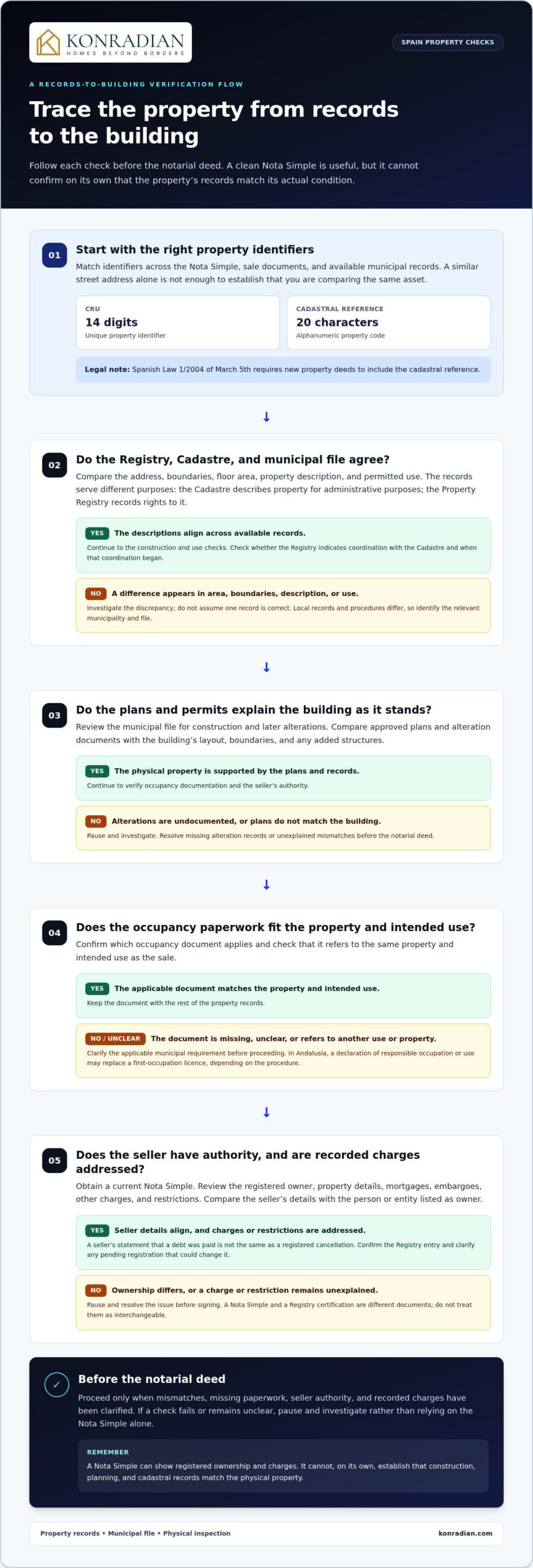
Follow the checks in order to see which documents to review, which discrepancies need attention, and what to resolve before signing the notarial deed.
Key Takeaways
- Compare the Property Registry, Cadastre, municipal records, and the property itself to spot inconsistencies before signing.
- Use a current Nota Simple to review registered ownership, property details, mortgages, and other recorded charges.
- Confirm that construction and occupancy documents correspond to the building and its permitted use.
- Check that the seller has authority to sell and that any registered charges or restrictions are addressed.
- Treat pressure to pay, missing paperwork, or mismatched records as reasons to pause and investigate further.
Comparing registry, Cadastre, municipal records, and the property’s actual condition
Before committing, compare the Property Registry, Cadastre, municipal records, and the building itself. Developer checks vary by region and municipality because local records and procedures differ. Use the municipality where the property is located to identify the relevant documents.
-
Compare Registry, Cadastre, and municipal records
Compare the registered property description with the Cadastre and municipal file, including the address, boundaries, floor area, and permitted use. The Cadastre describes property for administrative purposes, while the Property Registry records rights to it. A difference in area or description needs investigation, not an assumption that one record is correct. Check whether the Registry indicates coordination with the Cadastre and when that coordination began.
- Use both property identifiers to ensure you are comparing records for the same asset. The CRU is a 14-digit unique code, and the cadastral reference is a 20-character alphanumeric code. Spanish Law 1/2004 of March 5th requires new property deeds to include the cadastral reference. Match these identifiers across the nota simple, sale documents, and available municipal records; a similar street address alone is not enough.
-
Confirm permits and future-use documents
Ask to review the municipal file for construction and later alterations, then compare the approved plans with the building as it stands. For future occupation, check which occupancy document applies. In Andalusia, a declaration of responsible occupation or use may replace a first-occupation licence, depending on the procedure. Confirm that the documents refer to the same property and intended use as the sale.
-
Check regional and municipal warning signs
Compare the developer’s legal name on the sale documents with the entity named in property and municipal records. Look for inconsistencies in the plot, building description, plans, or stated use. Local procedures differ, so identify the relevant municipal file rather than relying on a document from another development. Resolve missing alteration records or unexplained mismatches before the notarial deed.
- Inspect the building and compare it with the plans, description, and alteration documents. A nota simple can show registered ownership and charges, but it cannot confirm on its own that construction, urban-planning, and cadastral records match the physical property. Note differences in layout, boundaries, or added structures, then match each one to supporting paperwork before proceeding.
- As a non-resident buyer, follow the same document trail through signing and registration. After the public deed is signed, the notary submits it to the relevant Property Registry with proof of tax payments. Keep the registered deed and related records together, then compare the final Registry entry with the agreed property description. If a cadastral graphic representation has been incorporated into registration, its location, boundaries, and area are presumed true.
Spanish laws governing Registry searches and Cadastre certificates
Use the legal framework to understand what each record can establish in a Spanish property purchase. Then review the Nota Simple, certificates, and tax documents as separate parts of the transaction.
-
Compare Catastro and Registry records
Compare the Catastro entry with the Registro de la Propiedad entry, because they serve different purposes. The Catastro describes the property for administrative purposes; the Registry records rights to it. Check the address, boundaries, area, and description in both records. Law 13 of 2015 made it possible to register a graphical representation of a property, helping connect mapped details with registered property rights.
-
Check the Nota Simple
Obtain a current Nota Simple from the Registro de la Propiedad or online through the Colegio de Registradores. Review the registered owner, property description, mortgages, embargoes, other charges, and restrictions. Identify what could affect the purchase, then compare the seller’s details with the person or entity listed as owner. A Nota Simple and a registry certification are different documents, so don’t treat them as interchangeable.
- Use the applicable legal framework to understand the record you’re reviewing. Spanish Land Registry property searches are regulated by Royal Decree 1427 of 1989, while the Mortgage Law, updated in 2022, provides legal principles governing property registration. For Catastro certificates, Law 13 of 2015 is the relevant framework. These laws relate to distinct records, so one document should not be treated as proof of every property detail.
- Investigate every mortgage or charge shown on the Nota Simple before agreeing to complete the purchase. Identify the creditor, the property affected, and whether the charge has been cancelled in the Registry. A seller’s statement that a debt has been paid is not the same as a registered cancellation. Ask whether a pending registration could change the current entry, then clarify its effect before signing.
- Keep tax evidence with the public deed and registration papers. After signing, the notary submits the deed to the relevant Property Registry with proof of tax payments. Compare the submitted deed with the final registered details, including the named owner and property description. An AEAT certificate is not a standard document every seller must provide for every sale, so distinguish it from the tax-payment evidence connected to deed submission.
- Budget for registration charges using the declared property value as the reference. Spanish property registration fees are typically 0.1% to 0.2% of that value. Treat this as a registration expense, not a tax or a developer charge, and confirm which documents support the declared figure. If villas or other properties have different recorded descriptions, resolve those differences before registration proceeds.
For a purchase with several records to reconcile, coordinated Spanish property transaction support can help bring the legal and financial steps into one process.
Construction legality and occupancy documentation
Review the construction file, occupancy evidence, and payment protections separately. Match each document to the specific apartment and the use you intend.
- Request the municipal construction file and compare its approved plans with the completed building. Check the plot, layout, floors, and intended use against the apartment you’re buying. Review documents for later alterations too, including extensions or changed internal layouts. A sales brochure or agency description can help identify what was promised, but it does not replace permits or municipal records. Note differences and resolve them before signing.
- Confirm the property’s CRU, the unique identifier regulated by Law 13/2015 of June 24th. Since 2016, every property in Spain must have a CRU assigned. Match the identifier on the property documents to the unit in the sale contract. This helps distinguish an apartment from another unit in the same development. If the identifier or unit description differs, ask for the paperwork linking the records before making further payments.
- Check which occupancy document applies in the property’s municipality, then verify that it names the correct building and use. In Andalusia, a declaración responsable de ocupación or utilización may serve as an alternative to a Licencia de Primera Ocupación, depending on the applicable procedure. Don’t assume the same document applies throughout Spain. For an apartment intended as a home, compare its stated use with the occupancy evidence and municipal procedure.
- Review the energy performance certificate alongside the other sale documents. In Spain, the owner or developer is responsible for commissioning it when required, and it must be available when the property is sold or rented. Check that the certificate corresponds to the property being sold, rather than another unit or a general description of the development. Treat it as one document in the file, not as proof that construction or occupancy requirements are met.
- For a purchase during construction, identify how each payment toward the purchase price is protected. If the transaction is subject to security regulations, those funds should be protected by an appropriate bank or insurance guarantee. Compare the guarantee’s coverage with the buyer, property, and payments described in the contract. Keep payment records with the agreement, and don’t treat a verbal assurance as a substitute for written protection.
- Before completion, assemble the construction permits, alteration records, applicable occupancy document, and energy certificate in one file. Compare names, unit identifiers, plans, and intended use across the documents. A mismatch between the project plans and finished apartment can affect what the records establish. Record unresolved differences and address them before the notarial deed, rather than relying on later corrections.
Checking ownership and the seller’s right to sell
Start with the registered owner, then establish who will sign the sale documents. Spain has 1,059 local Land Registries distributed among its 50 provinces and 2 autonomous cities.
- Obtain a current Registry entry for the exact property and compare the registered owner’s name with the sale contract. If the seller is a company, match its full legal name across the Registry entry, contract, and payment instructions. A development’s trading name may differ from the entity selling the unit, so identify the legal seller before transferring funds.
- Confirm that the person signing has authority to sell for the registered owner. If a representative signs, review the document establishing that authority and check that it names the correct person or company. If several owners are listed, establish who must participate in the sale. Even when an agency markets a lifestyle property, the registered owner or an authorised representative must complete the transaction.
- Read the Registry entry for mortgages, liens, embargoes, and other restrictions, then establish how each will be handled at completion. The entry itself matters: a developer’s assurance does not remove a registered charge.
- Ask for the certificate showing the status of owners’ community payments and compare its property details with the unit being purchased. In Spain, the seller generally provides this certificate with the public deed unless the buyer expressly waives that requirement. Owners’ community debts can affect the property for part of the purchase year and the three preceding years, so review the certificate before signing.
- Check potential IBI exposure as part of the same ownership review. In Spain, a property may be liable for IBI within the statutory scope. Ask for the available payment information and compare the property identification with the Registry and sale documents. This helps distinguish the seller’s personal account from charges associated with the property itself.
- As a foreign buyer, create a clear document trail before authorising payments. Keep the Registry entry, seller’s authority, community-payment certificate, and written arrangements for charges together. Check that each payment recipient matches the seller or the documented transaction arrangement. Resolve differences in names, ownership shares, or restrictions before the notarial deed, rather than relying on verbal explanations.
What warning signs indicate a fraudulent or unreliable property developer in Spain?
Assess each concern against the property records, municipal documents, and payment terms. One inconsistency calls for a specific explanation; several unresolved gaps should stop the transaction from advancing. A practical way to verify a real estate developer in Spain is to compare claims with independent property documents.
- Compare the developer’s legal name across the sale contract, Registry entry, and payment instructions. A different company name isn’t proof of wrongdoing, but documents must clearly explain who owns the property and who is authorised to sell it. Don’t send payments to an account that doesn’t match the documented arrangement.
- Request the Nota Simple and compare its registered description with the unit being marketed. Treat unexplained differences in ownership, boundaries, area, or property description as a reason to investigate. A Nota Simple does not establish that construction, urban-planning, and cadastral records match the property’s actual condition, so don’t rely on it as the only document supporting the sale.
- Compare plans and municipal documents with the completed building or promised new-build design. Unexplained changes to the layout, added structures, or intended use need supporting paperwork. Check records for alterations too. Knowing how to verify a real estate developer in Spain means matching project plans to the property and its supporting documents. If the developer cannot connect them, pause before signing rather than relying on a brochure or verbal explanation.
- For a property under construction, examine the written terms for every payment toward the purchase price. If the transaction is subject to security regulations, those funds should have an appropriate bank or insurance guarantee. A vague promise of future protection is not a guarantee. Match the buyer, property, and covered payments in the guarantee to the purchase documents.
- Be cautious if you’re pressured to pay before reviewing the records, permits, or contract. Being asked to proceed while material differences remain unresolved prevents you from comparing the documents properly. Keep a written record of what the developer says will be supplied, and match each response to the relevant property record or municipal document before continuing.
- Check whether the seller’s explanations are consistent across the Registry entry, municipal file, and contract. Changing answers about who owns the unit, what is included, or how a charge will be handled call for documentary clarification. Resolve discrepancies before the notarial deed; don’t rely on assurances that corrections will happen afterward.
For structured help with a Spanish purchase, explore support with Spanish property acquisition.
Konradian: Spanish Property Acquisition
Konradian’s Spanish Property Acquisition can support you through a purchase after you’ve reviewed the developer and property documents. The service covers property selection, legal and financial transaction support, and the process through to key handover. It helps bring the stages together, from identifying a suitable property to progressing the transaction with a clearer view of its paperwork.
If you’re considering a property in Spain and would value guidance through the acquisition process, contact Konradian or visit konradian.com.
Make your decision with a clear record
Knowing how to verify a real estate developer in Spain gives you a stronger basis for deciding what to do next. Treat remaining questions as part of the purchase decision, not as details to resolve after committing. Separate essential documents from explanations, record which points are settled, and keep the basis for your decision together.
If the paperwork supports the purchase, use it to move forward with a deliberate plan. If important issues remain, decide whether they can be resolved before signing. A considered decision may mean proceeding, revising the terms, or stepping away. Each outcome is easier to manage when it follows a clear review rather than pressure or assumptions.
For guidance with a Spanish purchase, explore your next steps with Konradian. A measured process can help you approach your property decision with greater clarity and confidence.
Frequently Asked Questions
What is Nota Simple and what information does it contain?
A Nota Simple is an extract from the Property Registry showing key registered details about a property. It can identify the registered owner, describe the property, and list mortgages, embargoes, other charges, or restrictions. Use it to compare the seller and property with the purchase documents. It is not a technical inspection or proof that municipal, construction, and physical details all align.
What should you check before buying a property in Spain?
Check that the seller is the registered owner or has documented authority to act, then compare the property description across the sale documents. Review charges, permits, occupancy documentation, and payment protections for a property under construction. Walk through the property and compare its layout and condition with the agreed description. Keep a written list of inconsistencies and resolve material ones before signing.
What else should you watch out for before signing a contract?
Read the payment schedule, completion terms, included fixtures, and process for handling delays or changes to the property. Check that each amount and milestone is clearly described and that the contract identifies the correct seller and unit. Don’t rely on verbal assurances about later paperwork or corrections. Ask for unclear clauses to be explained in writing before signing, and keep copies of the final contract and its attachments.
How to check a Spanish real estate developer’s company registration and legal status?
Start by obtaining the developer’s exact legal name and company identification details from the draft contract. Compare them with current official company-registration information, including the company’s stated status and authorised representatives. Ensure the entity named in the contract matches the entity receiving payments or selling the property. If a separate company owns the unit, request documents explaining its role in the transaction.
How to verify a Spanish developer’s solvency, debts, and insolvency records?
Review available company financial information and search official records for insolvency proceedings using the developer’s exact legal name. Examine the property’s Registry entry separately: a charge recorded against a home does not establish the developer’s overall financial position. Compare any disclosed debts with the contract and payment arrangements. Treat unclear ownership structures, inconsistent company names, or unexplained liens as issues to resolve before committing funds.
What building permits and planning approvals should a Spanish property developer have?
For a new development, review the municipal construction file, approved plans, and documents supporting the building’s intended use. Check that permits and plans correspond to the specific plot and unit, not just the development name. Before occupation, identify the document that applies to the property and municipality. Compare the completed building with the approved design, and request records supporting any alterations or material changes.
How to verify a developer’s track record, completed projects, and customer complaints in Spain?
Ask for the legal names and locations of completed developments, then compare those projects with available Registry and municipal information. Look for evidence that advertised buildings were completed as described and that their promised uses match the documents. When reviewing customer complaints, look for recurring, specific issues, such as unresolved delivery or construction concerns, rather than relying on a single review. Request written explanations for patterns directly relevant to your planned purchase.
What clauses and documents should a Spanish property lawyer review before buying from a developer?
Have a lawyer examine the seller’s authority, property identification, payment schedule, completion conditions, and terms covering changes, delays, and cancellation. Ask them to compare the contract with the Registry entry, municipal permits, occupancy paperwork, and any payment guarantee. For an unfinished property, check that the guarantee’s named buyer, property, and covered payments correspond to the signed agreement. Resolve ambiguous wording before signing or transferring funds.