


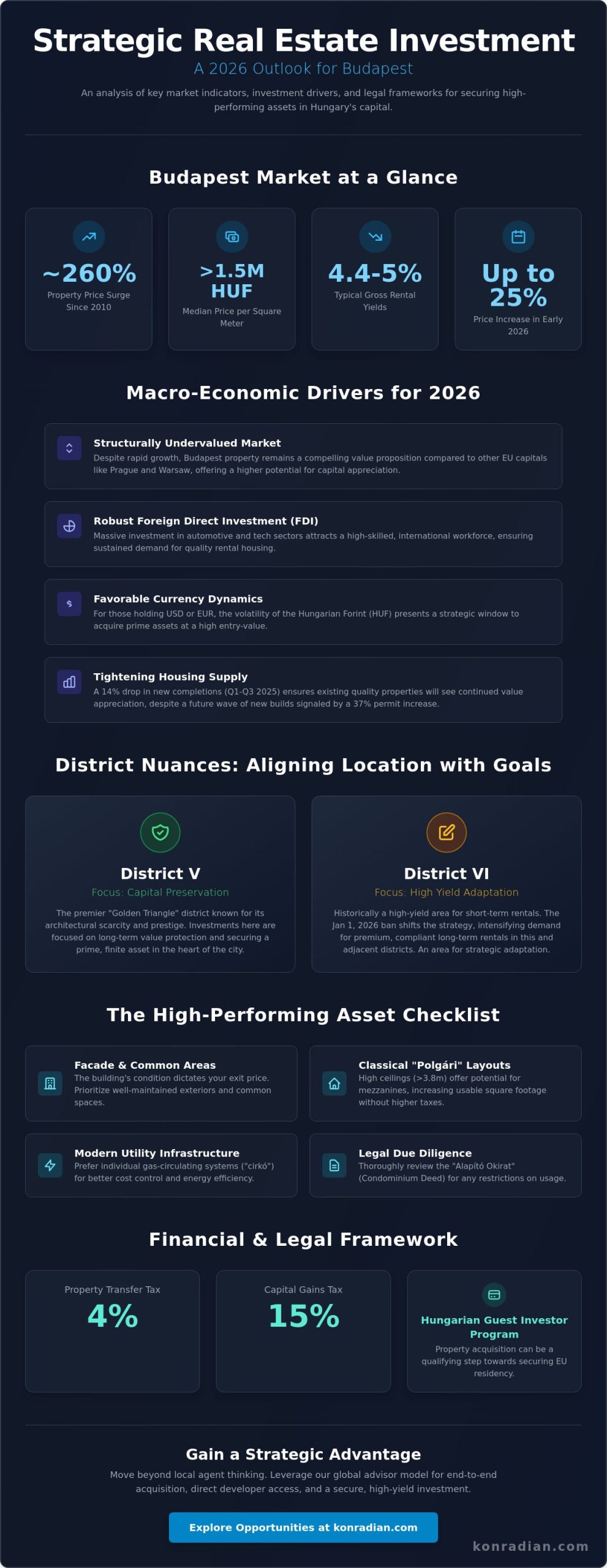
While property prices in Budapest have surged by approximately 260% since 2010, the city remains one of Europe’s most compelling entry points for strategic capital. You’re likely watching the Hungarian Forint’s volatility against the Euro or weighing the 2026 short-term rental ban in District VI, wondering if the window for a high-yield investment apartment Budapest has finally closed. It’s natural to feel cautious when navigating “tourist prices” or complex local mandates that vary by district. We understand that the complexity of international transactions requires a level of professional stewardship that prioritizes your long-term security and peace of mind.
This guide provides the professional framework you need to identify secure, high-performing assets in a market where median prices now exceed HUF 1.5 million per square meter. We’ll show you how to leverage the 2026 market landscape to not only secure a robust rental yield but also qualify for the Hungarian Guest Investor residency through a refined, end-to-end acquisition process. You’ll learn exactly which districts offer the best risk-adjusted returns and how to navigate the 4% property transfer tax and 15% capital gains rules with absolute precision.
Key Takeaways
- Evaluate the 2026 economic landscape to understand why Budapest remains a primary destination for sophisticated capital in Central Europe.
- Identify the specific physical markers, such as facade condition and classical “polgári” layouts, that protect your long-term exit price.
- Navigate the nuances between District V and VI to select an investment apartment Budapest that aligns with your goals for either capital preservation or high yield.
- Secure your future in the EU by leveraging the Hungarian Guest Investor Program through a compliant and transparent legal framework.
- Gain a strategic advantage by moving beyond local agent thinking toward a global advisor model that includes direct developer access.
The 2026 Budapest Real Estate Outlook: Why Invest Now?
Budapest has firmly established itself as the primary tech and tourism hub of Central Europe. While regional neighbors like Prague and Warsaw have seen property prices reach levels that challenge traditional yield models, Budapest continues to offer a compelling entry point for strategic capital. The median price per square meter now sits above HUF 1.5 million. This figure reflects a market that is maturing rapidly yet remains structurally undervalued compared to other European capitals. For the discerning buyer, an investment apartment Budapest represents a dual-play for both immediate yield and significant capital gain.
The 2026 economic climate suggests a period of cooling inflation and stabilizing interest rates. In May 2026, the National Bank of Hungary held the base interest rate at 6.25%, signaling a move away from the aggressive tightening of previous years. A deep dive into Hungary’s economic outlook shows a landscape bolstered by massive industrial investment and a resilient financial sector. While the Hungarian Forint (HUF) carries inherent volatility, the current exchange dynamics provide a high entry-value for those holding USD or EUR. It’s a window of opportunity to acquire prime real estate before the next cycle of appreciation begins.
Macro-Economic Drivers for 2026
Foreign Direct Investment (FDI) remains a cornerstone of the local economy, particularly within the automotive and technology sectors. These industries attract a cosmopolitan workforce that demands high-quality housing, sustaining a robust rental market. Revised EU-Hungary funding agreements are also fueling critical infrastructure improvements across the city. Tourism has undergone a strategic shift; while short-term rentals were banned in District VI as of January 1, 2026, the demand for premium, compliant accommodation in other central districts has only intensified.
Capital Appreciation vs. Rental Yield
Historical growth patterns in the “Golden Triangle” districts remain strong. In the early months of 2026, Budapest saw property price increases of up to 25%, significantly outperforming national averages. Current gross rental yields typically range between 4.4% and 5%. While these yields are lower than in previous decades, they’re supported by a tightening supply of new dwellings. In the first three quarters of 2025, new completions dropped by 14%, though a 37% increase in new permits suggests a wave of high-quality supply is on the horizon. This scarcity ensures that a well-chosen investment apartment Budapest will continue its upward trajectory through 2030.
The Investment Apartment Checklist: Vetting for Quality
Acquiring a high-performing asset requires a shift from “buying a flat” to institutional-grade vetting. While the interior of a property often captures the initial interest, seasoned investors know that the facade and common areas dictate the eventual exit price. A beautifully renovated unit in a building with a crumbling courtyard or neglected stairwell will always face a valuation ceiling. When evaluating an investment apartment Budapest, you must look beyond the paint to the structural health and renovation fund of the entire condominium.
Classical “polgári” flats in the city center offer unique advantages, particularly regarding ceiling heights which often exceed 3.8 meters. This vertical space allows for the installation of mezzanine levels, effectively increasing usable square footage without increasing the taxable area. However, you must inspect the utility infrastructure with precision. Individual gas-circulating systems, known locally as “cirkó,” are generally preferred over older central heating systems. They allow for better cost control and are a prerequisite for modern, energy-efficient rental listings. It’s also vital to review the Alapító Okirat (Condominium Deed) before committing. This document outlines the specific bylaws of the building, including any restrictions on commercial use or short-term stays. Understanding these foreign investment regulations ensures your asset remains legally versatile and secure.
Classical vs. New Build: Which Wins for Investors?
Classical apartments in Districts V, VI, and VII offer a sense of architectural scarcity that new developments cannot replicate. These properties are finite assets. They provide significant renovation potential, allowing you to transform “ruins” into luxury boutique rentals that command premium rates. In contrast, new builds in District XIII offer superior energy efficiency and significantly lower maintenance requirements. If you prefer a hands-off approach with predictable costs, our Hungarian property brokerage team can identify new developments that offer the best balance of price and performance.
The ‘AirBnB Proof’ Apartment
The regulatory landscape in Budapest has shifted significantly. As of January 1, 2026, District VI has implemented a ban on short-term rentals, forcing investors to rethink their strategy. This doesn’t mean the district is no longer viable. Instead, it has shifted the focus toward premium long-term rentals for the growing expat and tech community. An “AirBnB proof” investment apartment Budapest is one that remains profitable under various rental models. Whether you’re targeting the tourism market in District VII or the corporate sector in District V, your asset must be supported by a robust property management plan that can adapt to local district mandates.
Top Districts for Investment: A Comparative Analysis
Budapest’s investment landscape is a mosaic of micro-markets, each serving a distinct capital objective. Selecting the right location requires a nuanced understanding of how local regulations and infrastructure projects influence long-term value. While District V (Belváros) remains the undisputed safe-haven for capital preservation and luxury, other districts offer higher yield potential for those willing to analyze the city’s shifting dynamics. Choosing an investment apartment Budapest in 2026 isn’t just about the building; it’s about the street-level evolution of the neighborhood.
District VI (Terézváros) continues to be a primary target for sophisticated investors. Despite the short-term rental ban that took effect on January 1, 2026, the district’s status as a cultural and architectural epicenter ensures it remains attractive for high-end corporate tenants. District VII (Erzsébetváros) provides a different profile, balancing its nightlife appeal with consistent demand from the international student population. For a more stable, professional tenant base, District XIII (Újlipótváros) is the standout choice. Its proximity to the Váci út office corridor makes it a favorite for affluent locals and expats who prioritize proximity to work and the Danube.
Yield Heatmap: Where the Numbers Crunch Best
The yield-to-entry-cost ratio varies significantly across the Danube. In Pest’s central districts, gross yields currently hover between 4.4% and 5%. The “Palace District” in District VIII is the notable exception, where ongoing gentrification offers high-end potential at a lower entry point than District V. Conversely, the Buda side, specifically Districts I and II, typically offers lower yields, often between 3.5% and 4%, but provides superior capital security and prestige. For a comprehensive breakdown of how these district-level yields compare across the broader Hungarian market, our strategic guide to property investment in Hungary provides a precise district-by-district analysis for 2026.
Infrastructure and Future Growth Pockets
Infrastructure projects continue to redefine property values. The completion of the M3 metro line renovation has already begun to lift prices in previously undervalued pockets along its route. New commercial developments in South Buda are also creating a fresh rental pull for young professionals, expanding the city’s economic center. Gutenberg tér in the Palace District stands out as the specific square poised for exceptional growth in 2026.
Legal and Financial Security: Navigating the Transaction
Securing a high-stakes asset in a foreign market demands more than just capital; it requires a protective and proactive partner to handle the heavy lifting. The Hungarian legal framework is robust and transparent, yet the nuances of title deeds and acquisition permits can be overwhelming for the uninitiated. For non-EU citizens, the process involves obtaining a permit from local authorities, which generally costs between €130 and €160 and takes roughly 30 days to clear. We facilitate this through a secure remote purchase framework, allowing you to acquire an investment apartment Budapest with full legal certainty from your home office without ever needing to board a plane.
The Guest Investor Program (Golden Visa)
The 2026 Guest Investor Program has become a primary driver for international capital entering the city. By meeting the minimum investment thresholds, you can obtain a 10-year residency permit that extends to your immediate family, offering a level of global mobility that few other European schemes can match. This isn’t just a visa; it’s a strategic move to establish a secure foothold in the European Union. The key lies in selecting a property that not only meets the specific residency requirements but also functions as a high-performing asset in your broader portfolio. Investors who are also evaluating residency-linked opportunities across multiple European markets may find our guide to second home abroad investment a valuable resource for comparing Golden Visa structures in Hungary, Greece, and Portugal.
Transaction Costs and Hidden Fees
Financial clarity is the foundation of a successful acquisition. The standard property transfer tax is 4% of the market value for properties up to HUF 1 billion. Once your asset is performing, you’ll face a flat 15% tax on net rental income, which remains one of the more competitive rates in the region. It’s vital to account for attorney fees, which typically range from 0.5% to 1% of the purchase price, alongside property registration costs. Managing these flows requires a strategy that accounts for currency volatility between the Forint and your home currency. Our legal and financial transaction support ensures you navigate these costs without encountering bank-rate traps or unfavorable exchange spreads.
In Hungary, the attorney acts as a neutral guardian of the transaction, but their due diligence is your primary shield. They must verify that the title deed is clear of all encumbrances and that no third parties hold pre-emption rights. These rights are common in historic districts and can allow a municipality or a neighbor to match your offer, potentially stalling your acquisition. A thorough investigation into the condominium’s financial health is also part of this professional stewardship, ensuring you aren’t inheriting collective debts or unplanned renovation assessments.
The Konradian Advantage: Elite Sourcing at Zero Cost
Traditional real estate interactions often feel transactional; a local agent shows a property and hopes for a signature. We operate on a different logic. Our strategy-first approach moves beyond simple property matching to serve as a global advisor for your capital. By applying LSE-educated logic to the local market, we prioritize the macroeconomic factors that influence your exit strategy. This ensures that every investment apartment Budapest we present has been vetted against rigorous institutional standards. We look at the city through a lens of global capital flows, ensuring your entry price is protected by real-world demand drivers rather than speculative hype.
Our “Free for Buyer” model is a cornerstone of this professional stewardship. In the Hungarian market, brokerage commissions are typically settled by the seller or the property developer. This allows us to provide end-to-end support, from the initial search to the final key handover, at no direct cost to the investor. You gain access to elite sourcing, direct developer deals, and comprehensive transaction oversight without an additional line item on your balance sheet. It’s a structure that aligns our interests with yours, focusing entirely on securing the highest quality asset available in the 2026 landscape.
Why Institutional Expertise Matters
Strategic investment requires identifying the “unseen” risks that a typical salesperson might overlook. There is a fundamental difference between a salesperson trying to close a deal and a strategic consultant protecting a portfolio. Our role involves a deep dive into the condominium’s financial health, checking for planned renovation assessments that could impact your net yield. In 2025, we successfully guided a cross-border client through an acquisition in the Palace District by identifying a complex pre-emption right early in the process. This proactive intervention saved the client weeks of legal uncertainty and secured the asset before competing bids could materialize. We prioritize your long-term interests by handling the heavy lifting of local bureaucracy.
Your Next Steps in Budapest
The journey toward a high-yield asset begins with a clear, professional dialogue. We invite you to move beyond the public listings and into the world of off-market opportunities and pre-sale developer deals. During our initial strategy session, we’ll discuss your specific goals for capital appreciation and residency. You can expect your first property selection portfolio to be a curated list of assets that meet our institutional vetting criteria. Our team remains your dedicated partner from the first consultation until the moment you receive the keys to your new investment apartment Budapest.
Book your free Budapest investment consultation with Konradian
Securing Your Legacy in the Heart of Central Europe
Budapest in 2026 remains a landscape of high-stakes opportunity for those who prioritize strategic precision over speculative trends. We’ve explored how the city’s maturation as a tech hub and the introduction of the Guest Investor Program have redefined the local market. Success here requires more than just capital; it demands a deep understanding of district-level regulations and building-wide structural health. Whether you’re targeting the capital preservation of District V or the gentrifying potential of the Palace District, your investment apartment Budapest must be vetted with institutional rigor.
Navigating this complexity is where professional stewardship becomes invaluable. With over five years of international brokerage experience and a team of LSE-educated advisors, we provide the global logic necessary to secure high-performing assets. Our direct developer pre-sale access ensures you see the most exclusive opportunities before they reach the open market, all while benefiting from our free-for-buyer model. We’re here to handle the heavy lifting, ensuring your acquisition is as seamless as it is profitable.
The window for early-cycle entry in 2026 is open, and we’re ready to help you navigate it with confidence. Secure your 2026 Budapest investment strategy session today and take the first step toward a secure, high-yield future in one of Europe’s most vibrant capitals.
Frequently Asked Questions
Is Budapest real estate still a good investment in 2026?
Budapest continues to offer significant value as property prices in the capital rose by up to 25% in the early months of 2026. While the market has matured, the city remains structurally undervalued compared to regional peers like Prague or Warsaw. The combination of a cooling inflation rate and a steady 6.25% base interest rate as of May 2026 creates a stable environment for long-term capital appreciation and consistent rental demand.
How much is the property transfer tax in Hungary for foreigners?
The general property transfer tax rate is 4% of the market value for assets up to HUF 1 billion. If the property value exceeds this threshold, a 2% rate is applied to the portion above HUF 1 billion, with the total tax capped at HUF 200 million per property. These rates apply equally to domestic and foreign buyers, ensuring a transparent and predictable cost structure for your investment apartment Budapest.
Can I get a Hungarian Golden Visa by buying an apartment?
Yes, the Hungarian Guest Investor Program allows you to obtain a 10-year residency permit through strategic property acquisition. This program is designed for international investors seeking a secure foothold in the European Union for themselves and their immediate families. To ensure eligibility, the property must meet specific legal criteria, which we verify during our comprehensive due diligence process to guarantee a successful application.
What are the AirBnB restrictions in Budapest districts like District VI?
Short-term rentals are fully banned in District VI (Terézváros) as of January 1, 2026. Other central districts maintain their own specific regulations, often requiring explicit permission within the condominium’s deed. Investors should focus on assets that remain viable under long-term rental models or target districts where the regulatory environment remains favorable for tourism accommodation.
Do I need to be physically present in Hungary to buy a property?
Physical presence is not a requirement for a secure property transaction in Hungary. We facilitate remote acquisitions through a professional framework involving a power of attorney and independent legal oversight. This allows you to manage the entire process from consultation to closing without the need for international travel, providing a seamless experience for global citizens.
How much rental yield can I realistically expect in downtown Budapest?
Gross rental yields in the central districts currently range between 4.4% and 5%. While these figures have adjusted from previous years, they’re supported by a 15% flat tax on net rental income and a tightening supply of new housing. Strategic investors often look to the “Palace District” in District VIII for higher-end potential that can outperform these city-wide averages.
Is it better to buy a classical apartment or a new build for investment?
Classical apartments in Districts V and VI offer architectural scarcity and high renovation potential, which often leads to superior capital gains. New builds, particularly in District XIII, provide higher energy efficiency and lower ongoing maintenance costs. The choice depends on whether you prioritize the unique charm of a “polgári” flat or the hands-off simplicity of a modern development. For investors weighing Budapest against other European destinations, our strategic guide to second home abroad investment offers a broader framework for evaluating international property markets in 2026.
How does the ‘free for buyer’ service work at Konradian?
Our Hungarian property brokerage services are compensated by the seller or the developer, which means our expertise comes at no direct cost to the buyer. This model allows us to provide elite sourcing, LSE-educated strategy, and full transaction support while remaining entirely focused on your investment goals. You receive institutional-grade advice and direct developer access without an additional fee on your acquisition balance sheet.
