


Can you buy property in the UK while living abroad, without a UK visa or residency status? In general, foreign buyers can own UK property, but ownership doesn’t give you the right to live in the country. The legal requirements for buying property in the UK as a non-resident are less about eligibility and more about completing the purchase correctly.
It’s understandable to feel uncertain. Identity checks, evidence of where your money came from, tax obligations and conveyancing can all seem more complex when you’re managing a purchase from overseas. The rules and transaction processes can also differ across England, Wales, Scotland and Northern Ireland.
This guide explains what to prepare before making an offer, how a solicitor or conveyancer supports the legal transfer, and which tax or mortgage considerations may need specialist advice. It also explains how a buyer-side property adviser can help with selection and acquisition planning. Working through the requirements in sequence can make an overseas purchase easier to manage.
Key Takeaways
- Understand the difference between being able to own UK property and having permission to live in the UK.
- Know that the legal requirements for buying property in the UK as a non-resident depend partly on where the property is located.
- Prepare for identity, address, source-of-funds and ownership checks as part of conveyancing.
- Consider how your ownership structure and a lender’s criteria may affect tax and financing decisions.
- Plan the purchase in stages, with your solicitor, tax adviser and property sourcing adviser each contributing in their area.
Can a non-resident legally buy property in the UK?
In general, yes. You can buy UK property while living overseas, and a visa or UK residence status isn’t usually a prerequisite to ownership. That general position doesn’t remove the legal, identity, tax and transaction requirements that apply to a particular buyer and property. The legal requirements for buying property in the UK as a non-resident can depend on the property’s location, who will own it and how it will be used.
“Non-resident” can mean different things in different contexts. A UK tax residence assessment is not the same as immigration status, and neither is determined simply by the address where you receive post. Your nationality, time spent in the UK, ownership structure and intended use may each matter for different parts of the purchase. Clarify which definition applies before making decisions about tax, financing or legal ownership.
Does the UK restrict foreign buyers from owning property?
There is no general rule preventing foreign nationals from owning UK property. However, that doesn’t mean every buyer or transaction can proceed without further review. Sanctions, beneficial ownership disclosures and other transaction-specific restrictions may apply. A solicitor can assess how the rules relate to your circumstances and proposed ownership structure.
The form of ownership matters too. In England and Wales, freehold generally means owning the property and land for an indefinite period, while leasehold means holding the right to occupy and use a property for a defined term under a lease. This overview of English land law explains the foundations of these arrangements. Terminology and legal structures differ across the UK, so don’t assume that one jurisdiction’s framework applies everywhere.
Does buying a UK home give you the right to live there?
No. Owning property in the UK gives you property rights, not immigration permission to enter, live or work in the country. A purchase does not itself grant a visa, residence status or citizenship. If you plan to spend time in the UK, check current official immigration guidance for the relevant visa, entry and residence rules. These are separate from the property transaction.
Keep this distinction clear from the outset. You may own a property while living abroad, but whether you can occupy it personally depends on your immigration position and the property’s ownership terms. A solicitor can advise on the property transaction. Immigration questions should be addressed through current official guidance or suitably qualified immigration advice.
Which UK legal rules apply to your property purchase?
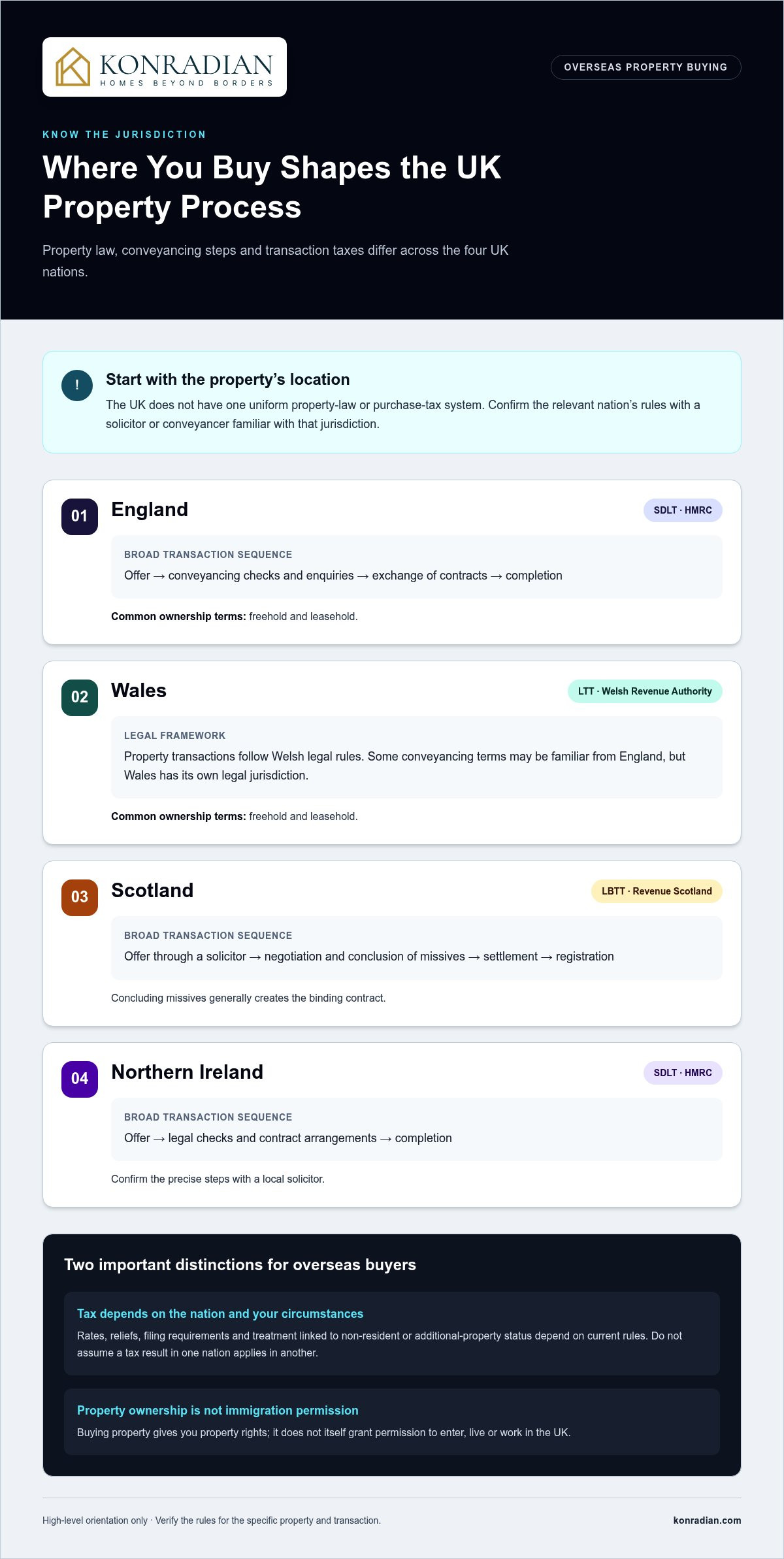
Start with the property’s location. The UK doesn’t have one uniform property law or purchase-tax system: England, Wales, Scotland and Northern Ireland have distinct legal frameworks, processes and tax regimes. The jurisdiction can shape contract terminology, when an offer becomes binding and which authority administers the transaction tax.
The table provides a high-level orientation, not transaction-specific legal advice. Verify tax names, process details and legal distinctions against current 2026 rules with a solicitor or conveyancer familiar with the relevant nation.
| Where you buy | Broad transaction structure and terminology | Property transaction tax and authority |
|---|---|---|
| England | Typically involves an offer, conveyancing checks and enquiries, exchange of contracts, then completion. Freehold and leasehold are common ownership terms. | Stamp Duty Land Tax (SDLT), administered by HMRC. |
| Wales | Property transactions follow Welsh legal rules. Freehold and leasehold terminology is also used. | Land Transaction Tax (LTT), administered by the Welsh Revenue Authority. |
| Scotland | Offers are commonly submitted through a solicitor. The contract is formed through conclusion of missives, followed by settlement and registration. | Land and Buildings Transaction Tax (LBTT), administered by Revenue Scotland. |
| Northern Ireland | Conveyancing generally progresses through offer, legal checks and contract arrangements to completion; confirm the precise steps with a local solicitor. | SDLT, administered by HMRC. |
How do the purchase processes differ across the UK nations?
In England and Northern Ireland, the broad sequence commonly moves from an accepted offer through conveyancing enquiries and checks, contract exchange and completion. Confirm the exact procedure and the point at which commitments become binding for your transaction. In Scotland, the offer and contract process uses different terminology: solicitors handle offers and negotiate missives, and concluding those missives generally creates the binding contract. Wales has its own legal jurisdiction and a separate transaction-tax regime, even where some conveyancing terms may be familiar to buyers from England.
Which property transaction tax applies where you buy?
England and Northern Ireland use SDLT, Scotland uses LBTT, and Wales uses LTT. Rates, reliefs, filing requirements and any treatment linked to non-resident or additional-property status depend on current rules and the buyer’s circumstances. Don’t assume that a tax result in one nation applies in another. Have a qualified adviser assess the property’s location, ownership structure and purchase details before budgeting or submitting a return.
Once you know the jurisdiction, you can assess property options in the right legal context. UK property sourcing support can help you focus your selection and acquisition planning alongside your solicitor’s legal advice.
What documents and checks must a non-resident buyer prepare?
Prepare for identity and anti-money-laundering checks early, rather than treating them as a last-minute formality. Solicitors and other regulated firms must conduct checks relevant to the transaction. The documents requested depend on your circumstances, ownership structure and how the purchase is funded. Use this as a planning checklist, not a universal list.
Common records to organise include:
- Identity: a valid passport or other accepted identity evidence.
- Residential address: a recent document showing your current address, such as a utility bill or bank statement.
- Purchase funds: bank statements and relevant transaction records showing where the money for the purchase came from.
- Ownership details: documents identifying the people or entities that will own or control the property, particularly if a company or trust is involved.
- Gift funding: records explaining the gift and its origin may be requested if someone else is contributing to the purchase.
What identity and source-of-funds evidence may be requested?
Identity and address records establish who you are and where you live. Source of funds means tracing the money used for the purchase, for example through account statements and transaction history. Source of wealth is broader: it explains how you accumulated your assets, such as through business activity, employment or an investment. The evidence needed to support these explanations depends on the case.
Purchases involving a company, trust or gift funding can require additional ownership and funding records. Your conveyancer can confirm acceptable document formats, whether copies need certification, and whether documents not in English require professional translation. Requirements vary, so don’t assume a document accepted in one transaction will be sufficient in another.
What does a UK conveyancer check before completion?
A conveyancer reviews the property’s legal position and the terms of the proposed purchase. Depending on its location and tenure, this may include checking title records and restrictions, arranging relevant searches, raising enquiries, reviewing the contract and, for leasehold property, examining the lease and associated documents. The precise scope depends on the property and jurisdiction. Your conveyancer can explain which checks apply and what any findings mean before you proceed.
Clear, organised records can help avoid preventable delays, but they don’t replace professional review. For broader context on transaction support, see this international property legal support guide. Preparing documents early is a practical step towards meeting the legal requirements for buying property in the UK as a non-resident.
How do mortgages, ownership structures and UK taxes affect overseas buyers?
Legal permission to buy, a lender’s willingness to provide a mortgage and the tax treatment of ownership are separate questions. A purchase that is possible in principle may still require planning around financing, who will hold title and how the property will be used. These decisions can affect both the transaction and your ongoing responsibilities.
Can a non-resident get a UK mortgage?
Some lenders consider applications from overseas buyers, but availability and underwriting are lender-specific, not guaranteed by non-resident status. A lender may assess your country of residence, income and currency, deposit, credit information and the property itself. Mortgage eligibility is separate from legal eligibility to purchase, so establish likely financing terms before committing to a transaction. For broader acquisition context, see this UK property sourcing service guide.
Should you buy in your own name or through a company?
Buying personally or through a company can lead to different legal, tax and reporting considerations. Individual ownership may be more straightforward, while company ownership can involve additional formation, record-keeping and disclosure responsibilities. Neither structure is automatically more suitable for an overseas buyer. Consider your intended use, financing plans, future sale and wider financial position with qualified legal and tax advisers before choosing how to hold the property.
What tax obligations can continue after completion?
Purchase transaction taxes are only one part of the tax picture. If you rent out the property, UK tax considerations may apply to rental income. A later sale may also have tax consequences for the proceeds or gain. The analysis can depend on your tax residence, ownership structure, how the property is used and the rules in force at the relevant time.
Don’t assume that a purchase-tax calculation settles your future obligations. Before relying on a tax position, seek advice from a qualified tax adviser and consult current HMRC guidance. Plan the legal requirements for buying property in the UK as a non-resident alongside these later obligations, rather than considering them only at completion.
For support with strategic property selection and acquisition planning, explore UK property sourcing support as part of your purchase preparation.
What steps make a UK property purchase from overseas more straightforward?
A clear sequence helps keep decisions, documents and professional advice aligned. The legal requirements for buying property in the UK as a non-resident are easier to plan when you set your priorities first, then move through property selection, due diligence and completion with the right advisers involved at each stage.
What is the overseas purchase process, step by step?
- Set your brief. Define your budget, intended use, ownership goals and funding route. Identify the UK nation where you want to buy, because legal processes and transaction taxes differ by location.
- Assess funding and ownership. If you need a mortgage, discuss your circumstances and property criteria with a lender early. Consider whether you intend to buy personally or through an entity, and seek legal and tax advice before settling on a structure.
- Select a property. Match potential properties to your objectives and practical requirements. A buyer-side sourcing adviser can help refine the search and assess options against your brief.
- Complete due diligence. Before making a binding commitment, coordinate the conveyancer’s legal review and property checks with any lender’s requirements. Have your tax adviser consider the purchase and intended use in light of your circumstances.
- Coordinate the legal milestones. Follow your conveyancing team’s guidance on contracts, exchange or the relevant contract-forming stage, completion, registration and post-completion obligations. The exact steps depend on the nation and transaction.
Remote coordination may be possible through representatives and digital processes, but don’t assume every step can be completed online. Identity verification, signing formalities and document execution can vary by transaction and jurisdiction. Your conveyancer can explain how documents will be verified, signed and returned, and whether you need to allow time for originals or certified records.
How can a UK property sourcing adviser support the process?
A property sourcing adviser works on the buyer’s side, helping shape the search, assess property options against your objectives and navigate acquisition stages alongside your solicitor and other specialists. The adviser’s role complements, rather than replaces, legal or tax advice. Konradian provides UK property sourcing and acquisition support on a buyer-paid basis, with the service scope and fee model made clear as part of the engagement.
If you’re ready to define your criteria and plan the next steps, discuss a UK property search and the buyer-side advisory process.
Plan your UK purchase with clarity
A non-resident can generally own UK property, but ownership doesn’t grant a visa or the right to live in the country. The property’s location matters too: legal processes and purchase taxes differ across England, Wales, Scotland and Northern Ireland. A well-planned purchase starts by identifying the relevant jurisdiction, preparing for identity and funding checks, and getting qualified legal and tax advice on your circumstances.
The legal requirements for buying property in the UK as a non-resident are easier to manage when you consider property selection, financing, ownership structure and due diligence in sequence. Your solicitor handles the legal transfer, while a property sourcing adviser can help shape the search and guide acquisition planning.
Konradian brings more than five years of international property experience, with a team educated at the London School of Economics. Its buyer-side UK support focuses on strategic property selection and acquisition navigation, with sourcing services paid for by the buyer.
Ready to define your search and plan the next steps? Discuss your UK property search with Konradian.
Frequently Asked Questions
Can a non-resident buy property in the UK?
Yes, non-residents can generally purchase UK property, but the property’s location and the buyer’s circumstances still matter. The legal requirements for buying property in the UK as a non-resident may involve jurisdiction-specific conveyancing, identity checks, tax considerations and review of the ownership structure. Before proceeding, identify whether the property is in England, Wales, Scotland or Northern Ireland, and get advice on restrictions or compliance issues relevant to your transaction.
Do I need a UK visa to buy property?
No, a UK visa isn’t generally required simply to own property. However, buying a home doesn’t grant permission to enter, live or work in the UK. Immigration permission depends on your circumstances and the current rules, so keep the property purchase separate from plans to visit or reside in the country. Check current official immigration guidance and seek qualified immigration advice if you need help assessing your options.
What documents does a non-resident need to buy UK property?
Expect to provide identity and address evidence, along with records explaining where the purchase funds came from. A solicitor or conveyancer may request bank statements, transaction records or further documents depending on your funding route and ownership structure. A company, trust or gift-funded purchase may involve additional records. Overseas documents might need translation or certification, so confirm the required format with the professional handling your transaction.
Do I need a UK solicitor to buy property as a non-resident?
A solicitor or other appropriately qualified conveyancing professional plays a central role in reviewing the legal transaction, title and contract documents. The process depends on the property’s location and type, so arrange legal representation early and establish who will handle searches, enquiries, contract milestones, completion and registration. Your conveyancer provides transaction-specific legal advice. A property sourcing adviser can support selection and acquisition planning, but doesn’t replace your conveyancer.
How much tax does a non-resident pay when buying UK property?
There’s no single tax amount for every overseas buyer. The purchase transaction tax depends on the property’s location, the buyer’s circumstances and current rules. Non-resident status or ownership of other property may also affect the calculation. Rental income and a future sale can raise separate tax questions. Before relying on an estimate or tax position, seek advice from a qualified tax adviser and consult current HMRC guidance where relevant.
Can a non-resident get a mortgage to buy property in the UK?
It may be possible, but mortgage approval depends on the lender’s criteria and your circumstances. Lenders may assess your country of residence, income and currency, deposit, and the property itself. Being legally able to buy doesn’t mean a lender will offer finance. Discuss your funding route early in the search, and don’t commit to a purchase on the assumption that a particular mortgage or approval will be available.
Can I buy UK property remotely without travelling there?
Some parts of a purchase can be coordinated remotely, but whether you can complete every step from overseas depends on the transaction and the professionals involved. Identity verification, document signing and completion arrangements may have specific requirements. Your conveyancer can explain the process before you rely on remote signing or representation. Buying remotely doesn’t remove the need to provide funding evidence, complete due diligence or understand the contract before committing.
