


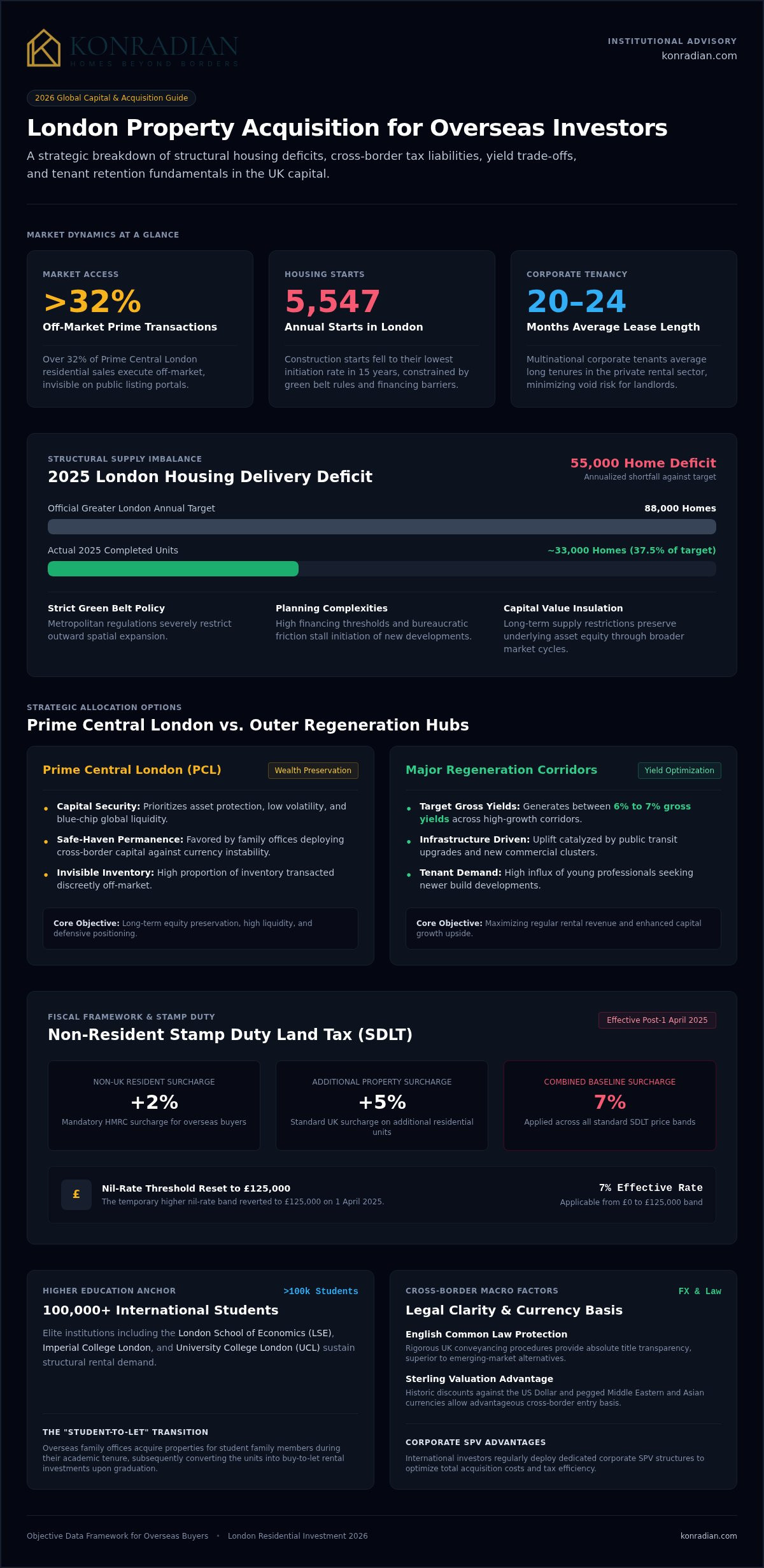
Over 32 percent of prime central London residential transactions now close off-market, remaining entirely invisible on public listing portals. For international investors seeking a resilient investment property in London for overseas buyers, securing genuine value demands sharp, data-driven strategy. You likely understand the friction points firsthand: absorbing a combined 7 percent stamp duty surcharge on additional UK homes, separating aggressive developer claims from fundamental capital growth, and managing complex conveyancing logistics without being physically present in the capital.
This 2026 guide provides the objective framework required to eliminate the uncertainty and acquire assets with absolute confidence. You will discover how seasoned global purchasers evaluate prime wealth-preservation districts against 6 to 7 percent gross yields in major regeneration corridors, assess total acquisition costs including non-resident surcharges and legal fees, and execute a seamless remote acquisition from initial sourcing to final completion. Here is your roadmap to building a high-performing London portfolio from afar.
Key Takeaways
- Understand how structural housing undersupply and established common law protections continue to support long-term capital preservation in the London market.
- Learn how to model total acquisition costs precisely, weighing the combined 7 percent stamp duty surcharge against the tax advantages of purchasing an investment property in London for overseas buyers through a corporate SPV.
- Discover the strategic trade-offs between defensive wealth preservation in Prime Central London and higher rental yields across major regeneration districts.
- Master the remote acquisition process from early foreign exchange planning and rigorous anti-money laundering verification to final legal exchange.
- Explore how independent, data-driven buyer representation counterbalances developer marketing and uncovers off-market opportunities.
Why London Real Estate Remains a Core Global Asset in 2026
Global capital moves toward stability. While regional UK markets often promote higher initial nominal yields, sophisticated international allocators understand that London operates in a class of its own. Selecting an investment property in London for overseas buyers is primarily a strategy of wealth preservation, liquidity, and unmatched legal protection. English common law provides absolute transparency, with the formal UK conveyancing process establishing rigorous title clarity that protects cross-border equity far better than emerging-market alternatives.
Foreign exchange dynamics continue to reinforce this position. With sterling trading at sustained historical discounts against the US dollar and pegged Middle Eastern and Asian currencies, international purchasers effectively enter the capital at an advantageous structural basis. London real estate acts as a durable monetary hedge, capturing institutional capital that values safe-haven permanence over speculative volatility.
The Supply-Demand Imbalance in the Capital
London faces an acute, systemic housing deficit that firmly underpins asset values. Greater London completed approximately 33,000 homes in 2025 against an official annual target of 88,000. Annual housing starts dropped to 5,547, marking the lowest construction initiation rate in fifteen years. Strict metropolitan green belt regulations, high financing thresholds, and planning complexities severely limit new development. For existing property owners, this perpetual supply restriction insulates capital value against market downturns. Simultaneously, continuous multinational corporate expansion across tech, finance, and professional services maintains a steady influx of high-earning tenants seeking central accommodation.
Educational Infrastructure and Global Tenant Pools
Academic prestige functions as an enduring economic driver for London residential demand. World-renowned institutions, such as the London School of Economics, Imperial College London, and University College London, attract a resilient cohort of over 100,000 international students each year. This persistent demand manifests in two strategic investment patterns:
- The Student-to-Let Transition: Overseas family offices regularly acquire residential units to house family members during university tenures. These properties seamlessly convert into premium buy-to-let investments upon graduation, ensuring zero portfolio friction.
- Corporate Tenancy Durability: Beyond student corridors, London attracts highly paid global corporate professionals. Within the private rented sector, multinational corporate tenants average tenure lengths of 20 to 24 months, significantly reducing voids and turnover costs for overseas landlords.
Acquiring an investment property in London for overseas buyers is not an exercise in chasing transient yield spikes. It remains an enduring commitment to world-class legal rights, deep structural scarcity, and global liquidity.
Taxation, Legal Frameworks, and Acquisition Costs for Non-Residents
Structuring cross-border capital requires precision. While acquiring an investment property in London for overseas buyers provides unmatched asset security, fiscal obligations demand deliberate modeling before submitting an offer. Transaction costs, entity structuring, and ongoing statutory declarations directly dictate your net returns. Working with specialists who offer legal support buying property abroad ensures total compliance across international boundaries while keeping your transaction friction-free.
Deciphering Non-Resident Stamp Duty Land Tax (SDLT)
Since the nil-rate threshold reverted to £125,000 on 1 April 2025, foreign allocators face substantial upfront duty. Official HM Revenue & Customs rules establish strict rates of Stamp Duty Land Tax for non-UK residents, applying an immovable 2% surcharge. When paired with the 5% additional property surcharge, foreign investors encounter a cumulative 7% baseline surcharge across all price bands:
- £0 to £125,000: 7% effective rate
- £125,001 to £250,000: 9% effective rate
- £250,001 to £925,000: 12% effective rate
- £925,001 to £1,500,000: 17% effective rate
- Above £1,500,000: 19% top marginal rate
Multiple Dwellings Relief was entirely abolished in mid-2024. Consequently, bulk acquisitions must comprise six or more separate dwellings to qualify under non-residential SDLT bands capped at 5%.
Corporate SPVs vs. Individual Name Acquisition
Under Section 24 rules, individuals cannot deduct mortgage interest against rental revenue, receiving only a flat 20% basic-rate tax credit. Because personal higher-rate income tax reaches 40% to 45%, corporate Special Purpose Vehicles (SPVs) remain the preferred structure for geared portfolios. A UK limited company deducts full finance costs against 25% corporation tax. Retaining profits within the SPV allows for untaxed reinvestment, though investors must weigh this against ongoing corporate filing requirements and Companies House compliance.
When exiting, Capital Gains Tax sits at 18% for basic-rate individuals and 24% for higher-rate taxpayers, with liabilities due within 60 days of completion. Properties held within corporate wrappers valued above £500,000 require annual ATED declarations, though genuine rental businesses can claim complete statutory relief.
Leasehold Regulations, Ground Rent, and Service Charges
Most London apartments are transacted as leaseholds. Shorter unexpired terms erode valuation rapidly; securing leases with at least 120 years unexpired is essential for unhindered liquidity. While recent statutory reforms capped modern ground rents on new leases at a peppercorn (zero economic value), legacy leases require careful scrutiny. High, unchecked service charges directly compress net yields. Prospective buyers should always commission an audit of sinking fund balances, historical maintenance accounts, and building safety certifications before exchanging contracts. If you want objective guidance through every stage of this due diligence, reviewing acquisition options with Konradian provides structured buyer representation that safeguards your capital from day one.
Prime Central London vs. Outer Regeneration Hubs: Balancing Yield and Growth
Selecting an investment property in London for overseas buyers requires a clear choice between two distinct investment theses: sovereign-grade capital preservation or cash-flow generation. Greater London rental yields average between 5.1% and 5.4%, but this top-level figure hides stark structural differences across travel zones. Deciding where to allocate hinges on how you balance ongoing income against long-term equity security.
Corporate transparency rules govern both strategies equally. Foreign companies holding UK real estate must maintain active filings on the Register of Overseas Entities, updating beneficial ownership details annually to maintain clean title status and permit future disposals.
Prime Central London (PCL): Capital Preservation and Heritage
Kensington, Chelsea, Westminster, and Marylebone function as established stores of global value. Gross yields here sit between 3.0% and 4.5%, reflecting substantial underlying land values. Investors accept these lower initial distributions because prime central postcodes provide defensive liquidity during broader economic contractions. Wealthy global purchasers, institutional funds, and diplomatic missions create a deep, permanent secondary market. When corporate executives or diplomatic staff take up residence, average London monthly rents of £2,290 represent mere entry points for multi-year, premium tenancies that protect real asset values over decades.
Outer Zones and Infrastructure Corridors: Maximizing Rental Yield
Investors seeking active distributions look toward major infrastructure nodes across Zones 3 through 5. Transport connectivity alters local economic fundamentals, delivering distinct performance metrics across the city:
- Regeneration Corridors (Zones 4-5): Locations like Barking lead the capital with gross yields averaging up to 7.2%, driven by aggressive council masterplans and modern housing stock.
- East London Transit Hubs (Zones 2-3): Stratford and Walthamstow deliver consistent 5.8% to 6.2% gross yields, drawing young domestic professionals seeking fast commutes.
- Crossrail Corridors: Stations along the Elizabeth Line, such as Woolwich and the Royal Docks, command 10% to 15% rental premiums over non-connected neighbouring postcodes.
Exit strategies differ sharply between these environments. PCL assets trade smoothly during economic downturns due to worldwide wealth inflows. Outer regeneration apartments rely heavily on domestic owner-occupiers and local buy-to-let landlords, making resale velocity sensitive to prevailing mortgage borrowing costs. Matching your specific liquidity timetable to these local dynamics ensures your capital remains productive and protected.
The End-to-End London Property Acquisition Process for Foreign Nationals
Executing a remote purchase demands methodical discipline. Securing an investment property in London for overseas buyers involves a four-stage pathway designed to protect international equity from the outset:
- Phase 1: Capital Preparation and Lending Alignment. With the Bank of England base rate holding at 3.75%, locking in formal mortgage agreements in principle or coordinating wholesale foreign exchange hedging shields your acquisition budget from mid-transaction currency volatility.
- Phase 2: Strategic Asset Selection. Comparative valuation models separate genuine capital growth potential from marketing hype, assessing realistic post-completion yields across competing postcodes.
- Phase 3: Legal Diligence and Title Scrutiny. Solicitors review lease terms, interrogate service charge budgets, verify planning consents, and complete statutory anti-money laundering assessments.
- Phase 4: Contract Exchange and Completion. Exchanging contracts binds both parties legally upon transferring the deposit (typically 10%), culminating in remote funds settlement on completion day.
Strategic Sourcing and Securing Off-Market Opportunities
Public listings represent only a fraction of prime inventory. With nearly a third of central London residential deals completing away from public portals, relying exclusively on open property websites puts international allocators at a notable disadvantage. Developers and private vendors frequently offer preferential pricing and early allocation to discreet networks before marketing to retail channels. Leveraging an independent UK property sourcing service allows you to evaluate unlisted stock objectively, cutting through seller-aligned promotional narratives to secure terms anchored purely in verified comparable sales.
Conveyancing Diligence and Remote Transaction Management
UK anti-money laundering (AML) legislation requires exhaustive proof of funds. Solicitors must trace international Source of Wealth (SoW) and Source of Funds (SoF) back to original corporate filings, salary distributions, or audited investment portfolios. Preparing certified, notarized documents early prevents costly administrative delays during critical transaction windows.
Physical travel to London is entirely unnecessary. Independent buyers handle transaction workflows using qualified electronic signatures and grant limited power of attorney to their legal teams for contract execution. Solitary closing steps proceed securely through client escrow accounts, ensuring uncompromised oversight across every stage. If you want to streamline this entire journey from cross-border structuring to legal completion, you can partner with Konradian for end-to-end acquisition support.
Partnering with Konradian: Strategic Acquisition Built for Overseas Investors
Traditional real estate channels present an inherent conflict of interest. High street estate agents and developer sales desks work on behalf of the vendor, legally mandated to achieve the highest possible price for their client. When purchasing an investment property in London for overseas buyers, relying on the seller’s representative leaves foreign capital vulnerable to inflated valuations, biased rental projections, and overlooked structural lease caveats. Konradian operates exclusively on the buy side, providing independent fiduciary advocacy that levels the playing field.
Led by alumni educated at the London School of Economics, our advisory team approaches real estate through rigorous macroeconomic analysis and micro-location metrics. We examine infrastructural delivery timelines, demographic wage shifts, and historic price-per-square-foot transaction records rather than marketing brochures. Established relationships with institutional developers and private estates unlock discreet pre-market allocations across the capital, giving our clients direct access to prime stock before public marketing campaigns commence.
Independent Advocacy vs. Seller Representation
Vendor-aligned brokers are incentivized to close transactions quickly at peak prices. Our buyer-side mandate fundamentally changes this dynamic:
- Strict Alignment of Interest: As dedicated buy-side advocates, our sole responsibility is safeguarding your capital and maximizing risk-adjusted performance.
- Evidence-Based Valuation: We conduct rigorous forensic reviews on local transactions, challenging overly optimistic developer yields to negotiate optimal acquisition pricing.
- Objective Filtering: We actively reject underperforming schemes that carry disproportionate service charge liabilities, problematic ground rent escalator clauses, or poor build quality.
The Complete Cross-Border Advisory Experience
Acquiring prime property from abroad requires disciplined transaction coordination. Our process begins with a detailed video consultation to evaluate your portfolio diversification strategy, capital preservation goals, and risk profile. From there, we curate a focused shortlist of high-conviction assets, providing comprehensive investment memorandums detailing realistic net yields and long-term liquidity.
Once you select an asset, we oversee the cross-border logistics from start to finish. Our team coordinates directly with specialist conveyancing solicitors, chartered surveyors, and trusted tax advisors to resolve structural questions, streamline Source of Funds clearance, and keep the acquisition moving forward. We manage the friction, so you can build a resilient UK property footprint with total composure.
Securing Your London Advantage With Strategic Conviction
Acquiring an investment property in London for overseas buyers remains an unparalleled pathway for cross-border wealth preservation. Success requires looking past surface-level yields and promotional sales decks. Navigating the combined 7 percent stamp duty surcharge, structuring through a corporate vehicle, and distinguishing resilient infrastructure corridors from oversupplied developments demands analytical clarity and independent buyer advocacy.
Konradian eliminates the traditional frictions of cross-border real estate. Backed by advisors educated at the London School of Economics, our dedicated buyer-side advisory model removes the conflicts inherent in conventional high street brokerages. We manage the entire acquisition lifecycle on your behalf, coordinating everything from initial pre-market identification to legal cross-border completion. International capital deserves objective stewardship, precise data modeling, and complete peace of mind.
Take the definitive step toward securing a high-performing UK residential footprint. Schedule a Private Consultation with Konradian today and access off-market London opportunities tailored to your global wealth objectives.
Frequently Asked Questions
Can foreign nationals and overseas buyers purchase property in London without UK residency?
Yes, the UK imposes no citizenship or residency restrictions on purchasing real estate. Foreign individuals and offshore entities enjoy identical legal rights to acquire, hold, and lease residential property. You don’t need a British passport, visa, or permanent residence status. However, your acquisition must fully satisfy UK anti-money laundering regulations and standard land registry verification checks.
How much Stamp Duty Land Tax (SDLT) do overseas buyers pay on London residential property?
Non-resident buyers face an effective 7% baseline surcharge on top of standard residential rates. This combines the 2% non-resident surcharge with the 5% additional property surcharge. Following the April 2025 threshold reversion to £125,000, effective marginal rates range from 7% on initial tiers up to 19% for acquisition amounts exceeding £1,500,000.
Can non-resident international investors secure a mortgage for London investment properties?
Yes, international buyers can access UK buy-to-let financing through private banks and specialist international lenders. Borrowing typically requires a minimum cash deposit between 25% and 35%, along with verified proof of international earnings. Sourcing lenders through cross-border financial specialists ensures borrowing facilities align smoothly with your transaction schedule.
Is it better to purchase London investment property individually or through a UK limited company?
Holding property within a UK Special Purpose Vehicle (SPV) is generally more tax-efficient for geared portfolios. Individual non-resident landlords cannot deduct finance costs directly against rental income due to Section 24 restrictions. A corporate entity deducts mortgage interest in full against 25% corporation tax, making it advantageous for portfolios designed for long-term equity accumulation.
What average rental yields can overseas investors realistically expect in London in 2026?
Average gross yields across Greater London sit between 5.1% and 5.4%. Prime Central London districts yield between 3.0% and 4.5%, functioning primarily as long-term capital preservation assets. Outer London transport hubs and regeneration corridors in Zones 3 to 5 deliver higher ongoing income, yielding between 5.8% and 7.2%.
How do international buyers complete the UK property conveyancing process remotely?
You can execute an acquisition of an investment property in London for overseas buyers entirely from abroad. Legal representatives complete identity checks via certified digital platforms and accept documents signed through qualified electronic signature portals. By granting limited power of attorney to your independent conveyancing solicitor, they can exchange contracts and complete financial settlement without requiring your presence.
What ongoing taxes apply to overseas landlords generating rental income in the UK?
Overseas landlords must register under the Non-Resident Landlord (NRL) scheme to receive gross rent without automatic 20% basic-rate tax withholding by letting agents. Net rental profits face UK taxation via annual self-assessment returns or corporation tax filings if holding via an SPV. When disposing of an asset, Capital Gains Tax applies at 18% or 24%, payable within 60 days of legal completion.
