


The simplest way to gain exposure to overseas real estate may also give you the least control. That’s the central trade-off in real estate investment trusts vs direct ownership abroad: a REIT can offer a more accessible, diversified route, while buying a property gives you a direct stake in an individual asset and more say over it.
To compare the two, look beyond potential returns. Liquidity, diversification, time commitment and cross-border responsibilities can matter just as much. Direct ownership may involve checking local legal and tax rules, arranging financing and deciding how the property will be looked after. REITs reduce the need to oversee an individual asset, but don’t give you the same control over one property.
This guide compares how each route works in 2026, the main trade-offs and risks, and what to investigate before committing to an investment or destination. Use it to match your choice to your goals, available time and appetite for cross-border responsibilities.
Key Takeaways
- Understand whether you’re buying shares in a real estate investment vehicle or holding title to an individual property, directly or through an entity.
- Use real estate investment trusts vs direct ownership abroad to compare diversification, control, liquidity and the work each route may involve.
- Neither option guarantees income, capital growth, liquidity or protection from loss. Assess the risks against your goals and investment horizon.
- Before choosing a destination, define your objectives and investigate ownership rules, the specific asset and your ongoing obligations.
- For a direct purchase, prepare focused questions and seek independent legal and tax advice in the relevant jurisdiction.
REITs vs Direct Ownership Abroad: What Are You Actually Buying?
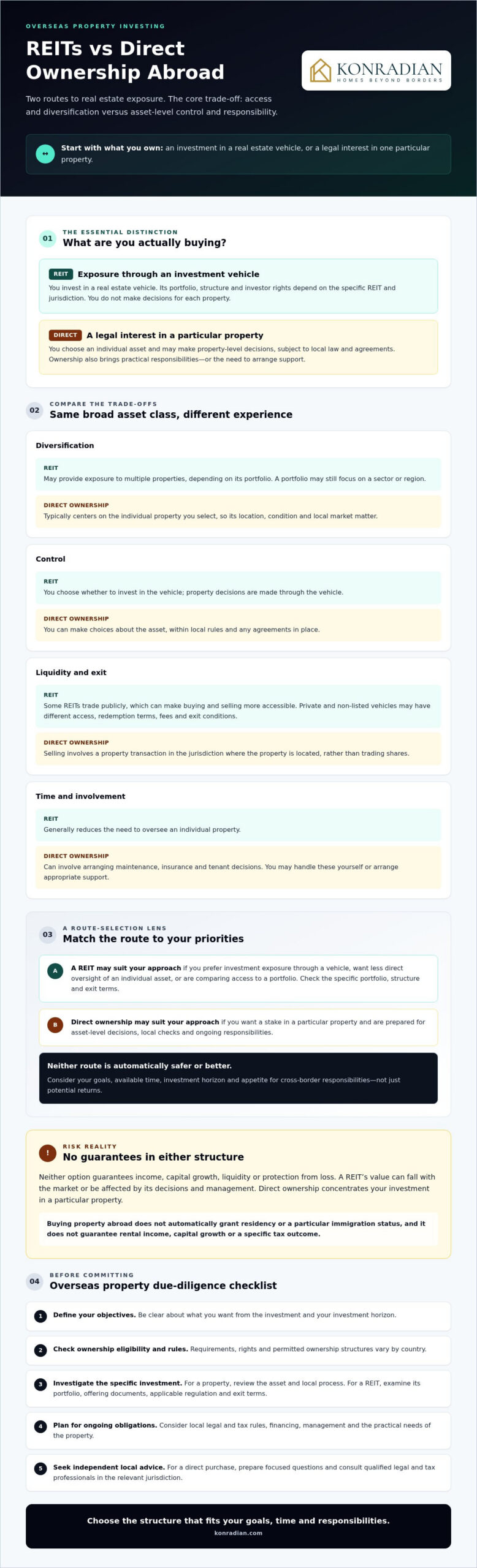
The key distinction in real estate investment trusts vs direct ownership abroad is what your investment represents. A REIT gives you exposure through an investment vehicle. Direct ownership gives you a legal interest in a particular property, along with asset-level decisions and responsibilities.
Buying property overseas doesn’t automatically grant residency or any particular immigration status. It also doesn’t guarantee rental income, capital growth or a specific tax outcome. Those depend on the property, the investment structure and the relevant country’s rules. Verify your circumstances with qualified local professionals.
How does a REIT give investors real estate exposure?
A REIT is a real estate investment vehicle that may pool investor capital or operate through a company structure. Its portfolio and investor rights depend on the specific vehicle and jurisdiction. For a foundational overview of structures and types, see Real estate investment trust (REIT).
Some REITs trade publicly on an exchange; others are private or non-listed. Public trading can make buying and selling more accessible, but it doesn’t mean every REIT has the same liquidity or risk. For private and non-listed vehicles, access, redemption terms and fees may differ. Review the offering documents and applicable regulation rather than assuming REIT status alone determines how easily you can exit.
What does direct ownership abroad involve?
Direct ownership starts with choosing a property and checking that you’re eligible to buy it under the destination’s rules. The purchase then follows the local process for due diligence, transferring title and any required registration. Steps, ownership rights and permitted ownership structures vary by country, so confirm the details locally before committing.
Legal title and day-to-day responsibility are related, but not identical. You may have choices about the property, subject to local law and any agreements in place. Practical matters can include maintenance, insurance and decisions about tenants. You may handle these yourself or arrange appropriate support. Buying a property does not itself provide ongoing management.
In short, a REIT provides investment exposure, while direct ownership provides asset-level control and responsibility. That distinction is a useful starting point, not a verdict. The right route depends on the specific vehicle or property, the rules that apply and how involved you want to be.
How Do Returns, Control and Risk Differ Across the Two Routes?
With real estate investment trusts vs direct ownership abroad, risk comes from both the property market and the route you choose. A REIT may hold several assets, but its value can still fall with the market or be affected by the vehicle’s decisions and management. Direct ownership concentrates your investment in a particular property, making its location, condition and local market especially important.
| Factor | REIT | Direct ownership |
|---|---|---|
| Diversification | May provide exposure to multiple properties, depending on its portfolio. | Typically focused on the individual property you select. |
| Control | You choose whether to invest in the vehicle, not the decisions for each property. | You can make property-level choices, subject to local rules and agreements. |
| Liquidity | Listed shares may be traded on a market, subject to availability and price fluctuations. Private or non-listed vehicles may have different exit terms. | Selling involves a property transaction in its jurisdiction, rather than trading shares. |
| Involvement | Property decisions are generally made through the vehicle. | Ownership can involve oversight and arranging local support for property needs. |
Which route offers more control and diversification?
Direct ownership lets you select a particular asset and make decisions about it, within the limits of local law and any contractual arrangements. A REIT may spread exposure across properties, but its portfolio might focus on a particular sector or region. Diversification can reduce reliance on one asset, but it doesn’t eliminate market risk or make a single REIT representative of an entire property market.
Neither route assures returns. Rental income, capital growth and the ability to sell at a preferred time are never guaranteed, and neither structure protects you from loss.
How do liquidity and ongoing involvement compare?
Trading listed REIT shares can be more straightforward than selling an overseas property, but the sale price depends on market conditions and buyers. Private and non-listed vehicles may be harder to exit, so review their terms before investing. Direct property sales involve a local transaction process, and neither timing nor outcome is assured.
A REIT generally means relying on the vehicle’s investment and management decisions. A property owner has more asset-level choices, but may need to coordinate local professionals for matters such as maintenance or tenant decisions. For U.S. REITs, the SEC’s official SEC guidance on REITs explains relevant investor considerations. It doesn’t describe rules in every country.
In brief, direct ownership puts decisions around an individual asset in your hands; a REIT puts investment decisions in the hands of a vehicle. If you’re assessing a potential purchase, explore cross-border property acquisition guidance as you consider property selection and transaction steps.
Which Option Fits Your Goals, Time and Risk Tolerance?
Use five questions to make the comparison practical: How much control do you want? How broad should your exposure be? How soon might you need access to your money? How much time can you commit? How long can you stay invested? Your answers help frame real estate investment trusts vs direct ownership abroad around your circumstances, rather than a universal winner.
- Control: Would you rather select an individual property, or invest in a vehicle whose managers make property-level decisions?
- Diversification: Is exposure to a portfolio important, or are you comfortable concentrating on one asset and location?
- Liquidity: Could you tolerate waiting for a suitable opportunity to sell, especially if you own a property overseas?
- Time: Do you want to review an investment vehicle, or are you prepared to oversee property decisions and coordinate local support?
- Investment horizon: Does your timeframe allow for market fluctuations and a potentially lengthy property sale?
When might a REIT be worth researching?
A REIT may be worth researching if you want real estate exposure without choosing and overseeing one property. That doesn’t make it risk-free or entirely hands-off: you still need to understand what the vehicle owns, how it’s run and how you can exit. The U.S. Securities and Exchange Commission’s REIT guidance is a useful starting point for understanding U.S. REITs, but it isn’t a substitute for checking the rules where another vehicle is offered.
Before proceeding, examine the investment strategy, fees, governance, jurisdiction and liquidity or redemption terms. Check whether the portfolio’s property types and locations fit your goals, and whether you could tolerate a fall in value or limits on selling.
When might direct ownership abroad be worth researching?
Direct ownership may be worth exploring if you want to choose a particular location, property type and ownership approach. That choice comes with responsibilities: assess the asset, verify local purchase and ownership rules, seek independent legal and tax advice, and decide how ongoing matters will be handled from a distance.
Be realistic about the practical demands. You may need to coordinate local professionals and make decisions about maintenance, insurance or tenants. Don’t assume a property will stay occupied, produce a particular yield or sell on your preferred schedule.
Suitability depends on your objectives, finances, experience and tolerance for risk. This framework is educational, not individual financial advice. If direct acquisition is under consideration, review cross-border property acquisition guidance as one part of your research into selection and transaction steps.
What Should You Check Before Investing in Property Abroad?
Cross-border due diligence should move from your investment objectives to the details of a specific property and transaction. In the wider comparison of real estate investment trusts vs direct ownership abroad, this checklist applies to a direct purchase. The exact rules, costs and documents depend on the country and property, so treat this as a planning framework, not legal or tax advice.
- Define your objectives. Clarify whether the property is intended for personal use, rental or another purpose, your likely holding period and how much time you can devote to ownership.
- Select a market to investigate. Compare your objectives with local market conditions, ownership eligibility and your intended holding period. Check whether your plans fit the location rather than relying on broad country-level assumptions.
- Verify ownership rules. Ask an independent local lawyer to confirm whether you can buy, how title is held and whether restrictions or conditions apply to the intended use.
- Assess the individual asset. Have qualified local professionals check title, planning status, condition and relevant transaction documents. Understand what you’re buying before committing.
- Review the full obligations. Investigate local taxes, transaction costs, financing access, insurance, maintenance and rental rules with appropriate local advisers. Don’t assume these work the same way as in your home country.
How can you assess the country and property?
Start with the intended use and holding period, then check whether the market and property suit them. A home you plan to use personally raises different practical questions from a property intended for rent. Ask independent local advisers to verify title, permitted use, planning status and condition. Tax treatment, purchase costs, financing availability and rental requirements are jurisdiction-specific. Confirm each for your circumstances rather than relying on generalisations.
Before making an offer, ask your local advisers to explain the documents they’ll review, the checks they recommend and any issues that could affect your intended use of the property. Keep a written record of the questions they answer and the points that still need clarification.
What changes when you buy from overseas?
Plan the process before making an offer. Confirm how viewings will be arranged, how documents will be reviewed, what identity checks are required and how signing will take place if you’re not in the country. Ask who represents your interests and how commissions, potential conflicts and any buyer-paid service fees are disclosed. Brokerage guidance can support property selection and transaction steps, but it doesn’t replace independent legal, tax or financial advice.
For a direct purchase in Spain, Croatia, the USA or Hungary, Konradian’s buyer service is generally provided at no additional cost, with commissions paid by sellers or developers. UK sourcing services charge the buyer. Explore overseas property acquisition support and clarify the applicable service arrangement before proceeding.
How Can You Take the Next Step Toward Direct Ownership Abroad?
The choice is ultimately between vehicle-based exposure and responsibility for a specific asset. REITs may suit investors researching exposure through an investment vehicle; direct ownership may suit those who want to select an individual property and accept the decisions and obligations that come with it. Compare both against the same goals, time commitment and risk tolerance before deciding.
Before exploring a purchase, write down four things: your target country, the property’s intended use, how involved you want to be and the questions you need qualified advisers to answer. Include questions about ownership eligibility, tax treatment, transaction steps and ongoing responsibilities. A clear brief makes it easier to assess whether a particular opportunity aligns with your plans.
What can an international property buying consultation clarify?
A consultation can help organise your priorities, preferred markets, property criteria and unresolved questions. Konradian supports acquisitions in Spain, Croatia, the USA, Hungary and the UK. Its buyer journey can include an initial video consultation, property selection, transaction guidance and support through key handover.
Service arrangements vary by market. In Spain, Croatia, the USA and Hungary, the buyer service is generally provided at no additional cost, with commissions paid by sellers or developers. UK sourcing services charge the buyer. Confirm the applicable arrangement for your intended market before proceeding. Konradian doesn’t provide property management or direct lending, so consider separately how you’ll handle the asset after purchase and assess financing options.
How do you move from comparison to a considered decision?
Apply the same questions to each route: Does it match your intended use and investment horizon? Is the level of control appropriate? Can you accept possible limits on liquidity, the risk of loss and the work involved? For a REIT, review the vehicle’s documents and consider independent financial advice. For direct ownership, seek independent legal and tax advice in the relevant jurisdiction before committing.
Acquisition guidance can help you work through property selection and transaction steps, but it doesn’t replace independent professional review or guarantee an investment outcome. Clarify the details, then decide whether direct ownership fits your plans. To discuss your international property plans, Discuss your international property plans.
Choose the Route That Fits Your Investment Priorities
The choice between real estate investment trusts vs direct ownership abroad comes down to what you want to own and what you’re prepared to take on. REITs offer exposure through an investment vehicle, while direct ownership lets you select an individual property and accept its associated responsibilities. Neither guarantees income, growth or an easy exit.
Before deciding, match each route to your objectives, time commitment, investment horizon and tolerance for risk. For an overseas purchase, verify the destination’s ownership rules, property details and tax considerations with qualified professionals. A careful review can help you understand the commitment involved.
For buyers considering direct ownership, Konradian supports property selection and transaction guidance through to key handover. Direct relationships with developers and agencies may also provide access to listings and pre-sale opportunities. The buyer journey and service-fee arrangements vary by market, so clarify the details for your destination.
Discuss your international property plans and take the next step with a considered brief, informed questions and the right professional advice. Your investment decision should align with your goals and the level of involvement you’re comfortable taking on.
Frequently Asked Questions
What is the main difference between a REIT and owning property directly abroad?
The main distinction in real estate investment trusts vs direct ownership abroad is what you own: a REIT gives you exposure through an investment vehicle or company, while direct ownership means acquiring an interest in a specific property. Control, liquidity, costs and responsibilities can differ substantially. REIT structures vary by country, and direct ownership raises local legal and operational questions. Compare the actual vehicle and property; neither route is automatically safer or more profitable.
Can you invest in a REIT that owns property in another country?
Investors can often research REITs or similar vehicles with exposure to property markets outside their home country, but access depends on the specific vehicle, your location and applicable rules. Review its holdings, reporting, fees, trading arrangements and jurisdiction before investing. International exposure through a REIT isn’t the same as owning property abroad, and it doesn’t give you direct control over an individual asset.
Is buying property abroad riskier than investing in a REIT?
Neither route is universally riskier; the risks differ. Direct ownership can concentrate your investment in one asset and involve local transaction requirements and ongoing decisions. A REIT may carry market, portfolio, management and liquidity risks. The comparison depends on the specific vehicle, property, country and your circumstances. Review relevant documents and seek qualified advice. Neither option guarantees income, appreciation, protection from loss or an easy exit.
How much money do you need to invest in a REIT or overseas property?
There’s no single amount that applies across REITs, countries or properties. Investment minimums, transaction expenses, financing access and ongoing obligations depend on the specific opportunity and jurisdiction. Compare the full financial commitment, not just an advertised entry figure, and verify current terms with relevant providers or professionals. Avoid relying on general price ranges; obtain property- or vehicle-specific information before deciding whether the investment fits your resources.
Can you manage a property abroad remotely?
Remote ownership may be possible, but it doesn’t remove the need to make decisions about maintenance, insurance, local requirements or rental arrangements. The level of remote oversight depends on the property, country and available professional support. Before buying, establish who can act locally, what they’ll do and how responsibilities are documented. Don’t assume a property broker provides ongoing management; confirm separately how the asset will be looked after.
Which is better for passive income, a REIT or direct property ownership?
Neither route guarantees passive income. A REIT may reduce the need to oversee an individual property, but distributions and value depend on the vehicle and market. Direct ownership may give you choices about using or renting a property, while adding operating responsibilities and the possibility of vacancy. Compare the actual obligations, fees, risks and local rules, then seek advice suited to your circumstances before choosing an approach.
Do foreign investors pay tax on property or REIT income abroad?
Tax treatment depends on your tax residence, the property or vehicle’s jurisdiction, the type of income and applicable agreements or reporting rules. REIT investments and direct property ownership may receive different tax treatment. A general online comparison can’t establish your individual tax obligations. Ask qualified tax professionals familiar with the relevant countries to review your circumstances before investing, receiving income or filing required returns.
