


What if you could buy your dream property in Spain, Croatia, or the USA without ever boarding a plane? It sounds like a privilege reserved for the ultra-connected few, but a remote property purchase abroad has become a well-established, legally sound process that thousands of buyers complete successfully each year.
You’re right to approach it with care. The concerns are real: unfamiliar legal systems, the risk of misrepresentation, financing complexities, and the unsettling feeling of committing to something you can’t physically inspect. These aren’t small worries, and anyone who tells you otherwise isn’t being straight with you.
This guide is designed to change that. By the time you’ve finished reading, you’ll understand exactly how the remote buying process works, what legal protections are available to you, and how to structure your approach so that distance never becomes a disadvantage. From identifying the right market to completing your transaction with confidence, we’ll walk through every stage of the journey, giving you the clarity and the tools to move forward on your own terms.
Key Takeaways
- A remote property purchase abroad is a legally sound, well-established process — but it requires a clear understanding of each market’s ownership laws, documentation requirements, and foreign buyer restrictions before you commit.
- Securing financing from an overseas lender involves distinct criteria and processes; knowing your options in advance gives you a significant strategic advantage when making time-sensitive decisions from a distance.
- Virtual viewings and remote due diligence can be conducted with the same rigour as in-person inspections, provided you know exactly what to look for and who to involve at each stage.
- Konradian’s end-to-end support — spanning legal and financial guidance across Spain, Croatia, and the USA — is structured to ensure that distance never compromises the quality or security of your purchase.
- The right professional partnerships transform complexity into clarity; by the end of this guide, you will have a practical framework for moving forward with confidence, regardless of where in the world your property sits.
Understanding the Remote Property Purchase Process
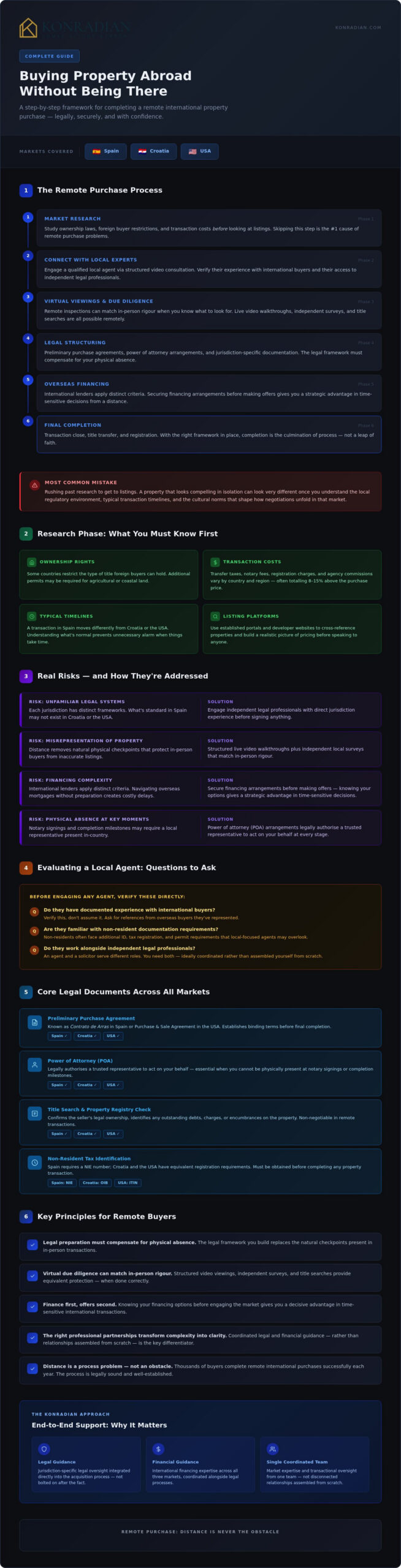
A successful remote property purchase abroad doesn’t happen by chance. It follows a deliberate sequence of steps, each one building on the last, and buyers who understand that sequence from the outset are the ones who complete transactions with confidence rather than anxiety. The process spans market research, professional engagement, due diligence, legal structuring, financing, and final completion, and every stage can be managed remotely when you know who to involve and what to ask.
The single most common mistake remote buyers make is compressing the early stages. Rushing past research to get to listings is understandable, but it’s where problems take root. A property that looks compelling in isolation can look very different once you understand the local regulatory environment, typical transaction timelines, and the cultural norms that shape how negotiations actually unfold in that market.
Initial Research: What You Need to Know
Before you engage with a single listing, you need a working understanding of the target country’s property ownership laws, foreign buyer restrictions, and transaction costs. These vary significantly between markets. Spain, Croatia, and the USA each operate under distinct legal frameworks, and what’s standard practice in one jurisdiction can be entirely absent in another.
Practically, your research phase should cover:
- Ownership rights for non-residents: Some countries restrict the type of title foreign buyers can hold, or require additional permits for agricultural or coastal land.
- Transaction costs beyond the purchase price: Transfer taxes, notary fees, registration charges, and agency commissions vary by country and sometimes by region.
- Typical timelines: A transaction in Spain moves differently from one in Croatia or the USA; knowing what’s normal prevents unnecessary alarm when things take time.
- Reputable listing platforms: Established portals and developer websites allow you to cross-reference properties and build a realistic picture of pricing in your target area before speaking to anyone.
For buyers considering properties in Australia, you can check out Ritz Realty, an online agency that provides the transparency and digital tools necessary for a successful remote search.
Connecting with Local Experts
Research gets you oriented. Local expertise gets you protected. Finding a reliable agent or advisor in your target market is one of the highest-leverage decisions you’ll make in the entire process, because the right professional doesn’t just show you properties; they translate the market for you, flag risks you wouldn’t know to look for, and advocate for your interests when it counts.
Virtual consultations have made this relationship far more accessible than it once was. A structured video call with a qualified local agent can cover property shortlists, neighbourhood context, and preliminary legal considerations in a single session. What matters is that you arrive at that conversation with specific questions, not just general interest.
When evaluating any agent or agency, ask directly about their experience with international buyers, their familiarity with the documentation process for non-residents, and whether they work alongside independent legal professionals. Konradian’s approach, for instance, integrates legal and financial guidance directly into the acquisition process across Spain, Croatia, and the USA, ensuring that buyers have access to market expertise and transactional oversight from a single, coordinated team rather than assembling those relationships themselves from scratch.
Legal Considerations for Remote Property Purchases
The legal architecture of an international property transaction is where the most consequential decisions are made, and where the most damaging mistakes tend to occur. For anyone conducting a remote property purchase abroad, the absence of physical presence makes rigorous legal preparation not just advisable but essential. Distance removes certain natural checkpoints, so the legal framework you build around your transaction has to compensate for that.
Essential Documents and Legalities
Every international purchase involves a distinct set of documents, and understanding what you’ll encounter before you encounter it is a meaningful advantage. The core instruments vary by jurisdiction, but across Spain, Croatia, and the USA, buyers should expect to engage with some version of the following:
- Preliminary purchase agreement: Often called a contrato de arras in Spain or a purchase and sale agreement in the USA, this document binds both parties before completion and typically involves a deposit. Its terms deserve careful scrutiny.
- Title deed or equivalent: In Spain, the escritura pública is executed before a notary. In Croatia, ownership is registered through the Land Registry. In the USA, title is conveyed via deed and insured through a title company. Each system has its own verification process.
- Encumbrance and lien searches: A clean title search confirms that the property is free from outstanding debts, legal disputes, or undisclosed charges. This step is non-negotiable regardless of how straightforward a listing appears.
- Foreign buyer identification requirements: Spain requires non-residents to obtain an NIE (Número de Identificación de Extranjero). Croatia and the USA have their own identification and registration requirements for international purchasers.
Common legal pitfalls in remote transactions include signing preliminary agreements without independent review, assuming that a seller’s solicitor protects your interests (they don’t), and overlooking planning permissions or building licences that affect the property’s legal status. A property can appear sound on the surface while carrying unresolved legal irregularities that only a qualified local search would reveal.
Protecting Yourself Legally
Independent legal representation isn’t a luxury in cross-border transactions. It’s a structural necessity. A local attorney who acts solely on your behalf reviews contracts for unfavourable clauses, conducts due diligence on the title chain, and ensures that any conditions precedent are satisfied before funds are transferred. They also confirm that the transaction complies with local property laws, including any restrictions on foreign ownership of coastal, agricultural, or heritage-designated land.
Tax obligations deserve equal attention. Transfer taxes, stamp duty equivalents, notary fees, and registration costs vary considerably between markets and, in some cases, between regions within the same country. Capital gains implications for future resale and any applicable wealth tax obligations should be assessed before you commit, not after.
Konradian’s legal and financial transaction support is integrated directly into the acquisition process across its core markets, meaning buyers don’t have to source these relationships independently. If you’d like to understand how that support applies to your specific situation, speak with a Konradian property advisor before your transaction reaches the contract stage.
Financing Your Property Purchase Remotely
How you fund your purchase shapes almost every other decision in the transaction. Financing a remote property purchase abroad introduces layers of complexity that domestic buyers rarely encounter: different lending criteria, cross-border income verification, and the ever-present influence of currency markets on your effective budget. Understanding these dynamics before you reach the negotiating table puts you in a materially stronger position.
Types of Financing Options
Remote buyers typically have three practical routes available to them, each with distinct trade-offs.
- International mortgages: Some lenders in Spain, Croatia, and the USA will extend mortgages to non-resident foreign buyers, though the criteria are more stringent than those applied to domestic applicants. Lenders typically require a larger deposit, comprehensive proof of income from your home country, and, in many cases, a local tax identification number before they’ll proceed. Loan-to-value ratios for non-residents are generally lower than those offered to residents, so your available capital needs to be planned accordingly.
- Equity release from existing property: Buyers who hold significant equity in a domestic property often find this the most straightforward route. Releasing equity through a remortgage or secured loan in your home country lets you purchase abroad as a cash buyer, which simplifies the transaction considerably and can strengthen your negotiating position.
- Developer financing and alternative structures: In some markets, particularly for new-build properties, developers offer staged payment plans that reduce the need for immediate full financing. These arrangements vary widely in their terms and should always be reviewed by your independent legal representative before you commit.
Cash purchases, where feasible, remove lender timelines from the equation entirely. That can be a genuine advantage in competitive markets where sellers favour certainty over price. The trade-off is liquidity; it’s a calculation worth making carefully rather than defaulting to either option without analysis.
Navigating Currency and Exchange Rates
Currency movement is one of the most underestimated variables in cross-border property finance. If you’re purchasing in euros or US dollars from a sterling or other currency base, a shift of even a few percentage points in the exchange rate can meaningfully alter the effective cost of your property between the point of agreement and the point of completion.
There are practical strategies for managing this exposure. Forward contracts, offered by specialist currency brokers, allow you to lock in an exchange rate for a future transaction date, protecting your budget against adverse movement. Rate alerts let you monitor the market and act when conditions are favourable. What you shouldn’t do is leave currency conversion to chance and assume the rate at the time of your initial offer will hold through to completion.
Konradian’s legal and financial transaction support spans its core markets in Spain, Croatia, and the USA, and includes guidance on the financial structuring considerations that remote buyers need to resolve before contracts are exchanged. If you’d like to discuss how these factors apply to your specific purchase, speak with a Konradian property advisor at the earliest stage of your planning.
Tips for a Successful Remote Purchase
Knowing the legal and financial framework is one thing. Executing a remote property purchase abroad with precision is another. The gap between the two is where most avoidable mistakes happen, and it’s almost always a result of underestimating the preparation required at the operational level. The buyers who complete smoothly are the ones who treat virtual viewings and remote due diligence with the same rigour they’d apply in person.
Maximising Virtual Viewings
A poorly conducted virtual viewing tells you almost nothing useful. A well-structured one tells you a great deal. Before any online tour, send your agent a specific list of what you want to see: ceiling heights, natural light at different times of day, storage space, the condition of windows and external walls, and any areas the listing photographs seem to avoid. Agents who represent your interests will accommodate these requests without hesitation; those who don’t are worth noting.
During the session, ask the agent to move slowly through transitions between rooms and to open cupboards, step outside onto balconies, and show the view from each window. These are the details that staged photography routinely omits. For neighbourhood context, tools like Google Street View, local authority planning portals, and community forums in the target area give you a working picture of what surrounds the property before you ever ask an agent to confirm it.
Specific questions worth raising in any virtual meeting:
- What are the immediate neighbours, and what’s the noise profile of the street at different times?
- Has the property been vacant, and if so, for how long?
- Are there any known issues with the building’s structure, roof, or utilities?
- What planning activity is registered nearby?
Conducting Due Diligence
Remote due diligence is not a lesser version of in-person due diligence. It’s a differently structured version of the same process. Verifying property condition remotely means commissioning an independent structural survey from a qualified local surveyor, not relying on the seller’s documentation or the agent’s assurances. A surveyor who works independently of the selling party will produce a report you can trust.
For value verification, cross-reference the asking price against comparable recent sales in the same area using local property portals, land registry data where publicly available, and your agent’s own market analysis. If those three sources don’t broadly align, that’s a conversation to have before you make an offer.
Documentation accuracy deserves its own discipline. Confirm that the property’s registered size matches what’s described in the listing, that all building works have the appropriate licences, and that utility connections are legal and active. In markets like Spain and Croatia, discrepancies between the registered and actual property footprint are more common than buyers expect, and they carry legal consequences that take time and cost to resolve.
Set realistic timelines from the outset. Transactions in international markets rarely move at the pace buyers initially anticipate, and building contingency time into your planning prevents pressure-driven decisions at critical moments. If a seller or agent is pushing for a faster signature than your legal review allows, that pressure itself is a data point worth taking seriously.
If you’d like guidance on structuring your due diligence process across Spain, Croatia, or the USA, speak with a Konradian property advisor before you reach the offer stage.
Why Choose Konradian for Your Property Purchase
Every stage of a remote property purchase abroad carries decisions that benefit from experienced, coordinated guidance. What distinguishes Konradian isn’t simply the breadth of markets it covers; it’s the way those markets are served. Legal support, financial transaction guidance, and access to exclusive listings are built into the acquisition process from the outset, not assembled piecemeal once a buyer has already committed to a direction.
End-to-End Support
Konradian’s model is structured around a single principle: the buyer should never be left to navigate unfamiliar territory alone. From the initial market assessment through to legal completion, a dedicated advisor remains with you throughout, providing continuity that fragmented professional relationships rarely deliver. That consistency matters because the questions that arise at the offer stage are often connected to information gathered weeks earlier, and a single advisor who holds the full picture is far better placed to protect your interests than a rotating cast of specialists who each see only their own piece of the transaction.
Across Spain, Croatia, and the USA, Konradian’s integrated approach covers:
- Legal and financial transaction support coordinated within the acquisition process, so buyers aren’t sourcing these relationships independently under time pressure.
- Access to exclusive listings and developer relationships that aren’t always visible through public portals, giving clients earlier and broader access to the market.
- Market-specific expertise across three distinct legal and regulatory environments, applied to the practical realities of buying from a distance.
What sets Konradian apart in international real estate is the absence of unnecessary complexity for the buyer. The coordination happens behind the scenes. The client experience is one of clarity and forward momentum.
Client-Centric Approach
Transparency isn’t a value Konradian claims; it’s built into how the service operates. Buyers receive straightforward assessments of each property’s legal standing, realistic timelines, and honest guidance on whether a particular opportunity aligns with their objectives. There’s no pressure to accelerate decisions that warrant careful consideration.
Clients who have completed purchases through Konradian consistently describe the same experience: a process that felt manageable, supported, and professionally overseen at every stage, regardless of the distance involved. That outcome doesn’t happen by accident. It’s the result of a service model designed specifically for buyers who can’t be present on the ground but refuse to compromise on the quality of their transaction.
If you’re ready to take the next step toward your international property purchase, speak with a Konradian property advisor and begin with a conversation tailored to your specific market, budget, and timeline.
Your International Property Journey Starts Here
A successful remote property purchase abroad isn’t a matter of luck. It’s the result of structured preparation, the right professional relationships, and a clear understanding of the legal and financial landscape before you commit to anything. This guide has walked you through each of those layers: from researching your target market and navigating ownership laws, to managing cross-border financing and conducting due diligence that holds up regardless of the distance involved.
The key is that none of it has to feel overwhelming. With the right support in place, complexity becomes process, and process becomes progress. For those who find that such significant life changes also prompt a period of personal reflection, Paulínky.cz offers a wealth of spiritual literature to accompany your journey.
Konradian’s end-to-end service spans Spain, Croatia, and the USA, with integrated legal and financial transaction support, access to exclusive listings and developer relationships, and a dedicated advisor who remains with you from first conversation through to completion. There are no hidden layers to navigate on your own.
If you’re ready to move forward with confidence, contact Konradian today and take the first step toward owning the property you’ve been planning for.
Frequently Asked Questions
What are the first steps to buying property abroad?
Start by researching your target country’s ownership laws, foreign buyer restrictions, and total transaction costs before you look at a single listing. This groundwork prevents you from falling in love with a property that sits in a legally complicated zone or carries costs you hadn’t budgeted for. Once you understand the regulatory landscape, your next priority is securing independent legal representation in that country.
From there, connect with a local agent or advisory service that has direct experience working with international buyers. The sequence matters: research, then legal representation, then property search. Reversing that order is where avoidable problems begin.
Is it safe to buy property overseas without visiting?
Yes, provided you approach it with the right professional structure in place. A remote property purchase abroad is a legally established process that buyers complete successfully across Spain, Croatia, the USA, and many other markets every year. The risks aren’t unique to remote buying; they’re the same risks any buyer faces when they skip independent legal review, skip a structural survey, or rely solely on a seller’s documentation.
What makes remote purchasing safe is the quality of the people acting on your behalf on the ground. An independent local solicitor, a qualified surveyor, and an advisor with genuine experience in cross-border transactions collectively provide the oversight that physical presence would otherwise offer.
What legal protections do I have when purchasing internationally?
Your primary legal protection comes from the independent solicitor you appoint in the country where you’re buying. They review contracts for unfavourable clauses, conduct title searches, verify planning permissions and building licences, and confirm that the transaction complies with local property law. That protection only applies, however, if your solicitor is working exclusively for you and not for the seller or the agent.
Beyond your solicitor, each market has its own formal protections. Title insurance is standard practice in the USA. Land Registry verification applies in Croatia. In Spain, the notarial process provides an additional layer of legal oversight at completion. Understanding which protections exist in your target market is part of the preparation your advisory team should walk you through before contracts are exchanged.
How do I finance a property purchase in another country?
You have three main routes: an international mortgage from a lender in your target country, equity released from an existing domestic property, or developer payment plans for new-build purchases. Each carries different requirements. Non-resident mortgages typically come with lower loan-to-value ratios and stricter income verification than domestic equivalents, so your deposit requirements are likely to be higher than you’d expect at home.
Currency exposure is a separate consideration that buyers frequently underestimate. If you’re purchasing in euros or US dollars from a different currency base, exchange rate movement between offer and completion can materially affect your total cost. Forward contracts through a specialist currency broker let you lock in a rate and protect your budget. This is a planning step worth taking early, not something to address at the last minute.
What should I consider when choosing a property remotely?
Prioritise what photography routinely obscures: the condition of external walls and the roof, the legal status of any extensions or outbuildings, the registered floor area versus what’s described in the listing, and the noise and activity profile of the immediate neighbourhood. Request a structured virtual tour with specific instructions for your agent rather than accepting a pre-recorded walkthrough, and supplement it with independent tools like local planning portals and street-level mapping.
Don’t treat the asking price as validated until you’ve cross-referenced it against comparable recent sales using local property portals and, where publicly available, land registry data. A property that looks well-priced in isolation can look different once you understand what similar homes in the same area have actually sold for.
Can I get help with legal issues after the purchase?
Post-completion legal questions are common in international property ownership and can range from tax filing obligations and inheritance planning to disputes over boundaries or building works. Whether you have ongoing access to legal support depends on the advisory relationship you established during the purchase. Some buyers retain their local solicitor for continued support; others find their initial transaction team wasn’t structured to provide it.
It’s worth clarifying the scope of any legal relationship before you complete, not after. Konradian’s legal and financial transaction support is integrated into the acquisition process across Spain, Croatia, and the USA; if you have questions about what ongoing guidance looks like for your specific situation, speak with a Konradian property advisor directly.
What are the common pitfalls to avoid when buying property abroad?
The most consequential pitfalls share a common cause: compressed preparation. Signing a preliminary agreement before your solicitor has reviewed it, assuming that transaction timelines will match domestic expectations, overlooking regional taxes and fees that sit on top of the purchase price, and failing to verify that all building works on the property carry the correct licences are all mistakes that create expensive, time-consuming problems after the fact.
Equally damaging is relying on a single professional who has a financial interest in the transaction completing. The seller’s agent, the developer’s representative, and the notary each have defined roles that don’t include protecting your interests. Independent legal representation, an independent structural survey, and an advisor whose mandate is to act for you rather than facilitate a sale are the three structural safeguards that experienced international buyers treat as non-negotiable.
