


What if the most secure way to acquire international real estate in 2026 involves never actually boarding a flight? For many high-net-worth investors, the idea of a remote property purchase abroad feels like a calculated risk fraught with hidden structural defects and impenetrable legal jargon. You likely feel the weight of foreign bureaucracy or the nagging worry that you’ll be overcharged simply because you aren’t a local. It’s a natural response to the high stakes of global acquisition, where even a small oversight in a distant market can lead to significant complications.
This guide demonstrates that remote buying isn’t a shortcut, but rather a sophisticated method of professional stewardship. We’ll provide a clear roadmap that replaces travel fatigue with legal certainty and elite representation. You’ll learn how to leverage a “verifiable on paper” model to ensure every document is authenticated and every structural detail is vetted before funds are ever transferred. We’ll preview the essential steps for navigating markets in Spain, Hungary, and the US, moving you from a broad global strategy to a precise, personal acquisition with total peace of mind.
Key Takeaways
- Understand how 2026 technology, including 4K virtual walkthroughs and drone-assisted analysis, provides greater transparency than traditional in-person property visits.
- Master the “Three-Pillar” legal framework to independently verify property titles, planning permissions, and outstanding liabilities before committing capital.
- Learn why professional, independent structural surveys and the use of secure escrow accounts are non-negotiable safeguards for your international investment.
- Discover the strategic roadmap for a remote property purchase abroad that eliminates travel fatigue while ensuring you aren’t overcharged by local markets.
- Explore a refined stewardship model that combines elite global expertise with personalized care to create a seamless, end-to-end acquisition experience.
The Evolution of Remote Property Purchase Abroad in 2026
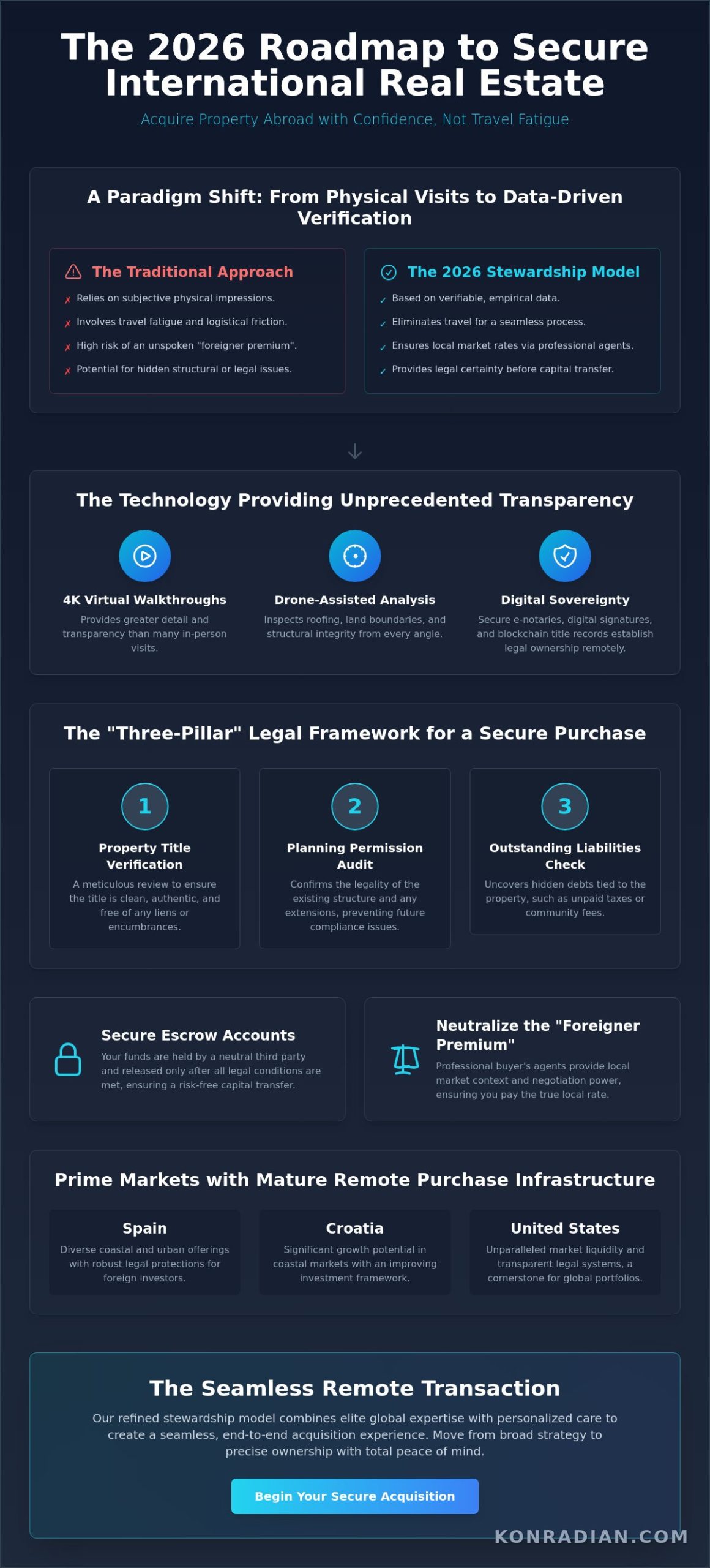
The concept of a remote property purchase abroad has transformed from a high-risk venture into a meticulously managed professional process. In 2026, the traditional “sight-unseen” purchase, once reserved for the most daring investors, is now often more secure than physical visits conducted without expert oversight. This shift is driven by a transition from fragmented, do-it-yourself buying to integrated, end-to-end services that prioritize empirical data over subjective physical impressions. Modern investors recognize that a successful acquisition depends less on walking through a hallway and more on the rigorous verification of the underlying legal and structural data.
This evolution mirrors the broader sophistication of the global real estate market, where transparency has become a primary currency. Investors are moving away from the stress of coordinating international travel and local meetings. Instead, they’re opting for a model of professional stewardship. This approach allows for a broader global perspective, enabling capital to move toward high-yield opportunities without the logistical friction of the past. It is a transition from being a tourist with a checkbook to acting as a strategic consultant for one’s own portfolio.
Markets such as Spain, Croatia, and the United States remain the primary targets for this refined acquisition model. Spain continues to attract capital through its diverse coastal and urban offerings, while Croatia’s coastal markets provide significant growth potential. The US market, particularly for high-net-worth individuals, remains a cornerstone of global investment due to its unparalleled liquidity and transparent legal systems. In each of these regions, the infrastructure for a secure remote property purchase abroad is now fully established, providing the legal certainty required for high-stakes transactions.
The Rise of Digital Sovereignty in Real Estate
Physical presence is no longer a prerequisite for legal validity in major international transactions. In 2026, e-notary services and digital signatures have reached a level of maturity across the European Union and the US that allows for the secure exchange of title deeds with total confidence. Many emerging markets have integrated blockchain technology to provide an immutable record of property ownership, which significantly reduces the risk of title fraud. These advancements ensure that your legal footprint is established with precision, regardless of your physical location, allowing for a seamless transition from offer to ownership.
Overcoming the “Foreigner Premium” Risk
Direct-to-seller inquiries often trigger an unspoken “foreigner premium,” where prices are adjusted upward for international buyers who lack local market context. Neutralizing this bias requires a protective barrier. Professional buyer agents ensure you pay the local market rate rather than an inflated price designed for outsiders. This is why the expertise of an international real estate investment advisor is indispensable. They provide the intellectual authority and market savvy needed to navigate local nuances, ensuring your acquisition is both strategically sound and financially optimized.
Navigating the Legal and Financial Architecture Remotely
A secure remote property purchase abroad demands a structural shift in how we approach legal safety. While a physical walkthrough provides sensory detail, the true security of an investment lies in the precision of its legal architecture. To achieve this, you must implement a “Three-Pillar” legal check that scrutinizes every facet of the asset before capital is committed. This involves a meticulous review of the property title to ensure it’s free of encumbrances, a verification of planning permissions to confirm the legality of the structure, and a deep dive into existing liabilities like unpaid taxes or community fees. This data-driven approach replaces the “sight-unseen” anxiety with empirical certainty.
Managing these moving parts requires seamless coordination between your home-country tax advisor and local legal counsel. International transactions often trigger complex tax implications, from wealth taxes in regions like Spain to capital gains considerations in the US. Ensuring these two teams are in sync prevents the friction of double taxation and ensures compliance with both local and international reporting standards. By treating the purchase as a strategic business acquisition rather than a simple retail transaction, you protect your portfolio from the bureaucratic oversights that often plague unmanaged purchases.
The Strategic Power of Attorney
Protecting your interests remotely requires a limited Power of Attorney (PoA) that defines specific, authorized actions without surrendering total control. In 2026, the use of digital apostilles has matured, allowing for the rapid authentication of legal documents across jurisdictions with high-level encryption. It is imperative that your legal representative remains entirely independent of the developer, seller, or real estate agency. This independence is the cornerstone of professional stewardship, ensuring your counsel’s only priority is your legal and financial protection throughout the acquisition process.
Financial Readiness for Cross-Border Transactions
Securing capital and managing liquidity across borders is a methodical process. In 2026, opening non-resident bank accounts through remote biometric verification has become standard, yet it requires a proactive approach to Anti-Money Laundering (AML) documentation. Most European lenders, particularly in Spain and France, offer non-resident mortgages with a Loan-to-Value (LTV) ratio between 60% and 75%, typically requiring deposits of 25% to 40%. You must also account for the hidden costs of buying property abroad, which generally range from 10-13% in Spain and 7-10% in Portugal to cover taxes and notary fees.
Currency volatility remains a significant risk that can result in a “hidden” 3% loss if handled through traditional retail banks. Savvy investors utilize forward contracts to lock in exchange rates, ensuring the final price remains stable regardless of market fluctuations. If you are seeking professional legal and financial transaction support to navigate these complexities, focusing on early tax alignment and secure currency hedging will provide the tranquility needed for a high-stakes international investment.
The “Boots on the Ground” Model: Technology vs. Local Presence
While the legal and financial architecture provides the necessary safety net, the physical reality of a remote property purchase abroad requires a sophisticated synthesis of high-resolution technology and elite local expertise. In 2026, relying on a simple video call or grainy smartphone photos is an unacceptable risk for high-stakes acquisitions. A professional process involves a multi-layered verification of the asset’s physical state, replacing subjective impressions with empirical data and professional stewardship.
- Step 1: Implementing 4K Virtual Walkthroughs and Drone-Assisted Analysis. We utilize ultra-high-definition virtual tours and drone surveys to capture every angle of the property and its surrounding topography. This allows for a detailed inspection of the roof, exterior finishes, and the property’s relationship with neighboring lots, identifying potential environmental risks or boundary discrepancies before they become your problem.
- Step 2: Professional Structural Surveys by Independent Engineers. Technical rigor is non-negotiable. We coordinate independent engineers who have no ties to the developer or seller. They provide a comprehensive assessment of the foundation, load-bearing structures, and utility systems, ensuring the property’s bones are as sound as its marketing materials suggest.
- Step 3: Neighborhood “Vibe” and Infrastructure Audits. We look beyond the property line. This includes analyzing noise levels at various hours, researching municipal planning records for future developments, and assessing the long-term viability of local infrastructure. You won’t be surprised by a new construction project blocking your view six months after closing.
- Step 4: Real-Time Reporting via Dedicated Client Portals. Every finding, from the smallest survey detail to the latest drone footage, is uploaded to a secure, synchronized portal. This platform provides a central repository for your due diligence, allowing you to monitor progress with total transparency and quiet confidence.
Beyond the Video Call: Technical Due Diligence
Photos are easily curated to hide flaws or omit unfavorable views. True technical due diligence requires a deeper level of access. Working with a real estate agency with developer access ensures you aren’t just choosing from the leftovers of a project. It grants you a comprehensive view of the full inventory and the development’s overall trajectory, often securing pre-sale pricing and prime units that never reach the public market. This level of access is the investor’s edge in a competitive global landscape.
Managing the Human Element Remotely
Vetting local professionals from thousands of miles away requires a concierge mindset and cultural fluency. It’s not enough to hire a random scout; you need a partner who speaks both “Investor” and “Local Authority.” This protective barrier handles the heavy lifting of local bureaucracy, ensuring that every architect, notary, and local official is held to an international standard of accountability. We act as your cosmopolitan guide, translating complex local nuances into clear, actionable insights that prioritize your long-term interests and emotional well-being. This methodical approach ensures your remote acquisition is handled with the same care as a local transaction, but with the added benefit of elite global expertise.
Mitigating Risks: How to Avoid Mistakes Buying Property Overseas
Acquiring property from a distance creates a specific vulnerability to local market distortions and listing inaccuracies. While technology provides the eyes, only a rigorous risk mitigation strategy provides the protection. You must approach every remote listing with a degree of intellectual skepticism, looking beyond the aesthetic appeal to the underlying legal and structural reality. This begins with a Red Flag checklist designed to identify high-risk assets before you engage in formal negotiations. Common warning signs include prices that sit significantly below the 2026 local market average, a lack of verifiable public records, or any pressure to bypass established legal channels in favor of direct bank transfers.
The use of secure escrow accounts is the only safe way to handle remote deposits. Without a neutral third party holding funds, your capital remains at the mercy of the seller’s liquidity or their integrity. In competitive markets like Spain and Croatia, verifying building permits is equally critical. You must confirm the existence of the First Occupation License in Spain or the Usage Permit in Croatia to ensure the structure is legally fit for habitation. Failure to verify these documents can lead to significant legal liabilities or the inability to secure utility connections, transforming a strategic investment into a bureaucratic burden.
Be particularly wary of “free” local services. If a lawyer or surveyor is offered at no cost to you, their fees are almost certainly being covered by the developer or seller. This creates an inherent conflict of interest where your representative’s primary loyalty is not to you, but to the party paying their commission. True professional stewardship requires that every member of your team is independently retained and strictly focused on your long-term interests throughout your remote property purchase abroad. Knowing how to identify a trusted real estate agency abroad is therefore a foundational skill for any sophisticated international investor operating in 2026.
Due Diligence in the Digital Age
Modern investors avoid mistakes buying property abroad by cross-referencing listing claims with independent data sources. This involves verifying land registry records to confirm ownership and cross-referencing satellite imagery with listing photos to identify “ghost” properties or unrecorded structural changes. A comprehensive security audit goes beyond the property itself, investigating the financial stability of developers and the historical transparency of local municipal offices. This level of scrutiny ensures your acquisition is based on verified facts rather than marketing narratives.
The Conflict of Interest Trap
Dual agency, where a single agent represents both the buyer and the seller, is a significant risk for remote buyers. It fundamentally compromises the agent’s ability to negotiate the best price or disclose potential flaws. Engaging in a real estate buyer consultation before you begin your search establishes a clear framework for exclusive representation. This process identifies potential kickback structures in local legal referrals and ensures your advisor acts as a protective barrier against predatory pricing. If you are ready to secure your portfolio with expert oversight, our team provides professional Spanish property acquisition and transaction support designed for the sophisticated global investor.
The Konradian Approach: A Seamless Remote Transaction
A sophisticated remote property purchase abroad requires more than just a digital portal; it demands a philosophy of professional stewardship. The Konradian approach is built on an LSE-educated mindset that combines strategic rigor with a deep sense of local hospitality. This ensures your acquisition isn’t just a transaction, but a carefully managed transition into a new market. By acting as a protective barrier between you and the inherent noise of foreign real estate, we handle the heavy lifting, allowing you to focus on the high-level goals of your investment portfolio.
Our end-to-end service is designed to remove the friction that typically plagues international buying. One of the most significant advantages we provide is exclusive pre-sale access. We secure opportunities in prime developments before they ever reach the open market, ensuring you aren’t fighting for leftovers. In many of our key markets, including Spain, Croatia, Hungary, and the US, our buyer-side representation is provided at no cost to the investor. This model ensures you have elite, independent advice without adding to your overhead, as we align our interests with your long-term success.
From Consultation to Key Handover
The end-to-end property buying service we offer follows a methodical workflow that prioritizes transparency. We coordinate a synchronized team of legal, financial, and logistical experts who work on your behalf, ensuring that every step is documented and verified. For instance, in a recent acquisition in Malaga, we managed the entire process from the initial virtual due diligence to the final notary signing via Power of Attorney. Similarly, in the competitive market of Split, we’ve successfully navigated local bureaucracy to secure coastal assets for remote investors, providing legal certainty without the need for travel.
Your Global Property Concierge
Peace of mind is our primary product. We understand that for a sophisticated investor, time is the most valuable asset. Our role is to act as your global property concierge, maintaining a cosmopolitan mindset that reflects your own international standards. We don’t just find properties; we secure your interests in a foreign landscape with quiet confidence and intellectual authority. If you’re ready to master the complexities of a remote property purchase abroad with a partner you can trust, take the first step toward a secure acquisition. We invite you to book your free video consultation with Konradian today to discuss your specific investment goals.
Securing Your International Legacy with Strategic Precision
Mastering a remote property purchase abroad in 2026 requires a fundamental shift from traditional, travel-heavy methods to a sophisticated model of professional stewardship. You’ve seen how a rigorous “Three-Pillar” legal check and advanced technical due diligence replace the anxiety of sight-unseen buying with empirical certainty. By prioritizing independent representation and secure financial structures, you transform a complex cross-border transaction into a managed process that values your time as much as your capital.
Our LSE-educated advisory team brings more than five years of specialized cross-border transaction experience to every acquisition. We provide direct developer access to ensure you secure exclusive pre-sale deals that often remain invisible to the public market. This level of oversight ensures your investment is protected by intellectual authority and local market savvy. When you’re ready to move from global insight to personal acquisition, we’re here to guide the way with quiet confidence.
Schedule a Free Video Consultation for Your Remote Purchase
Your international investment journey deserves the tranquility that comes from elite professional stewardship. We look forward to helping you build a secure and prosperous global portfolio with total peace of mind.
Frequently Asked Questions
Is it safe to buy property abroad without visiting it in person?
Yes, a remote property purchase abroad is secure when you transition from a “sight-unseen” mindset to a “verifiable on paper” model. In 2026, digital land registries and 4K virtual due diligence provide a level of transparency that often exceeds a brief physical visit. By prioritizing independent structural surveys and legal audits over subjective impressions, you ensure the asset is vetted by data rather than emotion.
How do I handle the legal signing process for a remote property purchase?
The legal signing process is managed through a limited Power of Attorney (PoA), which allows your legal representative to act on your behalf for specific, authorized actions. Modern digital apostilles and e-notary services in the EU and US have matured to provide high-level encryption for document authentication. This ensures your legal footprint is established with precision without the need for international travel or physical presence at a notary’s office.
What are the main risks of buying property remotely in 2026?
The primary risks involve undisclosed legal encumbrances, structural defects hidden by curated marketing photos, and the “foreigner premium” pricing bias. There is also a significant risk of conflict of interest if your local representative is receiving kickbacks from a developer or seller. Mitigating these risks requires an independent team that conducts a “Three-Pillar” check on the title, planning permissions, and existing liabilities.
How can I verify the condition of a property from another country?
Verifying a property’s condition requires a combination of high-resolution technology and independent engineering expertise. Professional walkthroughs utilize 4K video and drone-assisted site analysis to inspect hard-to-reach areas like roofs and foundations. Crucially, you should always retain an independent structural engineer who has no ties to the seller to provide a comprehensive, unbiased report on the building’s utility systems and structural integrity.
Do I need a local lawyer even if I have a buyer’s agent?
Yes, retaining independent legal counsel is essential to ensure a clear separation of interests during your remote property purchase abroad. While a buyer’s agent manages the search and negotiation, a lawyer focuses exclusively on the legal architecture of the deal, such as title verification and tax alignment. This dual-layered representation provides a protective barrier, ensuring every facet of the transaction is scrutinized by a specialist whose only priority is your security.
What are the hidden costs of remote property acquisition?
Beyond the purchase price, you must budget for transfer taxes, notary fees, and land registry charges, which typically add 10-13% to the cost in Spain and 7-10% in Portugal. Currency volatility can also lead to a “hidden” loss of approximately 3% if exchange rates aren’t locked in via forward contracts. Professional stewardship involves identifying these costs early to ensure your capital allocation remains accurate and your portfolio isn’t impacted by unforeseen bureaucratic expenses.
Can I get a mortgage for a property purchase abroad remotely?
Yes, many international lenders offer non-resident mortgages that can be processed entirely through remote biometric verification and digital document submission. In European markets like Spain and France, non-resident buyers can typically secure financing with a Loan-to-Value (LTV) ratio between 60% and 75%. While interest rates for non-residents are often 0.50% to 0.75% higher than domestic rates, they remain a viable tool for leveraging your international investment.
How does Konradian ensure the security of my remote transaction?
Konradian ensures security by acting as a sophisticated global citizen and protective partner throughout the end-to-end acquisition process. We utilize an LSE-educated advisory team to coordinate every expert, from independent engineers to legal counsel, ensuring all data is verified before funds move. By providing direct developer access and maintaining total independence from sellers, we eliminate conflicts of interest and provide the intellectual authority needed for a seamless transaction.
