


A country’s reputation can’t make an individual property a secure investment. To assess secure real estate investment opportunities in Europe, examine the deal itself: its documentation, costs, local context, and fit with your investment goals. Start with evidence, not a country label or a persuasive sales claim.
It’s understandable to feel cautious. Legal and tax systems differ across borders, headline market trends don’t reveal the details of a specific property, and a remote purchase can leave you unsure about documents, counterparties, and next steps. A consistent framework helps you compare those differences and identify what needs further due diligence before you make an offer.
This guide explains how to compare markets and individual properties, assess deal-level risks, and prepare for an international transaction. You’ll learn what to review before committing, from ownership and transaction details to the assumptions behind an investment claim. Konradian supports buyers with property selection, legal and financial transaction support, and guidance through to handover.
Key Takeaways
- Assess secure real estate investment opportunities in Europe by examining ownership, documentation, permitted use, and exit options, not by relying on a country’s reputation.
- Compare properties using consistent criteria, including intended use, ongoing costs, liquidity, and fit with your goals.
- Separate verifiable property details from forecasts and marketing claims before deciding whether an opportunity merits further consideration.
- Use a jurisdiction-specific sequence of checks for title, property records, permitted use, condition, and transaction documents.
- See how guided property selection and transaction support can help carry an international purchase from initial consultation through handover.
What makes a European real estate investment opportunity secure?
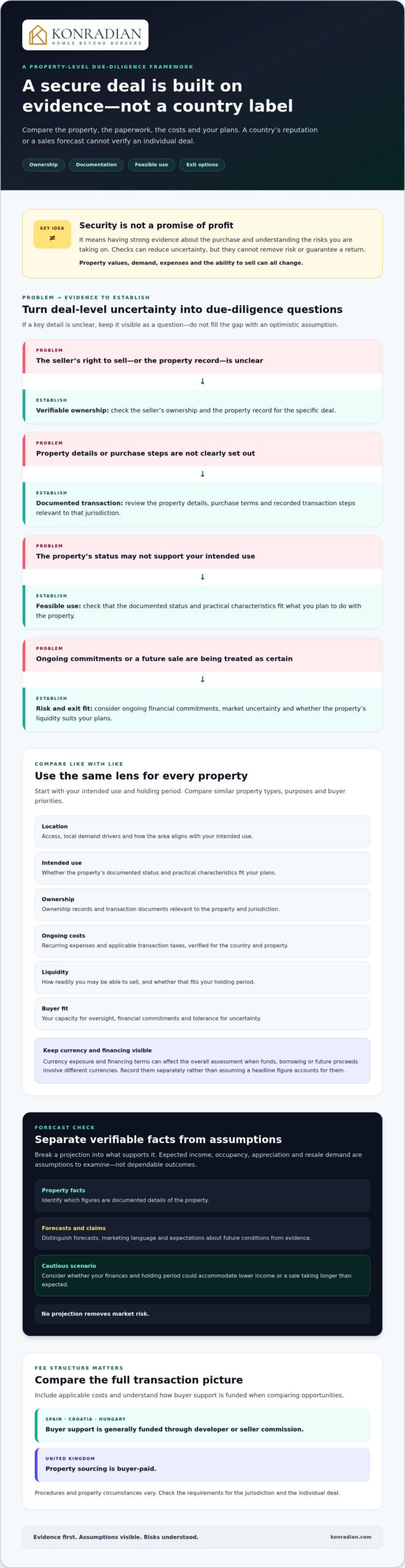
Security isn’t a promise of profit. It means having strong evidence about the purchase and understanding the risks you’re taking on. Secure real estate investment opportunities in Europe have verifiable ownership, reliable property records, documented transaction steps, a feasible intended use, and exit options that fit the buyer’s plans. These checks can reduce uncertainty, but they can’t remove risk or guarantee a return. Property values, demand, expenses, and the ability to sell can all change.
What does secure property investment mean in practice?
Secure property investment is a purchase supported by verifiable ownership, clear documentation, feasible use, and considered exit options, with remaining risks understood rather than ignored. Clear title and accurate property records help establish what’s being acquired; documented purchase terms clarify the steps and commitments. Legal risks concern ownership and transaction requirements. Financial risks include costs and funding assumptions. Market risks involve changing demand or values, while operational risks affect how the property can be used. None can be assumed away. The broader concepts of real estate investing also include valuation and investment analysis, not just selecting a location.
Why Europe is not one uniform property market
Rules for ownership, taxes, transaction steps, and local market conditions vary by country. Details may also depend on the property and the buyer. Spain, Croatia, and Hungary can be useful markets to compare, but their procedures and property circumstances aren’t interchangeable. A country’s reputation or a headline about its market can’t verify the title, permitted use, condition, or transaction documents for a specific property. Check requirements for the jurisdiction and the individual deal.
Use this initial screen before comparing locations:
- Ownership: Can you verify the seller’s ownership and the property record?
- Documentation: Are the property details and purchase steps clearly recorded?
- Feasible use: Does the property’s documented status fit your intended use?
- Risks and exit: Have you considered ongoing financial commitments, market uncertainty, and how you might sell?
If key details are unclear, treat them as due-diligence questions rather than filling gaps with optimistic assumptions. This gives you a consistent starting point. Next, compare opportunities using the same criteria instead of letting projected returns or a country label set the terms.
How to compare European property opportunities beyond headline returns
Put each property through the same questions before weighing projected performance. The aim is to understand what you’re buying, how it fits your plans, and which assumptions still need evidence. This makes it easier to compare secure real estate investment opportunities in Europe without treating a sales forecast as a dependable outcome.
Which factors should buyers compare across markets?
Start with your intended use and holding period. A home for personal use, a long-term investment, and a property you may need to sell quickly have different requirements. Compare like with like: similar property types, purposes, and buyer priorities. The EU Charter recognizes a fundamental right to property in the EU, but that principle doesn’t verify the title or transaction documents for an individual purchase.
| Factor | What to compare |
|---|---|
| Location | Access, local demand drivers, and how the area aligns with your intended use. |
| Intended use | Whether the property’s documented status and practical characteristics fit your plans. |
| Ownership | Ownership records and the transaction documents relevant to that property and jurisdiction. |
| Ongoing costs | Recurring expenses and applicable transaction taxes, verified for the country and property. |
| Liquidity | How readily you may be able to sell, and whether that fits your holding period. |
| Buyer fit | Your capacity for oversight, financial commitments, and tolerance for uncertainty. |
Currency exposure and financing terms can also affect the overall assessment, especially when your funds, borrowing, or future proceeds involve different currencies. Record these separately rather than assuming a compelling headline figure accounts for them.
How to assess an opportunity without relying on yield claims
Break any projection into its assumptions. What supports expected income, occupancy, appreciation, or resale demand? Which figures are documented property facts, and which are forecasts, marketing language, or expectations about future conditions? Test a cautious scenario against your holding period and financial capacity. Consider whether you could manage if income is lower or a sale takes longer than expected. No projection removes market risk.
Compare the full transaction picture, including applicable costs and the buyer-fee arrangement. In Spain, Croatia, and Hungary, buyer support is generally funded through developer or seller commission, while UK property sourcing is buyer-paid. Understanding the fee structure helps you assess the basis of the comparison.
For a structured view across markets and purchase stages, explore Konradian’s international property guidance.
What property-level checks help reduce cross-border investment risk?
Once an opportunity fits your comparison criteria, move from market-level impressions to the specific property and transaction. Work through due diligence in a consistent sequence: verify the seller’s ownership, compare property records with what’s being offered, establish whether the intended use is feasible, assess the property’s condition, and review the purchase documents and financial commitments. Records and processes differ by jurisdiction, so check the requirements for the country and property in question.
Which documents and property details need review?
- Ownership and records: Review evidence of ownership and relevant land or cadastral records through the applicable local process. Compare names, identifiers, boundaries, and the property description across documents.
- Permitted use: Check that the property’s documented status aligns with your intended plan. A mismatch between marketing descriptions, records, and proposed use needs clarification before you proceed.
- Condition and obligations: Assess the physical condition and identify any outstanding obligations associated with the property. Consider whether your findings could affect costs, usability, or the timing of the purchase.
- Transaction documents: Review the purchase terms, required steps, and supporting paperwork under local requirements. Keep a record of what you’ve verified and what remains unresolved.
These checks can reveal discrepancies and help you make an informed decision, but they can’t predict every future issue. Documentation may establish what’s recorded today; it can’t remove market shifts, unexpected costs, or uncertainty about a future sale.
How to assess financial and exit risks
Build a complete cost picture before committing. Separate acquisition costs, applicable taxes and fees, financing terms, and recurring obligations. Verify how each applies to the particular country and property instead of assuming the rules are consistent across Europe. Then consider how long you may need to hold the property, whether resale liquidity fits that timeframe, and whether your plan depends on a single use case.
Consider whether your finances can accommodate a longer holding period or a change in expected use. Market research can provide context, but it isn’t a property-level guarantee. PwC’s Emerging Trends in Real Estate offers broader perspectives, not a substitute for reviewing a specific asset and its documents. For more on the transaction process, see the legal support buying property abroad guide.
This disciplined sequence helps you assess secure real estate investment opportunities in Europe by separating facts you can investigate from risks that remain uncertain.
How to choose the right European market for your investment goals
The right market depends on what you want the property to do for you. Start with intended use, likely holding period, property type, and how much oversight you can realistically provide. Then compare each market against the same criteria: access, ownership and transaction requirements, ongoing costs, local demand context, and the property’s fit with your plans. This keeps the decision focused on evidence rather than broad claims that one country is inherently safer than another.
How do Spain, Croatia, and Hungary fit different buyer priorities?
Assess Spain, Croatia, and Hungary as distinct markets, not interchangeable entries on a shortlist. Within each country, location, property characteristics, and buyer circumstances can change the practical fit. If you’re considering Spain, the Spanish property acquisition guide provides country-specific purchase context. Use the same comparison framework for other markets, checking local requirements and the individual property before forming a view.
Buyer priorities differ, too. One person may value convenient access for personal use, while another may put more weight on a manageable ownership structure or flexibility over the holding period. These preferences don’t establish that a market or property will perform well. Instead, they help define what “suitable” means for you, so you can compare relevant features rather than relying on lifestyle appeal or a broad national reputation.
When should buyers consider a different European market?
Reconsider a location if the intended use doesn’t align with practical access, ownership considerations, or your capacity to oversee the asset. Croatia and the Istrian region may attract interest for lifestyle reasons, but appeal alone isn’t evidence of investment quality. Examine the specific property, its documented use, costs, and likely resale considerations. For regional background, read the Istria real estate investment guide.
Apply the same discipline when exploring Hungary. The Hungary property investment guide offers focused context for buyers researching that market. Country guides can help frame questions, but they don’t replace a property-level review or current jurisdiction-specific checks.
To create a more considered shortlist, define your goals first, then compare properties using consistent criteria across markets. Explore international property acquisition support to see how guided selection and transaction support can help structure the process.
How Konradian supports a more considered international property purchase
Cross-border buying involves more than finding a property. A structured process connects your goals with relevant opportunities, clarifies what needs review, and keeps the steps from selection to handover in view. Konradian supports international acquisitions in Spain, Croatia, Hungary, the UK, and the USA, helping buyers assess secure real estate investment opportunities in Europe with guidance throughout the purchase journey.
What does end-to-end acquisition support look like?
The process begins with an initial video consultation to understand your objectives, preferred markets, intended use, and practical requirements. Property selection then focuses the search on relevant options, including opportunities available through Konradian’s direct relationships with developers and real estate agencies. These relationships can provide access to pre-sale opportunities, but access alone doesn’t establish whether a property suits your plans or risk tolerance.
As a purchase progresses, support can include legal and financial transaction assistance, coordination around the acquisition, and guidance through to handover. Requirements differ by jurisdiction, and transaction support doesn’t guarantee a legal outcome or replace property-specific review. Konradian has over five years of experience, and its team is educated at the London School of Economics. These are background credentials, not promises of investment performance.
Understand the buyer-fee arrangement as part of your decision. In Spain, Croatia, Hungary, and the USA, buyer support is generally funded through commission paid by the seller or developer. UK property sourcing is a buyer-paid service. Clear fee expectations help you assess the overall purchase process.
What should buyers prepare before an initial consultation?
A few clear priorities can make the first discussion more productive. Consider:
- Intended use: How do you expect to use the property?
- Market preferences: Which countries or locations are you considering, and why?
- Time horizon: How long might you hold the property, and how important is resale flexibility?
- Practical requirements: What property type, access, and ownership responsibilities fit your circumstances?
- Financial boundaries: What is your budget range, and what assumptions are you making about financing and ongoing costs?
Bring your priorities, not a fixed conclusion. A considered conversation can help shape a relevant shortlist and identify questions for further review. Discuss your European property investment goals with Konradian.
Make your next property decision with clarity
Assess secure real estate investment opportunities in Europe deal by deal. Verify ownership and documentation, confirm that the intended use is feasible, and compare costs, liquidity, and buyer fit using the same framework across markets. Forecasts can inform your thinking, but they can’t guarantee returns or remove the risks of property ownership.
A considered purchase also depends on how well the opportunity fits your goals and capacity for oversight. Konradian supports buyers from initial consultation and property selection through transaction support and handover. The company has over five years of experience, and its team is educated at the London School of Economics. Its direct relationships with developers and agencies can provide access to relevant listings, including pre-sale opportunities, but can’t guarantee that a particular property is right for you.
Start with a clear view of your priorities, then explore suitable options with experienced guidance. Discuss your European property investment goals with Konradian and take your next step with greater confidence.
Frequently Asked Questions
What makes a real estate investment in Europe secure?
A more secure investment is supported by verifiable ownership, accurate property records, clear transaction documents, feasible intended use, and considered exit options. These checks help you understand the deal, but they can’t eliminate legal, financial, market, or operational risks. To assess secure real estate investment opportunities in Europe, focus on the individual property and purchase process rather than relying on a country’s reputation or a projected return.
Is Europe a safe place to invest in real estate?
Europe isn’t one uniform property market, so no single answer applies to every country or property. Ownership rules, taxes, transaction steps, and local market conditions vary. A well-documented purchase in one location can still carry risks related to condition, use, costs, or resale prospects. Compare specific opportunities against your goals, and verify the property and applicable requirements in its jurisdiction before committing.
How do I compare property investment opportunities in different European countries?
Use the same criteria for every opportunity: location and access, intended use, ownership records, applicable transaction taxes, recurring costs, liquidity, and fit with your time horizon and oversight capacity. Compare similar property types and use cases rather than putting unrelated investments side by side. Keep verified property details separate from forecasts and marketing claims, and account for currency exposure and financing assumptions in your assessment.
What due diligence should I do before buying property abroad?
Review ownership and relevant land or cadastral records using the local process. Compare the property description and documented permitted use with the asset and your plans. Assess its condition, identify outstanding obligations, and review transaction documents under the jurisdiction’s requirements. Before committing, understand applicable taxes, fees, financing terms, and recurring costs. Due diligence can uncover issues, but it can’t make future values or resale demand certain.
Can I buy European investment property without travelling?
It may be possible to complete a purchase without travelling, but whether each step can be handled remotely depends on the country, property, and transaction requirements. Konradian supports buyers from an initial video consultation through property selection, transaction support, and handover. Remote guidance can help coordinate the process, but confirm the applicable signing, identity, and documentation steps for the specific purchase before relying on a fully remote transaction.
Does Konradian charge buyers for property acquisition support?
In Spain, Croatia, Hungary, and the USA, buyers generally receive Konradian’s support at no direct cost because developers or sellers pay the brokerage commission. UK property sourcing is a buyer-paid service. This describes the brokerage support arrangement, not the full cost of purchasing property. Taxes, transaction expenses, financing, and other property-related costs are separate considerations and vary by market and purchase.
Does a property investment guarantee rental income or appreciation?
No. A property investment can’t guarantee rental income, appreciation, or a particular resale outcome. Actual performance depends on factors such as the property, its use, costs, local demand, and wider market conditions, which may change over time. Treat income and growth projections as assumptions to examine, not promises. Consider whether your financial capacity and holding period can accommodate lower income, unexpected expenses, or a slower sale.
