


You can buy UK investment property without flying in. UK property sourcing for overseas investors can bring together property selection, local research, due diligence and acquisition support, with the purchase managed remotely. A clear process helps you assess each opportunity and its risks from abroad.
Buying from overseas can make it harder to judge a location, understand the rental market and coordinate the practical steps of a transaction. That doesn’t mean you have to make decisions at a distance without local insight. Careful research and hands-on acquisition support can help you move forward with a clearer view of the property and the process.
This guide explains how UK-wide sourcing works, what local research and due diligence should cover, and how rental demand and ongoing costs shape an investment decision. It also outlines the steps involved in buying remotely, from the initial search through to acquisition.
Key Takeaways
- Remote buying is possible when property selection, local checks and acquisition steps are coordinated from overseas.
- Compare locations by employment, infrastructure and tenant demand, then assess the tenancy model against local requirements.
- Build a realistic investment picture by accounting for legal and condition checks, ongoing costs, vacancy and currency movements.
- Understand what a sourcing fee covers and how it is structured before assessing the service’s value for your purchase.
- Map out the transaction from initial search to completion so you know which decisions and documents to prepare for.
UK-wide sourcing and local market research
UK property sourcing for overseas investors starts with matching a purchase strategy to local evidence. Research should compare regional demand, property condition, likely costs and the buyer’s intended portfolio role.
Below-Market and Off-Market Opportunities
Sourcing can uncover advertised properties and off-market opportunities. Less competition may create scope for value, but an unadvertised property is not automatically a sound investment. Compare its asking terms with similar local properties, then examine its condition, likely refurbishment needs and rental prospects. Investors looking across diverse acquisition channels might also review residential or commercial opportunities from Auction Property Ltd to benchmark lot values. A low purchase price matters only if the property fits your investment plan.
Location Selection
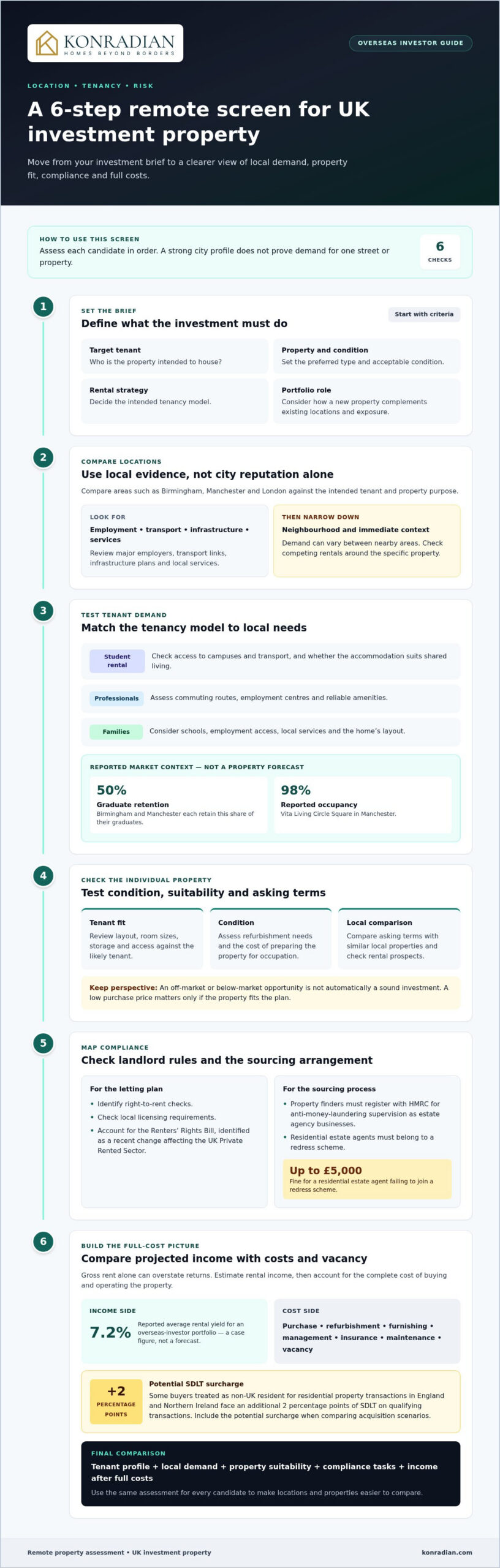
Choose an area based on the intended tenants and the property’s purpose. Compare employment, infrastructure and tenant demand across locations such as Birmingham, Manchester and London. Then narrow the search to neighbourhoods where transport, services and local employers support your intended tenancy model. Demand can vary between nearby areas, so assess each property in its immediate context.
A UK-wide search lets investors compare more options than focusing on one familiar city. Set your criteria first: target tenant, property type, acceptable condition and rental strategy. A sourcing specialist can screen opportunities against those criteria instead of treating every listing as suitable. For a portfolio, consider how a new property complements your existing locations and exposure.
Local research should test the investment case, not simply describe an area. Review transport links, major employers, infrastructure plans and competing rental properties. Compare these factors with the property’s layout and likely tenant profile. A flat near a university may suit student demand, while a family house may depend more on schools, employment access and local services. These examples can guide research, but do not replace property-specific checks.
Market and legal risks also affect the sourcing process. Property finders must register with HMRC for anti-money-laundering supervision as estate agency businesses. Residential estate agents must belong to a redress scheme and can face a fine of up to £5,000 for failing to join. These requirements make regulatory compliance relevant when assessing how a sourcing arrangement is conducted.
Tax treatment belongs in the early financial assessment. According to HM Revenue & Customs, some buyers treated as non-UK resident for residential property transactions in England and Northern Ireland face an additional 2 percentage points of SDLT on qualifying transactions. Include this potential surcharge when comparing acquisition scenarios, alongside the property’s location and investment purpose.
Verifying location, tenancy model, regulations and rental demand
A location can look attractive on a map and still fail a rental strategy. Assess the intended tenant first, then test whether local employment, transport, education and services support that demand. Birmingham and Manchester each retain 50% of their graduates, while Vita Living Circle Square in Manchester has a reported occupancy rate of 98%. These examples offer context, not forecasts for another property.
Student rentals and professional lets call for different property features and local evidence. A student-focused property may depend on access to campuses, transport and suitable shared accommodation. Professionals may prioritise commuting routes, employment centres and reliable amenities. Compare nearby rental listings, property layouts and local employers before choosing a tenancy model. A strong city-wide profile does not prove demand for an individual street or building.
Check whether the property’s layout and condition suit the intended tenant. A family home, shared student house and city-centre apartment appeal to different renters. Review room sizes, storage, access and the likely cost of preparing the property for occupation. Then compare competing rentals nearby. This helps distinguish an area with broad appeal from a specific property that may need changes before letting.
Rental rules also shape the operating plan. The Renters’ Rights Bill is identified as a recent change affecting the UK Private Rented Sector. Regulatory changes affect landlords regardless of residency status. Right-to-rent checks and local licensing requirements are also part of landlord compliance. Before choosing a tenancy model, identify the requirements that apply to the property and intended letting arrangement, then account for the work needed to meet them.
Gross rent alone can overstate returns. Estimate rental income, then account for purchase and refurbishment costs, furnishing, management, insurance, maintenance and vacancy. A reported overseas-investor portfolio achieved an average rental yield of 7.2%, but that case figure should not be treated as a forecast for another investment. The useful comparison is each property’s projected income against its full costs and likely periods without a tenant.
Use a consistent assessment for each candidate: tenant profile, local demand, property suitability, compliance tasks and net income after costs. This makes comparisons between locations more meaningful and reveals whether the proposed rental strategy fits the asset. For a structured acquisition process, explore UK property sourcing support alongside your location and tenancy assessment.
Property due diligence and investment risk assessment
Due diligence tests both the property and the assumptions behind its investment case. Overseas buyers should also assess the sourcer’s compliance, evidence and working process before proceeding.
To assess a sourcer’s credentials and track record, review relevant transaction examples, references and the services provided in each case. Check whether the business has HMRC registration for anti-money-laundering supervision and belongs to a redress scheme when acting as a residential estate agent.
Investor and Seller Due Diligence
Customer checks begin when an investor instructs a sourcing agent. A UK property sourcing business must conduct customer due diligence at that point. Buyers should prepare identification and proof of funds for anti-money-laundering checks. Sellers and other transaction parties may also need to provide information confirming their identity and role.
These checks establish who is involved and help clarify the source of funds. Keep names, ownership details and transaction documents consistent throughout the purchase. If buying through a company, prepare its ownership information alongside personal identification. Getting documents ready early can help prevent delays later.
Local Property Due Diligence
A sourcer can gather local information and flag issues for further assessment, but an investment decision also needs legal review and a condition assessment. Compare the listing description with inspection findings, identify visible repairs and consider how the work could affect your rental plan.
Legal checks should examine title information, restrictions and transaction documents. Condition checks should consider the building, fixtures and likely maintenance needs. Review these findings alongside projected income and costs, so an attractive purchase price does not obscure repair or ownership risks.
Ask for a clear record of the sourcing process: the property criteria, why each opportunity was shortlisted and which local checks were completed. A track record is most useful when examples relate to a similar property type, location or investment strategy. Look for a transparent explanation of the sourcer’s role, rather than treating a completed purchase as proof that every future opportunity is suitable.
Regulatory compliance is another practical test. Property finders must register with HMRC for anti-money-laundering supervision as estate agency businesses. Residential estate agents must join a redress scheme and can be fined up to £5,000 for failing to do so. These requirements help buyers distinguish documented compliance from general claims of expertise.
Include financial and cross-border risks in your assessment. Currency movements can change the sterling cost of a purchase and affect returns when income is converted. Set out the purchase funds, expected rental income and ongoing expenses in one consistent currency, then consider how exchange-rate changes could alter the investment case. Review legal findings, property condition evidence and financial assumptions together before deciding whether to proceed.
Property sourcing and acquisition support
Remote buying is a sequence of linked decisions, not simply an online property search. A sourcing and acquisition process can move from defining investment criteria to selecting a residential property, reviewing documents and coordinating completion. Overseas buyers can complete without travelling to the UK, with sourcing, due diligence, conveyancing and mortgage applications handled remotely. Each stage needs clear responsibilities and timely document exchange.
Begin with an agreed brief covering location, property type, intended letting strategy and investment priorities. The sourcer can then present suitable opportunities with comparable information, including asking terms, condition, local context and potential next steps. If you already have a portfolio, assess how each candidate fits its existing locations and tenant profile. A shortlist should explain why each property matches your brief, not merely describe its features.
Once you select a property, acquisition support can coordinate the practical steps:
- Collect identification, proof of funds and purchase details for transaction checks.
- Arrange property inspections and gather findings for legal and condition reviews.
- Coordinate conveyancing documents, mortgage application steps and required responses.
- Track outstanding decisions, funds and completion arrangements through to key handover.
Non-resident buy-to-let mortgages are available in the UK, but the lending market is narrower than for UK residents. Eligibility criteria vary by country of residence. A mortgage broker can help assess the lending route, and you should allow time for lender requirements and supporting documents. Financing is separate from sourcing: finding a property does not secure mortgage approval.
Remote coordination depends on a reliable record of decisions. Keep the agreed offer, survey findings, legal enquiries, lender requests and completion documents organised in one transaction timeline. If refurbishment is needed, record the proposed work and how it affects the letting plan before completion. Some sourcing arrangements also include renovation planning, which can help you assess improvements before committing to a purchase.
Completion does not end the acquisition process. After a UK purchase completes, the property is registered in the buyer’s name with HM Land Registry. Confirm that the handover includes the relevant transaction records and property information. One reported overseas purchase took fourteen weeks from initial enquiry to key handover. That timeline illustrates how sourcing, legal work and coordination fit together, but is not a standard timetable for every purchase.
For a portfolio strategy, repeat the same decision framework for each acquisition. One case study reports an overseas investor acquiring 4 properties, showing how a defined search can extend beyond a single purchase. The useful takeaway is to make each opportunity pass through the same documented stages, from investment brief to completion, while keeping financing, legal review and property preparation aligned.
What fees do UK property sourcing companies charge?
Sourcing fees depend on the arrangement. The price is provided after a quote request; key factors include search scope, property type, location and the level of acquisition support. A focused search for one property, for example, may involve different work from sourcing several assets across regions.
Agreements may use a fixed fee, a percentage of the purchase price, staged payments or a success-based structure. The label alone does not show what you receive. Ask which work each payment covers, when it becomes due and what happens if you decide not to proceed with a shortlisted property. A written scope makes the terms easier to compare.
Separate the sourcing service from other transaction expenses. Conveyancing, surveys, mortgage advice, refurbishment and ongoing letting costs may fall outside a sourcer’s fee. Build a complete acquisition budget, listing each expected expense alongside the responsible professional. This avoids treating the sourcing fee as the only cost of buying a UK investment property.
Use this checklist when reviewing a proposal:
- Scope: Does the service cover the property search, local research, viewings or remote reports?
- Due diligence: Which checks are coordinated, and who performs legal and condition assessments?
- Payment trigger: Is payment due at instruction, property selection, offer acceptance or completion?
- Additional expenses: Are third-party services and transaction costs itemised separately?
- Exit terms: What happens to payments if the purchase does not proceed?
Compare proposals based on the work you need, not just the headline fee structure. One arrangement may cover property introductions only, while another may include more research and acquisition coordination. An overseas buyer who needs remote viewing reports, for example, may value a different scope from a buyer already familiar with the area.
Ask for the service stages and payment terms in writing before instructing a sourcer. Match each payment to a defined deliverable, such as an agreed shortlist or completion coordination. Then compare the scope with your investment priorities, including location, property condition and intended rental strategy. This gives you a clearer basis for deciding whether the arrangement suits your purchase.
For a considered discussion of your acquisition priorities, outline your UK property search and the support you need from sourcing through purchase.
Konradian: Spanish Property Acquisition
Konradian offers Spanish Property Acquisition for investors whose plans extend beyond the UK. After assessing a UK opportunity, you may also be considering how another country could fit your wider investment strategy. Comparing markets starts with clarifying your objectives, preferred property type and the role each purchase should play in your portfolio.
Konradian also offers Croatian Real Estate Sales, US Real Estate Investment Services and Hungarian Property Brokerage. These services can help when your property interests span more than one country and you want to explore acquisition opportunities in those markets.
If you’re considering property in Spain, contact Konradian to discuss your plans.
Set Your Next Investment Decision in Motion
A disciplined approach to UK property sourcing for overseas investors starts with a clear investment brief. Before pursuing another opportunity, define how the purchase should support your wider portfolio, how much involvement you can manage remotely and what evidence will guide your decision. That clarity helps keep future choices aligned with your objectives rather than driven by an appealing listing alone.
If your plans extend beyond the UK, Konradian also offers Spanish Property Acquisition, Croatian Real Estate Sales and US Real Estate Investment Services. Considering how different markets might fit your strategy can help you decide where to focus next, with each acquisition tied to your broader investment goals.
To discuss your UK property plans and the acquisition support you need, contact Konradian about UK property sourcing. A clear next step can turn an overseas investment objective into a considered plan.
Frequently Asked Questions
Can you really buy without flying in?
Yes, overseas buyers can complete a UK property purchase remotely without travelling to the country. Each stage needs reliable documentation and clear communication. For example, request a written property report and recorded viewing details before making an offer. Conveyancing, mortgage applications and acquisition coordination can also be handled remotely, helping you make decisions from abroad while keeping a clear record of each step.
How does the property purchase process work for international buyers?
International buyers typically begin by setting their budget, preferred property type and intended use. Next, they review a shortlist, select a property and progress the offer through legal and financial checks. Prepare identification and proof of funds for anti-money-laundering checks, and organise mortgage documents if borrowing. The transaction then moves through conveyancing and completion. A shared timeline helps overseas buyers track outstanding documents, decisions and funds without relying on informal updates.
Want genuine off-market property deals?
Off-market opportunities are properties marketed outside the usual public listing channels. Sourcing professionals may research them alongside advertised properties. Access can depend on local relationships and whether a seller is open to a private approach. Ask for the property’s terms, condition and rationale for sale, then compare it with similar local homes. Less competition can be useful, but does not replace independent legal and condition checks.
What’s the difference between a property sourcer and a buyer’s agent?
The terms can overlap, so focus on the agreed work rather than the title. A property sourcer commonly searches for opportunities matching a buyer’s brief; a buyer’s agent may also represent the buyer’s interests in negotiations and acquisition coordination. Ask for the written scope, payment triggers and any excluded services. Clarify, for example, whether property viewings, local research and communication with transaction professionals are included.
Why are overseas investors choosing UK property?
Investors may consider UK property for its varied locations, tenant profiles and property types. A buyer comparing a city apartment with a family home, for example, can assess distinct rental strategies within the same country. Test the investment case against local demand, purchase costs and your objectives. A UK address alone does not establish suitability; the property and its operating plan matter.
How does UK property sourcing work for overseas investors?
The process begins with a defined investment brief, followed by a search for suitable properties and a reasoned shortlist. The buyer reviews each option, decides whether to proceed and coordinates legal, financial and property checks before completion. For an overseas investor, useful sourcing updates explain why a property fits the brief, what local evidence supports it and which decisions remain outstanding. This makes the search more structured than browsing listings without agreed criteria.
What UK rules apply to property sourcers, including estate agent and anti-money-laundering requirements?
An estate agent handling residential property must also join a redress scheme and can be fined up to £5,000 for failing to do so. These obligations are distinct from property-specific legal checks. Overseas buyers can review a sourcer’s stated compliance arrangements and written service terms as part of assessing how the sourcing instruction will be handled.
What taxes do overseas investors pay when buying UK property, including stamp duty and non-resident tax rules?
Tax depends on the transaction and the buyer’s circumstances. For qualifying residential transactions in England and Northern Ireland, some buyers treated as non-UK resident face an additional 2 percentage points of SDLT, according to HM Revenue & Customs. Overseas investors should also assess how UK property tax rules interact with those in their home country. Include tax considerations in the purchase calculations before committing to an investment.