


The property with the highest headline yield may not deliver the stronger investment. A UK property yield calculator for investors is only as useful as the assumptions behind it. Gross figures can make two homes look directly comparable, even when purchase costs, empty periods and ongoing expenses tell a different story.
Look beyond rent alone. This guide explains gross and net rental yield, what each measure includes and where each can fall short. You’ll learn how to compare properties using consistent assumptions, account for acquisition and operating costs, and identify figures that need further investigation.
Transaction taxes and rules differ across the UK’s jurisdictions, while mortgage costs and tax can affect your overall return. A clear view of these figures can help you assess opportunities before progressing with an acquisition.
Key Takeaways
- Use a UK property yield calculator for investors to compare returns with consistent inputs, not headline rent alone.
- Separate one-off purchase costs from recurring operating expenses to see how each affects the yield calculation.
- Compare gross and net yield as distinct measures, and treat neither as a complete prediction of investment performance.
- Test a base case, cautious case and stronger case by adjusting rent, vacancy, repairs and management assumptions.
- Use your results to shape a shortlist, then investigate each property’s condition, location, achievable rent and transaction assumptions.
UK Property Yield Calculator: What It Measures and What It Cannot Tell You
Rental yield compares a property’s annual rental income with its value or purchase cost, expressing the relationship as a percentage. A UK property yield calculator for investors uses the figures entered to estimate that ratio. It can help compare scenarios, but it can’t guarantee rent, occupancy, costs or a financial outcome.
Gross yield is a quick screening measure based on rent and purchase price. Net yield brings specified operating costs into the comparison, offering a more cost-aware view of rental income. Both depend on the quality and consistency of your inputs. The related concept of capitalization rate also measures property income against value, though definitions and included income or costs can vary.
Calculated yield measures rental income relative to a stated value; it is not total return, capital growth or cash flow. Those outcomes involve other factors, including changes in property value, financing and the timing of income and expenses.
Gross rental yield: a quick first comparison
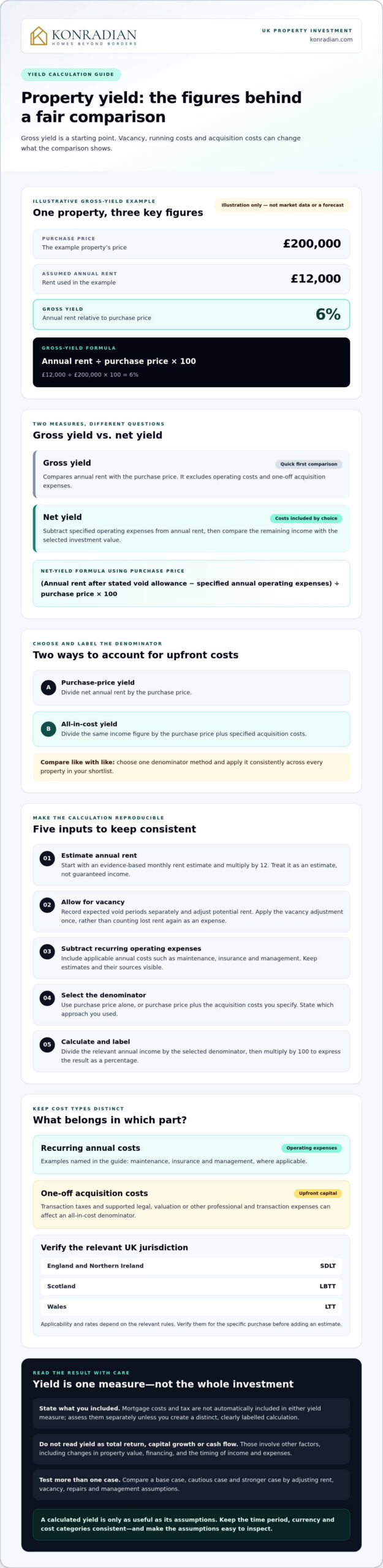
Formula: annual rent ÷ purchase price × 100. For a hypothetical example, a property bought for £200,000 with assumed annual rent of £12,000 has a gross yield of 6% (£12,000 ÷ £200,000 × 100). This is an illustration, not market data or a forecast.
Gross yield excludes operating costs, such as repairs or insurance, and one-off acquisition expenses. It can help with an initial comparison, but a property with a higher gross figure may leave less income after costs.
Net rental yield: a closer view of income
Net yield subtracts the operating expenses you choose to include from annual rent, then expresses the remainder as a percentage of the investment value. A clear convention is to use the purchase price as the denominator: (annual rent − specified operating expenses) ÷ purchase price × 100.
For a fuller view of upfront capital, you can instead use purchase price plus acquisition costs as the denominator. Label this as an all-in-cost yield, and apply the same method to every property you compare. Keep one-off costs distinct from recurring annual expenses.
Neither version automatically includes mortgage interest, tax or capital growth. Assess financing and tax separately, and state which expenses your calculation includes. That transparency makes the result easier to interpret and less likely to suggest a precision the inputs can’t support.
How to Calculate UK Property Yield: Formulas, Inputs, and Assumptions
A useful calculation is reproducible: keep the same time period, currency and cost categories for every property, and record where each estimate came from. A UK property yield calculator for investors can organise the arithmetic, but the result depends on the assumptions entered.
- Estimate annual rent. Start with an evidence-based monthly rent estimate and multiply by 12 to calculate potential annual rent. Treat this as an estimate, not guaranteed income.
- Allow for vacancy. Record expected void periods separately and adjust potential rent to show the income assumption after vacancies. Apply the adjustment once, rather than counting lost rent again as an expense.
- Subtract recurring operating expenses. Include the annual costs relevant to the property, such as maintenance, insurance and management, where applicable. Keep each estimate and its source or date visible.
- Select the denominator. Use either the purchase price alone or the purchase price plus specified one-off acquisition costs. State which approach you chose.
- Calculate and label the measure. Divide the relevant annual income by the selected denominator, then multiply by 100 to express the result as a percentage.
Which figures belong in a UK rental yield calculation?
Separate recurring costs from one-off costs. Operating expenses relate to running the property over the year; purchase and transaction expenses arise from acquiring it. Keep mortgage costs and tax distinct unless you’re deliberately calculating a separate, clearly labelled measure. This makes it easier to see what is driving the result.
For a net yield using purchase price as the denominator, subtract the listed annual operating expenses from annual rent after the stated void allowance, divide by purchase price, and multiply by 100. If you include management, maintenance and insurance, name them. Don’t imply the result includes costs you left out.
How purchase costs change the yield denominator
A purchase-price-only calculation divides net annual rent by the agreed property price. An all-in approach divides the same income figure by purchase price plus the acquisition costs you’ve included. The latter can show how upfront expenses affect the return on total capital committed. Compare like with like by using one denominator method across your shortlist.
Transaction taxes depend on the property’s UK jurisdiction. SDLT applies in England and Northern Ireland, LBTT in Scotland, and LTT in Wales, subject to the relevant rules. Verify current applicability and rates for the specific purchase before adding an estimate. Include legal, valuation or other professional and transaction expenses only when supported by your assumptions, and record the source and date.
Once your assumptions are clear, connect disciplined property selection with guidance through the acquisition process. Konradian’s UK property sourcing and acquisition support can help you take that next step.
Gross vs Net Yield: Compare UK Investment Properties on Equal Terms
Gross and net yield answer different questions. Gross yield offers a quick view of rent relative to a property’s price; net yield shows what remains after the operating costs you choose to include. A UK property yield calculator for investors is most useful when it applies the same definitions, time period and denominator to every property.
| Metric | Basic formula | Included costs | Best use |
|---|---|---|---|
| Gross yield | Annual rent ÷ purchase price × 100 | No operating or acquisition costs | Initial screening with consistent rent and price inputs |
| Net yield | Annual rent less specified operating expenses ÷ stated property value or investment cost × 100 | Only the recurring costs named in the calculation; acquisition costs may be included in the denominator if stated | Comparing rental income after selected operating expenses |
| Cash flow | Income received less outgoings over a defined period | Income and expenses included in the chosen period, potentially including finance costs | Assessing whether the investment generates or requires cash |
| Cash-on-cash return | Annual cash flow ÷ cash invested × 100 | Depends on the cash-flow and invested-capital assumptions | Considering income against the investor’s cash contribution |
| Total return | Income plus change in value, less relevant costs, over a stated period | Depends on which income, value changes and costs are included | Reviewing broader performance over time, not rental income alone |
When gross yield is useful, and when it misleads
Gross yield can narrow an initial shortlist, provided rent and purchase price are calculated consistently. But it leaves out the expenses that distinguish one property from another. A home with higher gross yield may need more maintenance or carry higher recurring costs, so its net yield could rank below a lower-gross-yield alternative. No single yield threshold proves that an investment is right. Suitability depends on your priorities, evidence and assumptions.
Yield is not cash flow, mortgage return, or capital growth
Cash flow tracks income and outgoings over a defined period, so its result depends on which expenses and financing payments are included. A mortgage changes your cash position and can affect cash-on-cash return, but it doesn’t change the property’s gross yield calculation. Keep future capital growth outside rental yield; include it only in a separately labelled total-return scenario, with assumptions made explicit.
Yield comparisons are one part of acquisition analysis. For broader context on property selection and the UK purchase process, explore Konradian’s UK property sourcing service.
Stress-Test Investments with a UK Property Yield Calculator
A single yield result can conceal how sensitive an investment is to its assumptions. Use a UK property yield calculator for investors to compare scenarios, not to treat an estimate as a forecast. Build a base case from your best-supported inputs, then test a cautious and a stronger case using evidence relevant to the property.
Build a transparent property-investment scenario
Start with an annual rent estimate and record its source and date. Asking rents show what landlords advertise; achieved rents, where reliable evidence is available, can offer a different reference point. Don’t treat either as guaranteed income. Next, enter expected vacancy and recurring costs such as repairs, insurance and management where applicable. State which expenses you’ve included and excluded, such as financing or tax.
Change one assumption at a time to see its effect: lower or higher rent, a longer or shorter void period, increased or reduced repair costs, then different management assumptions. Once you understand each change independently, combine cautious assumptions for a downside case and stronger evidence-based assumptions for an upside case. Label all three as estimates, not predictions.
Keep a simple assumption log for each property:
- Input: rent, void period, repair allowance or another material figure.
- Source and date: where the estimate came from and when it was recorded.
- Confidence: high, medium or low, with a brief reason.
This record makes comparisons easier to revisit when new information becomes available. It also reveals which uncertain inputs have the greatest influence on the result.
Check jurisdiction, tax, and regulatory assumptions
Identify whether the property is in England, Northern Ireland, Scotland or Wales before researching transaction-tax treatment. SDLT, LBTT and LTT are jurisdiction-specific, so don’t assume one set of rules applies across the UK. Use HMRC for relevant SDLT and tax information, and consult the appropriate official source for Scotland or Wales. Verify current rules, applicability and rates for the specific purchase before using them in an acquisition-cost estimate.
Keep transaction taxes and one-off purchase expenses separate from annual running costs in your scenario. Review relevant regulatory assumptions for the property’s jurisdiction as part of due diligence, and date your notes so the basis of the calculation stays clear.
For wider transaction guidance, read about legal support for buying property abroad. With your assumptions defined, Konradian’s UK property sourcing support can help turn your criteria into a focused property search.
From Yield Calculation to UK Property Selection: Make the Next Decision
A yield figure can help narrow your options, but it shouldn’t make the decision on its own. Use the calculation to create a shortlist, applying the same rent, cost, vacancy and denominator assumptions to each property. Then weigh the results against your priorities, such as rental income, investment timeframe and tolerance for uncertainty.
Use yield as one part of a property decision
Review each shortlisted property in context. Consider its location, condition, evidence for achievable rent and likely tenant demand, as well as the costs and transaction assumptions behind your calculation. A higher estimate may rely on rent that hasn’t been demonstrated or expenses that need closer examination.
Before progressing, identify which inputs need documentary or professional review. These may include the property’s condition, evidence supporting expected rent, purchase expenses, jurisdiction-specific tax treatment and legal matters. A calculator output is a comparison tool, not a complete investment recommendation or a substitute for property-specific, legal and financial due diligence.
How Konradian supports UK property acquisition
Once you’ve defined your investment priorities and yield assumptions, strategic property sourcing can help translate them into a focused search. Konradian provides UK property selection and acquisition guidance, including support navigating the transaction process. The team brings international property experience and an investment perspective to this work, without implying a particular yield or investment outcome.
UK buyer-side advisory services are fee-based. Include the advisory fee as a separate acquisition consideration in your own analysis, using the terms applicable to your engagement rather than treating it as a property operating cost.
Plan a considered next step
Prepare a concise brief covering your priorities, target locations, preferred property characteristics, investment timeframe and the assumptions you used to compare options. A clear brief helps connect your criteria with disciplined property selection, while leaving room to revisit estimates as property-specific information emerges.
If you’re ready to explore the process, explore Konradian’s UK property sourcing service. It’s a measured next step from yield comparison to acquisition planning, with the final decision informed by the property’s merits and the due diligence behind it.
Turn Clear Yield Assumptions into a Confident Next Step
A useful UK property yield calculator for investors does more than produce a percentage. It makes assumptions visible, separates gross from net yield, and helps you compare properties on consistent terms. Stress-testing rent, vacancy and operating costs can show how sensitive the result is, but it can’t replace checks on the property, location, achievable rent or transaction details.
Use the figures to guide your shortlist, not to make the decision for you. Legal, financial and property-specific due diligence remains essential before proceeding. The next step should reflect both your investment priorities and a careful review of each opportunity.
Konradian provides UK property acquisition support, from strategic property selection through transaction guidance. The team brings international real estate experience, with team members educated at the London School of Economics. UK buyer-side advisory services are fee-based, and the fee should be considered as part of your acquisition planning.
Explore Konradian’s UK property sourcing service to turn your yield assumptions into a focused property search. Share your priorities and criteria to begin planning your UK property acquisition.
Frequently Asked Questions
How do you calculate rental yield on a UK property?
Calculate gross rental yield by dividing expected annual rent by the property’s purchase price, then multiplying by 100. For net yield, subtract the recurring operating expenses you’ve chosen to include from annual rent before dividing. State whether the denominator is purchase price alone or includes acquisition costs. A UK property yield calculator for investors can perform the arithmetic, but the result is only as reliable as its inputs.
What is the difference between gross yield and net yield?
Gross yield compares annual rent with the purchase price and excludes costs. Net yield deducts specified recurring operating expenses, such as maintenance or insurance, before calculating the percentage. Net yield can offer a more cost-aware comparison, but it still isn’t a complete measure of investment performance. Make comparisons meaningful by using the same expense categories, time period and denominator method for each property.
What costs should a UK property yield calculator include?
For a net-yield estimate, include relevant recurring operating expenses, such as maintenance, landlord insurance and management costs where applicable. Record expected void periods separately and show how they reduce estimated rent. Keep one-off acquisition expenses, including applicable transaction taxes and professional costs, distinct from annual expenses. If you include acquisition costs in the yield denominator, label that approach clearly and use it consistently across properties.
Is a higher rental yield always better for property investors?
No. A higher yield estimate doesn’t automatically make a property the stronger investment. It may rely on optimistic rent assumptions or omit costs that could materially affect the result. Compare properties using consistent inputs, then investigate condition, location, achievable rent and likely expenses. The right balance depends on your priorities, investment timeframe and tolerance for risk, so there’s no single yield figure that suits every investor.
Can a rental yield calculator account for UK property tax?
It can include a tax estimate if you enter one, but the output depends on the tax and purchase details used. Transaction-tax treatment differs across the UK: SDLT applies in England and Northern Ireland, LBTT in Scotland, and LTT in Wales. Rules, rates and applicability can change, so verify current information with the relevant official source before relying on an estimate. Keep tax assumptions separate and clearly labelled.
What is a good rental yield for a UK investment property?
There isn’t one yield percentage that defines a good UK investment property. A figure that appears attractive may reflect higher costs, uncertain rent or other property-specific considerations. Use yield to compare opportunities on consistent assumptions, not as a stand-alone verdict. Consider net income alongside property condition, location, tenant demand, acquisition costs and your investment objectives before deciding whether an opportunity merits further due diligence.
Does rental yield include mortgage payments or capital growth?
Standard gross and net rental yield calculations don’t automatically include mortgage payments or capital growth. Mortgage costs affect your cash flow and may be assessed in a separate financing scenario. Capital growth is a change in property value, not rental income, so keep it outside the yield calculation. If you estimate total return, label it separately and state the assumptions about income, value changes, costs and timeframe.
