


The island with the strongest investment case may not be the most famous. Among the Croatian islands with the best property investment potential, Pag stands out for its year-round bridge connection to the Zadar region and comparatively affordable property. Hvar is associated with a longer tourist season, while Brač’s ferry connections to Split make access another important point of comparison.
Visitor appeal matters, but an investment decision also depends on how easily guests can reach a property, when demand is strongest and whether the purchase price fits your strategy. A popular destination alone doesn’t settle the question.
This comparison looks at Pag, Hvar, Brač and Korčula, focusing on access, rental demand, property prices and risks to assess. Use it to weigh each island against your priorities, from seasonal income potential to the practicalities of owning property at a distance.
Key Takeaways
- Compare island access as part of the investment case: Pag’s year-round bridge, ferry routes and nearby airports can shape how convenient a property is for visitors.
- Assess rental demand alongside purchase price, seasonality and occupancy rather than relying on destination appeal alone.
- Match the island to your priorities: Pag may suit a tighter purchase budget, while Hvar, Brač and Korčula offer distinct destination profiles to weigh.
- Build local infrastructure, ownership rules and tourist-letting requirements into your due diligence before committing.
- Use the decision guide to narrow your options, then consider how Croatian Real Estate Sales support can fit into the purchase process.
Pag Island’s year-round bridge connection and airport access
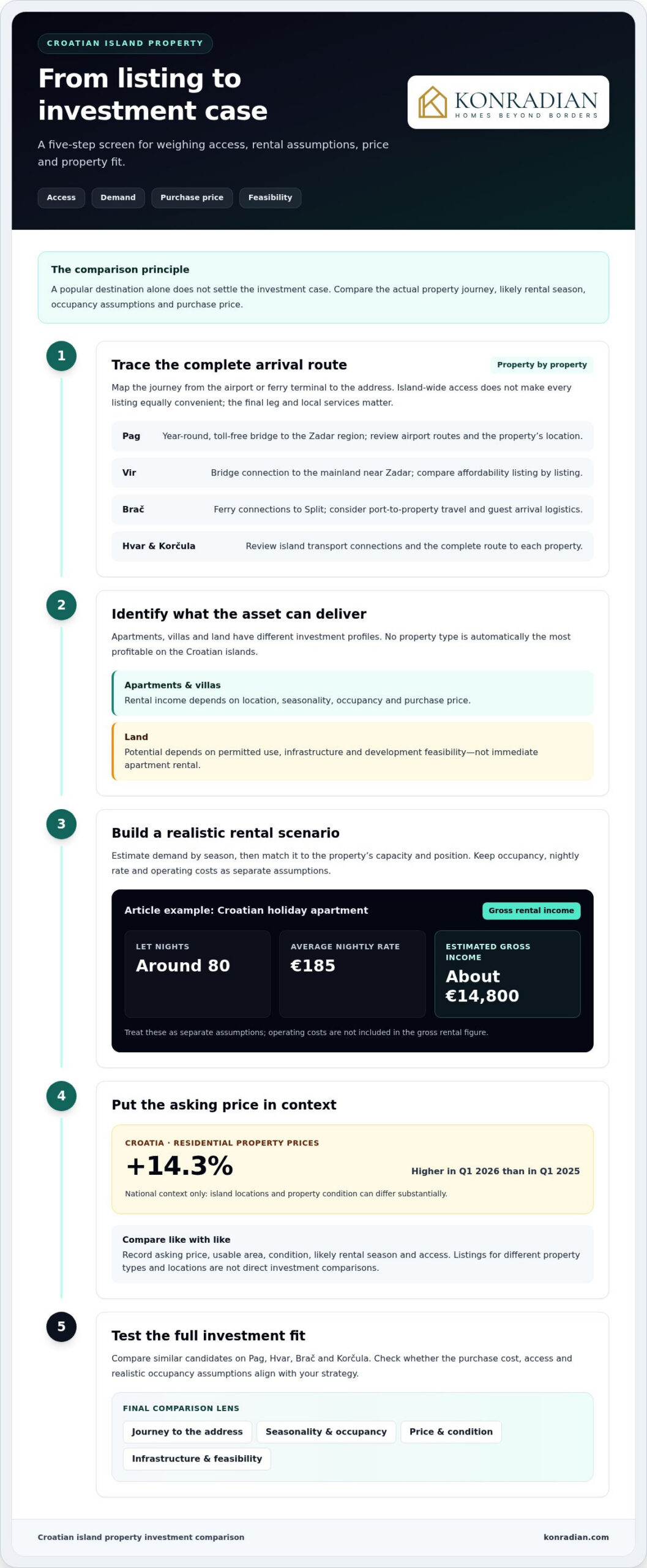
Pag’s year-round, toll-free bridge connects the island with the Zadar region, offering a practical access advantage over islands reached only by boat. For a property near Novalja or Pag Town, map the complete journey from arrival point to address. The bridge can simplify land travel, but the property’s precise location still determines the final leg.
Review airport access for each property, too. Map the route from Zadar Airport, including the mainland drive and onward journey across Pag. Don’t assume every listing is equally convenient just because the island has a bridge. Record the route, transport options and seasonal travel considerations for each address before assessing rental prospects.
Vir is another bridge-connected option near Zadar. Its mainland link can simplify arrival, while affordability depends on the property’s location, condition and features. Compare Vir listings with Pag homes using the same criteria instead of assuming one island is automatically cheaper. Growth potential also depends on local infrastructure and visitor appeal, not access alone.
Brač connects to Split by ferry, a practical consideration for family travel. Map the journey from the port to the property and consider how ferry schedules fit guest arrivals. For family tourism, access to the home, local services and nearby attractions may matter as much as the island’s name. The ferry connection is a useful starting point for assessing the guest experience.
Island infrastructure affects both visitor convenience and ownership. Before choosing a historic centre or a quieter coastal location, map the journey from the airport or ferry terminal and consider access to everyday services. Pag’s bridge and Brač’s ferry illustrate different travel patterns. Even on a well-connected island, properties can involve very different journeys.
| Island | Main access | Investment consideration |
|---|---|---|
| Pag | Year-round, toll-free bridge to the Zadar region | Compare airport routes and property locations |
| Vir | Bridge connection to the mainland near Zadar | Assess affordability listing by listing |
| Brač | Ferry connections to Split | Consider family travel logistics and port access |
| Hvar | Island transport connections | Review the full arrival route to each property |
| Korčula | Island transport connections | Compare journey convenience with location and infrastructure |
Trace the actual airport or ferry journey to each property, then weigh convenience against local infrastructure and your purchase priorities.
Rental demand, occupancy and property prices
No property type is automatically the most profitable on the Croatian islands. Apartments, villas and land have different investment profiles. Rental income depends on location, seasonality, occupancy and purchase price; land also depends on development potential.
Compare rental demand with the asking price, not just the island’s beauty or reputation. Croatia’s residential property prices were 14.3 percent higher in Q1 2026 than in Q1 2025. These national figures provide context, but island locations and property condition can differ substantially.
Listings illustrate the range of options. These asking prices refer to different property types and locations, so they aren’t like-for-like investment comparisons.
Compare features and location alongside headline price.
For rental analysis, estimate realistic demand by season and match it to the property’s capacity and position. A Croatian holiday-apartment example estimates gross rental income of about €14,800 from around 80 let nights at an average nightly rate of €185. Treat occupancy, nightly rate and operating costs as separate assumptions.
Land has a different investment profile. Its potential depends on permitted use, infrastructure and development feasibility, rather than immediate apartment rental. Before comparing land with a ready-to-use home, establish what the site can support and how long development may take.
For each candidate, record the asking price, usable area, condition, likely rental season and access. Compare similar properties on Pag, Hvar, Brač and Korčula, and test occupancy assumptions against the purchase cost. This helps distinguish attractive listings from properties that fit your investment strategy.
Investing in Real Estate on Croatian Islands: Which Island to Choose?
Long-term growth and rental income depend on location, access, infrastructure and property suitability. Hvar, Brač, Korčula, Vis and Pag each offer a different balance of visitor appeal and development.
Split Property Stability and Rental Demand
Split is Croatia’s second-largest city and has a different investment profile from the islands. Its role as a city and a connection point for island journeys can give visitors more reasons to stay nearby. This contrasts with Vis, which is less developed for tourism, and Hvar, associated with a longer tourist season.
For a property near Split, assess its proximity to transport, services and visitor activities. These factors shape its appeal and potential rental audience. On the islands, ferry access and local infrastructure influence the journey differently. Assess each property’s location rather than assuming a city or island name predicts steady demand.
Zadar Tourism Appeal and Rental Potential
Zadar matters to island buyers because Pag is connected to the Zadar region year-round by a toll-free bridge. This can make road travel simpler than relying solely on ferry connections. For a Pag property, consider how the route from Zadar and the property’s location affect the convenience of tourist arrivals.
Vir is also near Zadar and connected to the mainland by a bridge. Compare its listings with Pag properties by location, condition and visitor appeal, rather than treating bridge access as proof of stronger rental income. On either island, nearby infrastructure and practical property features help define the likely audience.
Island Infrastructure and Rental Yield
For long-term capital growth and rental income, Pag offers bridge access and comparatively affordable property. Hvar is associated with a longer tourist season, while Brač connects to Split by ferry. Korčula offers a tranquil island setting, and Vis is less developed for tourism. These differences help frame a comparison, but no island-wide ranking replaces an assessment of each property and its local infrastructure.
A Croatian holiday-apartment example estimates gross rental income of about €14,800 from around 80 let nights at an average nightly rate of €185. Treat these as assumptions to examine, not a forecast for every island or home.
Hvar’s longer season may appeal to buyers considering luxury accommodation, but season length alone doesn’t establish occupancy or income. Compare each property’s location, facilities, access and likely guest profile. For Brač and Korčula, weigh their transport connections and destination character against the purchase cost and intended use.
Hvar, Brač, and Korčula as exclusive island destinations
Hvar, Brač and Korčula are known for tranquil settings and natural beauty. Their Mediterranean appeal may attract buyers seeking an exclusive retreat, but an island’s image alone doesn’t establish investment value. Compare the property’s location, access, condition and intended use before deciding which destination fits your priorities.
On Hvar, compare properties by their setting and connection to towns and services. Stari Grad, for example, offers a historic setting distinct from coastal addresses elsewhere on the island. Consider whether the property suits your intended guests or personal use, then assess how its location affects arrival, everyday convenience and the rental profile you want.
Brač also calls for property-level assessment. Its ferry connections to Split provide a clear transport route to consider, while beaches and natural scenery shape the island’s appeal. Compare a home near a town with one in a quieter setting. Access to services, the journey from the ferry and the property’s condition all influence its practical appeal.
Korčula offers another distinctive Mediterranean setting. When comparing Korčula Town with a quieter location, consider how each suits your intended use. Map the route to the property, identify nearby services and assess the home’s condition. These steps make the comparison more useful than relying on the island’s reputation or a single appealing photograph.
For an exclusive island purchase, separate lifestyle appeal from investment criteria. Hvar, Brač and Korčula may suit buyers drawn to tranquil scenery, but individual properties serve different needs. A home intended for personal stays may not suit a rental-focused strategy. Write down your intended use first, then compare each shortlisted property against that goal.
Beaches can shape a destination’s appeal, but proximity alone doesn’t show whether a home suits your plans. For each listing, note the route to the coast, the surrounding setting and access to local infrastructure. On Hvar, Brač and Korčula, this helps distinguish a convenient base from a property whose appeal depends mainly on its scenery.
Apply the same comparison to all three islands: record the property’s location, condition, transport links, nearby services and likely use. Weigh those details against your priorities, whether you’re looking for a historic home, a coastal retreat or a quieter setting. This keeps the decision grounded in the property itself, rather than treating Hvar, Brač or Korčula as a guaranteed investment choice.
Buyer due diligence and investment risks
Compare each opportunity against ownership rules, permitted use, tax exposure and ongoing rental obligations. These checks can affect a property’s value before purchase.
Permits and Zoning Rules
US citizens should assess Croatian foreign-ownership rules before purchasing. Eligibility and restrictions depend on the applicable rules, so treat ownership eligibility as an early transaction check, not something to resolve after choosing a home.
For building or renovation, review the property’s zoning designation, approved plans, permits and existing construction records. For tourist letting, establish whether the building and intended use meet local requirements. These checks help distinguish a ready-to-use home from land or a renovation opportunity that may need further approvals.
In buildings with several owners, tourist letting requires written consent from more than two thirds of the co-ownership shares and directly adjoining owners. Croatia intends to introduce a registration number for tourist rentals from 2027 under EU Regulation 2024/1028, through a law that has not yet been passed. Include both points in a rental-readiness review.
Compare your intended use with the property’s legal and planning status before committing. A coastal plot’s development potential, for example, depends on its zoning and permitted use, not simply its location.
Taxes, Fees, and Ongoing Costs
For an existing property purchase, the real-estate transfer tax is 3 percent, according to Porezna uprava. Croatia charges 25 percent VAT on the first purchase of a new-build property, included in the price. Identify which tax treatment applies to the transaction before comparing an existing home with a new apartment.
Rental projections should account for local charges and income taxes. In Kolan, the flat-rate holiday-letting tax is 30 euros per bed in 2026. A Croatian property lawyer’s paperwork and legal guidance is estimated to cost about 1 percent of the purchase price. These costs sit alongside the property price and affect the overall investment calculation.
A seller who sells within two years of the purchase-contract date pays 24 percent income tax on the gain. Keep the contract date and purchase records available when assessing a resale plan. For an existing property, include transfer tax; for a new build, distinguish VAT treatment. Then model likely rental income after relevant taxes and charges.
Use a transaction checklist: confirm ownership, review land-register details, compare permitted use with your plans, and calculate applicable taxes. For tourist letting in a multi-owner building, obtain the required written consents before relying on rental income. Review your Croatian island purchase options as you weigh these legal and financial factors.
Konradian: Spanish Property Acquisition
Konradian supports buyers considering Croatian island property through its Croatian Real Estate Sales service. From property selection to legal and financial transaction support and key handover, the service provides a coordinated path through an international purchase.
Turn to Konradian after comparing locations such as Pag, Hvar, Brač and Korčula and when you’re ready to assess specific properties. Discuss your priorities, intended use and purchase criteria, then explore suitable opportunities with transaction support alongside your search.
For a considered conversation about buying property in Croatia, contact Konradian through its website.
Turn Your Island Shortlist Into a Clear Investment Plan
Start by defining what a successful purchase means to you. Set out your intended use, preferred property type, appetite for seasonal rental income and long-term ownership priorities. This framework helps you assess the Croatian islands with the best property investment potential against your own objectives, rather than choosing by reputation alone.
Then turn those priorities into a focused property brief. Konradian offers Croatian Real Estate Sales, with legal and financial transaction support to help buyers progress through an international purchase. Its Spanish Property Acquisition and US Real Estate Investment Services also support clients comparing opportunities across markets. A clear brief gives your search structure and keeps practical requirements in view as you assess properties.
Discuss your plans with Konradian and take the next step toward a well-considered property decision. Your island investment journey can begin with a focused conversation and a plan shaped around your priorities.
Frequently Asked Questions
Conclusion: Which Location is Right for You?
Choose an island that fits your intended use, access preferences and investment budget. Pag suits buyers prioritising road access and comparatively affordable property; Hvar may appeal to those weighing a longer tourist season; Brač connects to Split by ferry. To build a practical shortlist, compare specific properties by location, condition, transport and permitted use. Then assess whether each supports your plans for personal stays, rental income or both.
Croatia: Where is it worth buying property?
Consider locations where the property’s setting matches your investment plan. Pag’s bridge connection and relative affordability may suit buyers prioritising access and a lower entry point than Hvar or Brač. Wherever you look, compare homes of similar type and condition, then assess nearby services, transport routes and potential use. A well-located apartment may suit one buyer better than a larger house requiring substantial work.
What yield is realistic?
That figure excludes tourist tax, tourism contribution and income tax, so it isn’t an estimate of net returns. For your own projection, test how seasonal occupancy, achievable nightly rates and property-specific running costs affect the result.
Why Croatia as a location for an investment property?
Croatia combines established visitor destinations with island settings that appeal to both property buyers and holidaymakers. It has been an EU member since 2013 and introduced the euro on 1 January 2023. For investors, those facts provide useful context when planning a cross-border purchase. The practical case still rests on the individual property, its location, its intended use and the costs associated with ownership.
Which Croatian islands have the strongest property investment potential in 2026?
The Croatian islands with the best property investment potential depend on the buyer’s priorities, not on a universal ranking. Pag combines a year-round bridge with comparatively affordable property. Hvar is associated with a longer tourist season, while Brač’s ferry connections to Split offer a different access profile. Weigh these advantages against each property’s location, condition, legal use and likely visitor appeal.
What are average property prices per square meter on Hvar, Brač, Korčula, Vis, and Pag?
Use local, like-for-like comparisons rather than applying one average across the five islands. Compare apartments with apartments, taking account of location, condition, age, sea views and access. Asking prices should not be treated as completed-sale prices.
Which Croatian islands have the highest tourist demand, occupancy rates, and rental yields?
Hvar’s longer tourist season is a useful demand indicator, while Vis is less developed for tourism than other Croatian islands. Neither fact alone establishes occupancy or rental yield for a particular home. Compare the property’s location, guest capacity, amenities and access, then model income across likely rental periods. Distinguish gross income from returns after taxes and other property-related costs.
How have property prices and transaction volumes changed across Croatian islands in recent years?
Croatia’s residential property prices were 14.3 percent higher in Q1 2026 than in Q1 2025. That is a national price movement, not an island-by-island transaction report. It doesn’t show whether completed sales rose or fell on Pag, Hvar, Brač, Korčula or Vis. For a local comparison, separate asking prices from completed transactions and compare similar properties over the same period.