


While broader European markets face uncharacteristic stagnation, Central Europe’s most resilient capital continues to outperform expectations. You probably recognize that Budapest offers a rare combination of architectural prestige and robust economic growth. Yet, the prospect of managing complex legal requirements or overcoming language barriers with local developers can turn a sophisticated opportunity into a source of unnecessary stress. It’s natural to feel cautious when the nuances of high-growth districts and hidden transaction costs remain opaque.
This 2026 guide provides the clarity you need to secure high-yield assets with absolute confidence. We’ll show you how to navigate property investment Hungary to achieve stable rental yields of 5-7% and significant long-term capital appreciation. You’ll discover the specific districts poised for expansion, a breakdown of the total acquisition cost, and the strategic advantages of a professional buyer advocacy model. Our objective is to move you from a broad global perspective to a precise, personal acquisition strategy that prioritizes your peace of mind and financial security.
Key Takeaways
- Recognize the unique economic ‘sweet spot’ that positions Hungary as a high-growth alternative to traditional Western European markets in 2026.
- Learn how to secure resilient assets that deliver 5-8% rental yields through a strategic property investment Hungary.
- Pinpoint the specific ‘Golden Districts’ in Budapest and luxury regional markets poised for significant long-term capital appreciation.
- Follow a structured legal and financial roadmap that ensures a secure transaction from initial due diligence to final deed registration.
- Leverage a sophisticated, zero-cost concierge model to access exclusive pre-sale opportunities and expert market analysis.
The Case for Property Investment in Hungary in 2026
Macroeconomic Drivers for Real Estate Growth
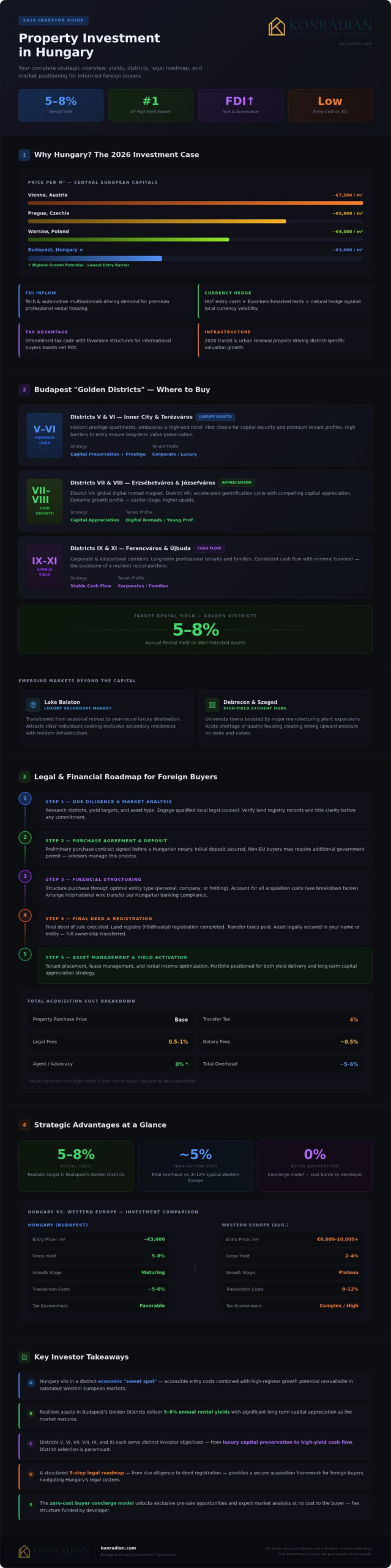
Foreign Direct Investment (FDI) continues to flow into the tech and automotive sectors, bringing a wave of high-earning expatriates and specialized professionals. This capital influx creates a steady demand for premium housing tailored to international standards. Beyond corporate growth, major infrastructure projects are reshaping the capital. The 2026 outlook for Budapest’s transit and urban renewal projects shows a clear path toward increased district-specific valuations, especially in areas previously considered undervalued. For international property holders, the relationship between the Hungarian Forint (HUF) and the Euro provides a strategic advantage. While the local currency offers a lower cost of entry, rental yields are often influenced by Euro-denominated benchmarks; this provides a natural hedge against local currency volatility.
Comparative Analysis: Hungary vs. Regional Competitors
Top Investment Locations: Budapest and Beyond
Identifying the right geography is the cornerstone of any successful property investment Hungary. While the national economy provides a stable foundation, the real value is found in the micro-markets of specific districts and emerging regional hubs. By 2026, the distinction between “prime” and “emerging” has blurred. This makes it essential to align your location choice with your specific exit strategy. Whether you’re seeking the prestige of a historic Budapest apartment or the high-yield potential of a growing industrial city, the choice of location dictates your long-term success. It’s about finding the intersection of demand and scarcity.
Budapest District Guide: Where to Buy
Budapest remains the primary engine of the Hungarian market. Districts V and VI represent the premium core, where high barriers to entry are balanced by unmatched prestige and capital security. These areas are the first choice for those seeking luxury assets and high-end rental potential. In contrast, Districts VII and VIII offer a more dynamic growth profile. District VII continues to be a magnet for the global digital nomad community, while the accelerated gentrification of District VIII provides a compelling case for investors looking for capital appreciation. For those prioritizing stability, Districts IX and XI have emerged as the city’s corporate and educational corridors. These districts attract long-term professional tenants and families, ensuring consistent cash flow with minimal turnover. In these “Golden Districts,” yields of 5-8% remain a realistic target for well-selected assets.
Emerging Markets Outside the Capital
The investment landscape extends well beyond the capital’s borders. Lake Balaton has successfully transitioned from a seasonal retreat into a year-round luxury destination. This shift is driven by a new class of high-net-worth individuals seeking secondary residences that offer both exclusivity and modern infrastructure. Simultaneously, university towns like Debrecen and Szeged are becoming high-yield student housing hubs. The expansion of major manufacturing plants in these regions has created an acute shortage of quality professional accommodation. Comparing yields reveals that these regional developments often outperform city-center apartments in terms of immediate ROI. Finding the perfect balance between these diverse opportunities requires a partner who understands the local nuances. You can explore how a tailored Hungarian property brokerage service can simplify this selection process and help you secure the ideal asset without the traditional stress of international acquisition.
Yields, ROI, and Market Dynamics in 2026
The financial allure of the Hungarian market is rooted in its consistent ability to outperform Western European benchmarks. In 2026, Budapest’s rental market remains a standout performer, where yields of 5-8% are achievable through meticulous asset selection. This performance is largely driven by a growing professional class and international students who prioritize high-standard, modern living spaces. One of the most effective ways to bolster your ROI is through the “Pre-Sale” advantage. By securing a property before construction begins, you capture immediate equity as the development progresses toward completion. It’s a strategic entry point that rewards early commitment with significant capital buffer. Successful property investment Hungary relies on this proactive approach to wealth building.
Understanding the operational landscape is equally vital for protecting your net margins. Beyond the purchase price, investors must account for ongoing costs that influence the final return. These typically include:
- Közös Költség: The “common cost” that covers building maintenance, cleaning, security, and communal utilities.
- Management Fees: Professional oversight usually accounts for 10-15% of the gross rental income.
- Utility Buffers: Ensuring individual meters are installed to keep tenant consumption separate from ownership costs.
New Builds vs. Classical Renovations
The 2026 rental market shows a distinct preference for modern energy efficiency. New builds offer a maintenance-free investment experience that appeals to corporate expats and high-earning professionals who demand reliability and lower utility expenses. While classical apartments provide high ceilings and historic charm, they often carry higher renovation risks and unpredictable structural maintenance. For most international investors, the predictable costs and structural guarantees of new developments offer a more tranquil path to long-term wealth. Modern insulation and smart-home integration have become non-negotiable standards for premium tenants in the current market cycle.
Maximizing ROI Through Strategic Management
Strategic management requires a keen understanding of evolving local regulations. The 2026 landscape has introduced nuanced guidelines for short-term rentals in central districts, making long-term professional lets increasingly attractive for those seeking passive stability. Navigating these administrative layers requires professional legal support buying property abroad to ensure your tax optimization and compliance are handled with precision. A well-structured acquisition succeeds when the heavy lifting of bureaucracy is managed by experts. Budapest is projected to maintain an average annual capital growth rate of approximately 6% throughout 2026 as major urban renewal projects reach their final stages.
The Legal and Financial Roadmap for Foreign Buyers
Moving from market analysis to asset acquisition requires a disciplined, step-by-step approach to ensure your capital remains secure. The Hungarian legal framework for real estate is transparent and highly structured, yet it demands a level of local expertise that few international buyers possess. A successful property investment Hungary is built on a foundation of rigorous due diligence and professional oversight. This process transforms a complex international transaction into a predictable, manageable journey. By following a clear roadmap, you can navigate the administrative requirements with the quiet confidence of a seasoned local investor.
The acquisition process typically unfolds in four distinct stages:
- Step 1: Selection and Due Diligence: This involves a thorough vetting of the developer’s track record and a deep dive into the Tulajdoni lap (title deed) at the Land Registry to confirm the property is free of encumbrances.
- Step 2: The Sale and Purchase Agreement (SPA): In Hungary, a licensed attorney must draft and countersign the SPA. This document outlines the payment schedule, technical specifications, and the lawyer’s role in escrowing the initial deposit.
- Step 3: Government Permit Process: Non-EU citizens require a standard administrative permit from the local government office. While largely a formality, it requires precise filing to avoid unnecessary delays.
- Step 4: Registration and Handover: Once the final payment is made, the lawyer submits the closing documents to the Land Registry (Földhivatal). You receive the keys only after the ownership is officially recorded.
Financing Your Hungarian Investment
Financing options for international buyers in 2026 remain accessible, though they require a strategic approach. Most Hungarian banks offer mortgages to non-residents with Loan-to-Value (LTV) ratios typically ranging from 50% to 60%. It’s also vital to consider currency exchange strategies. Since most high-end developments are priced in Euro while local costs are in Forint, using a specialized FX partner can protect your investment from unnecessary volatility. One of the most significant advantages for the investor is the “Seller-Paid” model. In the Hungarian market, brokerage commissions are traditionally covered by the developer, meaning you can access expert Hungarian property brokerage services at zero cost to you as the buyer.
Taxes and Closing Costs
Budgeting for a secure transaction involves understanding the various taxes and fees associated with ownership. The primary cost is the property transfer tax, known as Illeték, which is generally 4% of the property’s value. Legal fees and notary costs typically account for another 1% to 1.5% of the purchase price. On the revenue side, rental income is subject to a flat 15% personal income tax, which remains one of the most competitive rates in the European Union. These predictable costs allow for a high degree of financial clarity from the outset of your investment journey.
Why Konradian is Your Strategic Partner in Hungary
Success in an international market isn’t just about finding a property; it’s about finding the right strategy. Konradian brings an LSE-educated perspective to every transaction. We don’t just sell real estate. We provide a rigorous, data-driven analysis of market dynamics to ensure your acquisition aligns with your long-term financial goals. Our team acts as a bridge, combining the intellectual authority of a strategic consultant with the personalized care of a dedicated concierge. This ensures that your journey into property investment Hungary is defined by precision and ease. We prioritize your peace of mind through professional stewardship and a deeply self-assured approach to market entry.
Our involvement is comprehensive and methodical. We maintain direct relationships with the country’s most reputable developers. These connections unlock exclusive pre-sale opportunities, allowing you to secure assets before they reach the general public market. From the initial strategic assessment to the final handover of the keys, we manage every detail of the transaction. Perhaps the most compelling advantage is our fiscal structure. Because we operate on developer-paid commissions, our professional brokerage services come at zero cost to you as the buyer. This represents a risk-free entry point for sophisticated investors who value elite expertise without the burden of additional fees.
A Sophisticated Approach to Global Wealth
We understand that our clients are global citizens with demanding schedules and high expectations. Our model is designed to handle the heavy lifting of remote purchases. Whether you’re in London, New York, or Singapore, we navigate the local legal landscape on your behalf. We possess the cultural fluency required to bridge the gap between international expectations and local market realities. You can explore our property investment Hungary pillar for a deeper dive into specific 2026 listings and district-level data. Our role is to act as your protective and proactive partner throughout the entire acquisition lifecycle.
Starting Your Journey with a Free Consultation
Your journey begins with a focused, strategic video call. During this initial session, we discuss your risk profile, yield expectations, and desired timeline. We don’t believe in one-size-fits-all solutions. Instead, we provide custom sourcing that targets properties specifically suited to your unique portfolio. We take the time to address your concerns before they arise. This creates a methodical and logical flow to the entire process. When you’re ready to secure your future in Central Europe, you can book your free consultation with Konradian to begin a partnership built on transparency and elite expertise. Experience the difference of professional stewardship.
Securing Your Legacy in Central Europe
The Hungarian market in 2026 offers a rare convergence of economic stability and high-register growth. By focusing on Budapest’s Golden Districts and emerging regional hubs, you can capture yields that consistently outperform the continental average. Success requires more than just capital; it demands an international mindset paired with deep local access. Strategic property investment Hungary is no longer a matter of broad market entry, but of precise, developer-direct acquisition. Navigating this landscape becomes a seamless experience when you have a proactive partner handling the heavy lifting.
Our LSE-educated advisory team provides the intellectual rigor needed to identify high-yield assets before they reach the open market. We offer end-to-end transaction support at no cost to the buyer, ensuring your interests are protected from the first video call to the final handover of keys. You gain direct access to exclusive developer pre-sales and the peace of mind that comes from professional stewardship. It’s time to transition from observation to action. Secure your Central European future with a free expert consultation and discover how we can refine your acquisition strategy. Your future portfolio deserves the security of elite expertise.
Frequently Asked Questions
Can foreigners buy property in Hungary in 2026?
Yes, foreigners are fully permitted to acquire real estate in Hungary. EU citizens enjoy the same rights as local buyers, while non-EU citizens must obtain a standard administrative permit from the local government office. This process is a routine formality that typically takes a few weeks to complete. It’s a structured path that ensures legal ownership is clearly recorded in the Land Registry for every international investor.
What is the average rental yield in Budapest right now?
Average rental yields in Budapest for 2026 typically range between 5% and 8% for well-selected assets. These figures are particularly achievable in high-demand areas like Districts VII and IX, where professional and student demand remains robust. Your final return depends on the property’s energy efficiency and modern amenities. Strategic district selection remains the primary driver for maximizing your property investment Hungary ROI over a long-term cycle.
Are there any restrictions on short-term rentals (Airbnb) in Budapest?
Yes, short-term rental regulations are managed at the district level and have become more defined by 2026. Some central districts require specific building permits or have introduced limits on the number of days a property can be let. It’s essential to verify the current bylaws of a specific building before purchase. Many investors now favor long-term professional lets to ensure more predictable cash flow and fewer administrative hurdles.
How much are the closing costs when buying property in Hungary?
Closing costs generally total between 5% and 6% of the purchase price. The largest component is the 4% property transfer tax, known as Illeték, which is paid after the transaction is finalized. You should also budget approximately 1% to 1.5% for legal fees and notary costs to ensure the contract is properly countersigned and registered. These predictable costs allow for clear financial planning from the start of your acquisition.
Do I need to visit Hungary in person to complete a property purchase?
You don’t need to be physically present in Hungary to complete a transaction. Most international buyers utilize a Power of Attorney (POA), allowing their legal representative to sign documents and handle the Land Registry filings on their behalf. We facilitate this process through secure digital communication and verified legal channels. This remote approach allows you to secure premium assets without the need for frequent or disruptive international travel.
What are the benefits of buying pre-sale property from developers?
Buying pre-sale property allows you to secure a lower entry price and capture equity growth as construction progresses. These developments meet the latest 2026 energy efficiency standards, which is a significant draw for high-quality tenants. You also benefit from structural guarantees and the ability to select the best units within a building. It’s a sophisticated way to enter the market with a brand-new, maintenance-free asset.
How does Konradian provide services for free to the buyer?
Our services are free for buyers because we operate on a developer-paid commission structure. In the Hungarian market, it’s standard practice for the seller or developer to cover the brokerage fees. This model allows us to provide you with elite, LSE-educated advisory and end-to-end stewardship without adding to your acquisition costs. You receive high-level strategic support while your entire investment capital goes directly into the property itself.
Is it possible to get a mortgage in Hungary as a non-resident?
Yes, non-residents can access mortgage financing from several major Hungarian banks. In 2026, typical Loan-to-Value (LTV) ratios for international investors range from 50% to 60%. The application process requires proof of income and a standard credit assessment by the lending institution. While the requirements are thorough, it remains a viable path for those looking to leverage their property investment Hungary for enhanced long-term returns.
