


The Hungarian market is no longer a simple residency play; it’s a high-stakes arena where precision outweighs speculation. You likely feel the weight of opaque legal processes or the shifting landscape of the Guest Investor Program, but the potential for property investment Hungary remains exceptionally strong for those who know where to look. While price growth in Budapest reached 20.4% in early 2026, the real value lies in identifying districts where rental demand outpaces the current supply constraints. It’s natural to feel hesitant about navigating a foreign language or overpaying in a seller’s market, yet these complexities are manageable with the right professional stewardship.
This guide provides the clarity you need to secure high-yield assets with the benefit of zero-fee buyer representation. You’ll discover a precise breakdown of 2026 market yields across key districts like Belváros-Lipótváros and Józsefváros. We’ll outline a step-by-step roadmap to acquisition that simplifies mandatory legal requirements and provides access to exclusive, pre-sale developer listings. By the end of this article, you’ll have a clear strategy to navigate the Hungarian real estate landscape with total confidence and ease.
Key Takeaways
- Identify high-performing districts within Budapest’s “Golden Triangle” to maximize rental yields in a supply-constrained market.
- Clarify the 2026 residency landscape by evaluating the strategic differences between real estate fund investments and direct property ownership.
- Navigate the complexities of property investment Hungary with a clear, step-by-step roadmap for obtaining mandatory purchase permits and legal registration.
- Discover how to access exclusive, off-market developer listings through a brokerage model that prioritizes buyer interests with zero-fee representation.
- Minimize transaction risk by understanding the essential legal countersignatures and tax structures required for a secure international acquisition.
The 2026 Hungarian Real Estate Market: A Strategic Overview
Hungary has solidified its position as a central pillar of European wealth preservation. By mid-2026, the nation’s capital has transitioned from an emerging market into a sophisticated hub for institutional and private capital. While other EU nations struggle with stagnant valuations, Hungary continues to demonstrate remarkable resilience. This strength is rooted in Hungary’s export-oriented market economy, which provides a stable foundation for the real estate sector even during periods of global shifts.
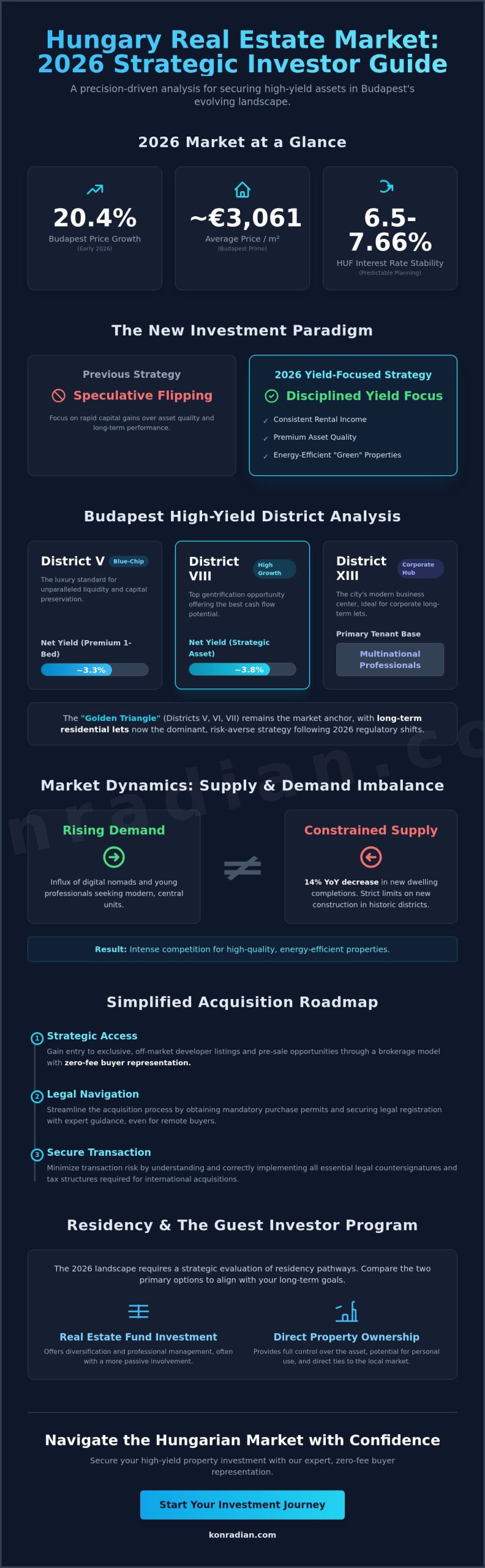
The 2026 climate is characterized by a notable change in strategy. Investors are moving away from the speculative “flipping” of previous decades and toward a disciplined, yield-focused approach. Property investment Hungary now rewards those who prioritize consistent rental income and asset quality over rapid capital gains. This normalization phase follows a period of rapid growth, with the market now focusing on energy-efficient properties in prime locations. Interest rates for the Forint (HUF) have reached a period of relative stability between 6.5% and 7.66%, allowing for more predictable financial planning and lower volatility in market valuations.
Why Hungary Outperforms Western European Markets
Entry barriers in Budapest remain significantly more attractive than those in London or Madrid. With an average price per square meter in Budapest at approximately €3,061 as of early 2026, the “Budapest Premium” offers high liquidity without the prohibitive costs of Western capitals. The corporate tax environment is among the most favorable in Europe for property-holding entities. This attracts a steady stream of international demand, ensuring that well-located assets retain their elite status and offer superior capital preservation compared to saturated Western markets.
Current Supply and Demand Dynamics
The market is currently defined by a pronounced supply-demand imbalance. New dwelling completions saw a 14% year-over-year decrease in late 2025, leaving a gap that won’t see significant relief until at least 2027. This scarcity drives intense competition for high-quality units, particularly energy-efficient “Green” properties that meet modern sustainability standards. At the same time, an influx of digital nomads and young professionals has reshaped the rental landscape. These tenants prioritize central locations and modern amenities, which sustains strong rental demand. Securing a property investment Hungary in 2026 requires acting swiftly on limited inventory in historic districts where new construction is strictly limited.
High-Yield Asset Classes: Where to Invest in 2026
Identifying the right asset class in 2026 requires a nuanced understanding of local regulatory shifts. The “Golden Triangle” of Budapest, which includes Districts V, VI, and VII, continues to anchor the market. However, the strategy has matured. Following the January 2026 short-term rental ban in District VI, long-term residential lets have become the dominant strategy for risk-averse investors. These assets provide a stable yield in a market where one-bedroom units consistently outperform larger residences. While residential property investment Hungary remains the most popular entry point, commercial assets are becoming a vital tool for high-net-worth individuals seeking to hedge against residential price normalization.
Budapest District Analysis: Yields and Capital Growth
Districts V and VI remain the blue-chip standard for luxury rentals. In District V, investors can expect net yields of approximately 3.3% for premium one-bedroom apartments. While these yields are lower than in emerging areas, the liquidity and capital preservation qualities are unparalleled. For those seeking higher cash flow, Districts VII and VIII offer the best gentrification opportunities. A strategically chosen investment apartment Budapest in District VIII can currently achieve net yields of 3.8%. Meanwhile, District XIII has solidified its role as the city’s modern business hub. It’s the primary destination for corporate long-term lets, supported by high-quality infrastructure and a dense concentration of multinational offices.
Lake Balaton: The “Hungarian Riviera” Opportunity
Lake Balaton has evolved into a sophisticated lifestyle and investment alternative. The market in 2026 is driven by a growing trend of secondary homes for Western European expats. Towns like Balatonfüred and Siófok are no longer just summer retreats; they’re year-round hubs for luxury new-build developments. While seasonal ROI remains a factor, the real story is the steady capital appreciation of lakeside villas. These properties offer a tranquility that Budapest cannot match, providing a balanced lifestyle component to a purely urban portfolio. For investors evaluating this as part of a broader second home abroad investment strategy, the Lake Balaton region represents a compelling intersection of lifestyle value and long-term capital growth. If you’re considering diversifying into these premium regions, our Hungarian property brokerage offers the specialized oversight required to navigate this niche market.
The choice between commercial and residential assets often comes down to your long-term liquidity needs. Residential units offer easier exit strategies, but commercial spaces in regenerating districts provide long-term lease stability. Strategic diversification across these classes ensures your portfolio remains resilient against shifting district regulations. For those serious about property investment Hungary, the key is matching district-specific trends with long-term financial goals and asset quality.
Direct Property vs. Real Estate Funds: The 2026 Residency Debate
International investors in 2026 face a pivotal decision between the liquidity of real estate funds and the tangible security of direct ownership. Both pathways are central to the Guest Investor framework, yet they offer vastly different lifestyle and financial outcomes. The €250,000 fund route appeals to those seeking a hands-off approach. It requires minimal administrative oversight but comes with management fees and a total lack of control over the underlying assets. You are essentially trusting a third party to manage your capital within a broader, often diversified, portfolio.
In contrast, the €500,000 residential property route provides a physical anchor in Central Europe. Direct ownership allows you to curate your portfolio, select specific districts, and utilize the property for personal use or high-end rentals. This tangible nature of property investment Hungary is often the deciding factor for high-net-worth individuals who value asset control over passive returns. While funds offer convenience, they cannot match the long-term capital appreciation potential of a well-selected apartment in Budapest’s historic core. Owning a physical asset provides a hedge against inflation that paper assets sometimes struggle to replicate.
Navigating the Guest Investor Residence Permit
The 2026 eligibility criteria for non-EU citizens remain clear. The permit offers a 10-year residence period, providing a secure gateway to the Schengen Area for the investor and their family. When comparing these benefits to Spanish Property Acquisition options, Hungary often presents a more accessible entry point for those focused on Central European growth. Property ownership is frequently preferred for long-term wealth because it avoids the volatility sometimes found in fund valuations. It transforms a legal requirement into a lifestyle asset that can be passed down or sold after the mandatory holding period. This route ensures that your capital is working for you in a market with proven resilience.
Risk Mitigation in Central European Investing
Regulatory stability is a cornerstone of the 2026 Hungarian market. Success requires attention to detail, especially regarding “monument” status in historic districts. Many prime buildings in Districts V and VI carry heritage protections that can complicate renovations or increase maintenance costs. We prioritize direct developer relationships over open-market listings to mitigate these risks. This approach ensures that the property’s legal status is verified before any capital is committed. Buying directly from trusted developers provides a layer of security that fragmented listings simply cannot offer. It turns a complex international transaction into a seamless, professional experience that protects your long-term interests. Investors who wish to apply this same disciplined approach to the broader Adriatic region will find that Istria real estate for sale presents a compelling Eurozone complement to a Central European portfolio.
The Acquisition Roadmap: Legalities, Taxes, and Remote Buying
The process of property investment Hungary is governed by a logical, start-to-finish sequence that ensures total legal transparency. It begins with the expert selection of an asset and concludes with a secure handover. Between these milestones lies a series of administrative requirements that, while complex, become straightforward under professional stewardship. Non-EU investors must obtain a purchase permit from the Land Registry, a process that typically takes 30 to 60 days with a very high approval rate. This methodical approach protects your capital and ensures that every transaction is registered correctly within the Hungarian legal framework.
The roadmap to a successful acquisition typically involves these essential steps:
- Selection: Identifying a high-yield asset through a dedicated buyer’s agent who understands 2026 market dynamics.
- Permit Acquisition: Filing the necessary applications for non-EU nationals, including the standard €130 administrative fee and €17 registration cost.
- Legal Framework: Engaging a mandatory Hungarian lawyer to draft and countersign the purchase contract, which is a prerequisite for Land Registry entry.
- Financial Settlement: Utilizing secure escrow accounts for the deposit and final payment to ensure funds are only released upon meeting contract conditions.
- Handover: Conducting a final inspection of the property and, for international landlords, coordinating with local agencies for future property oversight.
Understanding Hungarian Property Taxes in 2026
The primary cost for any buyer is the Property Transfer Tax, or Stamp Duty, which is a one-time payment of 4% of the market value. For new-build properties, a favorable VAT rate of 5% applies to apartments under 150 square meters and houses under 300 square meters. If the property exceeds these dimensions, the standard 27% rate applies to the portion above the limit. Ongoing rental income is taxed at a flat 15% for both residents and non-residents. It’s helpful to remember that capital gains tax also sits at 15%, but this liability reduces every year and disappears completely after five years of ownership.
Remote Purchases: Buying Without Leaving Your Home
Modern property investment Hungary doesn’t require your physical presence in Budapest. We facilitate a seamless remote experience through high-definition digital walkthroughs and thorough developer credential verification. The legal heavy lifting is handled via Power of Attorney (PoA), allowing your mandatory lawyer to sign documents on your behalf while you remain in your home country. This approach provides the same level of security and precision as an in-person transaction. It’s a sophisticated way to build an international portfolio without the stress of travel. To begin your journey with a partner who manages every detail of the Hungarian property brokerage process, contact our team for a strategy session.
Strategic Portfolio Growth with Konradian’s Expert Brokerage
Building a resilient international portfolio requires more than just capital; it demands a partner who understands the intricate interplay between global markets. At Konradian, we provide a bridge between your long-term financial goals and the specific opportunities within property investment Hungary. Our approach is rooted in intellectual rigor, led by LSE-educated consultants who view real estate through a lens of strategic asset allocation. We don’t just find buildings. We secure the foundation for your cross-border growth, whether you’re integrating Hungarian assets with our Spanish property acquisition services or expanding into Croatian real estate sales. This global perspective ensures that every acquisition fits into a larger, cohesive wealth strategy.
Our commitment to professional stewardship means we handle the heavy lifting of the transaction from start to finish. This includes providing direct access to pre-sale developer listings and exclusive off-market opportunities that aren’t available to the general public. These listings often represent the highest-quality assets in Budapest’s regenerating districts, offering superior growth potential. By maintaining deep, local developer relationships, we ensure our clients are first in line for energy-efficient “Green” properties and premium historic renovations. From the initial strategic consultation to the final key handover, our team provides the intellectual authority and personalized care necessary for a seamless experience.
The “Zero-Fee” Buyer Model Explained
Our brokerage operates on a sophisticated model where our elite expertise is provided at no direct cost to the buyer. In the Hungarian market, commissions are traditionally settled by the seller. This allows us to offer you comprehensive representation, including legal and financial transaction support, without impacting your acquisition budget. This structure is vital because it removes the conflict of interest found in typical sales environments. We aren’t here to sell you a specific property; we’re here to represent your best interests as a buyer. You gain the benefit of our market savvy and strategic oversight while preserving your capital for the investment itself.
Your Next Steps: The Free Video Consultation
Your journey toward a diversified Central European portfolio begins with a deliberate, strategic dialogue. During our first session, we move beyond surface-level data to analyze your specific ROI objectives and risk tolerance in the 2026 market. We don’t believe in one-size-fits-all solutions. Instead, we provide customized property sourcing that aligns with the district-specific yields and capital growth trends we’ve identified. This session is designed to provide you with a clear, actionable roadmap, ensuring you feel secure and informed before committing any capital. It’s the first step toward a partnership defined by transparency and professional excellence. Book your free property investment consultation today to discuss your goals with a trusted global advisor.
Securing Your Future in Central Europe’s Premier Market
The 2026 landscape offers a rare window for investors who prioritize asset quality and yield over short-term speculation. Success in property investment Hungary now depends on navigating the shift toward long-term rentals in central Budapest and understanding the nuanced tax benefits of early-stage acquisition. By prioritizing energy-efficient assets and verified developer relationships, you can build a portfolio that withstands market normalization while delivering consistent returns.
Our team brings the intellectual rigor of an LSE-educated advisory and over five years of international brokerage excellence to every transaction. We provide direct developer pre-sale access that ensures you secure the most competitive assets before they reach the open market. This professional stewardship removes the complexity of foreign legalities, allowing you to focus on your long-term wealth goals. It’s an attainable path to a sophisticated Central European portfolio when you have the right partner by your side.
Secure your high-yield Hungarian investment with a free consultation
Your transition into this thriving market starts with a single, strategic conversation. We look forward to helping you navigate this journey with precision and ease.
Frequently Asked Questions
Can foreigners buy property in Hungary in 2026?
Yes, foreigners can purchase real estate in Hungary, though the specific requirements depend on your citizenship. EU citizens enjoy the same rights as local buyers, while non-EU nationals must obtain a purchase permit from the relevant government office. These permits are typically granted within 30 to 60 days, and approval rates remain high for residential assets in urban centers.
What is the average rental yield for an investment apartment in Budapest?
Budapest offers a gross rental yield of approximately 5.03% as of early 2026. Your specific return depends on district selection and asset quality. While the historic core of District V provides stability with net yields around 3.3%, emerging areas like District VIII offer higher cash flow opportunities, where one-bedroom units frequently reach net yields of 3.8%.
Does buying property in Hungary automatically grant residency?
No, purchasing real estate does not automatically grant residency status in 2026. While property ownership is a significant component of a long-term wealth strategy, the legal right to reside is governed by specific visa categories. For those seeking a formal residency pathway, the Guest Investor Program offers a 10-year permit through specific investment routes that differ from direct residential acquisition.
What are the total closing costs when purchasing Hungarian real estate?
Buyers should budget for a one-time Property Transfer Tax of 4% of the asset’s market value. Additional costs include mandatory legal fees for contract countersigning, which are essential for Land Registry entry, and administrative fees for property registration and acquisition permits. If you’re purchasing a new-build property, a VAT rate of 5% applies to units within specific size limitations.
How long does the property acquisition process take for non-EU citizens?
The standard timeline to complete a property investment Hungary is between two and three months for non-EU citizens. This period accounts for the mandatory 30 to 60 days required to receive the government purchase permit. Once the permit is secured, the final Land Registry registration and handover can proceed quickly, ensuring a structured and predictable closing process.
Are there restrictions on buying agricultural land in Hungary?
Yes, agricultural and forestry land is generally off-limits to non-EU nationals. Hungarian law maintains strict protections for rural and farming acreage, limiting ownership primarily to domestic or EU citizens who meet specific professional criteria. International investors typically find the most security and liquidity within the residential and commercial sectors of major urban hubs like Budapest or the Lake Balaton region.
How does the Hungarian Golden Visa (Guest Investor) program work in 2026?
The Guest Investor Program provides a 10-year residence permit through two primary investment options. You can invest a minimum of €250,000 in a real estate fund registered with the Hungarian National Bank or provide a €1,000,000 donation to a designated public trust. It’s important to note that direct residential property purchase does not grant residency under the current 2026 regulations.
Can I manage my Hungarian investment property remotely?
Yes, remote management is a standard practice for the majority of international investors in the Hungarian market. While our brokerage focuses on acquisition and legal transaction support, we ensure that your purchase is handled with the necessary Power of Attorney to avoid travel requirements. Many owners successfully oversee their portfolios through local agencies that handle day-to-day tenant relations and maintenance.
