


While many investors hesitate at the sight of rising European interest rates, Istria has quietly recorded 4.1 million overnight stays in early 2026, signaling a demand that far outweighs current supply. It’s no secret that securing Istria real estate for sale has become a complex pursuit where the best opportunities rarely reach a public portal. You’ve likely felt the frustration of navigating Croatian bureaucracy or the sting of hidden fees that often accompany tourist-facing listings. We understand that your goal isn’t just to buy property, but to secure a legacy asset in a stable Eurozone market.
This guide offers a sophisticated roadmap to the 2026 landscape, promising you direct access to high-quality developer pre-sales and the legal precision required for a seamless transaction. We’ll break down the shift toward new construction, analyze the impact of the average price of 3,812 Euros per square meter, and reveal how to identify properties exempt from capital gains tax. From off-market stone villas to modern coastal retreats, you’re about to discover how to move from a casual observer to a strategic Istrian homeowner with confidence and ease.
Key Takeaways
- Understand why Istria’s integration into the Eurozone and Schengen Area has solidified its status as a premier European asset class for 2026.
- Navigate the diverse landscape of Istria real estate for sale by identifying high-growth coastal hubs for luxury and emerging inland zones for exceptional value.
- Master the essential legal requirements, including the OIB registration and reciprocity protocols, to ensure your acquisition is fully compliant and secure.
- Gain a competitive edge by accessing off-market lists and developer pre-sales that offer superior capital appreciation before they reach the public market.
- Discover how an analytical, end-to-end brokerage service provides the professional stewardship needed to manage complex international transactions with total peace of mind.
The 2026 Istria Real Estate Market: A Strategic Overview
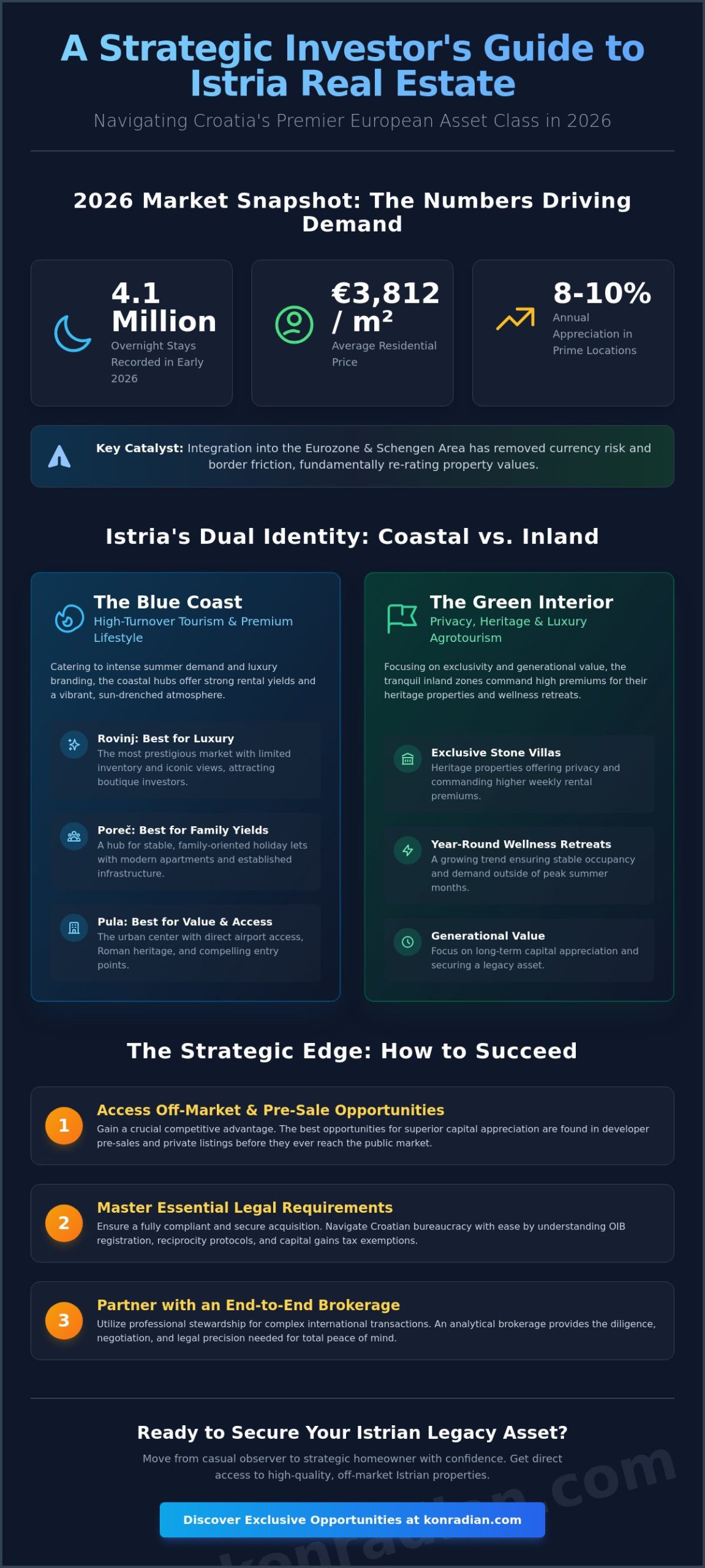
Often referred to as the “Tuscany of the Adriatic” for its rolling vineyards and medieval hilltop towns, the Istrian peninsula has entered a new phase of market maturity. In 2026, the region represents a sophisticated alternative to the saturated markets of Western Europe. While prices in traditional hotspots like the French Riviera have plateaued, Istria real estate for sale continues to offer a compelling entry point for capital appreciation. The integration into the Eurozone and Schengen Area acted as a catalyst, removing currency risk and border friction, which has fundamentally re-rated property values across the peninsula.
Investors today see a dual-layered opportunity. There’s the immediate high-yield potential of the summer season, bolstered by 4.1 million overnight stays recorded in early 2026. Simultaneously, a growing trend toward year-round wellness and gastronomic tourism ensures stable occupancy outside the peak months. Unlike the volatile speculative markets of the past, Istria’s growth is anchored by its status as a premier lifestyle destination for the affluent European middle class. This unique combination of Mediterranean charm and Central European efficiency creates a “buy” signal that is increasingly rare in today’s global market.
To truly understand the appeal of the peninsula, many investors choose to visit as tourists first; if you are planning such a trip, you can learn more about Primatour to explore holiday arrangements and travel services that facilitate your journey.
Economic Drivers and Property Appreciation
Strategic infrastructure projects have transformed the region’s accessibility. Pula Airport now serves as a vital hub, while the proximity to major cities like Trieste and Venice allows for effortless transit. The development of new luxury marinas and championship golf courses serves as a value anchor, elevating the surrounding residential sectors. Prime locations like Rovinj and Poreč are currently seeing an annual property appreciation rate between 8% and 10%. This growth is supported by an average residential price of €3,812 per square meter as of May 2026, reflecting a steady 4.10% increase over the previous year.
Why International Investors Choose Istria
The primary draw for global citizens is the combination of legal security and cultural richness. As a member of the EU, Croatia offers a transparent legal framework where EU and EEA citizens enjoy property ownership rights identical to locals. Beyond the paperwork, the lifestyle is incomparable. Investors find a rare intersection of Roman history, world-class gastronomy, and a pristine Mediterranean climate. Owning property here isn’t just a financial move; it’s a portfolio hedge. In a climate of volatile equity markets, a stone villa or a modern coastal apartment in Istria provides a tangible, appreciating asset that delivers both peace of mind and personal enjoyment. For those looking to further diversify beyond the Adriatic, US real estate investment from Europe offers a compelling strategy to insulate your portfolio from Eurozone volatility through high-yield Sun Belt assets.
Top Regions for Real Estate in Istria: Coastal vs. Inland
Investors exploring Istria real estate for sale often find themselves choosing between two distinct identities: the vibrant, sun-drenched “Blue Istria” and the tranquil, sophisticated “Green Istria.” In 2026, the peninsula’s geography dictates the investment profile. Coastal regions cater to high-turnover tourism and premium lifestyle branding, while the interior focuses on privacy, heritage, and the growing luxury agrotourism sector. Understanding these zones is the first step toward a portfolio that balances immediate cash flow with generational value.
The rental market shows a clear divergence in performance. Coastal apartments in high-traffic hubs like Rovinj benefit from intense summer demand, fueled by an 11% increase in overnight stays this year. Conversely, inland stone villas are commanding higher weekly premiums due to their exclusivity and the trend toward year-round wellness retreats. While you weigh these options, it’s essential to consult the official legalities of buying property in Croatia to ensure your acquisition strategy aligns with current residency and reciprocity regulations. Investors broadening their Croatian coastal strategy may also find it valuable to review how Split real estate for sale compares across key metrics like price per square meter and micro-market yield potential on the Dalmatian coast.
The Blue Coast: Rovinj, Poreč, and Pula
- Rovinj (Best for Luxury): The region’s most prestigious market, where limited inventory and iconic views maintain a high price floor. It’s the primary choice for boutique investors.
- Poreč (Best for Family Yields): A hub for stable, family-oriented holiday lets. It offers a balanced mix of modern apartments and proximity to established tourist infrastructure.
- Pula (Best for Value): As the urban center with direct airport access and Roman heritage, Pula provides a lower entry cost and significant potential for urban regeneration plays.
Green Istria: Motovun, Grožnjan, and Labin
The interior of the peninsula has become a sanctuary for those seeking “The Istrian Stone House.” In hilltop towns like Motovun and Grožnjan, the focus is on authentic restoration and high-end privacy. These properties act as a hedge against market volatility, appealing to a demographic that prioritizes gastronomy and tranquility over beach proximity. For investors who want a blend of both worlds, Labin and the eastern coast offer a quieter, high-value alternative with dramatic sea views and a more rugged, authentic atmosphere. If you’re ready to explore these diverse micro-markets, our team can facilitate a private portfolio review to identify the specific region that matches your risk profile.
The Legalities of Buying Property in Croatia as a Foreigner
Securing Istria real estate for sale involves more than just selecting a beautiful villa; it requires a precise understanding of the Croatian legal architecture. The most common question we encounter is whether an international investment is truly protected. The answer lies in the transparency of the Land Registry, known locally as Zemljišne knjige. Every transaction is anchored by the OIB (Personal Identification Number), a prerequisite for all buyers that links your identity to the tax and property systems. This level of oversight ensures that Croatia’s economic outlook remains stable, attracting institutional and private capital with a level of confidence that matches any Western European market.
Reciprocity agreements define the path for non-EU citizens. While EU and EEA nationals enjoy parity with local buyers, those from outside the Union must verify that a reciprocal agreement exists between Croatia and their home nation. In 2026, this process is streamlined but still demands meticulous documentation to avoid bureaucratic delays. It’s a protective measure that ensures every owner in the region holds a clean, undisputed title.
The Acquisition Process: From Offer to Key Handover
Once you’ve identified a property, the journey begins with a pre-contract. This stage typically involves a “Kapara,” a down payment of roughly 10% that secures the asset and demonstrates intent. The final contract must be signed in the presence of a Public Notary, who acts as the impartial witness to the transaction. By 2026, Croatia has fully embraced digital filing standards, allowing for near-instantaneous registration of ownership once the purchase price is settled. This transition from paper to digital provides immediate proof of title and significantly reduces the traditional waiting periods.
Understanding the Financials: Taxes and Fees
Financial clarity is the cornerstone of a stress-free acquisition. Buyers of existing properties are subject to a 3% Real Estate Transfer Tax (RETT) based on the market value. However, if you’re investing in a new development directly from a developer, you’ll pay 25% VAT instead, which is usually included in the listed price. It’s also worth noting that if you hold the property for more than two years, you’re exempt from the 24% capital gains tax upon resale. At Konradian, we operate on a “Free for the Buyer” model where our commissions are typically handled by the sellers. This ensures our interests are aligned with your successful acquisition. For a deeper dive into these nuances, explore our comprehensive guide on Buying Real Estate in Croatia: The 2026 Strategic Investor’s Guide.
Finding Value: Pre-Sales and Off-Market Opportunities
Unlocking the highest potential of Istria real estate for sale requires moving beyond public listings. In 2026, the most lucrative acquisitions are often finalized before a single rendering appears on a commercial portal. This strategic approach demands a disciplined four-step process. First, we identify developers with a verified history of delivery and fiscal stability, ensuring your investment is backed by professional integrity. Second, we secure priority access to pre-sale lists, allowing you to select from the full inventory rather than the leftovers of a public launch. Third, we perform rigorous technical due diligence to ensure modern construction standards are met, from thermal insulation to soundproofing. Finally, we structure payment milestones that protect your capital, typically aligning transfers with documented construction stages.
This methodical approach mitigates the risks often associated with international property acquisition. By focusing on developer relationships, you gain a level of transparency that’s simply unavailable through traditional channels. You’re not just buying a property; you’re securing a position in a project’s lifecycle at the point of maximum value. This foresight is what separates a casual buyer from a strategic investor who understands the nuances of the Adriatic market. For a comprehensive framework on auditing developer history and structuring your off-plan purchase with institutional-grade precision, our pre-sale property Croatia investor’s checklist provides the step-by-step vetting process you need before committing capital.
The Advantage of Direct Developer Access
The premier properties in Istria rarely reach public listing sites because the demand from savvy European investors often exhausts supply during the private placement phase. Securing direct access isn’t just about price; it’s about choice. Early-stage involvement allows you to negotiate better floor plans, larger terraces, or specific interior finishes that align with your lifestyle. This proactive strategy is detailed further in our Coastal Property Croatia Investment: The 2026 Strategic Resource Guide, which outlines how to leverage developer connections for long-term gain. Investors who apply the same off-market discipline across multiple geographies — for instance, through a dedicated UK property sourcing service — consistently outperform those who rely solely on public portals for deal flow.
Vetting the Quality of Istrian New-Builds
Modern Istrian architecture in 2026 prioritizes the harmony between luxury and sustainability. High-performance energy efficiency and integrated smart home systems have become the standard for premium developments, reflecting a global shift toward conscious living. These projects utilize sustainable materials, often blending contemporary glass and steel with hand-chiseled Istrian stone to maintain the region’s historical character. It’s imperative to verify the validity of all building permits and urbanistic approvals before committing to a deposit. If you’re seeking a competitive edge in this fast-moving environment, you can request access to our current off-market portfolio to view projects currently in the pre-launch phase.
The Konradian Standard: Your Partner in Istrian Real Estate
Acquiring property in a foreign jurisdiction is rarely about the house itself; it’s about the security of the process and the precision of the execution. Our LSE-educated team approaches Istria real estate for sale with the intellectual rigor of a strategic consultancy. We don’t just show properties. We analyze market cycles, evaluate developer solvency, and dissect the long-term capital appreciation potential of every asset we recommend. This analytical mindset ensures that your acquisition isn’t merely a lifestyle choice, but a calculated addition to your global portfolio.
We act as your dedicated concierge, handling the heavy lifting of international transactions from start to finish. Our process begins with a comprehensive video consultation to align on your objectives and continues through every stage of legal oversight and financial planning. Because we maintain a cosmopolitan mindset, we understand the expectations of high-net-worth investors who require a seamless, end-to-end experience. In the Croatian market, our professional representation is typically offered at zero cost to the buyer, as our commissions are settled by the seller. This model allows you to benefit from elite expertise and protective stewardship without adding to your acquisition costs.
Why Professional Representation Matters
The difference between a “tourist” and a “local insider” lies in the quality of the information they access. Without expert advocacy, many buyers find themselves navigating a sea of low-quality listings and inflated “tourist prices.” We filter out the noise, presenting only those opportunities that meet our stringent standards for legal clarity and construction quality. By acting as your protective partner, we save you the most valuable resource of all: your time. Our team manages the bureaucratic complexities of the OIB registration and land registry filings, ensuring you move through the acquisition process with total peace of mind.
Securing Your Istrian Legacy
Our commitment to your success extends far beyond the final signature at the Public Notary’s office. We view every client relationship as a long-term partnership, providing ongoing advice on the legal and financial nuances of property ownership in the Eurozone. Whether you’re seeking a modern coastal apartment or a traditional stone villa, we provide the strategic guidance necessary to secure a lasting legacy on the Adriatic. If you’re ready to transition from research to action, we invite you to take the first step toward a secure investment. Book your free Istria real estate consultation with Konradian today and experience a level of service defined by precision, strategy, and personalized care.
Your Strategic Future on the Adriatic
The evolution of the Istrian peninsula into a mature Eurozone asset class has created a unique window of opportunity for the discerning investor. By understanding the regional nuances between the vibrant coast and the tranquil interior, you can align your portfolio with both immediate yield and long-term capital preservation. Navigating the legalities of Istria real estate for sale doesn’t have to be a source of anxiety when you have professional stewardship to handle the bureaucratic complexity on your behalf.
Success in this market depends on precision and privileged access. Our LSE-educated advisory team provides the intellectual rigor needed to filter the market, offering you direct access to exclusive developer pre-sales that never reach the public eye. We handle the heavy lifting, providing comprehensive end-to-end legal and financial support to ensure your transaction is as seamless as the lifestyle it promises. Secure your free Istria property consultation with our LSE-educated advisors and begin your journey toward a secure Mediterranean legacy. We look forward to helping you unlock the true potential of this remarkable region with confidence and ease.
Frequently Asked Questions
Can foreigners buy agricultural land in Istria in 2026?
EU and EEA citizens can purchase agricultural land in Istria under the same conditions as Croatian nationals as of 2026. However, citizens from outside the European Union generally cannot buy agricultural land directly. A common and effective workaround for non-EU investors is to establish a Croatian limited liability company, known as a d.o.o., to hold the title. This distinction is vital for those looking to develop large estates or vineyards in the interior.
What are the typical closing costs for Istria real estate for sale?
Closing costs for Istria real estate for sale typically range between 4% and 6% of the purchase price for existing properties. This total includes the 3% Real Estate Transfer Tax, along with notary fees and legal representation. If you’re purchasing a new development directly from a developer, you’ll pay 25% VAT instead of the transfer tax. This VAT is almost always included in the advertised price, ensuring financial transparency from the start.
How long does the property registration process take in Croatia?
The property registration process has been significantly accelerated by digital filing standards introduced by 2026. While a preliminary seal, or plomba, is placed on the title within 24 hours of filing to protect your interest, final registration typically takes between two and four weeks. This modern system provides immediate proof of ownership and significantly reduces the traditional waiting periods that once characterized international property acquisitions in the region.
Is it possible to buy property in Istria remotely?
It’s entirely possible to buy property in Istria remotely by granting a Power of Attorney to a trusted legal representative. This document allows your lawyer to sign the pre-contract and final deed on your behalf at a Croatian Public Notary. Many of our international clients utilize this method to secure high-demand pre-sales without needing to travel for every administrative milestone, ensuring they don’t miss out on prime inventory.
What is the average rental yield for a villa with a pool in Istria?
High-end villas with pools in Istria typically generate gross rental yields between 5% and 8% annually. These yields are driven by the region’s intense summer demand and an increasing trend toward luxury wellness stays in the shoulder seasons. Properties in prime locations like Rovinj or those with unique architectural heritage often command the highest weekly premiums, offering a compelling return for those focused on the Istria real estate for sale market.
Are there any specific taxes for owning a second home in Croatia?
Owners of second homes in Croatia are subject to an annual property tax that came into effect on January 1, 2025. The rate is determined by local municipalities and ranges from 0.60 Euros to 8.00 Euros per square meter of usable area. Primary residences and properties rented out long-term are often exempt from this specific levy. This makes it a key consideration for holiday home investors who aren’t planning to reside in the property year-round.
How does Konradian provide its services for free to the buyer?
Konradian provides its comprehensive acquisition services at zero cost to the buyer because our professional fees are typically covered by the property sellers. This model ensures that you receive elite, LSE-educated advisory and legal oversight without adding to your investment capital. It allows us to act as your protective partner while maintaining a focus on your long-term interests and the overall security of your high-stakes international transaction.
What is the difference between buying a stone house and a new-build apartment?
The choice between a traditional stone house and a new-build apartment depends on your goals for maintenance and character. Stone houses offer incomparable heritage and privacy in the interior but often require more ongoing stewardship and restoration work. Modern apartments focus on energy efficiency, smart home technology, and proximity to coastal amenities. They are ideal for investors seeking a turnkey, low-maintenance asset that is ready for immediate rental or personal use. European investors seeking to further diversify their holdings beyond the Adriatic may also wish to explore US real estate investment from Europe as a complementary strategy for generating passive income in USD while reducing exposure to a single regional market.
