


In 2026, the most significant equity gains in the Adriatic market aren’t found on public listing sites; they’re secured months before construction begins. While the prospect of acquiring a pre-sale property in Croatia is enticing, especially with prices in desirable coastal regions continuing to climb after a 13% growth period, the path to a successful off-plan purchase is often clouded by a lack of developer transparency and complex land registry bureaucracy. It’s natural to feel a sense of hesitation when the stakes involve both high capital and your personal peace of mind.
This article provides a professional vetting framework designed to transform that uncertainty into strategic confidence. You’ll learn how to master the complexities of off-plan acquisitions by applying the same rigor as a global institutional investor. We’ll examine the critical steps for auditing developer history, securing early-bird pricing, and ensuring your transaction is legally sound from the initial 10% deposit to the final handover. By following this structured approach, you’ll gain the tools to navigate the Croatian market with the precision and ease that a high-stakes investment demands.
Key Takeaways
- Understand how early market entry secures immediate equity gains in a high-demand coastal environment before projects reach the open market.
- Master the legal protections of the Croatian Pre-Contract to ensure a secure, transparent transaction from the initial deposit to final ownership.
- Use a professional five-point checklist to audit developer history and minimize construction risks when acquiring pre-sale property Croatia.
- Learn the standard financial milestones and payment structures used by Tier-1 developers to manage your capital flow and currency exposure effectively.
- Gain exclusive access to off-market developments through a strategic partnership that provides expert oversight and direct relationships with top-tier builders.
The Strategic Appeal of Pre-Sale Property in Croatia
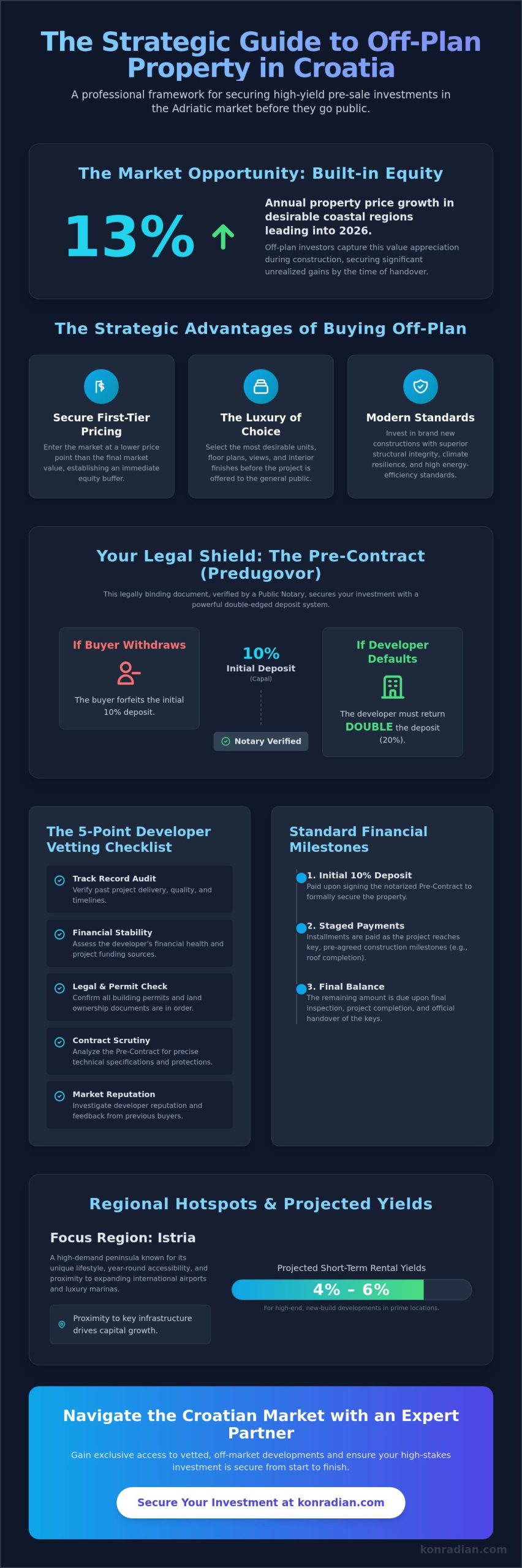
Securing a pre-sale property in Croatia represents a calculated move to capture value before it’s realized by the broader market. In a coastal landscape where premium land is finite, the off-plan model allows investors to enter at a lower price point, often referred to as first-tier pricing. This early entry provides a built-in equity buffer upon completion, which is especially relevant given that property prices grew by 13% in the twelve months leading into early 2026. By the time a project is delivered, the market has often already moved ahead, leaving the strategic buyer with a significant unrealized gain before the keys are even handed over.
Beyond the financial uplift, buying early offers the luxury of choice. You aren’t just buying a unit; you’re selecting the specific orientation, the optimal floor height, and the exact interior finishings that meet your personal standards. Frontline plots along the Adriatic are increasingly rare. Once a project breaks ground, the most desirable units, those with unobstructed sea views and expansive terraces, are usually the first to be reserved. Waiting for the finished product often means settling for the remaining inventory rather than the crown jewels of the development.
Market Dynamics in 2026: Why Off-Plan is Trending
The shift toward off-plan developments is driven by a fundamental supply-demand imbalance in premium coastal regions. While traditional stone house renovations have a certain charm, modern investors are prioritizing the structural integrity and climate-resilience of new builds. Current energy efficiency standards have become a non-negotiable requirement for the elite segment. This preference is supported by a stable Economic Overview of Croatia, which highlights the country’s integration into the Eurozone and its rising status as a primary Mediterranean hub. New constructions offer a level of technical sophistication that older properties simply can’t match, making them more attractive for long-term hold strategies.
Investment Yields and Regional Hotspots
Regional selection is the final piece of the appreciation puzzle. While Dalmatian hubs like Split real estate for sale commands premium prices, with average asking prices reaching €5,660 per square meter in 2026, many investors are also looking toward Istria real estate for sale for its unique blend of Italian-influenced lifestyle and year-round accessibility. Projected short-term rental yields in these high-end developments currently range from 4% to 6%, bolstered by the proximity to expanding international airports and luxury marina infrastructure. Strategic buyers look for projects near these infrastructure nodes, as they historically experience the most resilient capital growth and the highest occupancy rates for premium rentals.
Navigating the Croatian Off-Plan Legal Framework
The Croatian Pre-Contract (Predugovor) serves as the primary legal instrument for pre-sales, formalizing the intent of both developer and buyer to conclude a final purchase agreement once construction concludes. This document isn’t merely a placeholder; it’s a rigorous framework that protects your capital during the delicate period between ground-breaking and delivery. A Public Notary (Javni bilježnik) must verify the signatures to ensure the document’s validity in the Croatian land registry system. During the construction phase, the “Ownership Right” (Vlasnički list) remains with the developer, but your Pre-Contract creates a legal claim that prevents the unit from being sold to another party. For international buyers, the 2026 Economic Outlook for Croatia underscores a period of increased regulatory alignment with global standards, particularly as the nation nears OECD membership. This shift simplifies the acquisition of pre-sale property Croatia for many non-EU citizens, though Ministry of Justice approval remains a standard requirement for those outside the EEA.
The Pre-Contract (Predugovor) Essentials
The “Capal” or down payment is typically set at 10% of the purchase price. It acts as a double-edged security; if the buyer withdraws, they lose the deposit, but if the developer defaults, they’re legally required to return double the amount. Your contract should explicitly detail technical specifications, from the brand of heat pumps to the grade of oak flooring. This level of granularity prevents “bait and switch” tactics and ensures the final delivery matches the premium vision you’ve invested in. Professional legal and financial transaction support ensures these technical hurdles are cleared before your capital is at risk.
Usage Permits and Final Registration
Finalizing your acquisition requires the “Uporabna dozvola” (Usage Permit), which confirms the building was constructed according to the approved permits. Without this, you can’t obtain the final deed or register the “Etažiranje” (condominium conversion). This conversion is what separates a large construction site into individual, deeded apartments. Before committing to the first payment, it’s vital to ensure the land registry is free of any “plomba” or active encumbrances. These small markings in the registry can signal unresolved legal disputes or unpaid debts that could delay your ownership. Verifying these details early allows you to move forward with the quiet confidence that your investment is secure.
The Developer Vetting Checklist: Due Diligence for 2026
While the legal framework provides a necessary safety net, the ultimate success of a pre-sale property Croatia acquisition depends on the entity holding the shovel. In a market where demand often outstrips supply, new developers frequently emerge to capitalize on the momentum. Some are established firms with decades of Adriatic experience; others are “solar cowboys” who lack the institutional depth to manage complex coastal construction. Distinguishing between the two requires a methodical audit that moves beyond glossy brochures and into the technical and financial reality of the developer’s operations. Experienced investors understand that a developer’s past performance is the most reliable indicator of future results.
To ensure your capital is placed with a partner of integrity, we employ a rigorous five-point credibility audit:
- Verified Portfolio: Direct evidence of at least three successfully delivered premium projects within the region.
- Financial Independence: Confirmation that the project is backed by institutional bank credit or significant private equity rather than relying solely on buyer deposits.
- Regulatory Integrity: A valid and unencumbered building permit that aligns perfectly with the proposed architectural plans.
- Technical Accountability: A binding commitment to specific, high-register material brands and construction standards.
- Post-Sale Reliability: A documented history of honoring warranty claims and providing long-term structural support.
Physical Inspection of Past Projects
Visiting a completed project by the same developer is non-negotiable. Coastal builds face unique environmental stressors, including high salinity and seasonal humidity. By inspecting a site delivered three to five years ago, you can observe how the facade has weathered and whether the insulation quality remains intact. It’s equally vital to speak with current residents. Their feedback on post-sale support and the developer’s responsiveness to minor “settling” issues provides a clear picture of the professional stewardship you can expect after the handover.
Legal and Financial Transparency
A reputable developer will proactively provide the “Zemljišnoknjižni izvadak” (Land Registry Extract) to prove they hold clear title to the land. You must also verify the “Građevinska dozvola” (Building Permit) to ensure it’s active and hasn’t been contested. In 2026, the most secure projects utilize escrow accounts or bank-backed construction financing. This structure ensures that your funds are only released as specific construction milestones are met. This level of transparency protects your investment from the developer’s broader business risks, ensuring the focus remains entirely on the successful delivery of your specific unit.
Financial Milestones and Payment Structures
Structuring the financial flow of a pre-sale property Croatia acquisition requires a shift away from the traditional lump-sum mentality. Instead, it’s a strategic allocation of capital that follows the physical progress of the build. This milestone-based approach protects your liquidity and ensures that the developer remains incentivized to meet strict deadlines. With Croatia now fully integrated into the Eurozone, transaction friction has decreased, yet investors from outside the bloc must still account for the timing of currency transfers to optimize their entry price and manage potential volatility.
A balanced payment schedule typically begins with a 10% reservation fee upon signing the Pre-Contract. You should be wary of developers requesting significantly higher upfront percentages without corresponding construction progress. Subsequent payments are usually triggered by reaching the “Roh-bau” stage (structural shell), the completion of the facade and windows, and finally the interior finishing. It’s standard practice to retain the final 5% to 10% of the purchase price until the Usage Permit is officially issued and a thorough snagging list has been cleared. This final retention is your strongest lever for ensuring the build quality meets the agreed specifications.
The Milestone-Based Payment Model
Aligning your capital release with the developer’s progress creates a transparent and low-stress environment. Each payment stage should be verified by a third-party architectural report or a physical site visit to confirm the milestone has been reached. This “pay-as-you-go” structure is particularly effective for high-net-worth investors who prefer to keep their capital working in other vehicles until it’s absolutely required for the project. It also provides a natural exit or pause point should the developer fail to meet the technical standards established in the initial agreement.
Taxation and Legal Fee Planning
Fiscal obligations in the Adriatic market depend heavily on the seller’s status. If you’re purchasing a new build from a VAT-registered developer, the 25% VAT is typically included in the price, which exempts you from the 3% Real Estate Transfer Tax (RETT). However, when buying real estate in Croatia, the tax profile is notably different from the tiered systems in Spain or the administrative hurdles found in Hungary. Beyond the headline tax, you must budget for the essentials of an international transaction. This includes professional fees for your OIB application, certified translation of legal documents, and Public Notary verification. These costs are vital for a seamless registration process and should be factored into your initial ROI calculations. For a detailed breakdown of how these costs apply to your specific portfolio, our team provides comprehensive legal and financial transaction support to ensure every Euro is accounted for.
Securing Exclusive Access with Konradian
The complexities of acquiring a pre-sale property Croatia demands more than just market awareness; it requires a level of institutional access that few individual investors possess. At Konradian, we position ourselves as your strategic partner, bridging the gap between high-net-worth capital and the Adriatic’s most exclusive Tier-1 developments. Our approach is rooted in the intellectual rigor of an LSE-educated background, ensuring that every recommendation isn’t merely a property suggestion but a calculated contribution to your long-term wealth and portfolio diversification. We don’t just find units; we secure the specific frontline assets that are often reserved for private networks before they ever reach a public listing.
A significant advantage of our advisory model is the clarity of its structure. Our professional stewardship is entirely free for the buyer, as our remuneration is handled through a standard seller-paid commission model. This alignment ensures you receive elite-level due diligence, legal oversight, and strategic guidance without adding to your acquisition costs. We act as your protective shield, handling the “heavy lifting” of developer negotiations and bureaucratic navigation so you can enjoy the peace of mind that comes from professional stewardship. From the initial video consultation to the final key handover, our team provides a seamless, end-to-end experience that respects both your time and your capital.
The Concierge Approach to Pre-Sale
We understand that our clients often manage global portfolios from afar, which is why our concierge model is designed for effortless remote purchasing. We pre-vet every developer using the rigorous framework discussed earlier, filtering out high-risk projects and focusing exclusively on those with proven track records and financial solvency. This allows us to provide coastal property Croatia investment opportunities that meet the highest international standards. Whether you’re in London, New York, or Dubai, we manage the local complexities of OIB applications and notary verifications on your behalf, ensuring your Croatian acquisition is as simple as it is secure.
Your Next Steps in the Adriatic
The window for securing peak equity in the 2026 market is currently open, but the most desirable off-plan units move quickly. To help you navigate these opportunities with precision, we invite you to request our curated 2026 Pre-Sale Portfolio, a bespoke selection of projects that have already cleared our internal credibility audit. You can also book a private strategy session with our advisors to align your specific investment goals with the current market dynamics. We’re here to ensure your entry into the Croatian market is characterized by security, exclusivity, and significant capital growth. Explore our exclusive Croatia pre-sale listings today and take the first step toward securing your Adriatic legacy.
Capitalizing on the 2026 Pre-Sale Window
The opportunity to acquire pre-sale property Croatia is a strategic pursuit of early equity and prime location. By mastering the legal nuances of the Pre-Contract and applying a rigorous developer vetting framework, you replace market volatility with calculated security. Successful off-plan acquisitions aren’t just about the physical structure being built. They’re about the professional stewardship that ensures every financial milestone and technical specification is met with precision.
Konradian brings over five years of international brokerage excellence and the intellectual rigor of LSE-educated strategic advisors to your portfolio. Through our direct developer partnerships, we provide exclusive, off-market access to Tier-1 projects while maintaining a transparent model with zero buyer fees. We handle the heavy lifting of bureaucratic navigation and due diligence so you can focus on the long-term growth of your Adriatic assets. Our goal is to provide a seamless transition from global investor to Mediterranean homeowner.
Secure your priority access to Croatia’s most exclusive pre-sale developments.
The Adriatic coast is entering a new era of sophistication and international appeal. With the right framework and a trusted partner, your investment journey will be as seamless and rewarding as the lifestyle it promises to deliver.
Frequently Asked Questions
Is it safe to buy off-plan property in Croatia in 2026?
Acquiring a pre-sale property Croatia is secure when underpinned by a verified Pre-Contract and a developer with institutional backing. The country’s integration into the Eurozone and Schengen Area has brought its property laws into closer alignment with broader EU standards, providing a more transparent environment for international capital. Safety is further enhanced by ensuring the land registry is clear of encumbrances and that the developer utilizes milestone-based payment structures rather than requesting large upfront sums.
What happens if the developer fails to finish the project?
The Croatian legal system protects buyers through the “Capal” or deposit clause within the preliminary agreement. If a developer fails to deliver the project as specified, they are legally obligated to return double the amount of the initial deposit to the buyer. To mitigate this risk entirely, we prioritize projects with bank-backed construction financing, where the financial institution ensures the building’s completion regardless of the developer’s individual liquidity.
Do I need a Croatian bank account to purchase a pre-sale property?
You don’t strictly need a local bank account to execute the initial purchase, as most developers accept Euro transfers via the SEPA network. However, you must obtain a Croatian personal identification number (OIB) before any transaction can occur. While not mandatory for the buy, opening a local account is highly recommended for the subsequent management of utility payments and local tax obligations once the property is delivered.
How much is the typical deposit for a pre-sale property in Croatia?
The standard deposit for a pre-sale property in Croatia is 10% of the total purchase price, paid upon the notarization of the Pre-Contract. This amount is generally held in an escrow account or paid directly to the developer as a guarantee of intent. Be cautious of any request exceeding this 10% threshold during the initial reservation phase, as professional developers typically align larger capital releases with visible construction milestones.
Can non-EU citizens buy pre-sale property in Croatia?
Non-EU citizens can purchase property, though the process is contingent on a reciprocity agreement between Croatia and the buyer’s home country. This requires formal approval from the Ministry of Justice, a process that typically spans several months. With Croatia’s expected OECD membership in 2026, citizens from member states may soon see these requirements streamlined to match the ease of access currently enjoyed by EU and EEA citizens.
What is an “aktivna plomba” and why does it matter for new builds?
An “aktivna plomba” is an active seal or notation on the land registry that indicates a pending legal action or registration request. For a new build, it’s a critical warning sign that the ownership of the land or the validity of the building permit may be under dispute. We ensure that every project in our portfolio has a clean “Vlasnički list” (Title Deed) with no active seals before recommending it to our clients.
Are there any tax benefits to buying a new build vs. a resale property?
Buying a new build from a VAT-registered developer offers a significant administrative and tax advantage. While you pay 25% VAT, this is almost always included in the advertised purchase price, and it exempts you from the 3% Real Estate Transfer Tax (RETT) typically applied to resale homes. This creates a cleaner financial entry point and simplifies the closing process, as there is no separate tax assessment required by the local authorities.
How do I verify a developer’s building permit in Croatia?
You can verify a building permit by requesting the “Građevinska dozvola” number and cross-referencing it with the official ISPU (Information System of Spatial Planning) digital portal. This public registry allows you to confirm that the permit is active, final, and specifically covers the type of structure being marketed. Professional legal support will also check that the permit has not been contested by neighbors or local municipalities, ensuring the build can proceed without interruption.
