


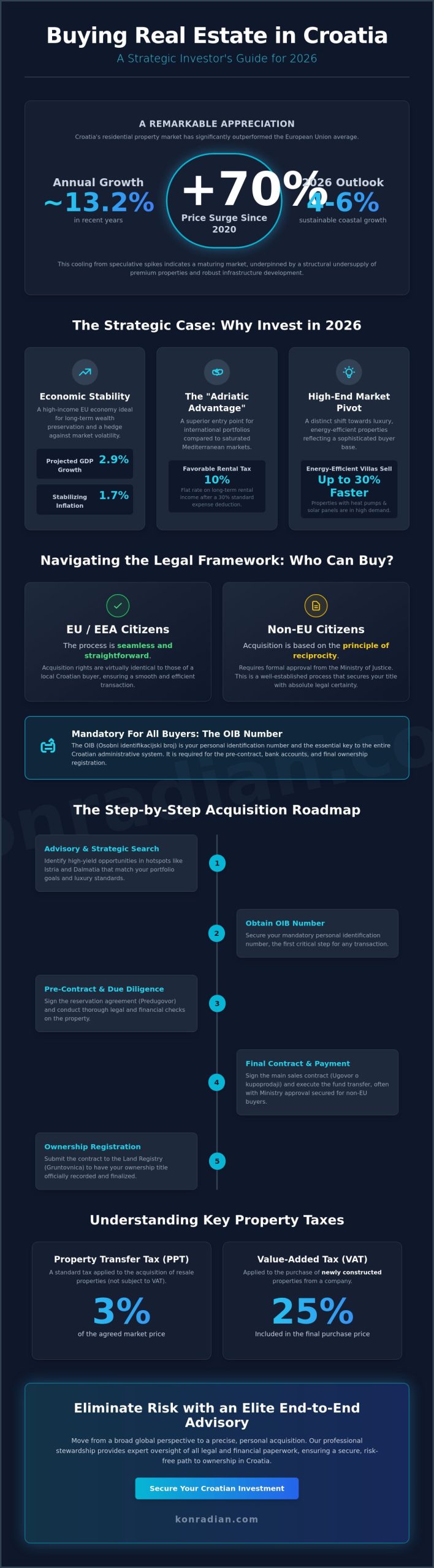
Did you know that residential property prices in Croatia have surged by over 70% since 2020, far outstripping the European Union average? This remarkable appreciation has turned the Adriatic coastline into a primary destination for sophisticated capital, making the process of buying real estate in Croatia a high-stakes endeavor for the strategic investor. You likely recognize the immense potential of the Mediterranean lifestyle, yet you’re probably concerned about the bureaucratic hurdles and the lack of pricing transparency that often accompany international transactions. It’s natural to feel hesitant when faced with complex legal requirements, such as obtaining a mandatory OIB or navigating the 3% property transfer tax.
This guide provides a clear, risk-free path to ownership by breaking down the market’s 2026 dynamics with precision. You’ll master the intricacies of the Croatian property market through an elite-level analysis of legal frameworks, investment hotspots like Istria, and seamless acquisition strategies. We’ll explore everything from the 25% VAT on new constructions to the specific reciprocity agreements required for non-EU citizens. This overview ensures you move from a broad global perspective to a precise, personal acquisition with the peace of mind that comes from professional stewardship.
Key Takeaways
- Identify the strategic advantages of investing in a post-Schengen market where coastal resilience continues to drive long-term value.
- Navigate the legal complexities of buying real estate in Croatia by understanding reciprocity rules and the mandatory documentation required for a secure transaction.
- Evaluate high-yield opportunities across Dalmatia and Istria to match your portfolio with the right regional ROI and luxury standards.
- Master the step-by-step acquisition roadmap, ensuring every stage from the Pre-Contract to the final deed is handled with professional precision.
- Learn how an elite end-to-end advisory model eliminates traditional buyer risks while providing expert oversight of all legal and financial paperwork.
The Strategic Case for Buying Real Estate in Croatia in 2026
Croatia has transitioned from a hidden Mediterranean gem into a cornerstone of the European Union’s economic frontier. Following its entry into the Schengen Area and the Eurozone, the nation has seen a fundamental shift in how global investors view its borders. For those considering buying real estate in Croatia, the 2026 landscape offers a unique window of stability. While the era of speculative, double-digit annual spikes has matured, the underlying value remains robust. The market is currently characterized by a structural undersupply of premium properties, ensuring that well-located assets in Dalmatia and Istria retain their allure.
Understanding Croatia’s economic profile is essential for any serious buyer. With a projected GDP growth of 2.9% in 2026 and inflation stabilizing at 1.7%, the country presents a compelling case for long-term wealth preservation. Real estate here isn’t just a lifestyle choice; it’s a strategic hedge against broader market volatility. This stability provides a sense of security for those seeking to move capital into a high-income, EU-member economy that prioritizes quality of life and infrastructure development.
Market Performance and 2026 Projections
Historical data reveals that residential prices in Croatia rose by approximately 13.2% annually in recent years, with a total increase exceeding 70% since 2020. As we move through 2026, growth is expected to moderate to a more sustainable 4% to 6% in coastal regions. This cooling is a sign of a maturing market rather than a decline. Infrastructure projects, such as improved highway connectivity and airport expansions, have consistently pushed property values upward. We’re seeing a distinct pivot toward high-end, energy-efficient luxury villas. Properties equipped with modern features like heat pumps and solar panels are currently selling up to 30% faster than older, unrenovated alternatives, reflecting a buyer base that values operational efficiency.
The “Adriatic Advantage” for International Portfolios
When compared to the saturated markets of Italy or the French Riviera, the Adriatic coast offers a superior entry point for international portfolios. The tax environment remains favorable; for instance, long-term rental income is taxed at a flat rate of 10% after a standard 30% expense deduction. This efficiency, combined with the rising demand for digital nomad-friendly luxury rentals, creates a potent lifestyle-investment synergy. Investors can secure a personal sanctuary that functions as a high-yield asset during the extended Mediterranean season—a level of luxury also visible in the Lošinj region at losinj-glamping.com. Buying real estate in Croatia allows you to capture this growth while the market is still in its professionalizing phase, offering a level of refinement and tranquility that is increasingly rare in Western Europe.
Navigating the Croatian Legal Framework: Ownership and Reciprocity
The legal architecture of buying real estate in Croatia is built on the principle of reciprocity. This concept dictates that your ability to acquire property as an individual depends on whether a Croatian citizen has the same rights in your home country. For EU and EEA citizens, the process is seamless and virtually identical to that of a local buyer. However, for investors from the United States, United Kingdom, or Canada, the path involves a formal approval process through the Ministry of Justice. While this adds a specific layer of administration, it’s a well-trodden path that secures your title with absolute legal certainty.
Before any transaction can move forward, every foreign buyer must obtain an OIB (Osobni identifikacijski broj). This personal identification number is the essential key that unlocks the Croatian administrative system. You’ll need it for the initial reservation agreement, the opening of a local bank account, and the final registration of ownership. This early step is a primary example of where professional transaction support transforms a bureaucratic requirement into a simple, managed task. It’s also worth noting that while the World Bank’s economic overview of Croatia highlights significant judicial and administrative reforms, having a dedicated guide ensures you don’t encounter local friction.
EU vs. Third-Country Buying Processes
EU citizens enjoy a streamlined registration, moving directly from the purchase contract to the land registry entry. Third-country nationals must submit their contract to the Ministry of Justice for approval, a process that can take several months. During this interim period, your interests are protected by the notarized purchase agreement. For those looking to move faster or acquire agricultural land, which remains restricted for direct foreign individual ownership in 2026, establishing a Croatian limited liability company (d.o.o.) is a strategic alternative. This allows the entity to act as the legal purchaser, bypassing the need for individual reciprocity approval.
The Land Registry and the “Aktivna Plomba”
The Zemljišne knjige (Land Registry) serves as the ultimate source of truth for any property. When we review property excerpts, we look specifically for an “aktivna plomba” or active seal. This is a critical red flag indicating a pending legal action or an unresolved claim against the title. Ensuring a “clean title” is particularly vital when buying real estate in Croatia in the form of old stone houses or heritage properties. These often have complex historical family claims that must be resolved. Our methodical due diligence verifies that all encumbrances are cleared before you commit capital, ensuring your investment is protected from the start.
Dalmatia, Istria, or the Islands: A Comparative Investment Analysis
Choosing the right location for buying real estate in Croatia requires a nuanced understanding of regional market maturity and infrastructure. While the entire coastline offers Mediterranean appeal, the investment profiles of Istria and Dalmatia differ significantly. Istria, often called the “Tuscany of Croatia,” serves as a premium hub for Central European buyers who value car-accessibility from Munich, Vienna, or Milan. Although some parts of Istria have seen a cooling in transaction volume recently, prices remain resilient due to a limited supply of high-end, renovated stone villas. In contrast, Dalmatia remains the vibrant heart of the country’s tourism growth, offering a more rugged, sun-drenched aesthetic that appeals to a global demographic.
Prestige investors often gravitate toward Dubrovnik, where the luxury market operates on its own set of rules. Here, the “Old World” charm commands the highest price per square meter in the country. However, for those seeking a balance of lifestyle and yield, the Pelješac Peninsula has emerged as a 2026 “hidden gem.” The completion of the Pelješac Bridge has fundamentally altered the region’s accessibility, unlocking value in previously isolated coastal villages. This infrastructure improvement is a prime example of how strategic placement can lead to superior long-term appreciation for those buying real estate in Croatia. For a deeper analysis of where the most lucrative opportunities lie along the Adriatic, our coastal property Croatia investment guide for 2026 provides an elite-level breakdown of off-market positioning and developer pre-sales across key regions.
Split and the Dalmatian Coast: The Hub of Growth
Split has evolved from a transit point into a year-round investment destination. The city’s real estate market is bolstered by a thriving tech scene and a Mediterranean lifestyle that attracts a consistent flow of high-net-worth individuals. We’ve observed significant interest in the “Golden Triangle” between Split, Trogir, and Rogoznica. These areas are particularly attractive for villa developments because of their proximity to Split International Airport. A property within a 30-minute drive of the terminal typically sees a much higher occupancy rate during the shoulder seasons, providing a more stable ROI than more remote coastal stretches.
Island Living: Brac, Hvar, and Korcula
The Croatian islands offer a level of exclusivity that is difficult to replicate on the mainland. Hvar remains the “St. Tropez of the Adriatic,” where the luxury market is defined by high-end waterfront estates and a cosmopolitan social scene. Conversely, Brac offers a more family-oriented appeal with its famous white limestone and world-renowned beaches. When evaluating island properties, ferry connectivity is the most critical factor. A property on an island with frequent, year-round lines, like Brac or Hvar, maintains its value better than those on more remote outposts. Beachfront stone houses remain the ultimate trophy assets; they’re rare, historically significant, and increasingly sought after by investors looking for a permanent personal sanctuary.
The Step-by-Step Acquisition Roadmap: From Search to Keys
The logical flow of buying real estate in Croatia follows a methodical sequence designed to protect your capital and ensure legal finality. While the process is structured, it requires a proactive approach to navigate local administrative nuances. A successful acquisition moves from a broad search to a detailed security audit, culminating in the formal registration of your title. This start-to-finish oversight is what transforms a complex international transaction into a secure, predictable experience.
Phase 1: Selection and Due Diligence
Modern acquisition begins with high-level efficiency. You’ll likely narrow your selection through remote video consultations, allowing you to evaluate the layout and surroundings of a property before committing to a site visit. Once a property is identified, a professional security audit of all documentation is non-negotiable. This involves verifying building permits, usage certificates, and the historical chain of ownership in the land registry. The OIB (Personal Identification Number) is the first technical requirement every foreign buyer must obtain before initiating any property transaction in Croatia. Securing this early ensures that you’re ready to act the moment the right opportunity arises.
Phase 2: The Contractual Process
The transition from interest to obligation happens with the Pre-Contract (Predugovor). This document outlines the terms of sale and typically involves a 10% deposit, known locally as kapara. Under Croatian law, this deposit serves as a powerful guarantee; if the seller withdraws, they’re often required to pay back double the amount. During this phase, you’ll also need to manage currency exchange and international bank transfers. Using secure, professional channels ensures your funds arrive on time and in the correct currency. The final contract is signed in the presence of a Public Notary (Javni bilježnik), who verifies the identities and signatures of all parties, providing a foundational layer of legal authenticity to the transaction.
Phase 3: Registration and Handover
The final phase is where ownership is officially recognized. For non-EU citizens, such as those from the US or UK, this involves a waiting period for Ministry of Justice approval, which confirms reciprocity. Once the full purchase price is settled, the seller issues the Tabularna isprava (Tabular Statement). This document is the symbolic and legal key to your investment; it’s the seller’s unconditional consent for you to register as the new owner. You’ll also be responsible for the Real Estate Transfer Tax, which is a flat 3% of the property’s assessed market value. Settling this tax within 30 days of the contract signing is a vital step in maintaining a clean legal standing.
If you’re ready to begin your search with the confidence of elite-level expertise, our team provides comprehensive Croatian real estate sales support to handle every detail of your acquisition.
Eliminating Risk: The Konradian End-to-End Buyer Advisory
The process of buying real estate in Croatia doesn’t have to be a source of stress. While the previous sections detailed the legal nuances and regional variations, the actual execution of a high-stakes transaction requires a partner who understands both the local terrain and international standards. This is where the Konradian model provides a distinct advantage. We act as a sophisticated bridge, translating local friction into a seamless acquisition experience. Our advisory service is designed to align with your interests, ensuring that every negotiation is backed by strategic insight and intellectual rigor.
A key differentiator of our approach is the financial structure of the advisory. In the Croatian market, professional buyer representation is often funded through the seller’s side of the transaction rather than being an additional burden on the buyer. This allows you to access LSE-educated expertise and high-level strategy without increasing your acquisition costs. By positioning ourselves as your dedicated advocate, we provide the protection of a strategic consultant with the personalized care of a dedicated concierge.
Why a Buyer’s Agent is Essential in Croatia
The “heavy lifting” of an international property purchase involves more than just finding a villa. It requires constant coordination between sellers, lawyers, and municipal offices. We handle this bureaucratic navigation on your behalf, providing you with a single point of contact for all legal and financial transaction support. This centralized oversight ensures that nothing is lost in translation. Beyond the administrative benefits, our network provides direct access to developers and exclusive off-market listings. These pre-sale opportunities often provide better value and more customization options than properties found on public portals.
Start Your Journey with a Free Consultation
Every successful investment begins with a clear strategy. We offer an initial video session to define your specific goals, whether you’re seeking a high-yield coastal asset or a private island sanctuary. During this session, we match potential locations to your lifestyle requirements and investment profile, providing a roadmap tailored to your timeline. It’s an opportunity to ask specific questions about the 2026 market and understand how we protect your interests from start to finish.
Take the first step toward a secure acquisition today. Schedule your free video consultation with our Croatia experts and discover how professional stewardship makes the difference in your international portfolio.
Securing Your Adriatic Legacy in 2026
The Croatian market has matured into a premier destination for those seeking both economic stability and lifestyle-driven returns. By understanding the nuances of reciprocity and regional performance, you’ve already bypassed the primary hurdles that many international investors face. Success in 2026 depends on combining this high-level market awareness with a methodical approach to legal due diligence. This ensures that your investment remains a secure sanctuary rather than a source of administrative friction.
Buying real estate in Croatia is a significant wealth-building exercise that requires professional stewardship to ensure a seamless outcome. Our LSE-educated advisory team brings over five years of international brokerage experience to your acquisition, handling every administrative detail from the initial security audit to the final title registration. Because our model is funded through the seller’s side, you receive elite-level representation at zero cost to you. It’s time to transition from observation to ownership with the confidence of a global citizen.
Explore Exclusive Croatian Property Listings with Konradian and take the first step toward securing your Mediterranean future with peace of mind.
Frequently Asked Questions
Can US or UK citizens buy real estate in Croatia in 2026?
Yes, US and UK citizens can purchase property in Croatia provided a reciprocity agreement exists between their home country and Croatia. In 2026, these agreements remain firmly in place, though third-country nationals must obtain formal approval from the Ministry of Justice. This administrative step ensures the transaction is legally sound and recorded correctly in the national registry, providing a secure foundation for your investment.
What are the hidden costs of buying property in Croatia?
Beyond the purchase price, you should budget for the 3% Real Estate Transfer Tax and attorney fees, which typically range from 0.5% to 1.5%. Additional expenses include notary fees, a land registry court fee of approximately €33, and the real estate agency commission of 2% to 3% plus VAT. These costs are standard when buying real estate in Croatia and should be factored into your initial financial strategy to avoid surprises.
Do I need a Croatian bank account to purchase a home?
You’ll find that opening a local bank account is a practical necessity for completing your purchase and managing the property afterward. It’s required for the secure transfer of funds to the seller and for the ongoing payment of municipal taxes and utility bills. Most banks allow non-residents to open an account relatively easily once they’ve obtained their mandatory OIB number.
How long does the property buying process take for foreigners?
The timeline for a property transaction depends largely on your residency status and the efficiency of local registries. EU citizens often complete the registration process within 30 to 90 days. For non-EU investors, the requirement for Ministry of Justice approval can extend the timeline to between three and six months, though your interests are protected by the notarized contract during this period.
Is it possible to buy property in Croatia remotely?
It’s entirely possible to manage the acquisition process from abroad by using a Power of Attorney (PoA). This document must be notarized and, depending on your home country, apostilled before it’s sent to your legal representative in Croatia. We frequently facilitate remote transactions for global clients, ensuring that every stage from the initial offer to the final deed is handled with professional precision.
What is the Real Estate Transfer Tax in Croatia?
The Real Estate Transfer Tax (RETT) is a flat 3% of the property’s market value as assessed by the local tax authorities. This tax applies to all resale properties and must be reported within 30 days of signing the final purchase contract. If you’re purchasing a new construction directly from a developer registered in the VAT system, you’ll pay 25% VAT instead, which is usually included in the advertised price.
Can I rent out my Croatian property as a tourist rental?
You can rent out your property, but you must comply with specific local regulations regarding “categorization” and tax reporting. To operate a tourist rental, the property must be officially inspected by the local tourism office to ensure it meets safety and quality standards. Many international owners choose to establish a Croatian company to streamline these operations and manage the 10% rental income tax efficiently.
What is an OIB and how do I get one?
The OIB is a personal identification number used for all official, legal, and tax-related matters within the country. It’s the first technical requirement for buying real estate in Croatia and is obtained by submitting an application to the local Tax Administration office. This can be handled in person by the buyer or by a legal representative with a valid Power of Attorney, typically taking just a few days to process.
