


In 2026, the most lucrative coastal property Croatia investment isn’t found on a public listing; it’s secured behind the closed doors of developer pre-sales long before the first stone is laid. While average asking prices in regions like Dalmatia have reached approximately €4,070 per square meter, the true value lies in strategic off-market positioning and professional advocacy. You likely recognize that Croatia’s integration into the Schengen Area has transformed the Adriatic into a premier global destination. However, the complexity of foreign legal structures and the fear of “tourist-trap” pricing often create a significant barrier between you and your Mediterranean ambitions.
We understand that a secure second home should provide both personal tranquility and a clear path to capital appreciation. This guide provides the elite developer access and buyer-side protection required to navigate the market with absolute confidence. You’ll discover how to manage the 3% transfer tax on resales, understand the 25% VAT implications for new constructions, and secure gross rental yields that currently reach up to 9% in prime coastal pockets. From the initial search to the final transaction, we outline a methodical, stress-free path to acquiring a protected, high-performing asset in the heart of the Mediterranean.
Key Takeaways
- Analyze how Eurozone stability and the “Schengen Effect” have matured the Adriatic market into a premier destination for long-term capital appreciation.
- Identify high-performing investment zones by comparing the sophisticated luxury demand of Istria with the rapid growth engines of the Dalmatian coast.
- Streamline your acquisition process by mastering the essential legal requirements, including OIB registration and the strategic use of pre-contracts to secure your price.
- Gain a competitive advantage by learning how to access exclusive off-market opportunities and developer pre-sales before they reach the general public.
- Discover the benefits of professional advocacy in managing a coastal property Croatia investment, ensuring a seamless journey from your first inquiry to the final key handover.
The 2026 Outlook for Coastal Property Croatia Investment
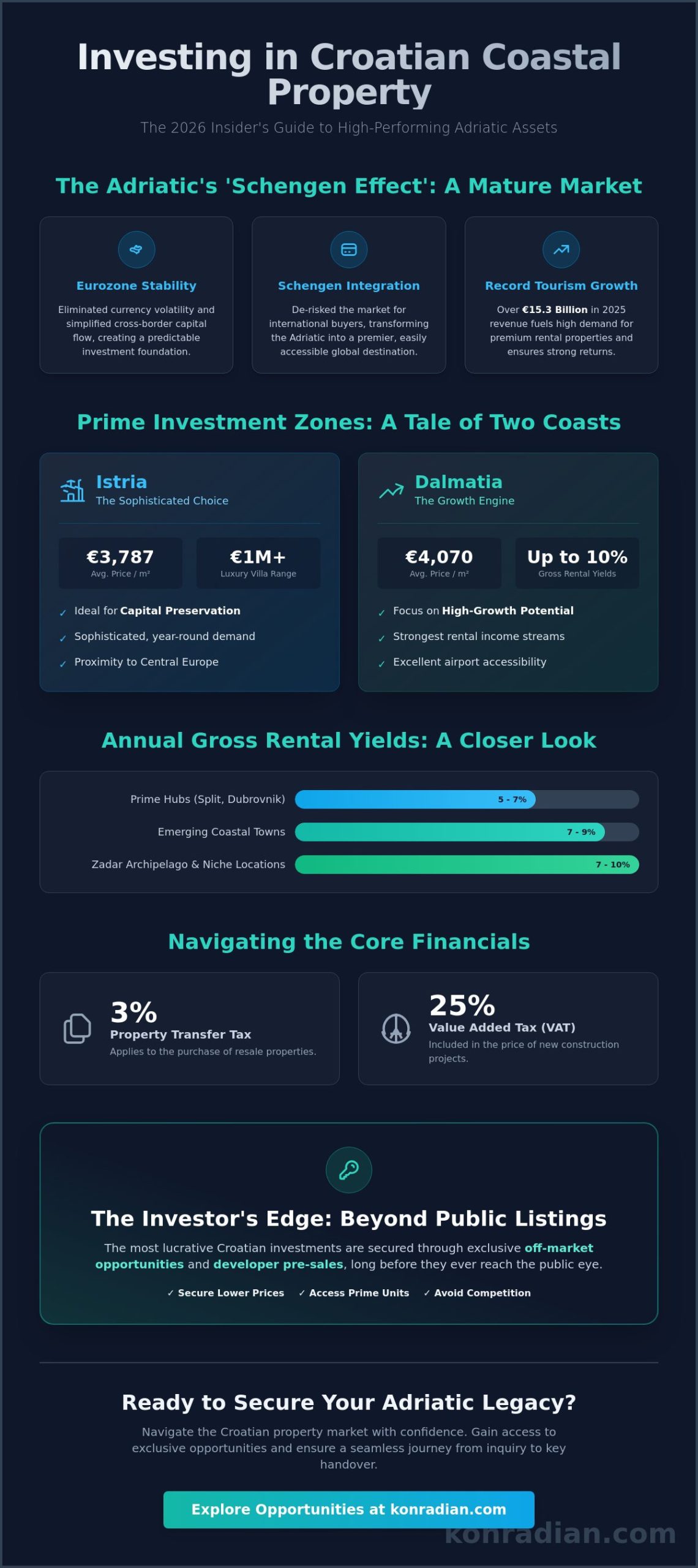
The 2026 landscape for coastal property Croatia investment reflects a market that’s transitioned from an emerging opportunity into a mature, stable asset class. Three years since the adoption of the Euro and entry into the Schengen Area, the “Schengen Effect” has effectively de-risked the market for international buyers. This integration has eliminated currency volatility and simplified cross-border capital flow, leading to a noticeable stabilization in property values across the Adriatic. Unlike more volatile Mediterranean markets, the economic stability of Croatia provides a predictable foundation for those seeking to preserve wealth while capturing growth.
Dalmatia is increasingly defined as the “New Riviera,” consistently outperforming traditional markets in France and Italy. This shift is driven by a unique combination of record-breaking tourism revenue, which exceeded €15.3 billion in 2025, and extremely tight supply constraints. Strict coastal development regulations ensure that direct sea-access properties remain a finite resource, protecting investors from the oversupply issues seen in other regions. While traditional stone house renovations offer significant heritage appeal, modern luxury villas are currently yielding the highest returns. Gross rental yields frequently reach between 7% and 9% in emerging coastal towns, whereas prime locations like Dubrovnik and Split maintain steady returns of 5% to 7%.
Why the Adriatic Coast is the Strategic Choice for 2026
Croatia’s appeal as a primary investment destination is bolstered by its top-tier safety and security ratings, making it a preferred choice for family-oriented wealth preservation. The successful transition from the Kuna to the Euro has enhanced market liquidity, allowing for more seamless transactions and transparent pricing. Additionally, the rapid expansion of digital nomad infrastructure and high-speed connectivity has extended the traditional tourist season. This evolution supports year-round occupancy, particularly for premium properties equipped with modern climate control and office amenities.
Capital Growth vs. Rental Income: Setting Your Objectives
Strategic buyers must distinguish between high-appreciation zones and stable-income hubs. The burgeoning luxury yachting industry in Zadar and Split is a major catalyst for premium demand, as high-net-worth individuals seek onshore assets near world-class marinas. While established cities remain anchors for stable rental income, smaller coastal villages offer aggressive capital growth potential as regional infrastructure improves. The 2026 investment climate represents a sophisticated balance of European institutional security and the dynamic growth typical of a high-potential emerging market.
Prime Investment Zones: Yield Analysis by Region
The Adriatic coastline is far from a uniform market. It’s a mosaic of micro-climates and economic zones, each requiring a specific strategic approach. For a successful coastal property Croatia investment, you must distinguish between the lifestyle-driven stability of the north and the yield-intensive growth of the central and southern regions. Understanding these regional nuances is the difference between a simple purchase and a high-performing asset.
Istria, often called the “Tuscany of Croatia,” appeals to investors seeking sophisticated, year-round demand. With an average asking price of €3,787 per square meter as of April 2026, it remains a favorite for German and Austrian buyers who value its road-trip proximity to Central Europe. The region’s focus on high-quality villas, often priced between €1 million and €2 million, caters to a demographic that prioritizes tranquility and culinary heritage over seasonal tourism spikes. This creates a stable environment for capital preservation with a refined, upscale character. For a comprehensive breakdown of this region’s unique investment dynamics, our dedicated guide to Istria real estate for sale provides an in-depth analysis of current pricing, developer pre-sales, and legal considerations.
Dalmatia serves as the nation’s primary growth engine. In cities like Split and Zadar, average prices have climbed to approximately €4,070 per square meter. These hubs benefit from exceptional airport accessibility and a robust infrastructure that supports gross rental yields between 5% and 7%. For those looking toward the Zadar archipelago or smaller coastal towns, yields can even reach the 7% to 10% range. The southern coast remains anchored by Dubrovnik’s enduring prestige, while the completion of the Pelješac Bridge has unlocked easier access to the Pelješac peninsula. Island investments on Hvar and Brač offer premium rewards but require navigating logistical nuances like seasonal ferry schedules and limited local supply.
Istria vs. Dalmatia: Comparing the Investment Profiles
Choosing between these regions depends on your long-term objectives. Istria offers a more predictable, year-round market due to its geographical location and diversified economy. In contrast, Dalmatia provides higher summer intensity and stronger short-term liquidity. If you’re looking for tailored advice on which region aligns with your portfolio, our experts in Croatian real estate sales can provide a nuanced analysis of current local trends and upcoming infrastructure developments.
Micro-Location Scouting: Beyond the Famous Cities
Smart capital is increasingly moving toward “second-line” properties. These assets, located just behind the immediate waterfront, offer better value preservation and lower entry costs while still benefiting from sea views. Emerging hotspots like the Makarska Riviera and the Šibenik archipelago represent untapped potential for significant appreciation. However, investors must remain mindful of UNESCO heritage constraints. Building zones near protected sites in Trogir or Split require rigorous due diligence to ensure all usage permits are strictly in order and that your legacy remains secure.
Navigating the Acquisition: A Resource Guide for Strategic Buyers
Securing a coastal property Croatia investment requires a transition from market analysis to technical execution. The process is methodical and highly regulated, designed to protect the integrity of the land registry. Your journey begins with obtaining an OIB (Osobni identifikacijski broj). This personal identification number is the essential key for any foreign citizen wishing to enter into a contract, open a local bank account, or pay taxes within the country. Without it, the administrative machinery cannot move forward. We handle this initial hurdle as part of our comprehensive transaction support, ensuring your entry into the market is seamless from day one.
Once a property is identified, the “Pre-Contract” (Predugovor) serves as your primary safeguard. This document defines the terms of the sale, locks in the purchase price, and typically involves a 10% deposit. In a market where prime sea-view inventory is scarce, this step is vital for preventing gazumping. Following the pre-contract, rigorous legal due diligence must be performed. This involves a meticulous review of the Vlasnički list (Ownership Certificate) to ensure the title is clear of liens or encumbrances. We also verify that all building and usage permits are fully regularized, as historical properties or newer developments occasionally face zoning discrepancies that could affect future liquidity.
Understanding the financial obligations beyond the sticker price is equally important for your capital planning. For resale properties, buyers are responsible for a 3% Real Estate Transfer Tax (RETT). However, if you’re acquiring a new construction from a developer within the VAT system, this 3% tax does not apply. Instead, a 25% VAT is included in the purchase price. Additional closing costs generally include notary fees, which are set on a fixed legal scale, and legal fees that typically range from 0.5% to 1.5% of the property value. Managing these variables with precision ensures there are no surprises at the point of handover.
The Zero-Cost Buyer Representation Model
Many international investors are surprised to learn that elite buyer representation can often be secured without additional out-of-pocket expenses. In many new-build scenarios, the developer pays the agency commission, allowing you to benefit from our expert advocacy and market access for free. It’s critical, however, to maintain independent legal advice rather than relying solely on the seller’s representative. For a deeper dive into these safeguards, consult our Buying Real Estate in Croatia: The 2026 Strategic Investor’s Guide.
Remote Acquisition: Buying Property Without Traveling
Modern investment doesn’t always require a physical presence in the country. We facilitate secure, remote acquisitions through a limited Power of Attorney (PoA), which allows your legal representative to sign documents and register the title on your behalf. This process is supported by high-definition virtual tours and detailed site inspections that provide a transparent view of the asset. Funding is handled through secure escrow accounts and international bank transfer protocols, ensuring your capital is protected at every stage of the transaction.
Unlocking Off-Market and Pre-Sale Opportunities
In a market as competitive as the Adriatic, the most desirable assets rarely reach public listing portals. Portals often serve as a repository for inventory that failed to sell through private networks or properties with pricing that doesn’t align with current market realities. A truly sophisticated coastal property Croatia investment is typically secured during the “silent sale” phase. By the time a project is visible to the general public, the premier units with unobstructed sea views and optimal floor plans are frequently already under contract. We prioritize providing our clients with this “First-Look” advantage, allowing you to acquire units at developer pricing before the broader market drives up the entry cost.
The benefits of pre-sale acquisition extend beyond mere price protection. Buying off-plan allows for a level of customization that is impossible with a finished resale property. You can often influence the selection of high-end finishes, modify internal layouts to suit your lifestyle, and ensure that the latest 2026 energy-efficiency standards are integrated from the start. While this path offers significant rewards, it requires a disciplined approach to risk mitigation. To navigate this process with institutional-grade confidence, our pre-sale property Croatia checklist for 2026 provides a professional vetting framework for auditing developer history and securing legally sound off-plan transactions. We focus exclusively on developers with proven track records and verified financial liquidity, ensuring that your capital is tied to a project that will be delivered on time and to the promised architectural standard.
The Developer Relationship: Why Direct Access Matters
Long-standing partnerships with the country’s leading architectural firms and construction companies provide a distinct edge for the end-buyer. These relationships allow us to secure units in high-demand complexes long before the groundbreaking ceremony takes place. Pre-sale access is the primary tool for immediate equity growth upon completion. It ensures you aren’t just buying a home; you’re capturing the value created during the development cycle itself. If you’re ready to explore these exclusive opportunities, our team specializes in Croatian real estate sales for discerning international investors.
Identifying Quality: The Konradian Vetting Process
Our vetting process applies a rigorous financial and technical analysis to every developer deal, a method we refer to as the “LSE Mindset.” In 2026, technical standards have evolved, and we prioritize projects that feature advanced earthquake-resistant construction and sustainable climate control systems. We don’t just look at the aesthetic appeal; we analyze the underlying structural integrity and the long-term maintenance profile of the building. Case studies from recent developments in Split show that pre-sale buyers who entered at the initial offering saw double-digit capital growth before the keys were even handed over. This methodical oversight ensures that your investment remains a high-performing asset for decades to come.
Securing Your Adriatic Legacy with Professional Advocacy
A successful coastal property Croatia investment is more than a simple acquisition; it’s the foundation of a Mediterranean legacy. While the technical steps of obtaining an OIB and signing a pre-contract are vital, the true value of your asset is protected through long-term strategic stewardship. We don’t view our role as a mere intermediary. Instead, we act as a protective partner, handling the heavy lifting of international transactions so you can focus on the lifestyle rewards of your new home. Our involvement spans the entire lifecycle of the purchase, ensuring that every detail, from the initial site inspection to the final key handover, is managed with precision and care.
Integrating a Croatian asset into a broader international wealth strategy requires a cosmopolitan mindset. Many of our clients are diversifying their portfolios across multiple European jurisdictions. By comparing the Adriatic market with other high-performing regions, such as those detailed in The Comprehensive Guide to Spanish Property Acquisition, you can make informed decisions about where to allocate capital for optimal yield and appreciation. This global perspective ensures that your property isn’t just a holiday retreat, but a high-performing component of your wider financial estate.
The Konradian Difference: Elite Education Meets Local Expertise
Our approach is rooted in the “LSE Mindset,” where a background from the London School of Economics informs every risk assessment and market analysis we conduct. This academic rigor translates to a more disciplined investment process for you. We combine this high-level strategic consulting with the personalized care of a dedicated concierge. Our multilingual team speaks the language of international business, bridging the gap between local Croatian regulations and the expectations of sophisticated global investors. We prioritize your emotional well-being by providing a transparent, logical, and reassuring environment for every transaction.
Next Steps: Your Personal Coastal Investment Strategy
The path to a secure Adriatic home begins with a clear definition of your investment parameters. We offer a structured process to move you from initial interest to successful ownership:
- Initial Consultation: A free video session to discuss your financial goals and lifestyle requirements.
- Customized Sourcing: We leverage our developer relationships to identify off-market units that meet your specific criteria.
- End-to-End Advocacy: We manage the legal due diligence, financial transaction support, and administrative filings.
- Strategic Handover: A seamless transition where we ensure the property meets all technical standards before you take possession.
Your journey toward a premium Mediterranean asset doesn’t have to be complex or stressful. With the right professional stewardship, you can secure a property that offers both tranquility and significant capital growth. Begin your Adriatic investment journey with a free expert consultation and discover the peace of mind that comes from elite advocacy.
Realizing Your Vision on the Adriatic Coast
The Adriatic market has matured into a stable, high-yield environment where the most significant gains are found through early developer access and rigorous legal oversight. You now understand the regional nuances between the luxury demand of Istria and the growth engine of Dalmatia. Most importantly, you recognize that the most secure path to a legacy asset involves navigating the tax and regulatory landscape with a professional partner who understands the high-level risk management required for international transactions. A successful coastal property Croatia investment is no longer a matter of chance but a result of strategic positioning and elite advocacy.
Our team brings over five years of international brokerage excellence and a deep network of developer relationships to ensure you receive first-look access to off-market deals. By combining disciplined financial analysis with personalized concierge support, we handle the complex administrative heavy lifting so you can focus on the lifestyle rewards of your new home. Secure your free Adriatic investment consultation today to define your parameters and begin your journey with our LSE-educated advisory team. Your future on the Croatian coast is within reach, and we’re here to ensure it’s built on a foundation of absolute security and sophistication.
Frequently Asked Questions
Can foreigners buy coastal property in Croatia in 2026?
Citizens of EU and EEA countries can purchase property under the same conditions as Croatian citizens without special approvals. Non-EU/EEA citizens are also permitted to invest, though they require formal approval from the Ministry of Justice based on reciprocity agreements between Croatia and their home country. This administrative process typically takes between two and six months to finalize.
What are the hidden costs of investing in Croatian real estate?
Beyond the sticker price, you must budget for the 3% Real Estate Transfer Tax on resales or account for the 25% VAT included in new-build prices. Additional closing costs include legal fees ranging from 0.5% to 1.5% and fixed-scale notary fees. You should also consider the annual property tax for second homes, which ranges from €0.60 to €8.00 per square meter depending on the local municipality.
Is it better to buy an old stone house or a new-build villa for investment?
The choice depends on your specific objectives for a coastal property Croatia investment. Modern villas generally offer higher immediate rental yields and lower maintenance profiles, whereas traditional stone houses provide unique heritage value and long-term capital preservation. New constructions also exempt you from the 3% transfer tax, as they fall under the 25% VAT system.
How much rental yield can I realistically expect from a beachfront property?
Gross rental yields for coastal properties typically range from 5% to 9%. Prime locations like Dubrovnik and Split often see yields between 5% and 7% due to higher entry prices. Smaller coastal towns and emerging archipelagos can offer even more attractive returns, sometimes reaching between 7% and 10% for high-quality, well-positioned assets.
Do I need a local bank account to buy property in Croatia?
While not strictly mandatory for the initial transaction, having a local Euro account is highly recommended for managing utility payments and local taxes. Most international buyers find that a local account simplifies the ongoing financial stewardship of their property. We assist with the administrative steps required to establish these local banking relationships as part of our transaction support.
What is the OIB and how do I get one for my property purchase?
The OIB is a personal identification number required for all legal and financial transactions in Croatia. It’s essential for signing contracts, paying taxes, and registering your ownership in the land registry. We handle the application process for our clients, ensuring you receive your number promptly and without any administrative stress.
Is there a capital gains tax on property sales in Croatia?
Capital gains tax is set at 12% plus a potential municipal surtax, but it only applies if you sell the property within two years of purchase. If you hold the asset for more than two years, you are entirely exempt from this tax. This structure encourages long-term investment and rewards those who view their Adriatic property as a multi-year legacy asset.
How does Konradian offer services for free to the buyer?
We utilize a developer-paid commission model for many of our new-build and off-market opportunities. This means the seller covers our professional fees, allowing you to benefit from our LSE-educated advisory and elite buyer-side protection at no additional cost. Our priority is ensuring you navigate the market with absolute security while we handle the heavy lifting of the transaction.
