


With the average asking price for Split real estate for sale reaching €5,660 per square meter in May 2026, the Dalmatian coast has evolved into a sophisticated arena for strategic global capital. You’ve likely noticed that the city’s unique blend of UNESCO heritage and Mediterranean allure offers a compelling investment case, yet the fear of overpaying for a tourist trap or getting caught in the 3% property transfer tax paperwork remains a valid concern. It’s natural to feel cautious when navigating a foreign legal system that requires specific reciprocity agreements and Ministry of Justice approvals for non-EU buyers.
This strategic comparison is designed to replace that uncertainty with professional clarity. You’ll discover how to distinguish between high-yield micro-markets like the premium Jug area and the more accessible northeast districts. We’ll provide a clear, end-to-end roadmap for a secure purchase process that balances your personal lifestyle goals with long-term capital appreciation. By the end of this analysis, you’ll have the intellectual rigor needed to secure a property that serves as both a sanctuary and a high-performing asset.
Key Takeaways
- Understand how the “UNESCO effect” provides a protective layer for property values in the historic core, ensuring long-term stability for your Adriatic portfolio.
- Compare the distinct yield profiles of short-term tourist rentals in the Old Town against the emerging executive let market along the Split Riviera.
- Evaluate the strategic trade-offs between the timeless appeal of historic stone houses and the operational efficiency of modern luxury developments.
- Identify the critical legal milestones for securing Split real estate for sale, including the specific role of the notary and land registry in protecting your interests.
- Discover a refined, concierge-led acquisition model that simplifies complex international transactions and provides exclusive access to off-market developer deals.
Split Real Estate Market in 2026: Why Dalmatia’s Capital is the Strategic Choice
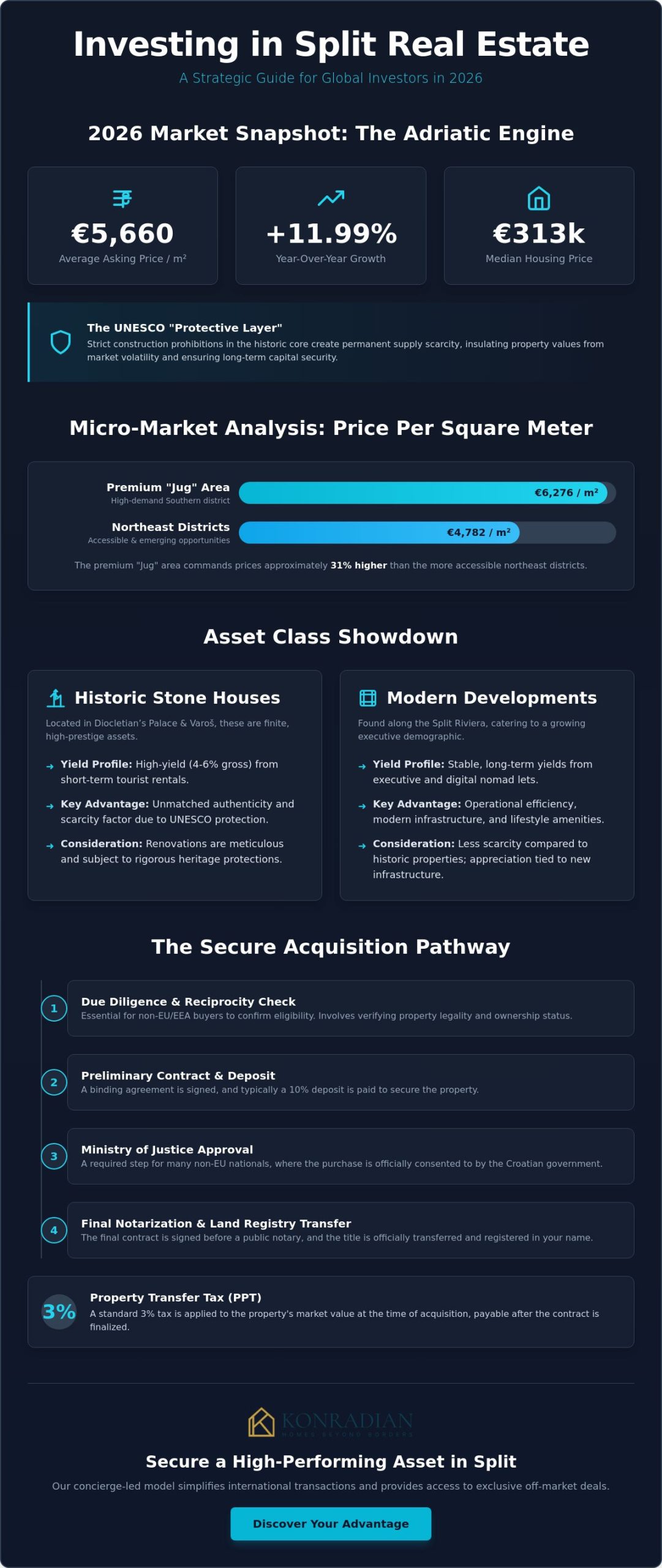
Split has moved beyond being a mere transit point for island-bound tourists. In 2026, it stands as the undisputed economic engine of the Adriatic. While other Mediterranean hubs face saturation and diminishing returns, the market here offers a superior price-to-quality ratio. You’ll find that Split real estate for sale provides a unique combination of historic preservation and modern growth that is rare in today’s global market. For those evaluating Split real estate for sale, the current median housing price of approximately €313,000 represents an entry point that remains remarkably competitive when compared to established markets like the French Riviera or Ibiza.
It’s clear that the city’s status as a UNESCO World Heritage site acts as a robust financial shield. Because new construction is strictly prohibited within the historic core, supply remains permanently capped. For a deeper context, a historical and cultural overview of Split reveals why these ancient assets retain such high prestige. This scarcity ensures that property values within the walls of Diocletian’s Palace aren’t just stable; they’re effectively insulated from broader market volatility. Investors are increasingly viewing these stone assets as “blue-chip” holdings that offer both cultural legacy and capital security.
The 2026 Investment Climate in Dalmatia
The market has shifted toward high-quality, sustainable luxury. In May 2026, Split’s real estate asking prices surged by 11.99% compared to the previous year, significantly outperforming the national average. You can see this divergence clearly in the city’s micro-markets; the southern “Jug” area now commands €6,276 per square meter, while more accessible opportunities in the northeast average around €4,782. This growth isn’t just driven by summer tourism. A growing community of digital nomads and year-round executive residents has stabilized rental yields, moving the market away from seasonal spikes and toward consistent, predictable income.
Connectivity and Growth Drivers
Infrastructure is the backbone of this appreciation. Split Airport’s expanded flight paths now connect the city to major European capitals throughout the winter, supporting a burgeoning 12-month economy. The international ferry terminal remains the busiest in the country, serving as the gateway to Hvar and Brač, which naturally boosts mainland demand as investors seek a central urban base. Government-led green development initiatives in 2026 are also revitalizing former industrial zones, creating new opportunities for urban renewal that previously didn’t exist. These projects are designed to enhance the city’s livability, ensuring that capital appreciation is tied to genuine municipal improvement rather than speculative bubbles.
Comparing Split’s Prime Districts: Old Town vs. The Riviera
Investors evaluating Split real estate for sale must decide between two diverging investment philosophies: the high-density historic core or the expansive coastal Riviera. Each micro-market serves a specific portfolio objective. The Old Town represents a finite, high-prestige asset class where heritage status acts as a natural barrier to entry. Conversely, the Riviera offers the modern infrastructure and lifestyle amenities that appeal to the growing executive resident demographic. This choice isn’t merely about location; it’s a strategic decision between immediate tourist-driven yields and long-term capital appreciation supported by Croatia’s economic outlook and its continued resilience within the Eurozone.
The Historic Core: Diocletian’s Palace and Varoš
Investing in Diocletian’s Palace or the charming streets of Varoš requires a deep appreciation for the scarcity factor. These stone houses offer unmatched authenticity, yet they come with rigorous heritage protections that make renovations a meticulous, high-stakes process. Because the supply of these historic units is permanently capped, they command premium rates in the ultra-high-end tourist market. Owners who successfully blend modern interior luxury with original Dalmatian aesthetics often see the highest short-term rental performance in the city, frequently achieving gross yields between 4% and 6% for well-managed units.
The Split Riviera: Žnjan, Podstrana, and Beyond
Moving south toward Žnjan and Podstrana, the landscape shifts to modern luxury and smart-home integrated apartments. This area is rapidly becoming the city’s “Gold Coast” due to significant public investment in the Žnjan plateau and coastal promenades. Unlike the car-free historic center, these developments prioritize private parking, direct beach access, and gated security. These features make the Riviera the preferred choice for long-term executive lets, providing a stable income stream that avoids the seasonal fluctuations of the tourist market. The southern “Jug” area, as previously noted, leads the market in price appreciation, reflecting its status as the city’s primary zone for high-quality residential growth.
Public investment in 2026 is heavily weighted toward these southern suburbs, with new infrastructure projects designed to improve connectivity and green spaces. This ensures that while the Old Town remains the cultural heart, the Riviera is the city’s future economic lungs. Selecting the right district requires a balance of lifestyle preference and financial precision. If you’re ready to explore these micro-markets with a dedicated partner, you might consider how professional acquisition support can streamline your decision-making process. The trade-off between urban vibrancy and Mediterranean tranquility is personal, but the data suggests that both paths offer a secure route to capital growth when executed with expert precision.
Asset Classes in Split: Historic Stone Houses vs. Modern Developments
Selecting an asset class within the 2026 market requires a balance of aesthetic desire and operational reality. You’re likely weighing the prestige of a heritage property against the streamlined efficiency of a new-build. While both paths lead to capital appreciation, they demand different levels of stewardship and involvement. Assessing Split real estate for sale in this context means looking beyond the facade to understand the long-term maintenance implications of each choice. The decision ultimately rests on whether you seek a legacy project or a high-performing, low-friction financial instrument.
Authentic Dalmatian Stone Houses
Authentic stone houses are the city’s most evocative assets. Their thick limestone walls and traditional green shutters aren’t just decorative; they offer natural thermal regulation that modern materials often struggle to replicate. However, the “fixer-upper” strategy has become more complex in 2026. High-level investors now prioritize structural integrity and modernized utility connections over mere cosmetic charm. Tourists consistently pay a premium for this “Old World” atmosphere, which drives impressive yields, yet the active management required for these centuries-old buildings is significant. For those seeking a more streamlined entry into the market, exploring pre-sale property Croatia provides a strategic alternative to the complexities of heritage renovation.
Contemporary Apartments and Penthouses
Modern apartments and penthouses in 2026 are defined by their Energy Efficiency Class A+ ratings and integrated EV charging stations. These developments are designed for the “lock-and-leave” lifestyle, appealing to international second-home owners who value peace of mind. Standard features now include expansive terraces and smart-home systems that allow you to manage your property from anywhere in the world. This asset class is where we see a significant influx of institutional capital, as standardized quality and predictable maintenance costs make these properties ideal for diversified portfolios. The convenience of a new-build ensures that your time in Split is spent enjoying the Mediterranean lifestyle rather than managing contractor schedules.
The rise of off-plan opportunities allows you to secure value before the first stone is laid. By entering the market early in the development cycle, you can capture the initial surge in equity that typically occurs upon completion. While stone houses offer a finite supply and undeniable charm, modern developments in Split-Dalmatia County provide the technical precision required for a truly passive investment. When evaluating Split real estate for sale, consider how each asset class aligns with your personal involvement threshold and your long-term yield expectations. Whether you choose the soul of history or the efficiency of the future, the market in 2026 rewards those who prioritize quality over volume.
Navigating the Acquisition: Legal Framework and Buyer Protections
The transition from identifying Split real estate for sale to holding the keys requires a disciplined adherence to Croatian property law. This journey begins with the acquisition of your OIB, the personal identification number essential for all financial and legal activities in the country. Once your offer is accepted, the process typically moves to a pre-contract phase where a 10% deposit is paid into a secure account. This stage is followed by the final contract, which must be executed in the presence of a public notary to ensure its validity. Because the Dalmatian legal system operates on specific civil law principles, legal support buying property abroad is a fundamental requirement for safeguarding your capital and ensuring a seamless transfer of title.
Securing the Transaction
Technical due diligence is your primary defense against “tourist trap” properties or legacy legal issues. Your representative must verify the Vlasnički list (title deed) for any hidden encumbrances and ensure the property possesses a valid Uporabna dozvola (usage permit). Using an escrow account for the final fund transfer provides an additional layer of security, releasing payments only when the land registry confirms the preliminary entry of your ownership. Non-EU buyers from the US and UK must navigate a Ministry of Justice approval process that typically spans two to six months, contingent upon existing reciprocity agreements.
The 2026 Tax Landscape
Understanding your fiscal obligations is critical for an accurate ROI calculation. For most resale properties, you’ll be responsible for a 3% Real Estate Transfer Tax (RETT) based on the market value determined by the tax authorities. However, many modern new-builds are sold by companies within the VAT system, which may exempt you from RETT but requires a different pricing analysis. You should also account for the annual property tax introduced in 2025, which in 2026 ranges from €0.60 to €8.00 per square meter for non-primary residences. For a comprehensive breakdown of these costs, our guide to buying real estate in Croatia offers a full fiscal overview to help you plan with precision.
The complexity of these regulations shouldn’t be a deterrent but rather a signal of the market’s maturity and the protections afforded to legitimate investors. By engaging with professional stewardship early in the process, you transform a potentially stressful transaction into a well-organized strategic move. If you’re ready to secure your position in the Dalmatian market with absolute confidence, contact our acquisition team to begin your personalized property search today.
Securing Your Split Investment: The Konradian Advantage
Securing a position in the Dalmatian market requires more than just capital; it demands a partner who views the Adriatic through a lens of global strategy. When searching for Split real estate for sale, you’ll find that the most exceptional opportunities are often shielded from the public eye. Our approach combines the intellectual rigor of a strategic consultancy with the personalized care of a dedicated concierge. We don’t just facilitate transactions. We provide the professional stewardship necessary to transform a complex international acquisition into a seamless, rewarding experience.
A distinctive feature of the Croatian real estate market is that our advisory services are entirely free for the buyer. In this jurisdiction, the seller typically compensates the agency, which means you can leverage our LSE-educated expertise and legal oversight without incurring additional brokerage fees. This model ensures that your interests are protected by a high-level advisor whose goal is to secure the best possible valuation and market timing for your portfolio. We prioritize transparency and intellectual rigor, ensuring every asset we present has undergone a thorough technical and financial vetting process.
Exclusive Direct-to-Developer Access
The premier Split real estate for sale often bypasses public aggregators entirely. Through our established direct-to-developer relationships, we provide you with exclusive access to off-plan acquisitions and pre-sale deals. Entering a project before the first stone is laid allows you to capture early-bird pricing and select the most desirable units within a development. This early entry also provides opportunities for bespoke customization of interior finishes. If you’re considering broader regional diversification, our insights into Istria real estate for sale offer a comparable strategic framework for the northern coast.
Your International Partner in Dalmatia
Our end-to-end concierge model is designed to alleviate the inherent stress of cross-border transactions. From the initial selection and legal navigation to the final key handover, we manage every detail with precision and quiet confidence. This start-to-finish involvement ensures that your transition into the Split property market is characterized by security and ease. Our team acts as a proactive partner, handling the heavy lifting of administrative coordination so you can focus on the lifestyle benefits of your new asset. You can begin this process by booking a free 2026 video consultation to discuss your specific investment goals with our cosmopolitan advisory team. Secure your piece of the Adriatic with Konradian and experience the peace of mind that comes from expert-led acquisition.
Securing Your Future on the Dalmatian Coast
The 2026 market in Split offers a rare window where heritage preservation and modern infrastructure converge. You’ve seen how the scarcity of the historic core and the rapid appreciation of the Riviera create distinct but equally compelling investment paths. Success in this sophisticated environment depends on more than just capital; it requires the intellectual rigor of an LSE-educated advisory team to navigate the local legal nuances and tax structures effectively. Each district offers a unique yield profile, and choosing between them is a strategic decision that defines your portfolio’s future performance.
Whether you’re drawn to a stone legacy project or a high-performing new-build, your search for Split real estate for sale deserves the highest level of professional stewardship. At Konradian, we bring over five years of specialized Adriatic market expertise to your acquisition, providing a seamless end-to-end service at zero cost to the buyer. We invite you to move beyond the complexities and embrace the tranquility of a well-executed international investment. Book a Free Consultation for Split Real Estate today and let us help you secure a property that perfectly balances your lifestyle aspirations with long-term capital growth.
Frequently Asked Questions
Is it safe for foreigners to buy Split real estate for sale in 2026?
Yes, purchasing property in Croatia is a highly regulated and secure process for international buyers. EU and EEA citizens enjoy the same rights as Croatian nationals, while non-EU citizens can acquire Split real estate for sale based on reciprocity agreements. The key to security lies in thorough due diligence, ensuring the title is clear and the property has all necessary usage permits before any funds are transferred.
Can I buy property in Split remotely without traveling to Croatia?
You can complete the entire acquisition process remotely by granting a Power of Attorney to a trusted legal representative. This document allows your lawyer to obtain your OIB, sign the pre-contract, and execute the final deed on your behalf. While many investors prefer a physical viewing, digital tours and professional technical inspections now provide enough transparency to facilitate secure, long-distance transactions for global citizens.
How much are the closing costs when buying property in Split?
Closing costs typically range between 4% and 5% of the property’s purchase price. The most significant component is the 3% Real Estate Transfer Tax applicable to resale properties. You should also budget for professional legal fees, notary costs, and land registry registration. It’s important to remember that in the Croatian market, the seller typically covers the agency commission, though you should always verify this during the initial negotiation.
What is the average rental yield for apartments in Split Old Town?
Gross rental yields for well-positioned apartments in the historic core generally range between 4% and 6% for short-term tourist rentals. While these assets command premium nightly rates, they do carry higher seasonal variability. Long-term executive lets in modern districts like the Riviera often provide more stable yields between 3% and 5%, appealing to those who prioritize consistent income over the higher peaks of the vacation market.
Is a lawyer required for property transactions in Croatia?
While not strictly mandated by law, engaging a specialized lawyer is essential for protecting your interests in a cross-border transaction. A lawyer performs the critical task of verifying the land registry status and ensuring the property is free of liens or historical encumbrances. Given the complexity of the 2026 regulatory environment, professional legal stewardship is the most effective way to alleviate the stress of international property acquisition.
What happens if I buy a pre-sale property and the developer fails?
Protecting your capital in off-plan developments requires a bank guarantee or a solemnized contract that outlines specific buyer protections. These legal instruments ensure that your staged payments are linked to construction milestones and provide a path for fund recovery if the developer fails to deliver. We recommend only engaging with reputable developers who offer these transparent security layers to ensure your investment remains protected from start to finish.
Do I need a local bank account to buy real estate in Split?
You don’t strictly need a local account for the initial purchase, but it is highly recommended for managing ongoing obligations. A Croatian bank account simplifies the payment of the 3% transfer tax, annual property taxes, and monthly utility bills. Most international investors find that having a local financial footprint provides a sense of ease and ensures that all property-related transactions are handled with professional precision.
Is Split a better investment than Dubrovnik or Zadar in 2026?
Split offers a unique advantage due to its robust, year-round economy and status as the administrative heart of Dalmatia. While Dubrovnik remains a prestigious “museum city” with higher entry costs, and Zadar offers emerging growth, the Split real estate for sale market provides a more balanced price-to-quality ratio. The city’s 12-month connectivity and diverse asset classes make it the strategic choice for investors seeking a property that balances lifestyle with capital appreciation.
