


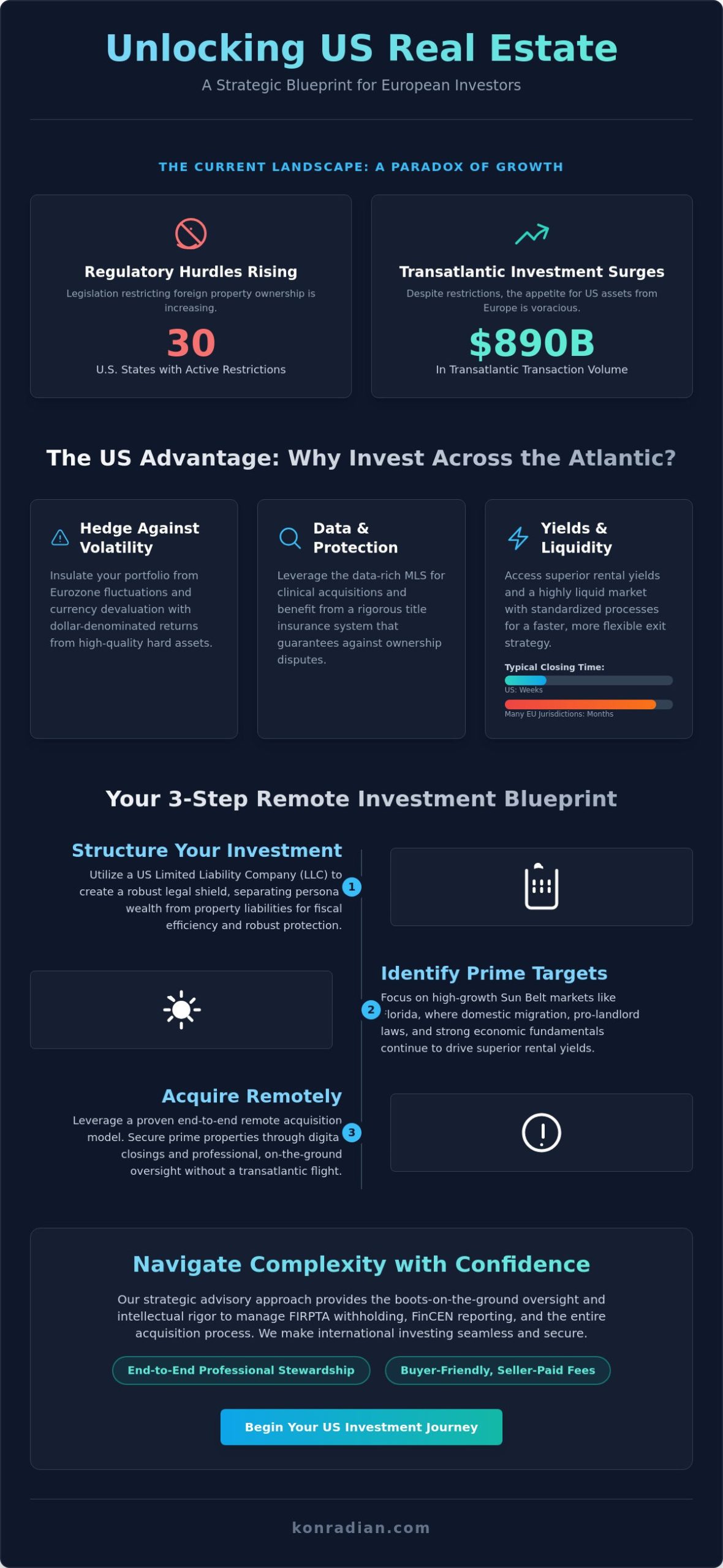
As of May 2026, 30 U.S. states have passed legislation restricting foreign property ownership, yet transaction volumes across the Atlantic have surged to a remarkable 890 billion dollars. This paradox highlights a critical truth: the appetite for US real estate investment from Europe remains voracious, even as the regulatory environment tightens. You’ve likely felt the tension between the undeniable allure of high-yield Sun Belt assets and the practical anxieties of navigating FIRPTA tax laws or the new March 2026 FinCEN reporting rules from thousands of miles away. It’s difficult to find a partner who provides the precise, boots-on-the-ground oversight necessary to protect your capital.
We’re here to bridge that gap with a strategy rooted in professional stewardship and intellectual rigor. This guide provides the blueprint for securing passive income in USD while insulating your portfolio from Eurozone volatility. You’ll discover how to leverage elite legal structures and data-driven location analysis to ensure your acquisition process is both seamless and secure. We’ll walk through everything from managing the 15 percent FIRPTA withholding to identifying markets where sale-to-list price ratios favor the sophisticated buyer. Our goal is to provide the clarity you need to invest with quiet confidence.
Key Takeaways
- Understand why the US dollar remains the premier safe-haven asset for diversifying your wealth away from Eurozone fluctuations and economic shifts.
- Learn how to structure your US real estate investment from Europe using a Limited Liability Company to ensure fiscal efficiency and robust legal protection.
- Identify high-growth opportunities in the Sun Belt, where domestic migration and pro-landlord regulations continue to drive superior rental yields in 2026.
- Discover the end-to-end remote acquisition model that allows you to secure prime properties through digital closings and professional local oversight without a transatlantic flight.
- Explore how a strategic advisory approach eliminates the complexity of international transactions while leveraging a buyer-friendly, seller-paid fee structure.
The Case for US Real Estate in a Diversified European Portfolio
The decision to pursue US real estate investment from Europe often begins with a fundamental desire for stability. While some global analysts suggest that domestic dominance is shifting, the reality for private wealth preservation remains clear: the United States offers a level of liquidity and legal protection that is difficult to replicate in the fragmented markets of the European Union. In 2026, as Eurozone economies face varied growth trajectories, the US residential market stands as a beacon of predictability for those seeking to balance their portfolios with high-quality, hard assets.
Hedging Against Eurozone Volatility
Currency diversification isn’t just a tactic for institutional funds; it’s a core necessity for high-net-worth individuals seeking to insulate their capital from local economic shifts. Holding physical assets in the US provides a natural buffer against the fluctuations of the Euro. Dollar-denominated returns act as a powerful hedge against local inflation, ensuring that your purchasing power remains robust regardless of regional currency devaluations. This strategic move transforms your portfolio into a global one, shifting your perspective from a single-market focus to a broader, more resilient financial outlook that prioritizes long-term security over short-term speculation.
Market Transparency and Investor Protections
One of the most striking differences between European and American property markets is the sheer volume of accessible data. The US Multiple Listing Service (MLS) provides a level of transparency that is virtually non-existent in many EU capitals. You can access historical sales prices, tax assessments, and neighborhood trends with a few clicks. This data-rich environment removes the guesswork that often plagues international buyers, allowing for a more clinical, strategy-based approach to acquisition.
Beyond data, the American legal framework offers unique safeguards. Foreign investment in U.S. real estate is supported by a rigorous title insurance system. Unlike many European jurisdictions where you rely solely on a notary’s record, US title insurance provides a private guarantee against ownership disputes or hidden liens. This creates a level of legal certainty that allows you to sleep soundly, knowing your deed is protected by a multi-billion dollar industry dedicated to asset security.
Yields and Liquidity: The US Advantage
When comparing rental yields, the numbers frequently favor the US residential sector. While major European cities often see yields compressed by high entry prices and stringent rent controls, US markets offer a more favorable balance for the landlord. Consider these structural advantages:
- Efficient Liquidity: The typical US closing process is measured in weeks, not the months often required in France or Italy.
- Standardized Documentation: Uniform legal documents across most states reduce the need for expensive, bespoke legal drafting for every individual transaction.
- Professional Stewardship: A mature ecosystem of inspectors, appraisers, and title agents operate with standardized protocols, ensuring a predictable path from offer to ownership.
This unrivaled market liquidity means your capital isn’t “trapped” in the same way it might be in a rural European village or a heavily regulated capital city. You have the flexibility to exit, refinance, or exchange assets with a speed that matches the pace of modern global finance. For the European investor, this agility is just as valuable as the monthly cash flow itself.
Structuring Your Investment: Legal and Fiscal Frameworks for Europeans
Establishing a robust legal foundation is the most critical step in securing a US real estate investment from Europe. While the acquisition process itself is remarkably fast, the underlying fiscal architecture requires meticulous planning to ensure long-term profitability. Most sophisticated investors opt for a US Limited Liability Company (LLC) to hold their assets, as this structure provides a clear separation between personal wealth and property liabilities. This isn’t merely about paperwork; it’s about creating a protective envelope that simplifies everything from banking to future estate transfers.
The US LLC: Your Protective Shield
An LLC offers international owners a vital layer of privacy and asset protection. By holding the deed in a corporate name, you insulate your global portfolio from any localized legal disputes. This structure also facilitates a seamless remote acquisition process. Once we help you obtain your Employer Identification Number (EIN) from the IRS, you can open a US business bank account without ever leaving your home office in London or Paris. This financial hub becomes the conduit for all rental income and expenses, ensuring your accounting remains clean and audit-ready. If you’re looking for a partner to manage these complexities, our US real estate investment services provide the strategic oversight needed to bridge the gap between European expectations and American regulations.
Fiscal Efficiency and Professional Stewardship
Navigating the tax landscape is where professional stewardship proves its value. As highlighted in the Profile of International Transactions, European buyers represent a significant portion of foreign capital in the US, yet many are initially surprised by the withholding requirements. You have two primary options for taxing rental income. You can accept a flat 30 percent withholding on gross rent, or you can elect to be taxed on Effectively Connected Income (ECI). The ECI election is often the superior choice for the strategic investor, as it allows you to deduct expenses like property taxes, insurance, and mortgage interest, potentially reducing your effective tax rate significantly.
Transparency is also a moving target. Starting March 1, 2026, a new FinCEN reporting rule requires all-cash purchases of residential property by legal entities to be documented via a “Real Estate Report.” This nationwide requirement emphasizes the importance of having a team that stays ahead of regulatory shifts. Furthermore, you must plan for the eventual exit. Under the Foreign Investment in Real Property Tax Act (FIRPTA), the standard withholding rate is 15 percent of the gross sale price. By working with a CPA familiar with transatlantic tax treaties, you can often mitigate double taxation and ensure that your US gains are recognized efficiently back home. This high-level coordination is what transforms a simple purchase into a sophisticated global asset. European investors who also hold or are considering UK property holdings will find that a professional UK property sourcing service applies a similarly rigorous off-market approach to navigating complex tax thresholds and identifying high-yield acquisitions in 2026.
Prime Targets for 2026: Why Florida and the Sun Belt Lead the Way
The geographic focus of US real estate investment from Europe has shifted significantly toward the Sun Belt, driven by a massive domestic migration trend that shows no signs of reversing. Americans are moving in record numbers to states with lower taxes, warmer climates, and robust job markets. This internal movement creates a sustained demand for housing that far outpaces many traditional European hubs. While pandemic-era spikes have normalized, markets like Atlanta and Charlotte continue to show resilience, with year-over-year price increases of 4.2 percent and 2.5 percent respectively. For the European investor, these regions offer a compelling mix of capital appreciation and reliable rental demand.
The Florida Advantage for European Investors
Florida remains the crown jewel of the Sun Belt for international buyers. With a statewide median home price of approximately 420,000 dollars as of April 2026, the entry point is often more accessible than prime London or Paris. The absence of a state income tax is a primary driver of ROI, allowing you to retain a larger portion of your rental income. This fiscal efficiency is paired with a pro-landlord legal environment that prioritizes property rights and streamlined eviction processes, providing a layer of security that is often missing in European capitals. For a comprehensive analysis of the regulatory landscape, inventory trends, and acquisition framework specific to the Sunshine State, our Florida real estate investment reference guide for 2026 provides the sophisticated framework international investors need. If you’re just beginning your journey, our guide on How to Start Investing in Property Abroad: A Strategic Guide for 2026 offers deeper insights into these regional nuances.
Investors must choose between short-term vacation strategies and long-term residential holds. Orlando continues to dominate the short-term market, supported by a tourism industry that provides year-round occupancy. Conversely, Miami’s evolution into a global financial and tech hub has solidified its status as a premier location for luxury long-term rentals. Regardless of the strategy, the state’s modest 2.2 percent projected price growth for 2026 suggests a stable market where value is built through consistent cash flow rather than volatile speculation.
Identifying High-Yield Micro-Markets
Sophisticated capital is now looking beyond the famous skylines of Miami to identify high-yield micro-markets. Emerging tech hubs like Austin and Charlotte are attracting a highly educated workforce, which in turn drives the demand for quality housing. We’re seeing a pronounced trend toward “Build-to-Rent” communities, where entire neighborhoods of single-family homes are developed specifically for the rental market. These turnkey options are particularly attractive for those managing a US real estate investment from Europe, as they offer modern construction and professional oversight that minimize maintenance surprises. For those looking to expand their search into the commercial sector, you can learn more about County Properties and their specialized guidance for the Southern California market.
A capitalization rate, or cap rate, represents the ratio between a property’s net operating income and its current market value, providing a snapshot of the potential rate of return on a residential multi-family investment. In 2026, these rates remain attractive in the Sun Belt compared to the compressed yields found in high-tax states like New York or California. By focusing on metros like Charleston, where appreciation is projected at 3.3 percent, you can build a portfolio that balances immediate income with long-term wealth preservation. Those navigating these decisions from abroad will find that a comprehensive framework for real estate investment for expats addresses the full spectrum of cross-border tax obligations, remote acquisition strategies, and high-growth market selection in 2026.
For investors who want to complement their property holdings with a proven business model in these same high-growth regions, you can visit Own a Russo’s New York Pizzeria & Italian Franchise – Pizza Franchise Opportunity to explore how international entrepreneurs are expanding into the American hospitality market.
The Remote Acquisition Model: Investing Without the Transatlantic Flight
The logistics of a US real estate investment from Europe have been fundamentally transformed by the widespread adoption of digital closing technology. You don’t need to endure an eleven-hour flight to sign a deed or verify a property’s condition. Instead, a sophisticated concierge model now allows for a start-to-finish acquisition process that is entirely remote, managed by a team that acts as your eyes and ears on the ground. This transition from physical presence to digital oversight ensures your capital is deployed with precision and speed, often closing a transaction in a fraction of the time it takes in most European jurisdictions.
The Digital Closing Process
The cornerstone of this modern model is Remote Online Notarization (RON). This legal framework allows you to execute closing documents through a secure video link with a US-based notary, provided your local jurisdiction accepts the digital format. The timeline is remarkably efficient; while a typical property might sit on the market for 71 to 77 days in Florida, the actual closing period, from an accepted offer to keys in hand, often takes just 30 to 45 days. We coordinate with title companies and legal counsel to ensure every digital signature is verified, eliminating the heavy lifting and administrative stress that often accompanies international transactions.
Sourcing and Due Diligence
Accessing the best opportunities requires more than just browsing public portals. True value is often found in off-market or pre-sale listings accessible only through deep-rooted agency networks. Our role as your Buyer’s Representative is to provide a filter, presenting only those assets that meet your specific strategic criteria. This includes commissioning a professional home inspection report, which is a non-negotiable step in the US market. These reports are incredibly detailed, covering everything from HVAC systems to structural integrity, providing a level of transparency that allows for a safe purchase from 5,000 miles away. For those accustomed to the European market, you might find it helpful to read The Comprehensive Guide to Spanish Property Acquisition to see how these protective measures compare to the Spanish system.
Once the acquisition is complete, professional property management becomes your most vital asset. Handling tenant relations, maintenance requests, and rent collection from a different time zone is impractical for an individual investor. A dedicated firm ensures your asset is maintained to the highest standards, protecting your long-term ROI. If you’re ready to explore how this seamless process can work for you, our US real estate investment services are designed to provide the elite expertise and personalized care you deserve.
Konradian: Your Refined Guide to US Real Estate Investment
Success in US real estate investment from Europe isn’t just about finding a property; it’s about finding a partner who understands the intellectual and emotional weight of international transactions. Our team, educated at the London School of Economics, combines analytical rigor with a cosmopolitan mindset. We don’t just act as brokers. We serve as strategic consultants who prioritize your long-term interests and emotional well-being throughout the entire acquisition lifecycle. This level of refinement ensures that your transition into the American market is as composed as it is profitable.
One of the most significant advantages for our clients is the “Seller-Paid” model prevalent in the American market. In the US, the seller typically pays the commission for both their agent and the buyer’s representative. This means you receive our elite, end-to-end stewardship at no direct cost to you. From the initial search to the final digital closing, you benefit from a high-level concierge service that handles the technical heavy lifting without impacting your initial capital outlay. It’s a rare opportunity to leverage world-class expertise to protect your interests while the counterparty covers the professional fees.
A Sophisticated Approach to Global Property
We act as the essential bridge between European capital and American opportunity. Our cultural fluency allows us to translate complex US regulations into terms that align with your existing portfolio strategy. You won’t have to worry about the nuances of state-level foreign ownership restrictions or the March 2026 FinCEN reporting rules we discussed earlier. We manage those complexities behind the scenes. This allows you to focus on the high-level returns and the tranquility that comes from professional stewardship. We believe that investing abroad should feel like a natural extension of your lifestyle, characterized by ease and security.
Our network provides exclusive access to US developers and pre-sale opportunities that never reach public listing portals. Whether it’s a “Build-to-Rent” community in Charlotte or a luxury residential project in Miami, we curate assets that offer both capital appreciation and reliable cash flow. This proactive approach ensures you aren’t just reacting to the market, but leading it. We take pride in our ability to source properties that meet the exacting standards of our European clientele, ensuring every asset is a worthy addition to a diversified global portfolio. Investors who apply this same off-market philosophy to the British market will find that a dedicated UK property sourcing service for high-yield acquisitions provides comparable institutional-grade access in regions like the North East, where growth is outpacing many other European markets in 2026.
Your Next Steps in Transatlantic Wealth
Embarking on a US real estate investment from Europe should feel like a natural extension of your financial growth, not a stressful hurdle. We invite you to begin this journey with a private, one-on-one video consultation. During this session, we’ll define your ROI goals, discuss your risk tolerance, and begin the process of curating a bespoke selection of properties tailored to your specific needs. It’s a methodical, logical process designed to build trust through transparency and results.
The path to diversifying your wealth into the world’s most liquid real estate market is now clear. Let us handle the intricate details of transatlantic acquisition while you enjoy the benefits of a secure, dollar-denominated asset. Book your free US investment consultation with Konradian today and take the first step toward a more resilient and sophisticated global portfolio.
Securing Your Transatlantic Legacy
The opportunity for US real estate investment from Europe has never been more accessible or strategically vital. By leveraging dollar-denominated assets in high-growth regions like the Sun Belt, you insulate your wealth from local volatility while securing reliable rental yields. Success depends on more than just location; it requires a robust legal framework and a digital acquisition model that respects your time and peace of mind. You’ve seen how sophisticated structures and remote technology can transform a complex international transaction into a seamless experience.
Our LSE-educated advisory team brings over five years of international brokerage experience to your portfolio, ensuring every transaction is handled with intellectual rigor. We’re proud to offer a zero-cost buyer service in the US market, providing you with elite representation without the burden of additional fees. We handle the complexity of tax compliance, LLC structuring, and remote closings so you can focus on the rewards of global ownership. It’s about providing the professional stewardship you expect from a high-level partner.
The next chapter of your investment journey begins with a dedicated guide. Schedule your free US Real Estate Investment consultation today to explore a curated selection of properties that match your vision. We’re ready to help you build a more resilient and sophisticated financial future.
Frequently Asked Questions
Can I buy property in the USA from Europe without a US visa or residency?
Yes, you can purchase and own property in the United States without a US visa or residency status. Property ownership is a civil right available to foreign nationals; however, it’s vital to remember that owning an asset doesn’t grant you the right to live in the country. You’ll still need to maintain a separate visa for travel or residency purposes if you plan to visit your investment.
Do I need to travel to the USA to close the property transaction?
You don’t need to travel to the United States to close your property transaction. Most states now utilize Remote Online Notarization (RON), allowing you to sign all legal documents via a secure video link from your home in Europe. This digital approach ensures that your US real estate investment from Europe is managed with maximum efficiency and minimal travel stress, allowing for a truly remote acquisition.
How is US rental income taxed for a European resident?
US rental income is typically taxed in one of two ways for international owners. You can choose a flat 30 percent withholding on gross rental income, or elect to be taxed on “Effectively Connected Income” (ECI). The ECI election is often more favorable because it allows you to deduct expenses like property taxes, mortgage interest, and management fees, only paying tax on the net profit.
What are the closing costs for a foreign investor in the US?
Closing costs for buyers in the US typically range from 2 percent to 5 percent of the purchase price. These costs cover essential services such as title insurance, recording fees, and escrow fees. It’s a transparent process where all costs are itemized in a standard closing statement, ensuring you have a clear view of the financial commitment before you finalize the transaction.
Can I get a mortgage in the US as a European citizen?
European citizens can secure financing for US property through specialized foreign national loans. As of June 2026, 30-year fixed Debt Service Coverage Ratio (DSCR) loans for well-qualified international investors start from approximately 6.875 percent with a 75 percent loan-to-value ratio. These loans are particularly attractive because they focus on the property’s income potential rather than your personal US credit history.
How does the US “Buyer’s Agent” system work and why is it free for me?
The US “Buyer’s Agent” system is designed to provide you with expert representation at no direct cost to you. In a typical transaction, the seller pays a commission that is split between their agent and yours. This allows you to have a dedicated advocate who manages due diligence and negotiations while the seller covers the professional fees for your stewardship.
What is an ITIN and do I need one for my investment?
An ITIN is an Individual Taxpayer Identification Number issued by the IRS for those who aren’t eligible for a Social Security Number. You’ll need this number to file your US tax returns and to claim any tax treaty benefits between your home country and the United States. It’s a foundational component of a compliant and professionally managed US real estate investment from Europe.
Is US real estate a good hedge against Euro inflation in 2026?
US real estate remains a premier hedge against Eurozone inflation in 2026 due to the enduring stability of the US Dollar. With global transaction volumes reaching 890 billion dollars over the trailing year, the liquidity of the American market provides a level of security that many European markets can’t match. Holding dollar-denominated hard assets protects your purchasing power against regional economic shifts. For a broader perspective on managing these cross-border complexities, our guide to real estate investment for expats in 2026 outlines the full strategic wealth framework for internationally mobile investors navigating shifting fiscal environments.
