


A sun-drenched terrace in Marbella or a coastal villa in Dalmatia shouldn’t be the primary reason you sign a contract. It should be the reward for a calculated financial move. Most investors understandably fear the “Margarita Effect,” where vacation bliss clouds professional judgment and leads to impulsive acquisitions. You likely recognize that securing high-yield international real estate requires more than an affinity for local culture. It requires precision. Learning how to start investing in property abroad is a journey that moves from broad global ambition to the meticulous details of a secure, end-to-end transaction.
This guide provides a professional roadmap to securing premium assets in 2026. We’ll explore the current landscape of Spain’s revised tax structures following the 2025 Golden Visa conclusion, Croatia’s 3% transfer tax environment, and the strategic nuances of the US market. You’ll gain the clarity needed to bypass language barriers and access exclusive pre-sale opportunities with the quiet confidence of a seasoned global citizen. From initial sourcing to final legal sign-off, we’ll outline a process that prioritizes your long-term interests and financial peace of mind.
Key Takeaways
- Learn to separate vacation emotions from investment logic to avoid the common pitfalls of impulsive international acquisitions.
- Understand the essential legal and financial infrastructure required to secure high-stakes assets with complete confidence and security.
- Discover how to start investing in property abroad using a proven five-step framework tailored for the 2026 global economic landscape.
- Compare the maturity and yield potential of key markets in Spain, Croatia, and the USA to find your ideal investment match.
- Identify the distinct advantages of working with a strategic sourcing partner to access exclusive, off-market, and pre-sale opportunities.
Defining Your International Investment Strategy: Beyond the Margarita Effect
Strategic wealth preservation requires moving beyond familiar borders. International property serves as a critical hedge against domestic market volatility, anchoring your capital in diverse economies. Many private investors fail because they succumb to the “Margarita Effect.” This occurs when vacation euphoria dictates a financial decision, leading to an emotional purchase rather than a calculated acquisition. A villa that feels perfect during a summer sunset may lack the infrastructure or rental demand necessary for a professional international real estate investment. Understanding how to start investing in property abroad begins with a clear distinction between a lifestyle-first purchase and a yield-first asset. In 2026, a resilient portfolio consists of several core components:
- High liquidity in secondary markets.
- Currency-diverse rental income.
- Tax-efficient holding structures.
Identifying Your Primary Objective: Yield vs. Capital Appreciation
Your financial goals must dictate your geography. You need to decide if you’re seeking immediate rental income or long-term capital growth. Short-term rental models thrive in regions with established tourism, such as coastal Croatia. These assets provide consistent cash flow during the peak Adriatic season. Mastering how to start investing in property abroad requires you to acknowledge that no single market fulfills every objective simultaneously. Urban centers like Budapest often serve as better vehicles for long-term appreciation. Successful investors also plan their exit before they buy. Liquidity varies significantly across different jurisdictions. A high-yield apartment in Spain might sell faster than a niche luxury estate; knowing these nuances is essential for a secure investment process.
Diversification as a Wealth Preservation Tool
Holding assets in multiple currencies, such as the Euro and the US Dollar, creates a natural buffer against inflation. This approach builds what we call cross-continental wealth, a strategy designed to protect your legacy regardless of regional economic shifts. It ensures your financial security isn’t tied to the performance of a single central bank. For instance, looking into property investment Hungary allows you to tap into a market with distinct growth drivers compared to Western Europe or the USA. Diversification is the hallmark of a sophisticated global investor who values both security and opportunity.
Building Your Financial and Legal Infrastructure Abroad
The foundation of a successful cross-border transaction is laid long before you step foot on a property. While the previous section highlighted the emotional pitfalls of the “Margarita Effect,” the antidote is a rigid legal infrastructure. Establishing a local legal representative is your first priority. An independent attorney ensures that your interests remain protected, particularly in Mediterranean markets where “clean” titles and historical liens can be complex to verify. Understanding how to start investing in property abroad requires shifting your focus from aesthetic listings to the rigorous due diligence that guarantees a secure asset. Professional transaction support eliminates the friction of disparate legal systems, providing a seamless bridge between your current capital and your future holding.
Navigating Local Legal Frameworks and Residency Rules
Residency regulations have shifted significantly. The end of Spain’s Golden Visa program on April 3, 2025, marked a transition toward more diverse visa routes, such as digital nomad or non-lucrative options. Investors must now focus on the intrinsic value of the real estate rather than a guaranteed residency path. Obtaining a local tax ID, such as the Spanish NIE, is a mandatory first step for any transaction. This process requires precision and timing to avoid delays during the closing phase. Leveraging specialized Spanish Property Acquisition expertise ensures you meet these administrative requirements without the stress of language barriers or bureaucratic confusion.
Structuring Finances and Understanding Tax Implications
Financial requirements for foreign buyers in 2026 demand a clear understanding of local tax burdens. In Spain, the Property Transfer Tax (ITP) for resale homes generally ranges from 6% to 10%, though regions like Andalusia offer a flat 7%. In contrast, Croatia maintains a straightforward 3% flat rate on market value. You must also account for currency exchange risks. Fluctuations between the Euro and your home currency can quietly erode your ROI if not managed through forward contracts or strategic timing. In many European markets, the “free for the buyer” brokerage model is standard, as the seller typically covers the agent’s commission. However, this makes having your own dedicated advisor even more vital to ensure unbiased guidance. For those seeking a truly frictionless experience, securing professional transaction support is the most effective way to manage these moving parts with quiet confidence.
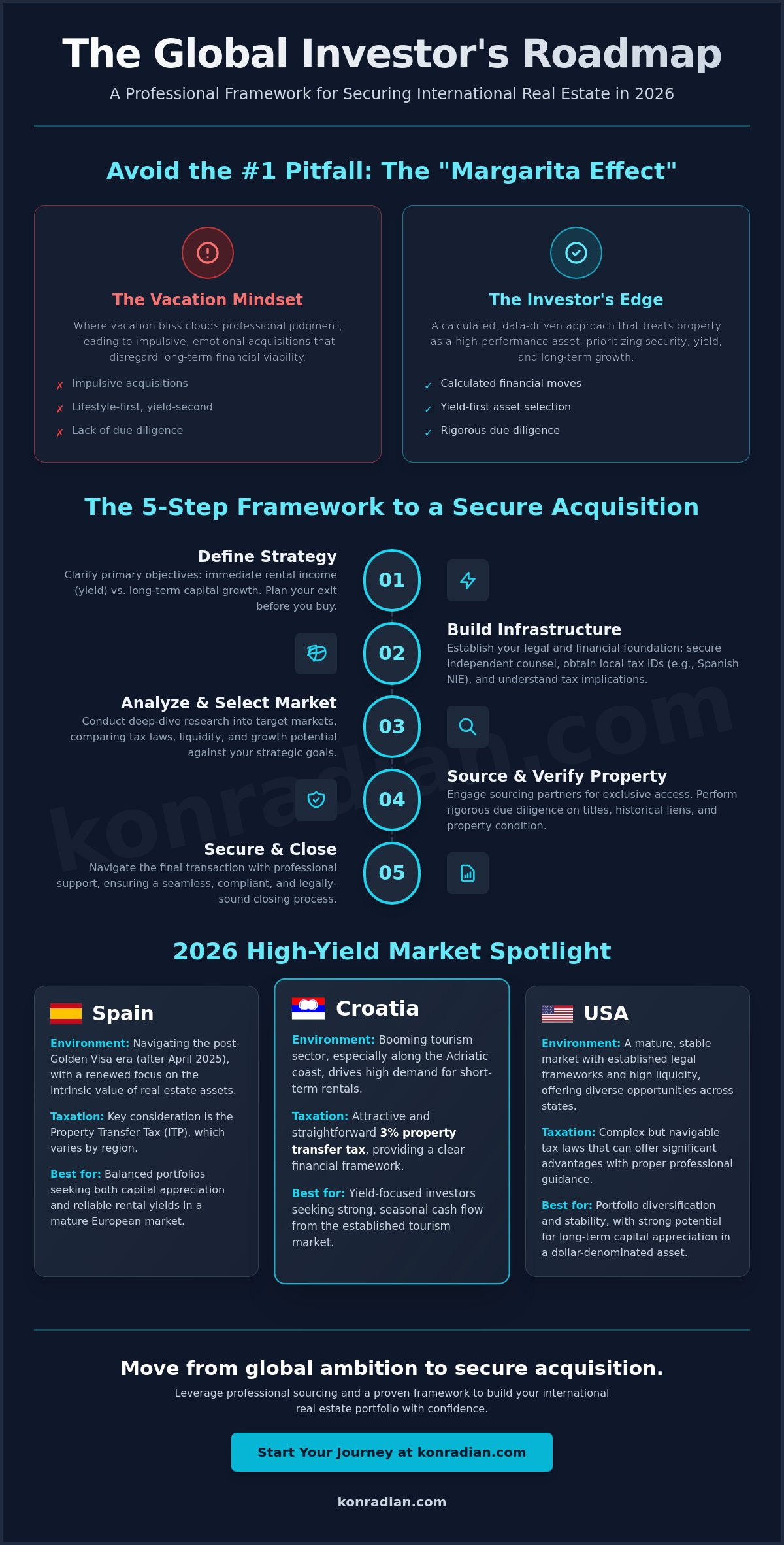
Comparing High-Yield Markets: Spain, Croatia, and the USA
Selecting the right jurisdiction requires a shift from aesthetic appreciation to cold analytical comparison. A sophisticated portfolio isn’t built on scenery; it’s built on a framework of market maturity, liquidity, and entry costs. Maturity dictates the stability of the legal environment, while liquidity determines how swiftly you can exit a position when capital needs to be redeployed. Entry costs, including taxes and acquisition fees, directly impact your initial ROI. Learning how to start investing in property abroad involves evaluating these metrics with the same rigor you’d apply to any other asset class. While Spain offers the deep liquidity of an established tourism giant, Croatia provides the high-growth potential of an emerging luxury frontier. Meanwhile, the USA remains a cornerstone for those seeking long-term capital preservation in a dollar-denominated environment.
Mediterranean Opportunities: Spain vs. Croatia
Spain remains one of the world’s most accessible markets for international buyers. In the period between January and September 2025, foreign nationals accounted for 13.58% of all home purchases in the country. This high level of international participation ensures a liquid secondary market. You can expect rental yields to remain resilient in established hubs like Marbella or the Costa del Sol, where tourism infrastructure is world-class. Croatia offers a different, perhaps more exclusive, value proposition. The Adriatic coast is rapidly transforming into a premier destination for high-net-worth investors, with the 3% property transfer tax offering a lower entry barrier than many Spanish regions. While Spanish transactions benefit from a highly standardized and transparent legal process honed over decades, Croatia has successfully modernized its framework to meet EU standards, providing a secure environment for coastal acquisitions.
The US Market: Strategic Sourcing from Europe
European investors are increasingly looking across the Atlantic toward Florida and the Sunbelt. The appeal lies in the stability of the US economy and the advantage of holding dollar-denominated assets. Between April 2024 and March 2025, foreign buyers purchased $56 billion worth of US residential property, signaling a robust appetite for American real estate. Diversifying into the US market protects your wealth from Euro-zone volatility and provides access to a market with historically strong capital appreciation. US real estate investment from Europe requires professional sourcing as the bridge that makes this possible. It allows you to identify high-performing assets in states like Florida without the logistical burden of managing a 5,000-mile gap. For those specifically targeting the Sunshine State, understanding the nuances of Florida real estate investment — including FIRPTA regulations, LLC structuring, and the latest FinCEN reporting mandates — is essential for a compliant and profitable acquisition. This strategic oversight ensures that your US holdings are managed with the same precision as your European assets. For those looking closer to home, Budapest continues to serve as a vital Central European hub, offering strategic value through lower entry costs and strong urban growth.
Understanding how to start investing in property abroad means recognizing that each market serves a specific purpose in your broader financial strategy. Whether you’re seeking the immediate yield of a Croatian villa or the long-term security of a Florida townhouse, your choice should always align with your primary objective of wealth preservation.
The 5-Step Process to Buying Your First Property Overseas
A successful international acquisition is a methodical progression. It requires a transition from high-level strategy to granular execution. While many investors focus solely on the property itself, the process is actually a series of logistical milestones that must be managed with precision. Understanding how to start investing in property abroad involves following a chronological roadmap that eliminates ambiguity and protects your capital. This structured approach ensures that every decision is backed by data and every legal requirement is satisfied before you commit funds. The journey follows five distinct phases:
- Step 1: Strategic Consultation and Market Selection. Aligning your financial objectives with the specific tax and growth profiles of regions like Andalusia or the Dalmatian coast.
- Step 2: Property Sourcing and Shortlisting. Moving beyond public listings to identify high-yield assets through an end-to-end professional lens.
- Step 3: Legal Due Diligence and Offer Negotiation. Engaging local counsel to verify titles and securing favorable terms through experienced representation.
- Step 4: Financial Execution and Contract Signing. Managing currency transfers, tax IDs, and the formal exchange of contracts.
- Step 5: Key Handover and Post-Purchase Logistics. Finalizing the walkthrough and transitioning the asset into your portfolio.
From Initial Sourcing to Due Diligence
The most lucrative opportunities rarely appear on public real estate portals. Strategic investors gain a significant advantage by accessing off-market or pre-sale listings through direct developer relationships. This exclusivity allows you to secure assets at lower entry points before they reach the general market. When you can’t be physically present, a successful remote property viewing requires more than a simple video tour. It involves a comprehensive video consultation where a professional evaluates structural integrity, checks for signs of humidity, and assesses neighborhood noise levels. Every land registry entry and building permit must be verified against local municipal records to ensure the asset is legally sound. This level of scrutiny is what separates a secure investment from a potential liability.
Managing Remote Transactions and Key Handover
Executing a transaction from another continent is a standard procedure for sophisticated global citizens. Most investors utilize a Power of Attorney (PoA) to allow their legal representative to sign deeds and handle administrative filings on their behalf. This eliminates the need for repeated international travel and ensures the process remains on schedule. The final walkthrough is equally critical. A dedicated partner can conduct this inspection to ensure the property matches the agreed conditions and manage the transfer of utility contracts. This end-to-end service acts as the definitive antidote to the stress of international buying. To secure your position with confidence, you can rely on our Legal and Financial Transaction Support to handle every administrative detail of your acquisition.
Securing Exclusive Access with Professional Sourcing Partners
High-street agents typically operate within a limited geographical radius, offering only the inventory currently on their books. In contrast, a strategic sourcing partner operates with a broader, more sophisticated mandate. We don’t just show you properties; we curate opportunities that align with your specific wealth preservation strategy. This distinction is fundamental when you’re learning how to start investing in property abroad. A sourcing partner acts as a protective shield, filtering out sub-par listings and focusing only on assets with verified growth potential. By adopting a concierge mindset, we handle the administrative coordination and logistical heavy lifting, allowing you to maintain your focus on your primary business and lifestyle.
The Value of Direct Developer Relationships and Pre-Sales
Accessing pre-sale opportunities is often considered the “holy grail” of capital appreciation. By the time a luxury development in Marbella or the Adriatic coast reaches a public portal, the most desirable units and the most attractive pricing are usually gone. Konradian maintains direct relationships with top-tier developers, securing exclusive listings before they hit the open market. For remote investors, new-build properties offer distinct advantages. They come with comprehensive structural warranties and adhere to modern energy standards, minimizing the maintenance concerns often associated with historic Mediterranean villas. This proactive approach ensures you enter a market at the most advantageous point possible, securing modern assets that meet the high standards of 2026.
Why an International Mindset Trumps Local-Only Knowledge
Local knowledge is necessary but insufficient for high-stakes international deals. A partner who possesses a cosmopolitan, international mindset understands both the nuances of the local market and the specific expectations of a global investor. Whether it’s navigating the 3% transfer tax in Croatia or understanding the implications of the 2025 Spanish Golden Visa closure, professional stewardship requires a high level of intellectual rigor. Our team combines the authority of a strategic consultant with the personalized care of a dedicated advisor. This cultural fluency allows us to bridge the gap between your home context and your new asset with quiet confidence. If you’re ready to define your roadmap for 2026, schedule a free video consultation to start your journey and experience a truly end-to-end investment process.
Mastering how to start investing in property abroad is ultimately about partnership. It’s about moving from the uncertainty of solo research to the security of professional oversight. By aligning yourself with a partner who understands the global landscape, you ensure that your international portfolio is not just a collection of properties, but a resilient engine for long-term wealth.
Securing Your Global Legacy in 2026
Building a resilient international portfolio requires a shift from aspiration to precise execution. You now recognize that high-yield assets in Spain, Croatia, or the USA aren’t found through casual browsing. They’re secured through strategic sourcing and rigorous due diligence. By moving beyond emotional impulses and establishing a firm legal foundation, you protect your capital from the complexities of foreign jurisdictions. Mastering how to start investing in property abroad is a significant financial milestone that demands professional stewardship and a cosmopolitan mindset.
Our team provides the analytical precision of LSE-educated strategic advisors combined with over five years of international brokerage experience. We offer direct access to exclusive pre-sale developer listings that remain invisible to the general public. This end-to-end support ensures your journey is defined by tranquility and precision rather than administrative friction. When you’re ready to elevate your wealth-building strategy, we’re here to act as your trusted partner. Book Your Free International Property Consultation today to begin your acquisition with quiet confidence. Your global future is within reach.
Frequently Asked Questions
Is it safe to buy property abroad without visiting the country in person?
It is entirely safe to purchase international real estate remotely provided you have a trusted legal representative and a professional sourcing partner on the ground. Modern technology allows for comprehensive video consultations and structural inspections that provide more detail than a casual walkthrough. By using a Power of Attorney (PoA), your lawyer can execute the necessary deeds and administrative filings without requiring your physical presence, ensuring a secure and efficient transaction.
What are the typical hidden costs when investing in property overseas?
Acquisition costs often include property transfer taxes, notary fees, and legal expenses that can add 7% to 12% to the purchase price depending on the jurisdiction. In Spain, for example, the Property Transfer Tax (ITP) in Andalusia is 7%, while Croatia maintains a flat 3% rate. You should also account for currency exchange fluctuations and potential bank fees for international transfers, which can subtly impact your final capital outlay if not managed strategically.
Can I get a mortgage in a foreign country as a non-resident?
Non-residents can certainly obtain financing in many international markets, though the terms are often more conservative than for local citizens. In Spain, fixed mortgage rates for foreign buyers in 2026 range from 3.5% to 5%, while Croatian banks offer similar products. Lenders generally require more extensive documentation regarding your global income and existing assets to satisfy their risk assessments, making professional financial transaction support a vital asset for a smooth approval process.
How much deposit is typically required for an international property investment?
International property investments generally require a down payment of 30% to 40% of the property’s value. While residents might access higher leverage, non-residents are typically capped at a 60% to 70% Loan-to-Value (LTV) ratio in Europe. In the United States, foreign national mortgages frequently demand a 30% to 40% deposit. Having these funds readily available in a liquid format is a critical first step when learning how to start investing in property abroad effectively.
What happens if I don’t speak the local language during the legal process?
Language barriers are eliminated by employing a bilingual legal representative who acts as your primary point of contact. All legal contracts and deeds should be translated by certified professionals to ensure you understand every clause before signing. Your advisor handles the “heavy lifting” of communicating with local authorities and notaries, protecting your interests and ensuring that technical industry terms are clearly explained in your native language throughout the transaction.
How do I manage the property and find tenants from another country?
Remote owners typically engage local, specialized property management firms to handle day-to-day operations and tenant sourcing. While our focus remains on the strategic acquisition and legal support, we often help clients identify reputable local partners who understand the specific rental laws of the region. This professional stewardship ensures your asset is well-maintained and continues to generate yield without requiring your constant personal intervention or presence on-site.
Which countries offer the best ROI for property investors in 2026?
Spain and Croatia remain top contenders for high-yield returns due to their robust tourism sectors and established secondary markets. Spain offers deep liquidity and a high volume of international transactions, while Croatia’s Adriatic coast provides significant capital appreciation potential for luxury assets. When you’re researching how to start investing in property abroad, these Mediterranean markets offer a compelling balance of security and growth that is difficult to match in more volatile emerging economies.
What is the “Margarita Effect” and how can I avoid it?
The “Margarita Effect” refers to the tendency of vacationers to make impulsive, emotional property purchases while influenced by the relaxed atmosphere of a holiday. This often leads to buying assets that lack rental demand or structural integrity. You can avoid this pitfall by adhering to a professional roadmap and working with a strategic sourcing partner. We replace emotional impulses with cold analytical data, ensuring every acquisition is a calculated move toward long-term wealth preservation.
