


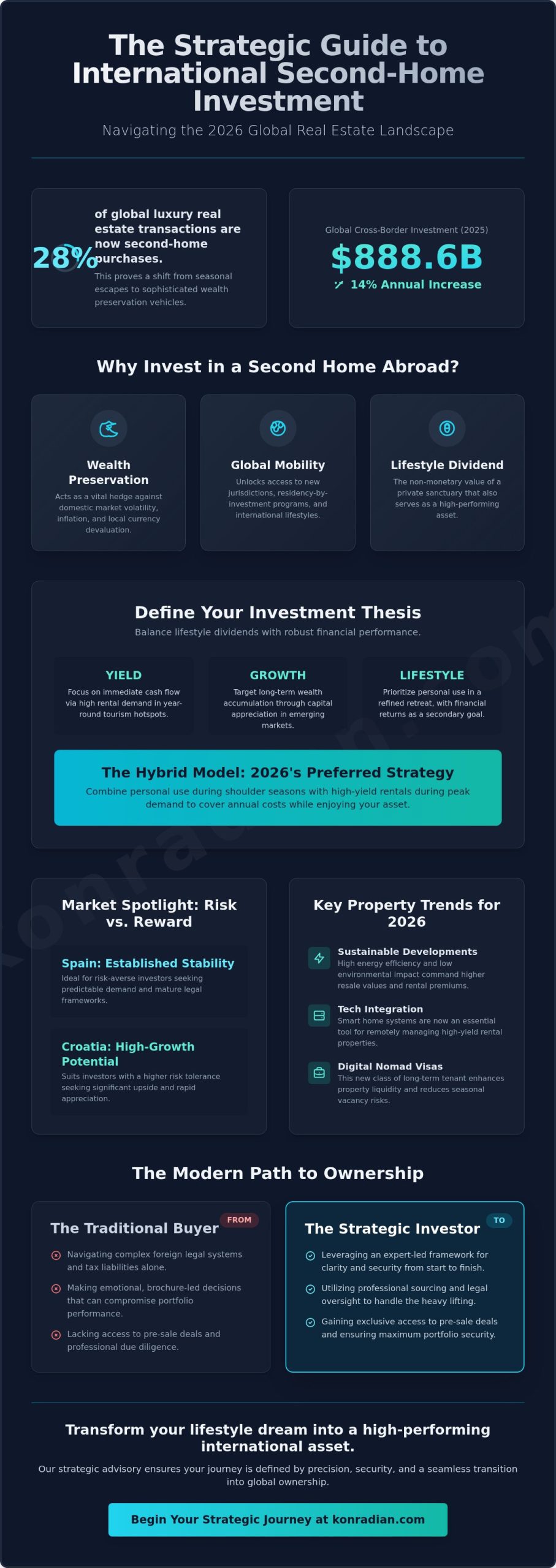
According to Sotheby’s International Realty’s 2026 Luxury Outlook Report, second-home purchases now account for 28% of global luxury real estate transactions. This shift proves that a second home abroad investment is no longer just a seasonal escape; it’s a sophisticated vehicle for wealth preservation and global mobility. You likely recognize the immense potential of diversifying your portfolio across borders, yet the prospect of managing foreign legal systems or uncovering hidden tax liabilities often creates a sense of hesitation. It’s natural to feel protective of your capital when faced with unfamiliar markets and complex international regulations.
We’re here to bridge the gap between aspiration and acquisition. You’ll discover how to transform a lifestyle dream into a high-performing international asset by applying our expert-led strategic framework. This guide provides clarity on the 2026 market landscape, from the new tiered Golden Visa structures in Greece to the evolving investment fund requirements in Portugal. You’ll learn how to secure a diversified property portfolio while gaining access to exclusive pre-sale deals and professional legal oversight. From initial sourcing to the final signature, we ensure your journey is defined by precision, security, and a seamless transition into global ownership.
Key Takeaways
- Define a clear investment thesis to balance lifestyle dividends with robust financial performance, ensuring your property serves both your personal and fiscal goals.
- Evaluate the 2026 market landscape by contrasting the established stability of Spanish real estate with the rapid appreciation currently seen in Croatia’s coastal markets.
- Navigate the nuances of residency-by-investment and international tax frameworks to ensure your second home abroad investment is structured for maximum security.
- Transition from a traditional buying model to a strategic advisory approach that handles the heavy lifting of property sourcing and legal due diligence.
The Strategic Case for a Second Home Abroad Investment in 2026
Global cross-border residential investment reached $888.6 billion in 2025, marking a 14% annual increase that signals a profound shift in wealth management strategies. A second home abroad investment acts as a vital hedge against domestic market volatility, providing a stabilizing force when local economies fluctuate. By diversifying across different legal jurisdictions and tax regimes, investors create a protective barrier around their capital. Holding assets in major currencies like the Euro or US Dollar further secures purchasing power against the erosion of inflation or local currency devaluation.
Beyond the financial metrics, the modern investor prioritizes the ‘lifestyle dividend.’ This represents the calculated non-monetary value of personal use, where a property serves as both a private sanctuary and a high-performing asset. For those looking to explore how this is executed at the highest level, TOM BENZON provides a curated selection of exceptional boutique villas in premier global destinations. The global shift toward a ‘work-from-anywhere’ culture has accelerated demand in secondary markets, transforming traditional holiday destinations into year-round residential hubs. This increased occupancy support provides a level of liquidity and rental demand that was previously reserved for major capital cities.
Why Real Estate Remains the Premier Choice for Global Wealth
In the 2026 economy, tangible assets offer a sense of permanence that digital investments simply cannot match. While financial markets experience rapid cycles of volatility, physical land in stable jurisdictions provides psychological security and long-term value preservation. Real estate remains a classic inflation hedge because property values and rental incomes tend to track with rising costs. This natural adjustment ensures your wealth retains its real-world utility over decades rather than months.
Emerging Trends in International Property for 2026
Current market dynamics favour ‘green’ and sustainable developments, particularly across the Mediterranean. Investors are increasingly seeking properties with high energy efficiency and low environmental impact, as these assets command higher resale values and rental premiums. Technological integration has also become a standard expectation; smart home systems are no longer luxury add-ons but essential tools for managing high-yield rentals remotely. Additionally, the proliferation of digital nomad visas has created a new class of long-term tenants, enhancing property liquidity and reducing the vacancy risks traditionally associated with seasonal markets.
Defining Your Investment Thesis: Yield, Growth, or Lifestyle?
Every successful second home abroad investment begins with a rigorous thesis rather than a property brochure. Before reviewing listings, you must determine if your primary objective is immediate cash flow, long-term wealth accumulation, or a refined personal retreat. While many buyers are drawn to the aesthetic appeal of a coastal villa, a strategic investor prioritizes how that asset fits into their broader financial architecture. Defining these goals early prevents emotional decisions that could compromise your portfolio’s performance.
The ‘Hybrid Model’ has emerged as a preferred strategy for 2026. This approach balances personal summer use with high-intensity rental income during peak seasons. By reserving the property for yourself during the shoulder months and opening it to the market when demand is highest, you can often cover annual operating costs while still enjoying the lifestyle benefits. It’s essential to recognize that a sophisticated exit strategy is just as vital as the entry point. You should evaluate the resale liquidity and potential buyer pool of a region before the first deposit is ever paid.
Risk profiling is equally critical when selecting a jurisdiction. Established markets like Spain offer the security of mature legal frameworks and predictable, steady demand. Conversely, high-growth emerging hubs such as Croatia provide a different opportunity for those seeking significant upside. Choosing between these paths requires a clear understanding of your own tolerance for market maturity versus growth potential. To ensure your selection aligns with these high-level objectives, it’s often beneficial to partner with a trusted strategic advisor who understands the nuances of each territory.
Targeting High Rental Yields
Focusing on yield requires identifying tourism hotspots with consistent, year-round demand. You should look beyond simple nightly rates and instead analyze occupancy data and seasonal pricing fluctuations. Success in this category depends heavily on local property management infrastructure. Without professional oversight to handle guest relations and maintenance, a high-yielding asset can quickly become a management burden. We prioritize locations where the rental market is supported by robust local services and diverse traveler profiles.
Focusing on Capital Appreciation
Investors targeting growth often look for ‘infrastructure plays’ where new airports, highways, or luxury marinas are planned. Securing pre-sale access allows you to buy at developer prices before the project’s completion, capturing value as the development matures. Capital growth is often higher in emerging coastal regions where supply is limited but international interest is rising. By entering these markets early, you position yourself to benefit from the natural upward trajectory of developing luxury destinations.
Navigating the Global Map: Top Markets for 2026 Investment
Selecting the right jurisdiction for a second home abroad investment requires a sophisticated balance of lifestyle appeal and structural stability. While the Mediterranean remains a primary focus for many, the 2026 landscape offers diverse opportunities ranging from the mature markets of Western Europe to high-growth urban hubs in Central Europe and the established resilience of the United States. Each region demands a unique strategic approach, tailored to your specific goals for yield or capital preservation.
Diversifying into the world’s largest economy remains a priority for many global citizens. In the USA, Florida and other sun-belt states continue to attract significant capital due to their favorable tax environments and consistent population growth. This domestic migration drives long-term demand for high-quality residential assets, making it a reliable pillar for a diversified property portfolio. The scale of the US market provides deep liquidity, ensuring that your exit strategy remains as robust as your entry point.
The Mediterranean Appeal: Spain and Croatia
Spain continues to be a cornerstone for international buyers due to its highly sophisticated legal frameworks and established property acquisition processes. Whether you’re targeting the sun-drenched Costa del Sol or the exclusive enclaves of the Balearic Islands, the maturity of the Spanish market provides a high degree of transparency and security. You can rely on a well-trodden path for ownership that minimizes the friction often found in less developed regions.
In contrast, Croatia represents the Adriatic’s rising star. The market here is characterized by exceptional capital growth potential, particularly for heritage assets like sea-view stone houses. While Spain offers a more predictable, high-volume environment, Croatia provides a boutique investment experience with limited supply and increasing global demand. Both EU nations require distinct legal approaches. Comparing the purchase process reveals that while Spain is more streamlined, Croatia’s market rewards those with the patience to navigate its unique coastal regulations and title histories.
Urban Strategic Plays: Hungary and the UK
Central Europe offers a compelling alternative for those seeking high-yield urban assets. We’ve observed that property investment in Hungary is a top choice for portfolio diversification in 2026, driven by Budapest’s growing status as a regional corporate and tech hub. To capitalize on this, investors should utilize our investment apartment Budapest checklist to evaluate building quality and rental potential in the city’s most resilient districts.
In the UK, professional property sourcing is vital. Buyer representation is no longer optional in the competitive London and regional markets; it’s a strategic necessity. The UK market is fragmented, and many of the best opportunities never reach public portals. Having a dedicated partner ensures you’re accessing off-market deals and navigating the complexities of leasehold versus freehold ownership with absolute clarity. This expert-led approach handles the heavy lifting, allowing you to focus on the long-term strategic value of your acquisition.
Overcoming Complexity: Legal, Financial, and Tax Frameworks
Navigating the administrative architecture of a second home abroad investment requires a shift from viewing paperwork as a hurdle to seeing it as a protective shield. The 2026 landscape for residency-by-investment has become increasingly nuanced, demanding a strategic approach to local regulations. For instance, the United Arab Emirates requires a minimum property investment of AED 2 million for its 10-year Golden Visa, while Greece has implemented a tiered system that reaches €800,000 in high-demand zones like Athens and Mykonos. Understanding these thresholds is the first step in aligning your property acquisition with your long-term residency goals.
Financial planning must also account for the diverse tax structures across different jurisdictions. Purchase taxes vary significantly; you’ll encounter a 4% transfer fee in Dubai, while non-resident buyers in Portugal may face a flat rate of 7.5% in 2026. Ongoing property taxes, such as the Greek ENFIA or the Portuguese IMI, must be factored into your annual yield calculations to ensure your ROI remains robust. Our team provides the legal and financial transaction support necessary to ensure your acquisition is as secure as it is rewarding.
Financing your purchase offers another layer of strategic choice. You might opt for a local mortgage, with non-resident interest rates currently ranging from 3% in Portugal to 6.5% in the UAE, or you could choose to release equity from your primary residence. Each path has distinct implications for your liquidity and tax exposure. Independent legal counsel acts as the vital link here, ensuring that every contract is scrutinized and every financial commitment is transparent.
The Legal Security Audit
- Title Deeds: We verify that the property is registered correctly in the local land registry and is entirely free of historical debts or liens.
- Tax Identification: Securing a local tax number, such as the NIE in Spain, is a prerequisite for opening bank accounts and finalizing contracts.
Due diligence is the non-negotiable first step in any foreign purchase to ensure the asset is free from historical encumbrances or undisclosed debts.
International Tax Planning
Sophisticated investors utilize double taxation treaties to ensure they don’t pay tax twice on the same rental income. It’s also essential to plan for your eventual exit; for example, Greece has suspended capital gains tax on real estate until December 31, 2026, providing a unique window for tax-efficient growth. Finally, you should establish an international will. Local inheritance laws can be complex, and a dedicated legal framework ensures your global assets are protected for future generations without unnecessary bureaucratic delay.
The Modern Path to Ownership: Professional Sourcing and Advisory
The traditional ‘local agent’ model often fails the international buyer because it’s fundamentally designed to serve the seller. When you approach a listing agent, their primary duty is to achieve the highest price for their client, not to protect your interests or provide a critical assessment of the asset’s strategic value. A successful second home abroad investment requires a different level of advocacy. We replace the transactional nature of high-street agencies with a strategic consultancy framework that prioritizes your long-term wealth and peace of mind.
Our approach combines LSE-educated market analysis with the warmth of local hospitality. This ensures every recommendation is backed by intellectual rigor while remaining grounded in the cultural nuances of the destination. Through deep-rooted developer relationships, we unlock exclusive pre-sale deals long before they reach the public market. This early access allows our clients to secure prime units at entry-level pricing, capturing immediate value as the development progresses toward completion.
One of the most significant advantages for buyers in the European market is the ‘Free for the Buyer’ brokerage model. In jurisdictions like Spain, Croatia, and Hungary, the sales commission is typically covered by the seller or the developer. This means you can benefit from our high-level strategic advisory and legal navigation support without increasing your acquisition costs. You gain a dedicated partner who handles the heavy lifting while your capital remains focused entirely on the asset itself.
End-to-End Stewardship
We manage the entire journey, from your initial video consultation to the final key handover. This seamless process is designed for the global citizen who values time as much as capital. Modern technology allows for secure remote purchases; high-definition virtual tours and digital legal signatures remove the need for constant international travel. Your partner acts as a protective shield, managing the complexities of local land registries and financial compliance so you don’t have to worry about the finer details of the transaction.
Your Next Steps in International Real Estate
The path to a secure, diversified property portfolio begins with a clear definition of your goals. We invite you to book a free initial consultation where we’ll help you refine your 2026 investment thesis. During this session, we’ll assist you in preparing a detailed ‘buying brief’ that serves as the blueprint for our sourcing specialists. This ensures every property we present aligns perfectly with your specific requirements for yield, growth, or lifestyle.
Discover our end-to-end property buying services and take the first step toward a strategic global acquisition that secures your future.
Securing Your Global Legacy through Strategic Acquisition
A second home abroad investment is more than a seasonal escape; it’s a sophisticated pillar of a modern, diversified wealth strategy. You’ve seen how defining a clear thesis between rental yield and capital growth ensures your capital works as hard as you do. By navigating the nuances of 2026 tax frameworks and residency programs with precision, you transform a complex cross-border transaction into a seamless transition toward global citizenship. It’s about replacing the anxiety of the unknown with the confidence of professional stewardship.
We provide the intellectual rigor and local presence needed to handle the heavy lifting of international real estate. Our team of LSE-educated strategists offers direct access to exclusive developer pre-sale listings, providing comprehensive end-to-end support at no cost to the buyer in most markets. This level of advocacy ensures your interests are always the priority. Secure your international future with a free Konradian consultation. We’re ready to help you turn your global aspirations into a high-performing reality.
Frequently Asked Questions
Is buying a second home abroad a good investment in 2026?
Real estate remains a cornerstone of wealth preservation in 2026 because it provides a tangible hedge against domestic market volatility and inflation. A second home abroad investment allows you to diversify your portfolio into stable currencies like the Euro or US Dollar. While global deal volumes rose by 14% in 2025, success depends on selecting jurisdictions with robust legal frameworks and long-term capital growth potential. It’s about balancing lifestyle dividends with fiscal security.
Can foreigners buy property in Croatia and Spain easily?
Foreigners can acquire property in both Spain and Croatia, though the processes differ in complexity. Spain offers a highly streamlined, mature system that has been a favorite for international buyers for decades. Croatia’s market is more boutique and requires careful navigation of coastal regulations and title histories. Both countries are part of the European Union, which provides a level of legal security and standardized transaction protocols that protect international investors during the acquisition phase.
What are the hidden costs of a second home abroad investment?
Transaction costs go beyond the purchase price and typically range from 7% to 12% depending on the country. You must budget for property transfer taxes, notary fees, land registry charges, and legal expenses. For example, Dubai requires a 4% transfer fee, while Greece recommends budgeting approximately 10% for total closing costs. Understanding these liabilities upfront prevents capital shortfalls and ensures your second home abroad investment ROI calculations remain accurate and realistic from the start.
Do I need to live in the country to own property there?
You don’t need to be a resident or live in a country to own residential property in most major investment hubs. Many owners utilize their assets as seasonal retreats or high-yield rental properties while maintaining their primary residence elsewhere. However, owning property can often provide a pathway to residency through Golden Visa programs. These programs offer long-term stay options if you meet specific investment thresholds, such as the AED 2 million requirement in the UAE.
How do I manage a foreign property if I don’t live there?
Managing a property from a distance is best handled through professional local property management infrastructure. These services oversee guest relations, routine maintenance, and emergency repairs, ensuring your asset remains in peak condition. Utilizing a trusted partner allows you to enjoy a truly passive income stream. We recommend selecting locations with established tourism services, as this ensures a reliable supply of qualified professionals to manage your investment on the ground while you’re away.
Are there tax benefits to owning a second home abroad?
Tax benefits often include the ability to utilize double taxation treaties, which prevent you from being taxed twice on the same rental income. Some jurisdictions also offer temporary incentives to attract capital. Greece, for instance, has suspended capital gains tax on real estate until the end of 2026. It’s essential to consult with a specialist to understand how these international frameworks interact with your domestic tax obligations to ensure your portfolio is structured for maximum efficiency.
How does Konradian’s ‘free for the buyer’ service actually work?
Our ‘free for the buyer’ model operates on the standard European brokerage practice where the seller or developer pays the transaction commission. This structure allows you to access our LSE-educated strategic advisory and end-to-end legal support without adding to your acquisition costs. You receive the full benefit of our market expertise and developer relationships, ensuring you secure the best possible deal while we handle the heavy lifting of the search, due diligence, and negotiation.
What is the minimum investment for a high-quality second home abroad?
Minimum investment levels vary significantly by region and your specific financial goals. While entry points in emerging markets may be lower, high-quality assets in prime Mediterranean or US locations typically require a more substantial commitment. For those seeking residency benefits, thresholds are clearly defined, such as the €400,000 to €800,000 tiered system in Greece. We help you define a buying brief that aligns your available capital with the most resilient and high-performing market opportunities.
