


Did you know that while property transactions in Croatia have dipped by up to 20% this year, prices in prime coastal hubs like Split have climbed beyond €4,000 per square meter? It’s a market paradox that rewards the strategic investor who knows the best places to buy property in Croatia 2026. You likely recognize that the nation’s expected OECD membership is maturing the landscape into a sophisticated European stronghold. However, navigating 3% transfer taxes or the nuances of the new 2026 Law on Real Estate Brokerage can still feel like a daunting hurdle for those outside the local system.
We’re here to replace that complexity with professional stewardship. This guide reveals the most lucrative and lifestyle-rich regions for the coming year, backed by expert market analysis and exclusive pre-sale insights. You’ll discover high-growth micro-locations, understand the end-to-end buying process from a global perspective, and learn how to secure off-market opportunities through dedicated, no-cost buyer representation. Whether you seek a quiet Istrian retreat or a high-yield Dalmatian apartment, our goal is to ensure your transition into the Croatian market is as seamless as it is profitable.
Key Takeaways
- Analyze the shift of the Croatian market into a mature Eurozone powerhouse and what this means for your long-term capital appreciation goals.
- Compare the commercial stability of Istria against the high-luxury tourism demand of Dalmatia to identify the best places to buy property in Croatia 2026.
- Discover the strategic advantage of securing off-market and pre-sale opportunities to capture value before properties reach the general public.
- Learn to navigate the end-to-end acquisition process with a framework that prioritizes legal security, financial precision, and professional stewardship.
The 2026 Croatia Real Estate Outlook: A Mature European Powerhouse
Croatia has officially shed its “emerging market” label. By mid-2026, the integration into the Eurozone and Schengen Area has reached full maturity, providing a level of fiscal transparency that was once the preserve of established Western hubs. Investors are no longer gambling on potential; they are securing assets in a stabilized economy where residential prices rose 14.3% year-on-year in early 2026. The 2026 Croatian property market stands as a premium Mediterranean safe haven for diversified portfolios. This transition from a frontier destination to a mature European stronghold means that identifying the best places to buy property in Croatia 2026 requires a more nuanced, micro-location strategy than in previous decades.
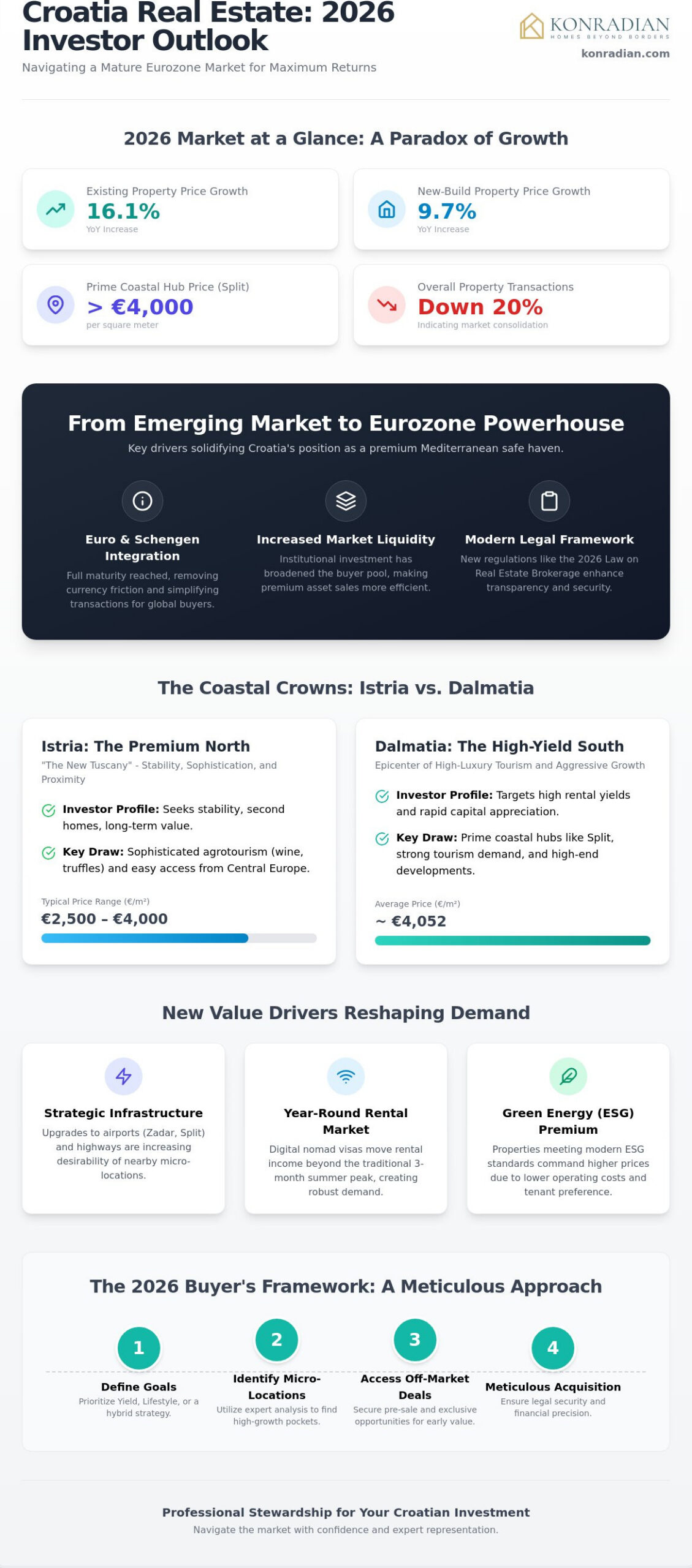
The primary driver of this market remains the enduring strength of Tourism in Croatia, which continues to underpin both rental yields and long-term capital appreciation. While the national average residential price reached approximately €3,844 per square meter by June 2026, the growth is not uniform. Sophisticated investors are now distinguishing between high-yield coastal apartments and the steady value growth found in the northern regions. Your investment goals must be clearly defined from the outset. Are you seeking the 16.1% annual price growth currently seen in existing resale properties, or do you prefer the lower-maintenance profile of new-builds which saw a 9.7% increase over the same period?
Post-Euro Stability and Market Liquidity
Currency alignment has fundamentally altered the transaction landscape by removing the friction of exchange rate volatility. For international buyers, particularly those from the Eurozone, the buying process is now as straightforward as a domestic transaction. We have observed a significant rise in institutional investment, with global capital flowing into high-end coastal hospitality and mixed-use developments. This institutional presence has bolstered market liquidity; selling a premium asset in 2026 is notably more efficient than it was in 2021, thanks to a more transparent legal framework and a broader pool of qualified global buyers.
Infrastructure Projects Reshaping Demand
Strategic infrastructure is the new map for value. Recent highway expansions and the significant upgrades to airports in Zadar and Split have shortened the “last mile” for travelers, directly increasing the desirability of nearby micro-locations. Additionally, the proliferation of digital nomad visas has created a robust year-round rental market, moving beyond the traditional three-month summer peak. New-build property values are also being influenced by strict green energy mandates. Properties that meet these modern ESG standards are commanding a premium, as they offer lower long-term operating costs and align with the preferences of the modern, environmentally conscious tenant.
To better reach these international clients, many owners are turning to professional digital solutions; for instance, Izrade sajtova specializes in building high-performance websites for regional businesses and property portfolios.
The Coastal Crowns: Istria and Dalmatia Compared
To identify the best places to buy property in Croatia 2026, one must look beyond the general shoreline and examine the distinct economic profiles of the North and South. Istria and Dalmatia represent the two primary pillars of the Croatian coast, yet they offer vastly different investment narratives. While Dalmatia currently leads as the most expensive coastal region with an average price of €4,052 per square meter, Istria offers a more commercially predictable environment with prices typically ranging from €2,500 to €4,000. This regional disparity is underpinned by a robust European Commission Economic Forecast, which highlights Croatia’s sustained fiscal stability and growth through 2026.
The choice between these regions is a strategic decision that should align with your 5-year exit strategy. Istria attracts those seeking stability and proximity to Central Europe, while Dalmatia remains the epicenter of high-luxury tourism and aggressive capital appreciation. Your lifestyle preference won’t just dictate where you spend your summers; it’ll define your rental occupancy rates and the profile of your future buyer.
Istria: The Premium North
Often referred to as the “New Tuscany,” Istria’s appeal lies in its sophisticated agrotourism and seamless connectivity. For German and Austrian investors, towns like Rovinj and Pula aren’t just holiday spots; they’re accessible second homes within a day’s drive. The high-end villa market here synergizes perfectly with the region’s world-class truffle and wine production, offering a tranquil alternative to the busier southern coast. If you’re exploring Istria real estate for sale, you’ll find a market characterized by organized spatial planning and consistent yield stability.
Dalmatia: Split, Zadar, and the Riviera
Further south, Dalmatia serves as the vibrant heart of the Adriatic lifestyle. Split has evolved into a year-round urban hub, recently overtaking Dubrovnik as the country’s most expensive city with average apartment prices exceeding €4,000 per square meter. Zadar remains the 2026 “dark horse” for capital appreciation, benefiting from significant airport expansions and a burgeoning luxury marina sector. Meanwhile, the Makarska Riviera continues to balance family-centric appeal with new, high-spec luxury developments that cater to an increasingly affluent demographic. If you’re ready to narrow your search to specific micro-locations, our team provides expert Croatian real estate sales support to ensure your capital is placed with precision.
Emerging Hotspots and Island Exclusivity
While the major coastal hubs command the highest headlines, the strategic investor in 2026 finds exceptional value in the micro-locations that surround these centers. The Pelješac Peninsula, for instance, has seen a steady rise in desirability following the completion of the landmark bridge, which transformed the region’s accessibility and logistics. Similarly, the quiet villages flanking Trogir and Dubrovnik offer the best places to buy property in Croatia 2026 for those who prioritize tranquility without sacrificing proximity to world-class amenities. These emerging pockets benefit from the broader economic stability highlighted in the World Bank Croatia Overview, which underscores the nation’s successful integration into the European single market and its reliance on robust structural growth.
Island Real Estate: Scarcity as a Value Driver
The allure of the Croatian islands remains rooted in their inherent scarcity. Stringent building restrictions ensure that supply remains low, protecting the long-term value of existing assets. Hvar and Brač continue to lead this segment, though the investment profile varies significantly between specific towns. Hvar Town remains the pinnacle of Adriatic prestige, attracting a high-net-worth demographic seeking vibrant luxury. Conversely, Stari Grad has emerged as a heritage-rich alternative, appealing to investors focused on restoration projects and cultural authenticity. When considering island property, logistics are paramount. The distinction between year-round ferry connectivity and seasonal private boat access can significantly influence your property’s rental potential and your own quality of life. It’s a market where patience and local insight are rewarded with unparalleled privacy.
Zagreb: The Year-Round Investment Case
Zagreb represents a sophisticated hedge against the seasonal volatility of the coast. As the political and corporate heart of the country, the capital attracts long-term wealth seekers who value consistent, year-round demand. The historical Lower Town is particularly prized for its grand architecture and proximity to international schools and diplomatic missions. This urban revival is driven by a growing class of professionals and digital nomads who require high-spec, turn-key apartments. By diversifying into the Zagreb market, you secure an asset that performs independently of the summer tourism cycle, providing a stable foundation for a multi-regional Croatian portfolio. It is a market defined by intellectual authority and long-term capital preservation, offering a composed alternative to the high-energy coastal regions.
The 2026 Buyer’s Framework: Yield, Lifestyle, and Pre-Sale
Before you commit to one of the best places to buy property in Croatia 2026, you must establish a clear five-year exit strategy. The Croatian market has matured into a landscape where short-term speculation is discouraged by a 24% capital gains tax on properties sold within two years of purchase. A longer holding period allows you to absorb the 3% Real Estate Transfer Tax while benefiting from the 20-30% cumulative growth projected over the next five years. This methodical approach ensures your capital is protected while you capitalize on the nation’s upward trajectory.
A critical decision in your framework is the choice between “Authentic Stone” heritage properties and “Modern New Builds.” While existing resale properties saw a significant 16.1% price increase in early 2026, they often require higher maintenance and rigorous title deed verification. Approximately 15% of properties in Croatia still exhibit mismatches between the land register and the cadastre. Modern new-builds, while often subject to a 25% VAT, exempt you from the 3% transfer tax and offer the peace of mind that comes with contemporary construction standards and green energy compliance.
The Pre-Sale Strategic Advantage
Securing developer listings before they reach public portals is the ultimate competitive edge for the 2026 investor. This pre-sale access allows you to negotiate lower entry prices and select the most desirable units within a development. Payment structures for off-plan properties are typically staged, with installments tied to specific construction milestones. This due diligence phase is vital; you must ensure the developer is financially stable and that all building permits are verified before the first payment is made. It’s a process that rewards those who prioritize transparency and professional oversight.
Yield Optimization in 2026
The rental market is no longer confined to the three-month summer peak. While high-luxury tourist rentals in Dalmatia continue to command premium rates, the medium-term “digital nomad” market is creating year-round demand in urban centers like Split and Zagreb. Long-term residential rental income is taxed at a favorable 10% flat rate on 70% of the income, providing a stable passive stream for remote owners. To navigate these complexities, securing expert legal support buying property abroad is essential for protecting your contracts and your yields. If you’re ready to move from analysis to acquisition, our team provides comprehensive legal and financial transaction support to ensure a seamless experience.
Meticulous Acquisition: How Konradian Redefines the Process
Identifying the best places to buy property in Croatia 2026 is only the first step in a successful investment journey. The true value lies in the precision of execution. At Konradian, we apply a London School of Economics mindset to every transaction, moving beyond the traditional role of a broker to act as a strategic consultant. We view the Adriatic landscape through a lens of intellectual rigor, ensuring that your capital is placed in assets that meet strict criteria for liquidity, legal clarity, and long-term appreciation. Our approach is designed for the sophisticated global citizen who demands a seamless, end-to-end experience without the friction typically associated with international real estate.
Our involvement is comprehensive and protective. We act as your dedicated advocate from the initial video consultation through to the final key handover. A distinct advantage of our service is that our buyer representation is provided at no cost to you. In the Croatian market, brokerage fees are typically settled by the seller, yet you receive the full benefit of our elite expertise and exclusive network. This includes direct relationships with top-tier developers, granting our clients access to pre-sale opportunities and off-market listings that are never visible on public portals. It’s a level of exclusivity that ensures you’re capturing value at the earliest possible entry point.
The Konradian Concierge Experience
We believe in a “heavy lifting” philosophy that removes the inherent stress of high-stakes international transactions. The Croatian legal system, particularly with the new Law on Real Estate Brokerage effective as of July 7, 2026, requires a methodical and proactive partner. We coordinate the entire ecosystem of legal, tax, and financial advisors on your behalf. Whether we’re obtaining your Personal Identification Number (OIB) or conducting deep-dive due diligence on land registry records, we handle the complexities so you don’t have to. Our tailored property sourcing is built around your specific investment criteria, ensuring every viewing is a strategic use of your time.
Your Next Steps in the Adriatic
Your transition into the Croatian market begins with a focused, one-on-one conversation. We invite you to book an initial video consultation to define your 5-year exit strategy and clarify your lifestyle objectives. Following this, we organize curated property viewing trips that provide a deep understanding of local micro-locations and their respective growth trajectories. You’ll gain a composed, expert perspective on the market, allowing you to move forward with quiet confidence. It’s time to secure your 2026 Croatia property consultation with Konradian and experience a level of stewardship that redefines the acquisition process.
Securing Your Legacy on the Adriatic
The Croatian property market in 2026 rewards the precise and the proactive. Success no longer depends on chasing broad national trends but on the ability to identify high-growth micro-locations and secure assets with verified legal titles. By focusing on the best places to buy property in Croatia 2026, you’re investing in a mature European stronghold that balances exceptional lifestyle appeal with robust fiscal stability. Whether your goal is a high-yield urban apartment or a tranquil coastal villa, the strategic framework we’ve discussed provides the roadmap for a secure and profitable acquisition.
Our team of LSE-educated strategic advisors brings over five years of international brokerage experience to every transaction. We provide our clients with direct access to exclusive pre-sale developer listings and handle the heavy lifting of the buying process from start to finish. If you’re ready to explore the market with a trusted, high-level partner, we invite you to Book a Free Video Consultation for Croatian Property today. Let’s work together to ensure your investment in the Adriatic is both effortless and enduring.
Frequently Asked Questions
Can foreigners buy property in Croatia in 2026?
Yes, foreigners can buy property in Croatia in 2026, though the specific requirements depend on your citizenship. EU, EEA, and Swiss citizens enjoy the same buying conditions as Croatian nationals. Non-EU citizens from countries with reciprocity agreements, including the US and UK, can also purchase residential property but require approval from the Ministry of Justice. With Croatia’s expected OECD membership, many international buyers may soon find the approval process significantly streamlined or even eliminated.
What are the property taxes for buyers in Croatia?
Buyers of resale properties are subject to a flat 3% Real Estate Transfer Tax (RETT) based on the property’s market value. If you’re purchasing a new-build property from a developer in the VAT system, a 25% VAT is included in the price, and you’re exempt from the 3% RETT. Additionally, non-primary residences are subject to an annual property tax that ranges from €0.60 to €8.00 per square meter, depending on the local municipality’s rates.
Which region of Croatia has the highest rental yield?
Dalmatia continues to offer the highest seasonal rental yields, particularly in high-demand hubs like Split and Zadar where tourism peaks are most intense. For investors seeking year-round occupancy, Zagreb is frequently cited as one of the best places to buy property in Croatia 2026. The capital’s corporate and diplomatic rental sectors provide a stable income stream that isn’t dependent on the summer months, offering a sophisticated hedge against coastal seasonality.
Is it better to buy a new build or a stone house in Dalmatia?
The decision rests on your investment goals and appetite for maintenance. Modern new-builds offer immediate “turn-key” utility, superior energy efficiency, and lower long-term upkeep costs, which often translates to higher net yields for remote owners. Traditional stone houses offer unmatched heritage appeal and scarcity value. While they can command premium resale prices, they often require meticulous renovation and more rigorous legal due diligence to ensure clear title deeds. To visualize how premium custom cabinetry and modern layouts can transform a traditional space, you can learn more about Inspired Home Design.
How long does the property purchase process take in Croatia?
The timeline typically ranges from one to six months depending on your residency status. EU citizens can often complete the registration within a few weeks once the contract is signed and the personal identification number (OIB) is obtained. For non-EU citizens, the mandatory Ministry of Justice approval process can add two to six months to the schedule. Professional stewardship is essential to ensure all administrative milestones are met without unnecessary delays.
Do I need to be physically present in Croatia to buy property?
You don’t need to be physically present in the country to execute a property transaction. Most of the process, from the initial offer to the final registration, can be managed through a Power of Attorney granted to a qualified legal representative. We regularly coordinate the entire acquisition for our international clients, utilizing high-definition video tours and secure digital communication to provide a seamless experience from your home country.
What are the hidden costs of buying property in Croatia?
Beyond the purchase price and 3% transfer tax, you should budget approximately 1% to 2% for notary fees, land registry charges, and legal representation. Foreign buyers must also account for the cost of official translations for required documents and the administrative fees for obtaining an OIB. While the Euro has simplified transactions, it’s wise to maintain a small contingency fund for these standard administrative expenses and potential bank transfer fees.
Are Konradian’s services really free for the buyer?
Yes, our buyer representation and strategic advisory services are provided at no cost to our clients. In the Croatian market, the brokerage commission is traditionally settled by the seller or the property developer. This allows you to access our LSE-educated advisors and our exclusive network of pre-sale listings without any additional service fees. You receive the full benefit of our professional stewardship and market expertise while we ensure your capital is placed with precision.
