


Coastal Croatia is no longer just a Mediterranean lifestyle purchase; it’s a sophisticated Eurozone asset class that demands institutional-grade strategy. For the 2026 investor, the primary challenge isn’t finding a beautiful view, but navigating the intricacies of buying a new build property in Croatia while avoiding inflated tourist pricing and complex legal bottlenecks. You likely recognize that the market has transitioned into a mature phase, where the window for speculative gambles has closed, replaced by a landscape that rewards precision and local market intelligence.
We understand that securing a high-stakes asset in a foreign jurisdiction can feel overwhelming when managed from afar. This guide provides the clarity you need to master the nuances of the coastal market, ensuring you secure a high-yield asset with elite oversight at no additional cost to your capital. We’ll examine the current 25% VAT structures, identify the specific regions in Dalmatia poised for the highest capital appreciation, and outline a methodical, start-to-finish process for a seamless transfer of ownership.
Key Takeaways
- Recognize the Adriatic market’s evolution into a stable, high-yield Eurozone asset class that offers long-term resilience for international portfolios.
- Navigate the financial complexities of buying a new build property in Croatia, specifically the 25% VAT structure and the 3% transfer tax exemptions.
- Evaluate the unique investment profiles of Istria and Dalmatia to balance immediate rental yields with long-term capital appreciation.
- Streamline your acquisition with a step-by-step roadmap that simplifies legal requirements, from obtaining your OIB to final key handover.
- Leverage professional, LSE-educated oversight and direct developer access through a buyer-first model that ensures your interests are protected at zero cost.
The 2026 Landscape for Buying a New Build Property in Croatia
The Adriatic market has undergone a fundamental transformation. What was once considered an emerging frontier has solidified into a cornerstone of the Eurozone property market. For those considering buying a new build property in Croatia in 2026, the value proposition has shifted from speculative growth to capital preservation and steady yield. This evolution is anchored by the country’s full integration into the European financial system, which has eliminated the currency risks and high transaction hurdles that previously deterred institutional-grade investors.
Eurozone Maturity and Market Stability
The 2023 adoption of the Euro has fundamentally reshaped Croatia’s economic landscape, creating a transparent environment for international capital. Transaction friction has plummeted as cross-border payments and mortgage valuations now align with broader EU standards. While Mediterranean competitors like Spain or Italy face saturated markets and complex tax structures, Croatia offers a compelling price-to-rent ratio that remains attractive to the strategic buyer. Political stability and a firm commitment to infrastructure growth have turned the coast into a safe harbor for wealth. Investors aren’t just buying square meters; they’re acquiring a stake in a region with high-register governance and increasing global relevance.
The 2026 Supply-Demand Imbalance
Scarcity is the primary driver of value in 2026. Prime coastal land is a finite resource, and strict zoning regulations protect the aesthetic integrity of the Dalmatian and Istrian shorelines. This limited supply is colliding with a surge in demand from affluent Northern European and North American buyers who prioritize security and accessibility. Buying a new build property in Croatia through off-plan opportunities has become the preferred entry point for savvy investors. This approach allows for customization and entry at a lower price point before the asset reaches full market maturity upon completion.
Infrastructure developments have significantly boosted coastal accessibility. The expansion of regional airports and the maturation of high-speed road networks mean that remote coastal enclaves are now within easy reach of major European hubs. In this environment, seafront properties remain the most inflation-resistant category. A direct view of the Adriatic isn’t just a lifestyle choice; it’s a structural barrier against market volatility. These assets maintain their desirability regardless of broader economic shifts, ensuring that your investment remains both liquid and prestigious.
Evaluating Investment Metrics: Yields and Capital Growth
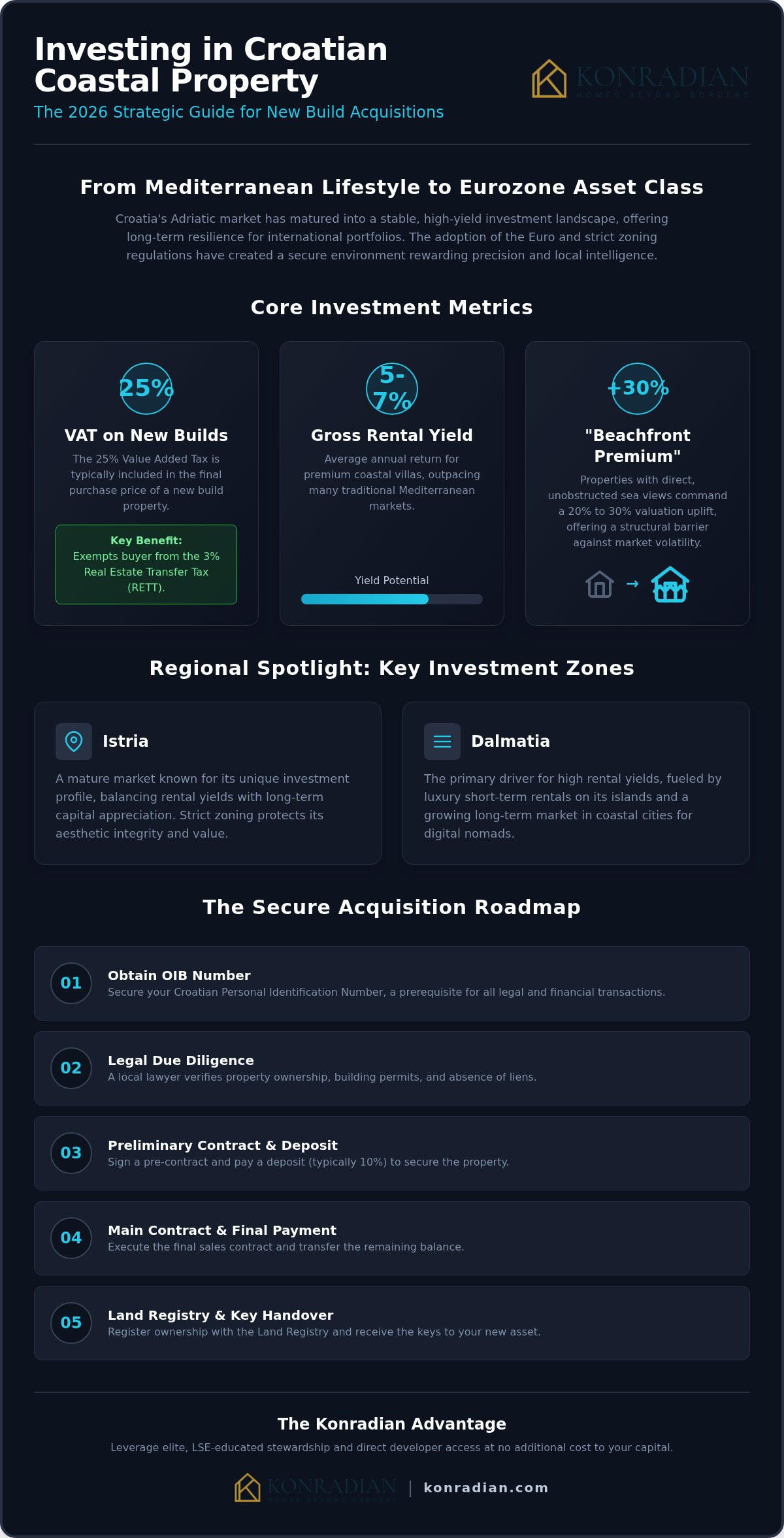
Sophisticated investors prioritize the balance between immediate cash flow and long-term asset appreciation. When buying a new build property in Croatia, you’re entering a market where these two metrics often move in tandem. The average gross rental yield for premium coastal villas in 2026 is approximately 5% to 7% depending on the specific micro-location and property management efficiency. These figures represent a resilient return profile that outpaces many traditional Mediterranean competitors where entry prices have already peaked.
The “Beachfront Premium” is a quantifiable reality rather than a marketing cliché. Properties with direct, unobstructed sea views typically command a 20% to 30% valuation uplift compared to secondary line developments. This isn’t just about the view; it’s a structural risk mitigation strategy. These assets hold their value during broader market corrections because the supply of frontline land is strictly limited by national environmental protections. Understanding these fiscal nuances is essential for calculating your net return. For new builds, the 25% VAT is typically included in the purchase price, which exempts you from the 3% Real Estate Transfer Tax (RETT) that applies to resale properties. You can review the broader regulatory framework on the official investment portal to see how the state encourages institutional-grade residential development.
Rental Yield Dynamics in Coastal Hubs
Short-term luxury rentals in the Dalmatian islands remain the primary yield driver, fueled by a high-spending international demographic. However, a new trend is emerging in coastal cities. The rise of the digital nomad has introduced a stable, long-term rental market that fills the shoulder seasons. To maintain these returns, you’ll need to budget roughly 15% of gross income for professional maintenance and local tax compliance. This ensures the asset remains in peak condition for both capital growth and rental appeal.
Capital Appreciation Projections
Istria has historically shown steady growth due to its proximity to Central Europe, while Southern Dalmatia offers explosive potential in micro-locations that were previously harder to access. Strategic investors are looking toward these undervalued pockets where infrastructure is finally catching up to the natural beauty. The exit strategy for these properties is increasingly robust. As the market matures, the liquidity of coastal assets is supported by a growing pool of global buyers seeking safe, Euro-denominated havens. If you’re ready to explore specific opportunities, our team can provide a curated investment analysis based on the latest 2026 market data.
Regional Analysis: Where to Buy in Croatia for Maximum Impact
Selecting the right location is the most critical decision when buying a new build property in Croatia. While the entire 1,700-kilometer coastline is visually stunning, the economic drivers vary significantly between the northern peninsula and the southern archipelagos. For investors planning a scouting trip to evaluate these regions firsthand, utilizing a custom Croatia travel itinerary ensures your journey is both productive and tailored to your specific interests. A strategic investor must distinguish between regions that offer year-round liquidity and those that provide concentrated, high-yield seasonal returns. Your choice should align with your specific goals for capital preservation or aggressive rental income.
Istria’s primary advantage is its geographic proximity to Central European wealth hubs. Because it’s within a few hours’ drive from Munich, Vienna, and Milan, the region enjoys a significantly longer rental season than the rest of the country. The investment focus here has shifted toward Istria real estate for sale that emphasizes privacy and land, such as luxury vineyard villas and modern interpretations of stone houses. These properties cater to an affluent demographic that prioritizes authentic gastronomy and wellness. High-quality road networks and a mature service industry ensure that occupancy rates remain stable even in the shoulder seasons, making Istria a bastion of stability for your portfolio.
Dalmatia: Split, Trogir, and the Southern Coast
Dalmatia represents the heart of luxury and maritime tourism. The Split real estate market is particularly resilient because it offers urban-coastal hybrid assets. These properties benefit from a dual-demand structure: high-end tourists in the summer and corporate or diplomatic tenants in the winter. The presence of UNESCO heritage sites in Split and Trogir creates a “halo effect” for nearby new builds, providing a level of prestige that is difficult to replicate. For investors seeking the absolute pinnacle of Adriatic luxury, the islands of Hvar and Brač remain the premier choice. These locations command the highest daily rental rates in the Mediterranean, though they require a more sophisticated approach to management and logistics.
Institutional interest is increasingly gravitating toward the Zadar region. It serves as an emerging hotspot because it combines an international airport with some of the most advanced marina infrastructure in the Eurozone. Zadar offers a price point that is still maturing compared to the saturated markets of Split or Dubrovnik, creating a unique window for capital appreciation. By securing new build assets in these developing micro-locations, you can capture the growth of a region that is rapidly becoming a preferred destination for high-net-worth maritime travelers.
The Secure Acquisition Process: Legal and Financial Steps
The process of buying a new build property in Croatia requires a methodical approach to ensure a secure transfer of title. It begins with obtaining your OIB (Personal Identification Number) and opening a local bank account. These are foundational steps that facilitate every subsequent transaction. Once these are in place, the acquisition moves through a two-stage contract structure. The Pre-Contract (Predugovor) secures the asset with a deposit, while the Main Contract (Ugovor o kupoprodaji) facilitates the final transfer of ownership after the property meets all technical requirements.
Relying on specialized legal support buying property abroad ensures these hurdles don’t become roadblocks. Professional oversight is essential to manage the communication between developers, notaries, and the Ministry of Justice, providing you with a layer of protection that DIY investors often lack. This elite stewardship allows you to manage the entire acquisition remotely, focusing on the strategic growth of your portfolio while we handle the administrative heavy lifting.
Legal Due Diligence for International Buyers
Verification of the Vlasnički list (Ownership Certificate) and Uporabna dozvola (Usage Permit) is mandatory. The Ownership Certificate must be free of encumbrances, while the Usage Permit confirms the new build meets all technical and zoning standards. Non-EU citizens, including those from the US and UK, must adhere to reciprocity agreements and are generally prohibited from purchasing agricultural land. As of September 2026, non-resident property acquisition requires formal approval from the Ministry of Justice unless the purchase is conducted through a local Croatian company (d.o.o.).
Financial Coordination and Closing
Managing cross-border currency transfers requires precision. While Croatia is a full Eurozone member, large international transfers should ideally be handled via escrow accounts to protect the buyer during the construction phase of a new build. When buying a new build property in Croatia from a developer in the VAT system, you’re exempt from the 3% Real Estate Transfer Tax (RETT). This is because the 25% VAT is already factored into the purchase price, a distinction that is vital for accurate ROI modeling.
The final step involves the notary-certified signature and the subsequent registration in the Land Registry and Cadastre. This dual-registration system is the only way to achieve absolute legal certainty. To ensure your acquisition follows this elite standard without the burden of administrative complexity, book a private consultation with our LSE-educated advisory team.
The Konradian Advantage: Elite Stewardship at Zero Cost
Buying a new build property in Croatia is a significant undertaking that requires more than just a local agent; it demands a strategic partner with a global perspective. At Konradian, we provide this through our LSE-educated team, bringing intellectual rigor and over five years of international market experience to every transaction. We operate as a protective and proactive advisor, handling the heavy lifting of the acquisition process so you can focus on the long-term potential of your Adriatic portfolio. Our mindset is cosmopolitan and knowledgeable, ensuring that your investment aligns with broader Eurozone trends and institutional standards.
A common concern for international investors is the hidden cost of professional representation. In the Croatian market, our services are provided at zero cost to the buyer. This is possible because our commissions are paid directly by the developer or seller, allowing you to benefit from elite legal and financial oversight without any additional capital outlay. This model ensures that your interests are prioritized from the initial video consultation to the final key handover. You receive professional representation and professional due diligence as part of a seamless, end-to-end experience that prioritizes your financial well-being and peace of mind.
Strategic Sourcing vs. Traditional Listing Portals
Traditional property portals often present a fragmented and sometimes outdated view of the market. We bypass these limitations through direct, long-standing relationships with top-tier developers, granting our clients exclusive access to pre-sale opportunities and off-market coastal listings. This strategic sourcing results in better pricing and a selection of assets that have already been vetted for investment quality. We don’t just look at aesthetics; we filter for structural integrity, legal compliance, and capital growth potential. For investors managing a multi-country portfolio, we serve as a single, sophisticated point of contact that simplifies the entire Adriatic landscape.
Your Next Steps to Adriatic Ownership
The journey toward securing a high-yield coastal asset begins with a clear understanding of your personal and financial objectives. Whether your priority is immediate rental yield in Dalmatia or long-term capital appreciation in Istria, our team is here to provide the necessary market intelligence. We invite you to define your investment criteria through a structured dialogue that moves from broad opportunities to specific, high-register assets. This methodical process ensures that every decision is backed by data and professional stewardship.
Your acquisition should be a source of tranquility, not stress. By leveraging our expertise and developer network, you can navigate the complexities of the Croatian market with absolute confidence. Start your Croatia property journey with Konradian by booking a free video consultation with our investment team today.
Securing Your Adriatic Legacy
The transition of the Croatian coast into a premier Eurozone asset class has created a unique window for the strategic investor. By prioritizing high-yield new builds in micro-locations like Zadar or the Istrian interior, you’re not just purchasing real estate; you’re securing a resilient financial future. Success in this market requires a move away from generic portals toward direct developer access and rigorous legal due diligence. The complexity of buying a new build property in Croatia is effectively neutralized when you have a dedicated partner handling the administrative and regulatory heavy lifting.
Our LSE-educated advisors provide the intellectual rigor and local intelligence needed to navigate this landscape with absolute confidence. We offer exclusive pre-sale access and a comprehensive, end-to-end service that remains entirely free for the buyer. This professional stewardship ensures that your transition to Adriatic ownership is as tranquil as the coastline itself. To begin defining your investment criteria and exploring off-market opportunities, book your free video consultation for Croatia investment today. We look forward to guiding you toward a sophisticated and high-performing property portfolio.
Frequently Asked Questions
Can foreigners buy coastal property in Croatia in 2026?
Yes, EU and EEA citizens can purchase residential property under the same conditions as Croatian nationals. Non-EU citizens, including those from the United States and the United Kingdom, can also acquire property based on reciprocity agreements but require formal approval from the Ministry of Justice. This process is standard for residential assets but excludes agricultural land. Many international investors choose to purchase through a local company to streamline the acquisition of multiple assets.
What are the total transaction costs when buying real estate in Croatia?
Investors should budget between 5% and 8% of the purchase price for one-off transaction costs. When buying a new build property in Croatia from a developer, you’re exempt from the 3% Real Estate Transfer Tax because the 25% VAT is already included in the price. Other essential costs include notary fees, which typically range from 0.5% to 1%, and professional legal representation to ensure a secure transfer of ownership.
What is the average rental yield for coastal property in Dalmatia?
Premium coastal villas in Dalmatia currently generate gross rental yields between 5% and 7%. These returns are driven by high-end maritime tourism and increasing demand for luxury short-term stays in hubs like Split and Zadar. While yields vary by micro-location, properties with direct sea views maintain the highest occupancy rates. Investors should also consider the potential for capital appreciation, which has remained resilient across the most desirable Adriatic stretches.
Is it possible to buy property in Croatia remotely without travelling?
Yes, remote acquisition is a standard service for our international clients. By granting a Power of Attorney to a trusted legal representative, you can manage the entire process from initial selection to key handover without visiting the country. Our team facilitates this through high-definition video consultations and digital documentation. This approach allows you to secure prime Adriatic assets while maintaining your global schedule, ensuring a seamless and professionally managed transaction.
How does the Konradian “free for the buyer” model work in Croatia?
Our model provides elite stewardship without increasing your capital outlay. In the Croatian market, the developer or seller pays our brokerage commission upon a successful transaction. This allows us to offer end-to-end support, including property sourcing and legal coordination, at no direct cost to you. You benefit from our LSE-educated expertise and direct developer relationships while your entire investment remains focused on the asset’s value and long-term performance.
What is the difference between buying a new build vs. a stone house renovation?
Buying a new build property in Croatia offers immediate utility and higher energy efficiency, often including a 25% VAT that exempts you from the standard transfer tax. Stone house renovations provide historic charm but often involve complex heritage regulations and unpredictable reconstruction costs. New builds generally offer more predictable maintenance schedules and modern amenities, making them the preferred choice for institutional-grade investors seeking stable yields and fewer operational surprises.
Do I need a local bank account to invest in Croatian real estate?
Yes, a local bank account is essential for the final stages of the transaction and ongoing property costs. While initial deposits can sometimes be managed via international transfers, having a Croatian account simplifies the payment of utilities and local taxes. We assist our clients in opening these accounts as part of our end-to-end service. This coordination ensures that your financial infrastructure is ready before the final contract is signed and the keys are handed over.
How long does the property acquisition process typically take in Croatia?
The timeline from initial selection to ownership registration usually spans two to four months. This includes obtaining your OIB, conducting legal due diligence, and securing Ministry of Justice approval for non-EU buyers. While the administrative steps are methodical, our team streamlines the coordination between all parties to prevent unnecessary delays. For new builds still under construction, the final handover occurs upon the issuance of the usage permit and final technical acceptance.
