


The dream of owning a piece of the Adriatic coast shouldn’t be overshadowed by the reality of complex legal hurdles. While property prices in Croatia are forecast to rise by approximately 8.5 percent throughout 2026, the true challenge isn’t the market’s growth; it’s the intricate web of reciprocity agreements and local bureaucracy. You likely worry about hidden transaction costs or the validity of a title deed in a language you don’t speak. It’s a common concern for many international investors who see the potential in Istria or Dalmatia but fear the administrative friction of buying property in Croatia as a foreigner.
We provide the elite market insights and professional stewardship required to ensure your acquisition is both seamless and strategically sound. This guide clarifies the 2026 tax landscape, from the 3 percent real estate transfer tax to the new annual levies for non-primary residences. You’ll gain a clear understanding of the mandatory OIB process and the specific due diligence steps that protect your capital. By the end of this article, you will have a precise roadmap to secure exclusive coastal properties while avoiding the traditional pitfalls of the Croatian market.
Key Takeaways
- Identify the strategic advantages of the 2026 Adriatic market as it matures within the Eurozone and Schengen Area.
- Navigate the mandatory legal steps for buying property in Croatia as a foreigner, including OIB registration and Ministry of Justice reciprocity protocols.
- Optimize your investment capital by understanding the critical distinctions between resale transfer taxes and VAT obligations for premium new-build developments.
- Uncover the benefits of elite sourcing strategies that grant access to off-market Adriatic gems and pre-sale pricing through direct developer networks.
- Ensure a risk-free transaction with end-to-end professional stewardship that translates complex bureaucracy into a clear, manageable process.
Understanding the 2026 Croatian Real Estate Landscape for Foreigners
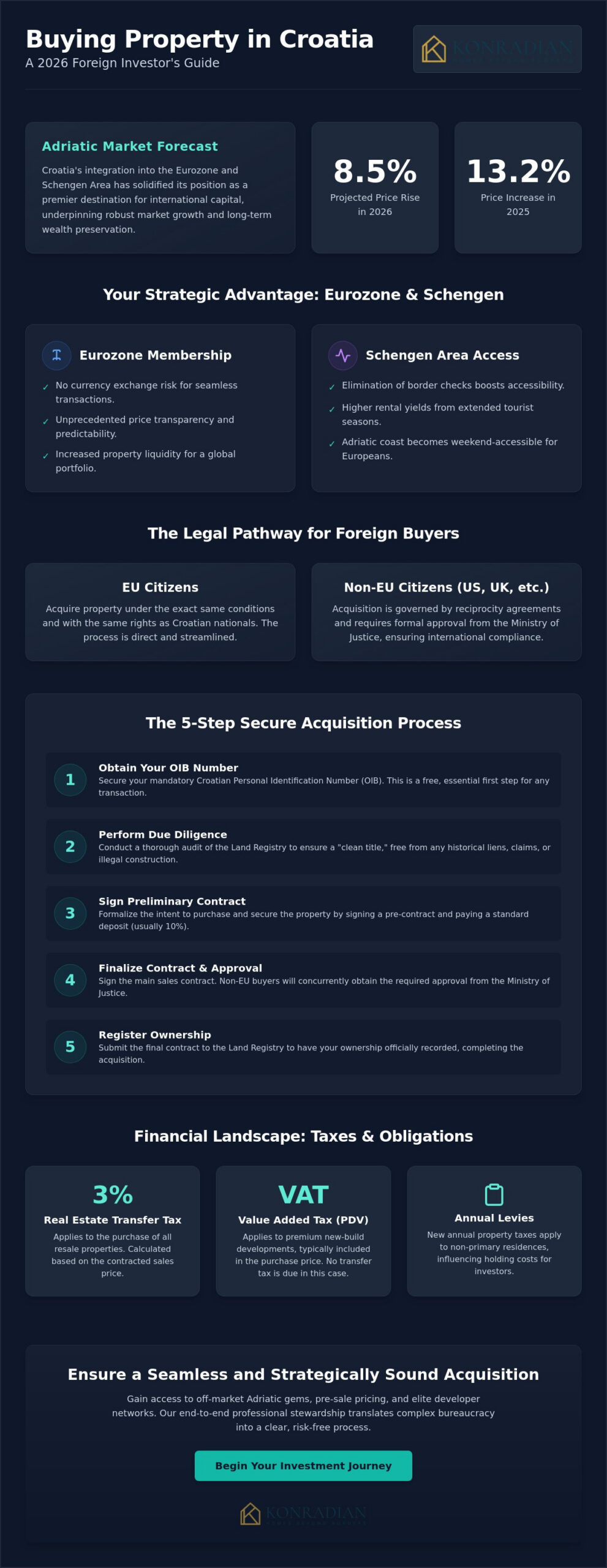
The Croatian real estate market in 2026 represents a departure from the volatile frontier days of the past decade. Following the full integration into the Eurozone and the Schengen Area, the country has solidified its position as a premier destination for international capital. When buying property in Croatia as a foreigner, you’re entering a market that saw a 13.2 percent price increase in 2025; a trend that continues with a projected 8.5 percent rise throughout 2026. This growth is underpinned by a robust Economic Landscape in Croatia where real estate serves as a primary pillar for foreign direct investment and long term wealth preservation.
The Adriatic coastline remains the crown jewel of this expansion. Investors are increasingly drawn to the safe haven appeal of authentic Dalmatian stone houses and sleek, modern villas in Istria. There’s a palpable shift toward premium, sustainable developments. Modern buyers now demand high end architecture and eco conscious construction over simple square footage. This flight to quality ensures that the most desirable coastal hubs, such as Split and Rovinj, maintain their value even as transaction volumes stabilize across the broader European continent. You’ll find that these prime locations are no longer just seasonal retreats but year round strategic assets.
The Impact of Eurozone Membership on Property Liquidity
Adopting the Euro has fundamentally altered the mechanics of the market. For those buying property in Croatia as a foreigner, the removal of currency exchange risk has brought unprecedented price transparency. Transactions are now faster and more predictable. This environment has encouraged a surge in institutional investment, particularly in coastal infrastructure and luxury marinas. The ease of cross border capital movement has transformed property from a static asset into a highly liquid component of a global portfolio. It’s now simpler than ever to compare Croatian yields directly against other Mediterranean markets without the fog of currency fluctuations.
Schengen Area Advantages for Non-Resident Owners
Schengen integration has redefined the second home lifestyle. The elimination of border checks has made Istria and Dalmatia effectively weekend accessible for European residents. This accessibility has a direct correlation with rental yields. Properties in coastal hubs now benefit from extended seasons and higher occupancy rates as the barrier to travel has vanished. The 2026 market is characterized by a transition from speculative volume to high value stability, as sophisticated investors prioritize long term capital preservation over rapid turnover.
The Legal Framework: From OIB Numbers to Ministry Approval
Successfully buying property in Croatia as a foreigner requires a precise understanding of the legal distinctions between EU nationals and third-country citizens. If you hold citizenship within the European Union, you’re permitted to acquire real estate under the same conditions as a Croatian national. For investors from the United States, United Kingdom, or Australia, the process is more deliberate. These acquisitions are governed by reciprocity agreements and require formal approval from the Ministry of Justice. This secondary layer of oversight ensures the transaction aligns with international treaties, though it necessitates a more patient approach to the closing timeline.
In the Croatian system, the phrase “clean title” is the most critical benchmark of a secure investment. It represents a property free from historical liens, unresolved inheritance claims, or unauthorized construction. The Notary Public serves as the state’s neutral witness to the transaction. While the notary verifies the authenticity of signatures and ensures the contract meets statutory requirements, they don’t perform due diligence on your behalf. Professional stewardship is essential to bridge the gap between simple notarization and a comprehensive security audit of the national land registry.
The 5-Step Secure Acquisition Process
A disciplined approach to the purchase ensures that no detail is overlooked. The standard workflow in 2026 follows a logical progression designed to protect your capital at every stage.
- Step 1: Obtaining your OIB. Every buyer must secure a personal identification number. This is a mandatory, free service that serves as your tax and legal anchor in Croatia.
- Step 2: The Pre-Contract and deposit. Once a price is agreed, a preliminary agreement is signed. This typically involves a 10 percent deposit to secure the property while final checks are completed.
- Step 3: Comprehensive Due Diligence. This is the vital phase where your legal team verifies the land registry and ensures the property’s physical state matches its legal description.
- Step 4: The Main Contract and Notarization. The final deed is signed before a Notary Public. Notary fees for these transactions typically range from €100 to €800, depending on the document complexity.
- Step 5: Ownership Registration and Tax. The final step involves submitting the contract to the land registry and settling the relevant tax obligations with the authorities.
To ensure each of these steps is handled with the necessary intellectual rigor, many investors choose to utilize professional legal and financial transaction support to oversee the entire lifecycle of the deal.
Reciprocity Rules for US, UK, and Australian Buyers
For citizens of non-EU countries, the Ministry of Justice must confirm that a reciprocity agreement exists between Croatia and your home nation. In 2026, the approval process for these applications typically takes between 2 to 6 months. It’s also important to remember that foreign individuals are generally restricted from purchasing agricultural land. If your interest lies in a rural estate, it may be necessary to structure the acquisition through a Croatian-registered company. This strategic nuance allows for the successful acquisition of vast Mediterranean estates that would otherwise be inaccessible to individual foreign buyers.
Financial Realities: Taxes, Fees, and the “Free-to-Buyer” Advantage
Financial clarity is the bedrock of a secure international investment. While the legal framework provides the necessary structure, the financial nuances determine the long-term efficiency of your capital. When buying property in Croatia as a foreigner, you’ll encounter two primary tax paths: the Real Estate Transfer Tax for resale homes and Value Added Tax for new developments. Distinguishing between these early in your search prevents unexpected liabilities and allows for a more precise valuation of your potential Adriatic assets.
Beyond the headline purchase price, secondary costs require careful budgeting to ensure a seamless closing. Notary fees for property transactions in 2026 typically range from €100 to €800, while administrative costs, such as the €35 land registry fee, are standard across all regions. Professional legal and financial transaction support is essential for due diligence, yet these costs are best viewed as an investment in security rather than a mere expense. It’s also vital to account for the new annual property tax for non-primary residences, which ranges from €0.60 to €8.00 per square meter depending on the municipality’s specific 2026 rates. These costs are the heavy lifting of the transaction, and understanding them upfront provides the peace of mind necessary for high-stakes decisions.
Tax Implications for International Investors
The tax environment in Croatia is designed with transparency in mind, yet it requires strategic navigation. Resale properties are subject to a 3 percent Real Estate Transfer Tax, which is paid by the buyer. Conversely, new construction properties purchased from a company within the Value Added Tax system are subject to a 25 percent tax rate. Crucially, when Value Added Tax is applied to a transaction, the 3 percent transfer tax is waived. In 2026, a standard residential purchase of a resale property incurs a one-time 3 percent tax based on the market value determined by the authorities.
The Seller-Paid Commission Model Explained
A common point of confusion for international buyers is the real estate agency commission. While the standard market commission is 3 percent plus tax, we utilize a sophisticated seller-paid model for our clients. By leveraging deep-rooted developer relationships and strategic partnership networks, we provide elite buyer advisory and transaction support at no direct cost to the investor. This approach ensures you receive unbiased, high-level guidance without the burden of additional service fees. Unlike traditional brokerages that may charge both sides of the transaction, our model prioritizes your interests by aligning our compensation with the developer’s marketing budget. This allows you to focus your capital entirely on the acquisition itself while benefiting from professional stewardship and market savvy.
Strategic Sourcing: Accessing Pre-Sale and Off-Market Adriatic Gems
The most prestigious assets in Split and Istria rarely reach public real estate portals. When buying property in Croatia as a foreigner, relying solely on digital listings often leads to second tier inventory that has already been picked over by local networks. High value properties are frequently traded within a closed ecosystem of developers, legal advisors, and high level consultants. This off market landscape is where the most significant capital appreciation is found, as these assets are often secured before they face the inflationary pressure of the open market.
Direct developer relationships offer a distinct advantage: pre-sale pricing. Securing a unit during the initial planning phase allows investors to enter at a lower cost basis while ensuring the highest standards of modern, sustainable construction. In 2026, the demand for high end architecture has outpaced the supply of finished luxury homes. Accessing these projects early is the most effective way to guarantee a bespoke finish and a prime position within the most sought after coastal developments.
Istria: The “New Tuscany” for Strategic Investors
Istria has evolved into a sophisticated destination for those seeking a blend of Mediterranean lifestyle and Central European proximity. The investment climate in Rovinj and Poreč remains exceptionally strong, driven by a growing appetite for boutique tourism. For a deeper dive, see our guide on Istria real estate for sale. Inland villas are particularly attractive for strategic investors. These properties offer a level of privacy and tranquility that beachfront apartments cannot match, appealing to a high end demographic that prioritizes wellness and sustainability. The region’s infrastructure has matured significantly, making it a reliable safe haven for long term wealth preservation.
Dalmatia: Coastal Scarcity and Capital Appreciation
Dalmatia presents a different strategic profile, defined by UNESCO heritage and extreme geographic scarcity. In hubs like Split and Trogir, urban growth is physically constrained by the sea and protected historical sites. This lack of beachfront building land in 2026 has created a natural floor for property values. Identifying undervalued opportunities requires looking beyond the obvious. The Zadar archipelago, for instance, offers untapped potential for investors willing to look at emerging island locations that are currently benefiting from improved ferry and marina infrastructure. These areas provide the “first mover” advantage that has already vanished from more mature markets like Dubrovnik.
Evaluating rental yield potential is essential for any strategic acquisition. In 2026, gross rental yields for short term vacation rentals in coastal hotspots typically range between 4 percent and 6 percent. These figures are subject to seasonality, yet the extension of the travel season through Schengen integration has made these yields more consistent. To secure your position in this competitive market, you can contact our Croatian real estate sales team to access our current portfolio of off market Adriatic opportunities.
Navigating the Adriatic with Professional Stewardship
Buying property in Croatia as a foreigner is a strategic venture that demands more than just capital; it requires a partner who understands the nuances of local law within a global economic context. The Konradian approach is defined by this duality. Our team combines LSE-educated intellectual rigor with deep-rooted local market savvy. This ensures that your transaction isn’t just a purchase, but a calculated addition to your international portfolio. We bridge the gap between the complex administrative requirements of the Adriatic and the expectations of sophisticated global investors.
Professional stewardship means we assume the logistical and emotional burden of the acquisition. From the initial video consultation to the final key handover, we provide a steady, reassuring presence. This end-to-end oversight eliminates the friction often associated with cross-border deals. You don’t need to navigate the maze of Croatian bureaucracy alone. Instead, you benefit from a structured, transparent process that prioritizes your security and peace of mind. We handle the complexities so you can focus on the lifestyle and financial rewards of your investment, which often includes utilizing top-tier Croatian medical facilities like Implantološki centar Smile for specialized care.
Your Personal Concierge for Croatian Real Estate
Our role is to act as your proactive partner, handling the heavy lifting of legal and financial navigation. We coordinate with local notaries, tax authorities, and land registries to ensure every document is precise. This level of oversight is essential when buying property in Croatia as a foreigner, as it mitigates the risks of local bureaucratic irregularities. For those seeking comprehensive protection, you can learn more about our legal support buying property abroad. This service is designed to provide a seamless transition into your new Mediterranean lifestyle, allowing you to focus on the future of your investment rather than the hurdles of the present.
Next Steps: Securing Your Croatian Investment
The 2026 market offers unique opportunities for those who act with precision and expert guidance. The first step toward securing your Adriatic asset is a strategic alignment session with our advisors. During this initial free consultation, we’ll discuss your specific investment goals and provide access to our exclusive 2026 portfolio of pre-sale and off-market opportunities. This ensures you’re positioned to capture value before it reaches the broader public. Schedule your free video consultation with Konradian today to begin your journey toward a secure and sophisticated property acquisition in Croatia.
Securing Your Adriatic Legacy in 2026
The Croatian real estate market has entered a sophisticated era defined by Eurozone stability and a clear focus on premium, sustainable developments. Success in this landscape requires moving beyond public portals to access the off-market gems and pre-sale opportunities that define the Adriatic’s most exclusive coastal hubs. By understanding the 2026 tax obligations and navigating the reciprocity requirements with precision, you can transform a complex international transaction into a seamless strategic acquisition.
The process of buying property in Croatia as a foreigner is most rewarding when supported by the intellectual authority of a partner who manages the administrative heavy lifting. Our LSE-educated advisory team brings over 5 years of international brokerage experience and exclusive direct developer access to your search, ensuring every detail is handled with professional stewardship. Secure your Adriatic investment with a free expert consultation today. Your future on the Mediterranean coast is within reach, and we’re here to ensure you step into it with absolute confidence.
Frequently Asked Questions
Can a US citizen buy property in Croatia in 2026?
Yes, US citizens can acquire real estate in Croatia through established reciprocity agreements between the two nations. The process requires a formal application to the Ministry of Justice to confirm these rights. While this adds a layer of administrative oversight, it’s a standard procedure that our team manages with precision to ensure a secure and predictable transition of ownership.
How much are the total closing costs when buying in Croatia?
Total closing costs typically range between 5 percent and 8 percent of the purchase price. This includes the 3 percent Real Estate Transfer Tax for resale properties, legal fees of 0.5 percent to 1.5 percent, and notary fees between €100 and €800. If you’re buying a new build from a company, you’ll pay 25 percent VAT instead of the transfer tax.
Do I need a local bank account to buy property in Croatia?
You don’t strictly need a local bank account to complete the initial purchase, but it’s essential for managing the property afterward. Most owners find it indispensable for paying municipal taxes and utility bills. We often assist clients in establishing these accounts to ensure their long term financial management is as tranquil as their new Mediterranean lifestyle.
Can I buy property in Croatia and get residency?
Owning residential property in Croatia allows you to apply for a temporary stay permit for up to one year. This permit is renewable and serves as an excellent entry point for those looking to spend significant time in the country. It’s a popular route for individuals buying property in Croatia as a foreigner who wish to fully immerse themselves in the local culture.
Is it possible to buy property in Croatia remotely?
It’s entirely possible to acquire property remotely by utilizing a Power of Attorney (PoA). This document must be notarized and apostilled in your home country to be legally recognized by Croatian authorities. Our professional stewardship ensures that every remote transaction is handled with the same intellectual rigor as an in person acquisition.
What is the “OIB” and why do I need it?
The OIB (Osobni identifikacijski broj) is a mandatory personal identification number required for all legal and financial activities in Croatia. You’ll need it to sign contracts, open bank accounts, and register utilities. Obtaining this number is a free service that we facilitate early in the acquisition process to prevent any delays.
Are there restrictions on foreigners buying agricultural land in Croatia?
Foreign nationals are generally restricted from purchasing agricultural land directly under current Croatian regulations. However, many sophisticated investors successfully acquire these estates by establishing a Croatian-registered company to act as the title holder. This strategic structure allows you to hold rural or agricultural assets while remaining fully compliant with local land use laws and tax requirements.
How long does the Ministry of Justice approval take for non-EU citizens?
For non-EU citizens, the Ministry of Justice approval process typically takes between 2 to 6 months. This timeline is a standard part of buying property in Croatia as a foreigner for citizens of countries like the US or UK. We provide proactive monitoring of your application to ensure the process moves as efficiently as possible through the official channels.
