


The cooling of transaction volumes across Europe has led many to believe the Mediterranean boom is over, yet Croatia tells a different story with prices forecasted to rise by 8.5% in 2026. For those currently buying property in Croatia as a UK citizen, the “third-country national” label often feels like a barrier to entry rather than an invitation. You’ve likely heard about the Ministry of Justice consent process that now takes between two and six months, or the intricacies of the 3% Real Estate Transfer Tax. It’s understandable to feel that the post-Brexit landscape has added layers of complexity to what should be a tranquil investment in the Adriatic.
We agree that the shift in legal status requires a more sophisticated approach than in years past. This guide provides the strategic roadmap you need to navigate these regulatory shifts and secure high-yield assets with absolute certainty. You’ll discover the specific coastal regions outperforming the national average, the legal structures used to bypass Ministry of Justice delays, and a step-by-step acquisition framework designed for the discerning UK investor.
Key Takeaways
- Understand how Croatia’s dual integration into the Eurozone and Schengen Area has eliminated currency risk and solidified property values for international capital.
- Identify the most efficient legal pathways, comparing the standard individual consent process with the accelerated corporate acquisition route for 2026 investors.
- Discover why buying property in Croatia as a UK citizen requires a strategic focus on high-growth coastal hubs like Istria and the Dalmatian Coast.
- Navigate the end-to-end acquisition timeline with confidence, from sourcing off-market Adriatic developments to managing the final land registry transition.
- Learn how to leverage professional brokerage expertise that offers institutional-grade strategy and zero-cost sourcing for the private buyer.
The 2026 Adriatic Landscape for UK Investors
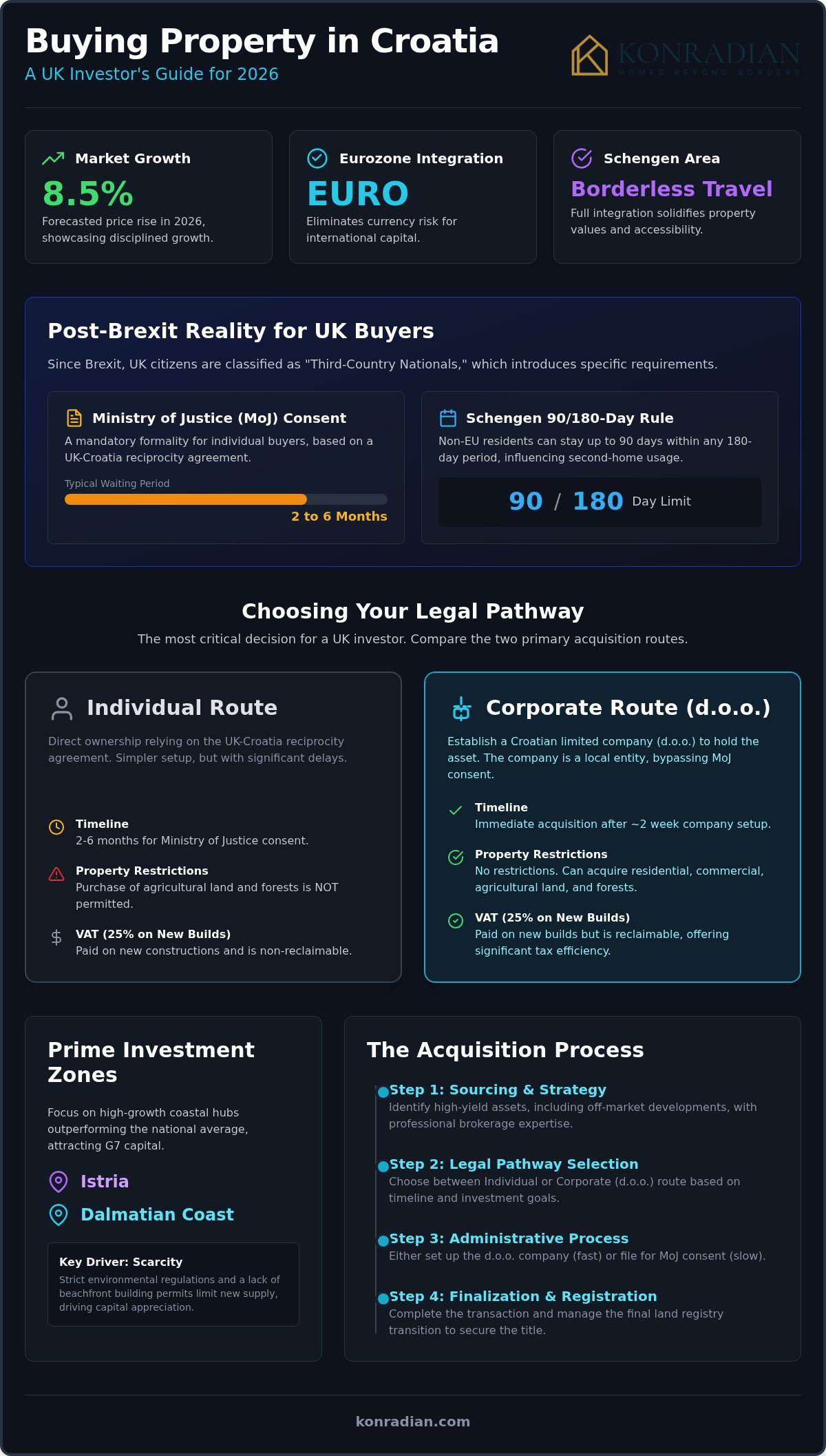
Croatia’s transition into a mature Eurozone market has reached a definitive milestone in 2026. While other Mediterranean regions grapple with volatility, the Croatian property market continues its trajectory of disciplined growth, with prices forecasted to rise by 8.5% this year. This stability is largely the result of the “Schengen Effect,” which has fully integrated the country into Europe’s borderless travel zone, alongside the adoption of the Euro that effectively eliminated currency risk for international buyers. For those considering buying property in Croatia as a UK citizen, these macroeconomic shifts provide a level of security that was previously absent during the pre-accession years.
The Dalmatian coast remains the primary target for G7 capital, driven by a transparent legal framework and Croatia’s economic outlook, which reflects a robust, open economy. The legal bedrock for British acquisitions is the long-standing reciprocity agreement between the UK and Croatia. This agreement ensures that UK nationals enjoy the same rights to purchase residential real estate as Croatian citizens, provided they navigate the post-Brexit administrative requirements correctly. It’s a sophisticated environment where the “emerging market” label has been replaced by institutional-grade reliability.
Why Croatia is the 2026 ‘Safe Haven’ for UK Capital
Political stability and a high level of English proficiency within the professional sectors make Croatia an approachable destination for British investors. The market is currently defined by a sharp imbalance between supply and demand; strict environmental regulations and a scarcity of beachfront building permits have created a natural ceiling on new inventory. This scarcity drives capital appreciation and protects the exclusivity of coastal assets. Croatia stands in 2026 as a premier Eurozone investment hub, offering a unique intersection of Mediterranean lifestyle and institutional-grade financial security.
Brexit and the ‘Third-Country National’ Status
Since the UK’s departure from the European Union, British buyers are classified as “third-country nationals.” This status requires a formal application for consent from the Ministry of Justice (MoJ) before a property title can be fully registered. While the process is a formality due to the reciprocity agreement, it introduces a waiting period that typically spans two to six months. It’s vital to recognize that this right currently extends only to residential and commercial property. Buying property in Croatia as a UK citizen as an individual does not allow for the acquisition of agricultural land or forests under 2026 restrictions. Additionally, owners must manage their time according to the 90/180-day Schengen rule, which limits stays for non-residents to 90 days within any 180-day period, a factor that influences how many use their second homes for seasonal living.
Legal Pathways: Individual vs. Corporate Acquisition
Choosing the correct legal vehicle is the most critical decision for a British investor in the current market. For those considering buying property in Croatia as a UK citizen, the path splits into two distinct legal avenues: individual ownership or corporate acquisition. Each route carries specific implications for your timeline, tax exposure, and future exit strategy. Consulting the official UK guidance on buying property in Croatia confirms that while the right to purchase exists, the administrative burden remains higher for individuals than for EU nationals.
The individual route relies on the principle of reciprocity. While this ensures your right to own residential real estate, it subjects you to a mandatory review by the Ministry of Justice (MoJ). Conversely, the corporate route involves establishing a Croatian limited liability company (d.o.o.) to hold the asset. This structure treats the purchaser as a local entity, bypassing the MoJ consent process entirely. The decision between these routes often dictates the speed and tax efficiency of buying property in Croatia as a UK citizen.
| Feature | Individual Route | Corporate Route (d.o.o.) |
|---|---|---|
| Timeline | 2-6 months for MoJ consent | Immediate (after ~2 week setup) |
| MoJ Consent | Mandatory | Not required |
| RETT (3%) | Applicable on resale properties | Applicable on resale properties |
| VAT (25%) | Paid on new builds; non-reclaimable | Paid on new builds; potentially reclaimable |
The Ministry of Justice (MoJ) Consent Process
Individual buyers must first obtain a Croatian Personal Identification Number (OIB) and a ‘Certificate of Purpose’ from local authorities. Once the Pre-Contract is signed and the deposit paid, the application is submitted to the MoJ. You cannot be registered as the official owner in the Land Registry until this consent is granted. This waiting period requires patience and a contract that protects your interests during the interim months.
Buying via a Croatian d.o.o. (Limited Company)
Seasoned investors frequently prefer the corporate route for its agility. A d.o.o. can acquire property immediately, making it ideal for competitive off-market deals. While there are ongoing costs for accounting and a registered office, the ability to reclaim the 25% VAT on new-build developments often offsets these expenses. We suggest reading our legal support buying property abroad guide for deeper due diligence on corporate structuring. While these paths are well-trodden, selecting the one that aligns with your long-term tax strategy is where bespoke Croatian property acquisition support becomes invaluable.
Strategic Locations: Where UK Citizens are Buying in 2026
Identifying the right micro-location is as vital as the legal structure itself. While the entire Adriatic coast offers aesthetic appeal, the financial performance of these regions varies significantly based on infrastructure and seasonal demand. For those buying property in Croatia as a UK citizen, the 2026 market presents a clear divide between the high-yield urban hubs of Dalmatia and the lifestyle-driven estates of Istria. Selecting a location requires a balance between personal utility and the asset’s eventual liquidity in a Eurozone market.
Istria vs. Dalmatia: A Yield Comparison
The Dalmatian coast, particularly the historic centers of Split and Trogir, continues to command the highest rental yields. Investors currently see net rental yields between 5% and 7% for well-positioned apartments in Split’s old town. This performance is bolstered by the ‘digital nomad’ visa, which has extended the traditional tourist season into a year-round occupancy model. Conversely, the capital growth projections for Istria real estate for sale are driven by the premium villa sector. Istria, often called the ‘New Tuscany,’ attracts a demographic seeking privacy and proximity to Central Europe, making it a stable choice for long-term wealth preservation.
Beyond the mainland, the islands of Hvar and Brač remain the crown jewels of the Adriatic. In 2026, we’ve observed a trend toward ‘sustainable luxury’ on these islands, where properties with eco-certified credentials are appreciating faster than standard builds. For those seeking a growth play, the Zadar region has emerged as a strategic alternative. With its expanded airport capacity and lower entry prices compared to Dubrovnik, Zadar offers significant upside potential for investors entering the market this year.
The Luxury Villa Market in 2026
The 2026 luxury sector is defined by a preference for two distinct styles: meticulously restored authentic stone houses and modern architectural masterpieces. Regardless of the style, a ‘sea view’ remains the single most important factor for liquidity. Properties without a clear vista of the Adriatic face longer days on market and lower appraisal values. Infrastructure updates have also played a decisive role; new flight connections from major UK hubs to Zadar and Pula have directly correlated with rising property values in those catchment areas.
Before finalizing a location, it’s wise to review the UK Government Guidance for Living in Croatia to understand how residency might influence your choice of a primary or secondary home. While the allure of a remote island retreat is strong, urban centers often provide more robust legal and property management support. Balancing these lifestyle desires with the practicalities of buying property in Croatia as a UK citizen ensures your investment remains a source of tranquility rather than a logistical burden.
The Acquisition Process: A Step-by-Step for UK Buyers
The transition from identifying a target asset to holding the keys is a methodical progression. While the legal structures discussed previously provide the framework, the actual acquisition sequence is where professional stewardship becomes most tangible. For those buying property in Croatia as a UK citizen, the process begins far before any contracts are signed. High-value Adriatic real estate often moves through private networks and direct developer relationships, meaning the most strategic opportunities rarely reach public listing portals. Securing these off-market deals requires a local presence that understands the rhythm of the Croatian market.
Once a property is selected, the first formal step is the Pre-Contract, or Predugovor. This document outlines the terms of sale and is typically secured with a 10% deposit. In the Croatian system, this deposit serves as a guarantee; if the seller withdraws, they’re legally required to pay the buyer double the deposit amount. It’s a robust mechanism that provides immediate security. However, this stage must be preceded by exhaustive due diligence. Verifying the Uporabna Dozvola (Usage Permit) and ensuring the title is “clean” and free from historical restitution claims is non-negotiable for protecting your capital.
From OIB to Key Handover
- 1. Obtain your OIB: Your Personal Identification Number is the prerequisite for all legal actions, from signing contracts to connecting utilities.
- 2. Open a Non-Resident Account: A local bank account ensures secure fund transfers and simplifies the payment of future taxes and fees.
- 3. Engage the Public Notary: The Javni Bilježnik witnesses the signing of the Final Contract, ensuring all signatures are authentic and legally binding.
- 4. Register the Title: The final step involves submitting the contract to the Land Registry (Zemljišne Knjige) to officially record your ownership.
Avoiding Common Pitfalls for Foreigners
One of the most frequent traps for international investors is the ‘Usage Permit’ oversight. Buying a property without a final Uporabna Dozvola can lead to significant complications with future sales or rental licensing. Similarly, the history of land ownership in Croatia means that a ‘Clean Title’ must be verified back through several generations to ensure no unresolved claims exist. You can compare these specific international risks to our UK property sourcing service to see how we apply the same level of institutional rigor to mitigate risk across different markets. If you are ready to secure your Adriatic asset without the logistical burden, our team is ready to facilitate your Croatian property acquisition from start to finish.
Why UK Citizens Choose Konradian for Croatian Acquisition
Buying property in Croatia as a UK citizen shouldn’t be a source of administrative anxiety or logistical friction. At Konradian, we transform a complex cross-border transaction into a seamless acquisition experience characterized by quiet confidence and professional stewardship. Our approach is rooted in institutional-grade analysis, led by an LSE-educated team that understands the intersection of international capital and local legal nuances. We serve as your protective partner, handling the heavy lifting from the initial search in London to the final title registration on the Adriatic coast.
Our business model is built on transparency and alignment with your interests. Unlike many UK-based sourcing firms that charge substantial upfront fees, Konradian operates on a zero-cost model for the buyer. Our commissions are paid by the sellers and developers, ensuring our world-class advisory services remain accessible without adding to your capital outlay. This structure allows you to allocate your full investment toward the asset itself, maximizing your potential for long-term appreciation in one of Europe’s most stable Eurozone markets.
The Konradian Difference: Sophistication in Sourcing
We don’t just find properties; we identify strategic assets that meet rigorous capital growth KPIs. Our team filters the market to find developments that offer the best long-term liquidity and rental performance. Because of our direct relationships with top-tier Adriatic developers, we provide our clients with exclusive access to off-market opportunities that never reach public portals. This “first-look” advantage is crucial in a market where prime beachfront permits are increasingly rare. Beyond the transaction, we coordinate a network of English-speaking legal and financial experts, ensuring every detail of buying property in Croatia as a UK citizen is handled with precision.
Securing Your Croatian Future Today
The 2026 market presents a definitive window of opportunity. With property values continuing their disciplined upward trajectory, entering the market now secures your position before further appreciation occurs. Whether you’re seeking a luxury villa in Istria for personal use or a high-yield rental hub in Dalmatia, the right strategy makes all the difference. We invite you to Schedule a Strategic Consultation for Croatian Property to begin your acquisition journey. During this free video consultation, we’ll provide a tailored overview of the current landscape and outline how our end-to-end stewardship can secure your Adriatic future.
Securing Your Adriatic Legacy in 2026
The transition of the Adriatic coast into a mature Eurozone asset class has created a unique window for British capital. We’ve explored how the dual integration of Schengen and the Euro has stabilized property values while providing a level of security previously unseen in the region. Whether you choose the individual route or the accelerated corporate structure, success in buying property in Croatia as a UK citizen now requires a sophisticated approach that balances local regulatory requirements with long-term capital growth KPIs.
At Konradian, we provide the elite expertise necessary to navigate these complexities with ease. Our LSE-educated advisors offer exclusive developer pre-sale access and leverage over five years of Adriatic market expertise to handle every detail of your acquisition from start to finish. If you’re ready to secure a high-yield coastal asset, we invite you to Book a Free Strategic Consultation for Croatian Property Acquisition. Your journey toward a tranquil Mediterranean retreat begins with a single, professional conversation. We look forward to helping you build your legacy under the Croatian sun.
Frequently Asked Questions
Can a UK citizen buy property in Croatia post-Brexit?
Yes, UK citizens retain the right to acquire residential and commercial property based on a long-standing reciprocity agreement. Since the UK is now a third-country, you must obtain formal consent from the Ministry of Justice (MoJ). This process confirms that the reciprocity agreement is active and allows for the final registration of your title in the Land Registry. It’s a standard administrative step for all British investors.
Do I need a visa to stay in my Croatian property as a UK citizen?
UK nationals don’t require a visa for short stays, but you must adhere to the 90/180-day Schengen rule. If you wish to stay longer, you can apply for a temporary residence permit based on property ownership. This permit is typically valid for one year and is non-renewable, requiring you to live in the property and restricting your total stay in Croatia to six months at a time.
What is the Real Estate Transfer Tax (RETT) in Croatia for 2026?
The Real Estate Transfer Tax is currently 3% of the property’s market value for all resale properties. For new-build properties purchased from a developer within the VAT system, a 25% VAT rate applies instead of the RETT. This VAT is typically included in the advertised purchase price. Understanding these tax distinctions is vital for accurately calculating the total capital requirement for your Adriatic investment.
Is it better to buy property in Croatia as an individual or through a company?
The optimal choice depends on your investment timeline and tax strategy. Individual ownership is straightforward for lifestyle buyers but involves a multi-month wait for Ministry of Justice consent. Conversely, buying property in Croatia as a UK citizen through a limited company (d.o.o.) allows for immediate acquisition and potential VAT recovery on new developments. This corporate route is frequently chosen by those seeking agility and tax efficiency.
How long does it take for a UK citizen to get Ministry of Justice approval?
The approval process currently takes between two and six months. While the reciprocity agreement ensures that consent will be granted, the administrative processing time is a mandatory requirement for all third-country nationals. Ensuring your documentation, such as the OIB and Certificate of Purpose, is perfectly prepared is the most effective way to avoid unnecessary delays during this period of the acquisition.
Can I get a mortgage in Croatia as a UK national?
Securing a mortgage from a Croatian bank as a non-resident with foreign income remains challenging in 2026. Most British buyers choose to utilize private funds or arrange financing through international lenders in the UK before beginning their search. We recommend having your capital ready or pre-approved, as the most desirable coastal properties often attract competitive offers from cash-ready international investors.
What are the hidden costs of buying property in Croatia?
Beyond the purchase price and taxes, you should budget for legal fees, which typically range from 1% to 1.5% of the property price. Notary fees and administrative costs for the Land Registry generally fall between €200 and €800. While agency commissions are often 2% to 3%, our model ensures these are handled without additional cost to you, providing a more transparent financial path to ownership.
Is Konradian’s service really free for the buyer in Croatia?
Yes, our end-to-end acquisition support is provided at no cost to the buyer. We operate on a seller-paid commission model, which means you receive our LSE-educated strategy and exclusive access to off-market developments without paying a sourcing fee. This ensures that buying property in Croatia as a UK citizen remains a high-value experience where our interests are fully aligned with yours in securing premium Adriatic assets.
