


With Spanish property prices projected to climb by 9.3% in 2026, more than double the European average, the window for a high-yield entry is narrowing just as the regulatory landscape becomes its most complex. You’ve likely noticed that the dream of Mediterranean ownership now requires navigating a dense thicket of Spanish bureaucracy and the recent termination of the Golden Visa program. It’s understandable to feel a sense of hesitation when faced with rumors of tax shocks or the realization that most local agents are legally bound to the seller’s interests, not yours.
This guide simplifies the process of buying property in Spain as a US citizen by providing an elite, strategic framework for 2026. We’ll show you how to secure a flawless legal title while optimizing your tax exposure against the current 24% non-resident rate. You’ll discover how to bypass market noise to access exclusive pre-sale developer opportunities and manage the mandatory NIE process with precision. From understanding the 2.855% Euribor impact to navigating local IBI obligations, we’re providing the professional stewardship necessary to transform a complex international transaction into a seamless transition for your portfolio and your lifestyle.
Key Takeaways
- Understand the 2026 market dynamics and why buying property in Spain as a US citizen remains a high-yield strategy despite the termination of the Golden Visa program.
- Master the essential legal architecture of an acquisition, from securing your mandatory NIE tax number to navigating the critical protections within a Contrato de Arras.
- Discover how to access exclusive pre-sale developer opportunities that provide modern efficiency standards and 10-year structural guarantees before they reach the general market.
- Learn the “12% rule” for budgeting closing costs and how to distinguish between ITP and VAT to ensure your capital is deployed with maximum efficiency.
- Evaluate the strategic necessity of buyer-side representation to counteract traditional seller-biased models and secure your long-term interests in a foreign jurisdiction.
The 2026 Spanish Real Estate Landscape: Strategic Navigation for US Citizens
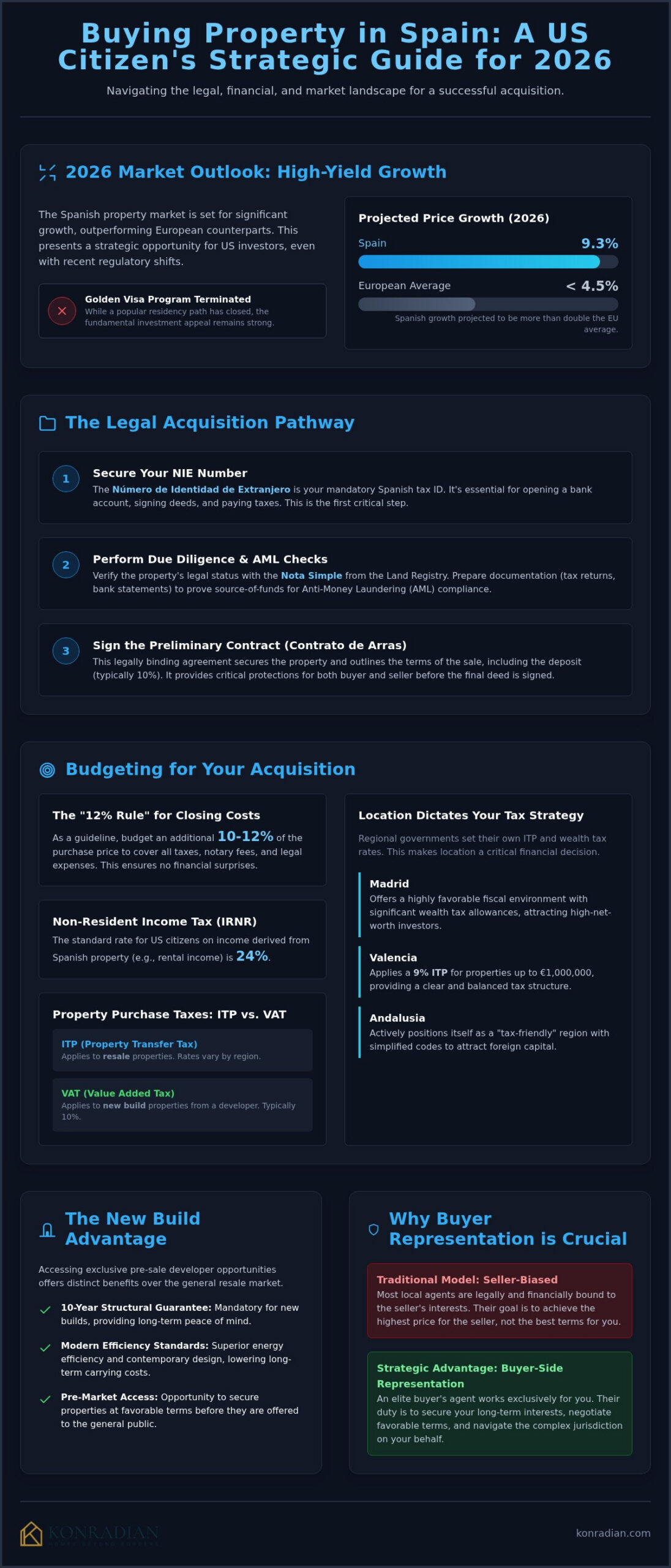
The Spanish property market in 2026 has transitioned into a phase of regulated, high-quality growth, moving away from the volatile surges of the early decade. For those considering buying property in Spain as a US citizen, this evolution offers a more predictable environment for capital preservation. Understanding the history of the Spanish real estate market reveals a consistent resilience that continues to attract sophisticated American wealth. With national price growth projected at 9.3% for 2026, the market is significantly outperforming the European average, driven by limited supply and sustained international demand.
The Impact of the 2026 Housing Reform Proposals
Recent legislative discussions have sparked concerns regarding a “tax shock” for non-EU investors. It’s vital to distinguish between sensationalist headlines and legislative reality. Current draft bills focus primarily on curbing speculative “flipping” in over-saturated urban centers rather than penalizing legitimate long-term investors. While some competitors highlight rumors of a 100% tax on certain foreign transactions, the European Commission is currently challenging Spain’s existing non-resident tax structures to ensure fairness. Clinical, expert analysis suggests that most US buyers will find the 24% Non-Resident Income Tax (IRNR) remains the standard, provided their acquisition is managed with professional stewardship. Our LSE-educated team monitors these shifts daily to ensure your investment remains shielded from administrative friction.
Regional Variations: Why Location Dictates Your Tax Strategy
Spain doesn’t operate as a monolithic tax jurisdiction. Regional autonomy allows different communities to set their own Property Transfer Tax (ITP) and wealth tax thresholds, making location choice a critical part of your financial strategy. A one-size-fits-all approach often leads to unnecessary fiscal leakage. Consider the following regional distinctions:
- Madrid: Traditionally maintains a more hospitable fiscal environment with significant allowances for wealth tax, making it a preferred hub for high-net-worth individuals.
- Valencia: As of June 2026, applies a 9% ITP for properties up to €1,000,000, balancing lifestyle appeal with a clear tax structure.
- Andalusia: Continues to position itself as a “tax-friendly” zone, having recently simplified its regional tax codes to attract international capital.
Successfully buying property in Spain as a US citizen requires an international mindset that looks beyond the purchase price. You must evaluate how regional autonomy impacts your long-term carrying costs. By aligning your acquisition with regions that prioritize fiscal hospitality, you turn a lifestyle purchase into a sophisticated global asset. This level of strategic mapping ensures that the complexity of Spanish bureaucracy never overshadows the tranquility of your new Mediterranean residence.
The Legal Architecture of Spanish Property Acquisition
Navigating the legal framework of a foreign jurisdiction requires more than just compliance; it demands a proactive strategy to protect your capital. When buying property in Spain as a US citizen, the process follows a structured sequence designed to provide transparency, provided you have the right oversight. This journey begins with the NIE (Número de Identidad de Extranjero), your essential Spanish tax identification number. Without this, you cannot open a local bank account, sign a deed, or pay taxes. While the application can be handled via a Spanish consulate in the U.S., many of our clients prefer to authorize us via power of attorney to secure it locally, ensuring no delays in the transaction timeline.
Essential Documentation for US Buyers
Modern acquisition in 2026 requires rigorous attention to detail, particularly regarding anti-money laundering (AML) protocols. Spanish banks and notaries perform deep source-of-funds checks on transfers originating from the United States. You’ll need to provide clear documentation, such as tax returns or brokerage statements, to satisfy these requirements. Simultaneously, we verify the Nota Simple, a document from the Land Registry that confirms the seller’s title and identifies any outstanding liens. Ensuring this is current is the baseline for any secure acquisition.
Once the property is verified, the Contrato de Arras (earnest money agreement) is signed, typically requiring a 10% deposit that legally binds both parties to the sale. If the seller defaults, they are generally required to return double your deposit, offering a unique protection compared to US contracts. This step effectively removes the property from the market while final preparations for the deed are made.
The Role of the Spanish Notary vs. Your Independent Counsel
It’s a common misconception among American buyers that the Spanish Notary performs the same function as a US title company or closing attorney. In reality, the Notary is a public official who witnesses signatures and ensures taxes are paid, but they do not perform comprehensive due diligence on your behalf. This makes independent legal support buying property abroad an absolute necessity to uncover hidden liabilities or zoning issues.
The Escritura is the definitive proof of ownership in Spain, signed before the Notary and later recorded in the Land Registry (Registro de la Propiedad). This final registration provides the ultimate legal shield against third-party claims. For those buying property in Spain as a US citizen, our team provides expert transaction oversight that bridges the gap between Spanish law and American expectations, ensuring every administrative detail is handled with precision.
New Build vs. Resale: Strategic Selection and Pre-Sale Access
Deciding between a contemporary new build and a character-filled resale property is a pivotal moment when buying property in Spain as a US citizen. Resale homes offer immediate entry into established neighborhoods and often carry a lower tax burden through the Property Transfer Tax (ITP), which typically ranges from 7% to 10% depending on the region. Conversely, new builds appeal to those prioritizing modern efficiency and structural peace of mind. These properties come with a mandatory 10-year structural guarantee, known as the Seguro Decenal, protecting your investment against significant defects from the moment of completion.
The Financial Logic of Off-Plan Acquisitions
Off-plan acquisitions present a compelling case for capital appreciation. By securing a unit during the early construction phases, investors often benefit from value increases as the development nears completion. To mitigate risk, Spanish law requires developers to provide an Aval Bancario, which is a bank guarantee that secures your staged payments. This ensures your capital is protected even if the developer faces insolvency. Accessing these premium opportunities often requires professional stewardship. We facilitate Spanish Property Acquisition by leveraging direct developer relationships, giving our clients access to pre-sale inventory before it reaches public portals.
Resale Risks: Hidden Liabilities and Structural Integrity
While resales offer historical charm, they require deeper technical scrutiny. Properties over 45 years old must pass the Inspección Técnica de Edificios (ITE), a mandatory structural health check. It’s also vital to verify the property hasn’t incurred urbanistic infractions, particularly in coastal areas where strict environmental laws can lead to legal challenges. For American buyers, the Contrato de Arras carries even more weight in the resale market. It serves as your primary defense, ensuring the seller is financially penalized if they attempt to withdraw from the sale or if undisclosed debts emerge during the final stages of due diligence. Our role is to ensure these risks are neutralized long before you reach the notary’s office.
Calculating the Total Cost of Acquisition: Taxes and Fees
A successful acquisition requires a clinical understanding of the total capital outlay. When buying property in Spain as a US citizen, a reliable rule of thumb is to budget approximately 12% of the purchase price for closing costs. This strategic buffer covers the primary purchase tax, administrative fees, and legal registration, ensuring no liquidity surprises at the point of signing. While the purchase price is the most visible figure, the underlying fiscal structure determines the true efficiency of your investment.
Taxes on Resale Property (ITP) for US Citizens
For resale properties, the primary cost is the Property Transfer Tax (ITP). Regional autonomy means rates vary significantly across the country. For instance, the Valencian Community applies a 9% rate for properties up to €1,000,000 as of June 2026, while the Murcia region maintains a general rate of 8%. A critical factor for US buyers is the Valor de Referencia, which is the tax office’s own valuation of the property. If your purchase price is lower than this official value, the government may demand tax based on their higher estimate. Our strategic oversight includes verifying these valuations early to prevent overpayment or future audits that could disrupt your financial planning.
Taxes on New Build Property (IVA & AJD)
New construction follows a different fiscal path. Instead of ITP, you’ll pay a national Value Added Tax (IVA) of 10% on residential properties. Additionally, you must account for Stamp Duty (AJD), which varies by location. In the Costa Blanca, AJD is currently 1.4%, whereas it reaches 1.5% in the Costa Cálida. AJD is calculated based on the mortgage and purchase value of the property. These costs are fixed and predictable, making new builds an attractive option for investors who prefer absolute fiscal transparency from the start of the project.
Beyond the initial tax, the administrative tail includes Notary fees for the public deed, Land Registry fees for title protection, and Gestoría fees for tax filing. Once you’re an owner, annual obligations include the Local Property Tax (IBI), ranging from 0.4% to 1.1%, and the Non-Resident Income Tax (Modelo 210) at a 24% rate. Managing these layers of bureaucracy is often where American investors encounter the most friction. To ensure your investment is structured for maximum efficiency and security, you should partner with an elite buyer’s representative who handles these complexities as part of a seamless, end-to-end service.
The Konradian Advantage: Elite Buyer Representation for Americans
The traditional Spanish real estate model is fundamentally built to favor the seller. Most local agencies operate on a listing-driven basis, meaning their primary fiduciary duty is to achieve the highest possible price for the property owner. For those buying property in Spain as a US citizen, this creates a significant conflict of interest that can lead to overpayment or overlooked legal risks. Konradian disrupts this dynamic by providing elite buyer-side advocacy. Our team, educated at the London School of Economics (LSE), brings a level of intellectual rigor and strategic market savvy that is rare in the local brokerage landscape. We act as your protective partner, ensuring that your interests are prioritized throughout the entire transaction.
Because developers and sellers pay the commission, you receive premium advisory and comprehensive legal and financial transaction support at no direct cost to you. This model allows us to remain objective and focused exclusively on the quality and security of your acquisition. With over 5 years of international real estate experience, we understand how to bridge the gap between American expectations and Spanish administrative realities.
Exclusive Access and Developer Relationships
Accessing the best opportunities requires looking beyond public listing portals. Many of the most desirable units in high-demand zones are sold before they ever reach the open market. We leverage direct relationships with top-tier developers to provide our clients with exclusive pre-sale access. This bypasses the delays and competition found on public sites, allowing you to secure assets with the highest potential for appreciation. This proactive approach is particularly valuable for sophisticated investors who are also managing US real estate investment from Europe and require a diversified, global portfolio.
A Seamless, Stress-Free Acquisition Process
We provide end-to-finish stewardship that transforms a complex international transaction into a refined, manageable experience. Our “Quiet Confidence” approach means we handle the heavy lifting, coordinating with legal, financial, and administrative experts so you don’t have to manage the friction of Spanish bureaucracy. From the initial strategy session to the final key handover, our involvement is comprehensive. We ensure that every document is verified and every tax obligation is optimized before you even step foot in the notary’s office. This methodical flow ensures transparency and builds trust at every stage of the process.
If you’re ready to secure your Mediterranean asset with professional precision, schedule your free video consultation with Konradian today. We’ll discuss your specific goals and begin mapping out a secure, high-yield strategy for buying property in Spain as a US citizen that is tailored to your unique lifestyle and financial requirements.
Securing Your Mediterranean Future with Strategic Precision
The landscape for buying property in Spain as a US citizen in 2026 is defined by high-growth potential and sophisticated regulatory layers. Success in this market requires more than just capital; it demands a clinical understanding of regional tax variations and the foresight to secure exclusive pre-sale opportunities before they reach the public domain. By prioritizing legal security through comprehensive due diligence and mastering the closing cost structures, you’re transforming a complex international transaction into a stable, high-yield asset.
Konradian provides the professional stewardship necessary to navigate this transition with ease. Our LSE-educated advisors offer global market expertise and direct access to top-tier developments, ensuring your interests are protected at every stage. We handle the administrative friction and coordinate all legal and financial transaction support at no additional cost to you. This end-to-finish oversight allows you to focus on the lifestyle benefits of your acquisition while we secure the intellectual and legal integrity of your investment.
Begin your Spanish property journey with a free expert consultation and discover the peace of mind that comes from elite, buyer-focused representation. Your path to a secure and sophisticated European residence starts with a partner who prioritizes your long-term interests.
Common Questions Regarding Spanish Property Acquisition
Can I buy property in Spain remotely from the US without traveling?
Yes, buying property in Spain as a US citizen can be handled entirely from the United States through a Power of Attorney. You’ll need to grant this authority to a trusted representative in Spain, typically a legal professional, who can sign the public deed on your behalf. This process includes obtaining your mandatory NIE tax number and opening a local bank account. We coordinate these administrative steps remotely to ensure a seamless transaction without the need for international travel.
What is the current status of the Spanish Golden Visa in 2026 for Americans?
The real estate investment route for the Spanish Golden Visa was officially terminated for new applications on April 3, 2025. While you can no longer gain residency solely through a €500,000 property purchase, Spain remains highly accessible for Americans. Many investors now utilize the Digital Nomad Visa, which requires a monthly income of approximately €2,500 to €2,850, or the Non-Lucrative Visa for those seeking a lifestyle change without local employment.
Is there really a 100% tax for non-resident property buyers in Spain?
There is no 100% purchase tax for non-residents in Spain; this is a common misinterpretation of draft bills aimed at curbing speculative urban “flipping.” The actual tax landscape for 2026 remains stable for long-term investors. Non-residents from the US are subject to a 24% Non-Resident Income Tax (IRNR) on imputed income. Our role is to provide the intellectual rigor necessary to distinguish legislative reality from market rumors, protecting your capital from unnecessary alarm.
How much should I budget for closing costs in Spain as a US citizen?
You should budget approximately 12% of the purchase price to cover all taxes and administrative fees. This figure includes the primary purchase tax, Notary fees, Land Registry costs, and legal registration. When buying property in Spain as a US citizen, it’s vital to account for regional variations in Stamp Duty (AJD), which ranges from 1.4% to 1.5% in popular coastal zones. This conservative estimate ensures you have sufficient liquidity for a smooth closing.
Do I need a Spanish lawyer if I am already using a real estate agency?
You absolutely need independent legal representation because traditional Spanish agencies are legally and financially bound to the seller. While an agency facilitates the search, only a dedicated buyer’s advocate ensures the property is free of liens and urbanistic infractions. We provide full legal and financial transaction support as part of our end-to-end service. This ensures your interests are prioritized by experts who aren’t incentivized by the seller’s commission alone.
What happens if I buy a Spanish property with hidden debts or urbanistic issues?
In Spain, debts such as unpaid property taxes (IBI) or community fees are attached to the property itself, not the previous owner. If you acquire a property with hidden liabilities, you become responsible for settling them. This makes the Nota Simple and the ITE structural check non-negotiable components of due diligence. We perform these rigorous checks before any deposit is paid, shielding your portfolio from the financial consequences of a seller’s undisclosed debts.
How does Konradian offer its services at no cost to the buyer?
We provide our sophisticated advisory and transaction support at no direct cost to the buyer because our fees are covered by seller-paid commissions. This model allows you to benefit from our LSE-educated expertise and direct developer relationships without increasing your acquisition budget. It’s a strategic advantage that grants you elite representation and exclusive pre-sale access, ensuring you receive premium stewardship while the developer or seller handles the professional compensation.
What is the difference between ITP and IVA for US buyers in 2026?
The primary difference lies in the property type and the specific tax authority. ITP is a regional Property Transfer Tax applied to resale homes, with rates typically between 8% and 10%. Conversely, IVA is a national 10% Value Added Tax applied exclusively to new construction. While new builds also incur a regional Stamp Duty (AJD), resales do not. Understanding this distinction is essential for accurately calculating your total capital requirement during the selection process.
