


You don’t need a decade of American credit history to secure a premium US mortgage. In fact, your UK financial profile is often more than enough to unlock the 2026 market. Many sophisticated investors feel paralyzed by the perceived wall of American bureaucracy, fearing that hidden FIRPTA withholdings or the lack of a US credit score will stall their ambitions of buying property in the US from UK shores. It’s a common concern, especially when you’re trying to manage a high-stakes transaction from six time zones away while navigating complex transatlantic tax rules.
Mastering this market requires a strategic shift toward a more sophisticated, concierge-led approach. This guide provides a definitive roadmap to building a high-yield American portfolio with total confidence. We’ll explore how modern Debt Service Coverage Ratio (DSCR) loans have replaced traditional credit requirements, ensuring your investment’s potential speaks louder than your zip code. You’ll gain clarity on the latest 2026 tax regulations, access to exclusive pre-sale developer inventory, and a blueprint for a seamless, hands-off acquisition process. From initial sourcing to final closing, we’re here to ensure your transition into the US market is as rewarding as it is refined.
Key Takeaways
- Learn how to utilize specialized Foreign National mortgage programs to secure US financing based on property yield rather than a domestic credit score.
- Navigate the complexities of FIRPTA and HMRC reporting with a clear roadmap for tax-efficient ownership structures, including the strategic use of US LLCs.
- Master the logistical steps of buying property in the US from UK, including the mandatory ITIN application and remote closing procedures.
- Leverage the intellectual rigor of LSE-educated advisors to access exclusive, pre-sale developer inventory through a dedicated “no cost to buyer” acquisition model.
Why UK Investors are Targeting US Real Estate in 2026
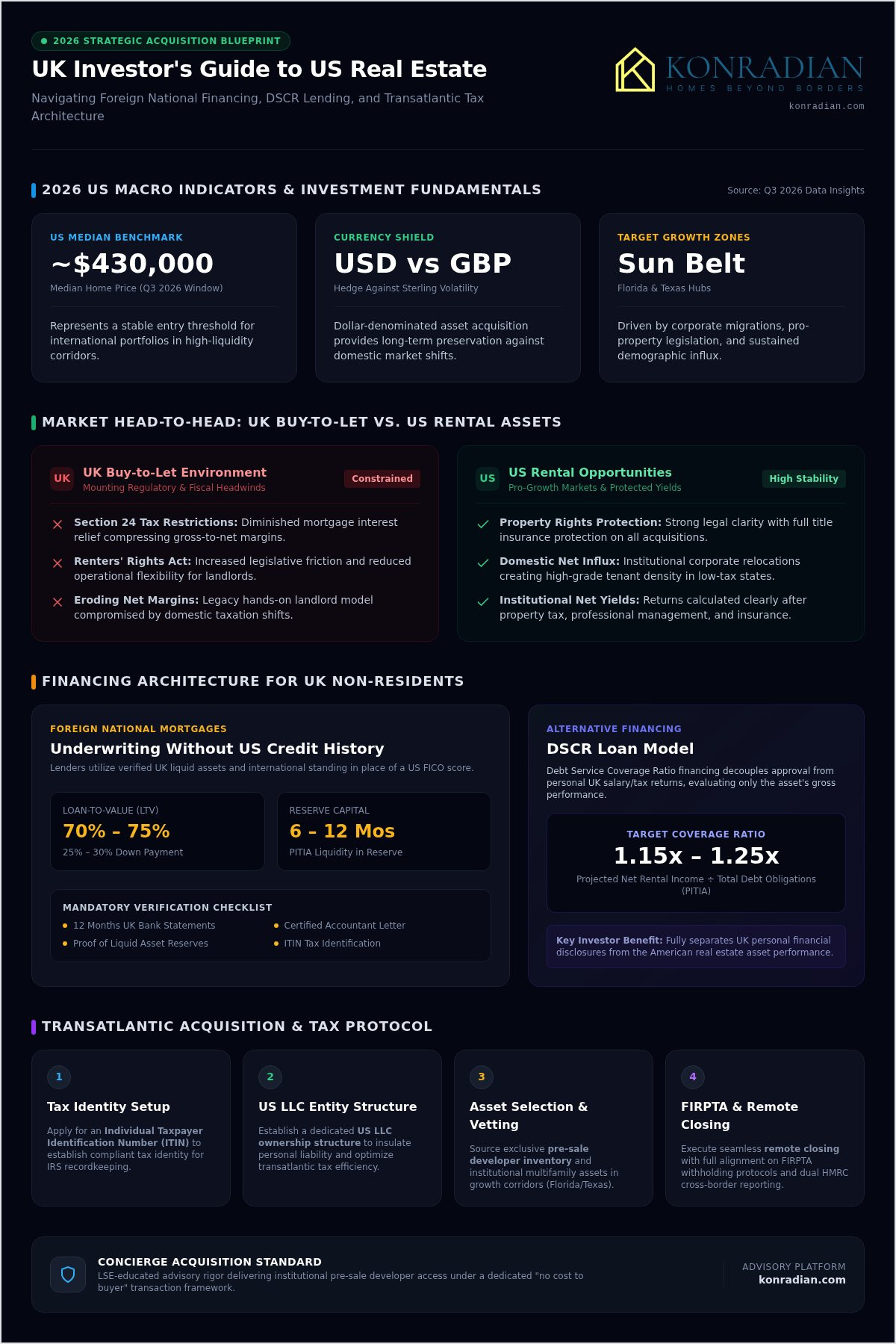
British capital is increasingly crossing the Atlantic as domestic headwinds reshape the investment landscape. For those considering buying property in the US from UK shores, the motivation isn’t just about geography; it’s a calculated move toward currency stability and regulatory ease. In 2026, the US Dollar continues to serve as a formidable hedge against Sterling volatility. This currency play, combined with the sheer scale of the American market, positions the US as the ultimate safe haven for capital that feels increasingly constrained at home.
We’ve observed a profound psychological shift among sophisticated investors recently. The old model of the hands-on landlord is being replaced by a preference for elite, managed international portfolios. Investors no longer feel the need to be within driving distance of their assets. Instead, they’re prioritizing markets like the Sun Belt, where multifamily developments and single-family rentals offer institutional-grade stability. For those interested in exploring the hospitality sector, click here to view restaurant opportunities in California. This transition is supported by a robust infrastructure of professional stewardship, allowing UK professionals to build wealth without the daily friction of property management.
Yield Comparison: UK Buy-to-Let vs. US Rental Markets
UK buy-to-let has become a gauntlet of tax restrictions and tenant-focused reforms. Provisions like Section 24 and the Renters’ Rights Act have significantly eroded the profitability that once made domestic property a staple of a British portfolio. By contrast, high-demand US markets like Florida and Texas benefit from massive domestic net migration and a legal framework that respects property rights. To clarify the math for international buyers, Net Yield in a US context is the annual rental profit remaining after all operating costs, including property taxes, management fees, and title insurance protection, are deducted from the gross receipts.
The 2026 US Market Outlook for Foreign Nationals
The 2026 horizon looks particularly bright for foreign nationals targeting key investment hubs. We’re seeing a massive institutional migration where major corporations are relocating to low-tax states, bringing a steady stream of high-quality tenants with them. This isn’t a speculative bubble; it’s a structural realignment of the American workforce. Buying property in the US from UK locations allows investors to capture this growth in multifamily and single-family sectors before prices fully reflect the long-term shift. With US median home prices holding steady in the $430,000 range as of Q3 2026, this year represents a strategic window to acquire prime assets in high-liquidity corridors. While many investors focus on the Sun Belt, specialized markets such as the Mountain West also offer unique opportunities; for instance, you can learn more about Colorado Horse Property to see how equestrian estates can enhance a global portfolio. Our team applies the intellectual rigor of an LSE-educated background to vet these opportunities, ensuring every acquisition aligns with a sophisticated global strategy.
Financing Your US Purchase: Mortgage Options for UK Residents
Accessing capital as a non-resident is simpler than most assume. While traditional US banks often demand a domestic credit history, specialized “Foreign National” mortgage programs bypass this requirement entirely. These lenders understand that your primary financial footprint is in the UK. Instead of a US FICO score, they rely on your international credit reputation and verified liquid assets. When buying property in the US from UK, you should anticipate a Loan-to-Value (LTV) ratio between 70% and 75%. This necessitates a 25% to 30% down payment, providing a solid equity cushion that lenders find reassuring in 2026.
To facilitate this, you’ll need an Individual Taxpayer Identification Number (ITIN). This acts as your tax identity in the States, ensuring compliance with IRS FIRPTA withholding requirements during future disposals, a vital step when buying property in the US from UK. Documentation is straightforward but precise. US lenders typically require twelve months of UK bank statements, a letter from your accountant, and proof of liquid reserves. Most programs mandate six to twelve months of mortgage payments (PITIA) held in an accessible account to ensure security.
DSCR Loans: Financing Based on Property Income
Debt Service Coverage Ratio (DSCR) loans represent a strategic pivot for the passive investor. Rather than scrutinizing your personal UK salary or tax returns, lenders focus on the asset’s ability to pay for itself. If the projected rental income covers the mortgage and expenses by a factor of 1.15x to 1.25x, the loan is often approved. It’s an elegant solution that separates your personal liability from the investment’s performance. This allows you to scale a portfolio based on market data and yield rather than your personal borrowing capacity in the UK.
Alternative Financing: Cash Purchases and Bridge Loans
In competitive markets like Miami or Austin, cash remains the ultimate lever. Operating as a cash buyer can often secure a price reduction or priority in a multi-offer scenario. For those looking to move quickly on pre-sale assets, bridge loans offer a temporary, interest-only solution until long-term financing is secured. For a deeper look at capital allocation, our US Real Estate Investment from Europe guide offers further insights. If you’re ready to explore these bespoke financing routes, our team can coordinate your financial pre-qualification with specialized lenders who cater to our international clientele.
Navigating Legal and Tax Obligations: FIRPTA and HMRC
Managing the legal landscape of a transatlantic acquisition requires a proactive stance on tax efficiency. For those buying property in the US from UK, the structural choice often begins with the US Limited Liability Company (LLC). This entity provides a robust shield against personal liability while offering flexible tax treatment. However, it’s vital to coordinate this with UK advisors, as HMRC often views a standard US LLC as an opaque corporation rather than a transparent partnership. Our team leverages its LSE-educated background to help you navigate these nuances, ensuring your structure aligns with both US federal requirements and UK domestic rules.
A significant point of concern for international investors is the Foreign Investment in Real Property Tax Act (FIRPTA). While often portrayed as an unavoidable hurdle, FIRPTA is essentially a 15% withholding tax on the gross sales price when a foreign person disposes of US real property. It’s important to understand that this withholding applies when you eventually sell the asset, not at the point of purchase, unless the seller is also a foreign national. By filing the correct documentation and leveraging the US-UK Double Taxation Treaty, you can often reconcile these amounts against your final tax liability, preventing the “trap” many fear.
The security of your transaction is further guaranteed through the use of escrow accounts and title insurance. In the US, funds are held by a neutral third party until all contractual obligations are met, providing a level of protection that mitigates the risks of remote transactions. This methodical approach ensures that every dollar is accounted for and that the transfer of ownership is legally unassailable.
UK Tax Reporting for US Rental Income
Your obligations don’t end at the US border. As a UK resident, you must declare your worldwide income to HMRC through the annual Self Assessment process. You should familiarize yourself with the UK rules on foreign property income to ensure full compliance. Fortunately, the double taxation treaty allows you to claim Foreign Tax Credits. This means you can typically credit the federal taxes paid in the US against your UK tax bill on the same income, ensuring you aren’t taxed twice on your American yields. We recommend consulting with our vetted cross-border tax specialists to optimize these filings and protect your net returns.
Title Insurance and Closing Costs
In the US, title insurance is a non-negotiable protection that guards against historical liens or ownership defects. You should budget for closing costs ranging from 3% to 5% of the purchase price, which cover title searches, recording fees, and legal oversight. While UK Stamp Duty is a direct tax on the transaction value, US closing costs are primarily service-based fees that ensure the legal integrity of your acquisition. This investment in due diligence provides the peace of mind necessary when buying property in the US from UK, shielding your portfolio from unforeseen claims against the property.
A Step-by-Step Guide to Buying US Property from the UK
Successfully buying property in the US from UK requires a methodical approach that respects the distance while leveraging local market nuances. The process begins long before an offer is placed. Your first step involves financial pre-qualification and the ITIN application. Securing an Individual Taxpayer Identification Number early is essential, as it serves as your tax identity for all future US transactions. Once your capital is verified and your tax status is in motion, you move into strategic sourcing, where the intellectual rigor of a vetted acquisition strategy becomes your greatest asset.
Navigating the US Contract of Sale is the third critical phase. Unlike the UK’s “subject to contract” period, US agreements are often binding once signed, though they include specific “contingency periods.” This leads to step four: the inspection and appraisal. This is your window to verify the property’s physical condition and market value through professional third-party reports. Finally, the process culminates in closing and the key handover. In 2026, this is almost exclusively handled via remote execution, ensuring you don’t need to cross the Atlantic to finalize your investment.
The Sourcing Phase: Beyond Zillow and Redfin
Public listing platforms like Zillow or Redfin are useful for sentiment analysis, but they’re often “picked over” by local domestic investors before a UK buyer can act. High-yield opportunities, particularly in luxury corridors like Miami or Brickell, are frequently found through direct developer relationships. These pre-sale deals offer early-entry pricing and better unit selection. We prioritize these off-market channels to ensure our clients aren’t competing for leftovers. To understand how we protect these interests legally, review our guide on Legal Support Buying Property Abroad.
Managing the Transaction Remotely
The logistics of a remote purchase are seamless when supported by modern digital infrastructure. We utilize secure document portals and digital notary services that allow you to sign legally binding documents from your office in London or Manchester. A specialized agency acts as your local representative, overseeing the “Final Walkthrough” to ensure the property’s condition matches the contract. This proactive oversight mitigates the risk of distance, providing a level of transparency that mirrors a local purchase. If you’re ready to begin your search with exclusive access to vetted US inventory, you can schedule your strategic sourcing consultation with our LSE-educated team today.
Strategic Acquisition: How Konradian Simplifies US Investment
Konradian’s approach is built on the principle that international transactions shouldn’t be a source of friction. When you’re buying property in the US from UK, you aren’t just looking for a house; you’re seeking a strategic asset that fits within a global financial framework. Our team, led by experts educated at the London School of Economics, brings a level of intellectual rigor to the acquisition process that’s rarely found in traditional brokerage. We handle the heavy lifting of vetting developers and coordinating legal advisory, allowing you to focus on the macro-level growth of your portfolio.
One of the most compelling aspects of our service is the “No Cost to Buyer” model. In the US market, commissions are typically settled by the developer or seller. This means you receive our full suite of end-to-end transaction support, from initial financial pre-qualification to final closing, without paying an agency fee. It’s a transparent, performance-driven structure that ensures our interests are perfectly aligned with your success. By leveraging our five plus years of international brokerage experience, we provide a seamless experience that prioritizes your peace of mind.
Why an International Mindset Matters
A local realtor in Florida or Texas understands their neighborhood, but they often don’t understand the specific tax reporting requirements of a UK resident. We bridge this cultural and regulatory gap. As global strategic advisors, we look beyond the single transaction to consider how an American asset interacts with your existing UK holdings. We prioritize transparency and long-term stability, focusing on high-growth corridors where institutional migration is driving demand. This cosmopolitan mindset ensures that your investment isn’t just a purchase, but a cornerstone of a sophisticated wealth strategy. We act as a protective partner, handling the complexities so you don’t have to.
Your Next Steps: The Free Video Consultation
The path to a high-yield American portfolio begins with a conversation. During your free video consultation, we’ll dive into your specific risk profile, yield goals, and timeline. We don’t believe in one-size-fits-all solutions; instead, we tailor a sourcing strategy that targets exclusive pre-sale opportunities and vetted inventory. You’ll leave the session with a clear roadmap and an understanding of the current 2026 market dynamics. If you’re ready to master the complexities of buying property in the US from UK with a trusted partner, you can book your strategy session today and begin your journey with total confidence.
Securing Your American Portfolio with Precision
The 2026 market presents a compelling window for diversification, where the strength of the US Dollar and robust rental demand in the Sun Belt offer a stable alternative to domestic challenges. Successfully buying property in the US from UK shores is no longer a matter of proximity; it’s a matter of professional stewardship. By leveraging modern DSCR financing and strategic tax structures, you can build a high-yield portfolio with the same ease as a local transaction. These tools allow you to bypass traditional credit barriers while maintaining full compliance with transatlantic tax obligations.
Our LSE-educated advisory team is dedicated to handling the heavy lifting of your transatlantic journey. We provide direct access to exclusive pre-sale developer inventory and deliver full end-to-end transaction support at no cost to the buyer. This ensures your capital is deployed with intellectual rigor and absolute security. We invite you to book your free US property investment consultation with Konradian today. Let us help you navigate the complexities of the American market with the quiet confidence and expertise your portfolio deserves.
Frequently Asked Questions
Do I need a US credit score to buy property in the USA from the UK?
You don’t need a domestic US credit score to qualify for financing. Specialized Foreign National lenders and DSCR programs utilize your UK financial history or the property’s projected income to assess risk. This allows you to bypass the traditional FICO system entirely. While you’ll still need to provide UK bank statements and an accountant’s letter, your lack of an American credit footprint won’t stall your investment ambitions.
Can I get a mortgage in the US if I am not a resident?
Yes, non-resident UK citizens can access a variety of mortgage products specifically designed for international investors. These programs typically require an Individual Taxpayer Identification Number (ITIN) and proof of liquid reserves. When buying property in the US from UK, most lenders will cap the loan-to-value ratio at 75%. This means your acquisition is treated as a commercial or investment transaction rather than a standard residential mortgage.
How much deposit do I need for a US investment property as a UK citizen?
You should plan for a minimum deposit of 25% to 30% of the property’s purchase price. While some domestic US buyers can access lower down payment programs, foreign national loans are viewed as higher risk. This equity requirement ensures a stable loan-to-value ratio for the lender. It’s also important to factor in an additional 3% to 5% of the purchase price to cover your closing costs and legal fees.
What is FIRPTA and how does it affect UK-based sellers?
FIRPTA stands for the Foreign Investment in Real Property Tax Act. It requires a mandatory 15% withholding of the gross sales price when a foreign person sells US property to ensure tax compliance. This isn’t a final tax but a deposit toward your capital gains liability. If you’re buying property in the US from UK, you only need to worry about this when you eventually decide to sell the asset.
Is it better to buy US property in my own name or through an LLC?
Purchasing through a US Limited Liability Company (LLC) is the preferred choice for many investors due to the asset and liability protection it provides. An LLC separates your personal wealth from your real estate holdings. However, you must coordinate this with a UK tax specialist because HMRC often treats a US LLC as an opaque corporate entity. This can lead to double taxation mismatches if your ownership structure isn’t professionally optimized.
Can I manage my US rental property while living in the UK?
Managing a property from 4,000 miles away is entirely feasible through professional local management agencies. While Konradian focuses on the acquisition and legal navigation of your purchase, we ensure you have the necessary introductions to local firms. These managers handle tenant screening, rent collection, and maintenance. This hands-off approach is vital for UK professionals who want to build an American portfolio without the burden of day-to-day operations.
What are the typical closing costs for a US property purchase?
You should anticipate closing costs between 3% and 5% of the total purchase price. These fees cover essential due diligence and legal requirements, such as title insurance, appraisal fees, and local government recording charges. Unlike the UK, where Stamp Duty is the primary transaction tax, US closing costs are largely comprised of service-based fees that protect your ownership rights. These costs are settled at the point of closing through the escrow agent.
How does the US property buying process differ from the UK “chain” system?
The US market doesn’t utilize the “chain” system common in the UK, making transactions significantly more predictable. Once an offer is accepted and the contract is signed, the buyer enters a contingency period to perform inspections. If these conditions are met, the contract becomes binding. There’s no risk of a deal collapsing because a third party’s sale fell through. This transparency is a major advantage for international investors seeking a secure transaction.
