


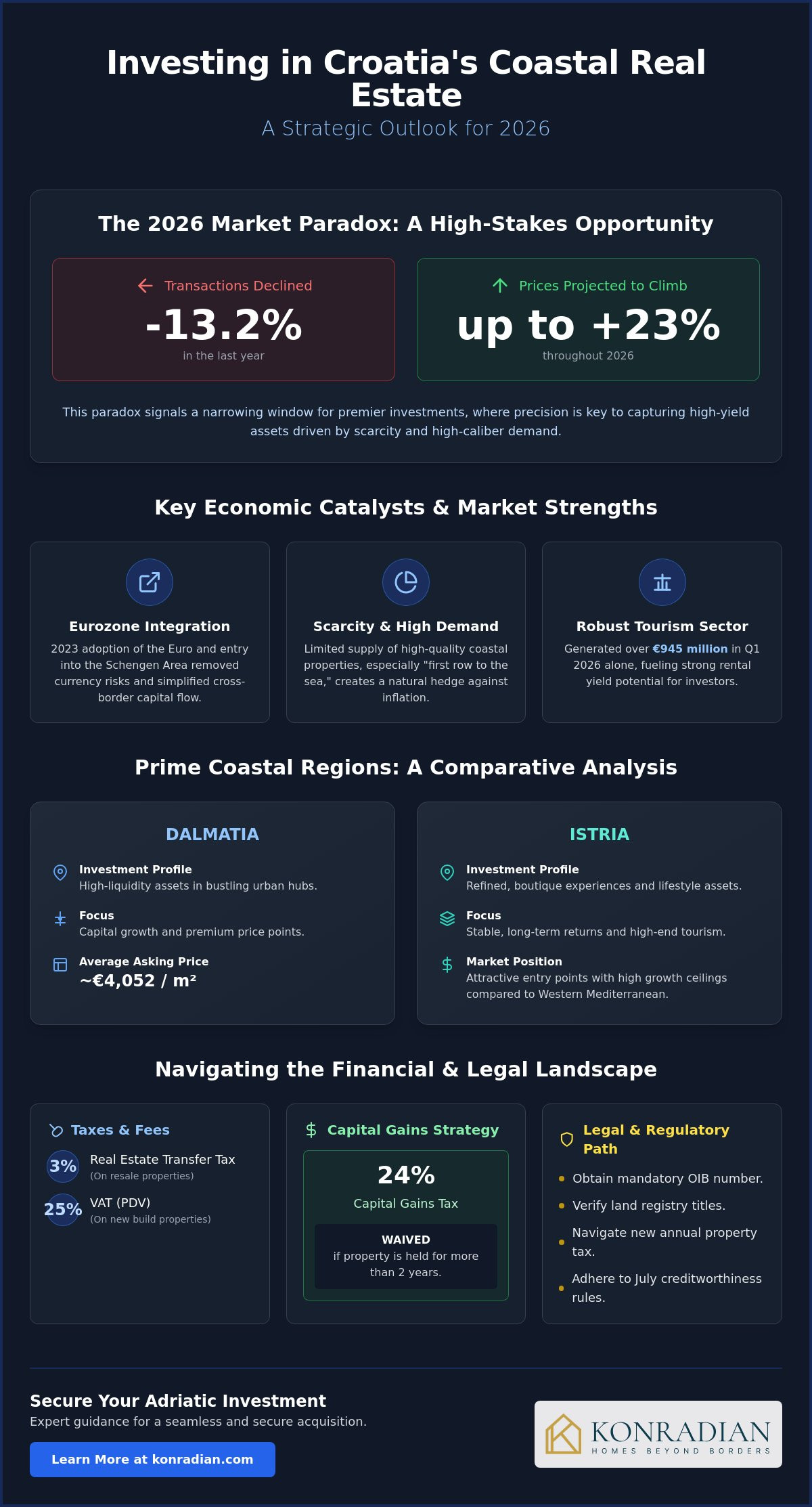
Did you know that while real estate transactions in Croatia declined by 13.2% last year, property prices are projected to climb by as much as 23% throughout 2026? This market paradox creates a high-stakes environment where the window for securing a premier coastal property Croatia investment is narrowing, yet the rewards for those who act with precision have never been higher. You likely recognize the immense potential of the Adriatic coastline, but you might also feel the weight of navigating land titles and shifting local regulations. It’s natural to seek the tranquility of a “first row to the sea” residence while worrying about the complexities of a cross-border transaction.
This guide provides the strategic clarity you need to master the nuances of the Croatian market and secure high-yield assets with complete confidence. We’ll explore the latest 2026 fiscal updates, including the new annual property tax and the July creditworthiness rules, while identifying the regions like Istria that offer the most stable returns. You’ll learn how to bypass common legal hurdles and implement tourism rental models that transform a lifestyle purchase into a sophisticated source of passive income. From understanding the 3% transfer tax to evaluating Dalmatia’s premium price points, we’ll ensure your journey to Mediterranean ownership is both seamless and secure.
Key Takeaways
- Understand how to leverage current market trends to secure a premier coastal property Croatia investment that balances lifestyle value with robust ROI.
- Compare the investment potential of Istria’s refined boutique experiences with Dalmatia’s high-liquidity urban hubs to find the perfect fit for your strategic goals.
- Master the end-to-end legal process, from obtaining your mandatory OIB number to verifying land registry titles, ensuring a transparent and secure acquisition.
- Learn how elite stewardship handles the complexities of cross-border transactions, providing professional oversight that protects your long-term interests.
The Allure of Coastal Property in Croatia: A 2026 Investment Outlook
The Adriatic coastline has transitioned from a seasonal retreat into one of Europe’s most disciplined and rewarding investment arenas. By 2026, the market has matured significantly, shedding its “emerging” status in favor of a sophisticated landscape defined by limited supply and high-caliber demand. Investors are no longer just buying a home by the sea; they are securing a stake in a region where geography dictates scarcity. This physical limitation, combined with a stable regulatory environment, makes a coastal property Croatia investment a cornerstone for those seeking to diversify away from volatile equity markets.
The 2023 adoption of the Euro and entry into the Schengen Area continue to pay dividends for property valuations. These milestones removed currency risks and simplified cross-border logistics, creating a frictionless environment for capital flow. As part of Croatia’s economic profile, the nation’s high-income status and deep integration into the Eurozone provide a stable bedrock for capital preservation. For the strategic buyer, “first row to the sea” assets represent a unique hedge against inflation. While secondary markets may fluctuate, these premium positions remain resilient because their value is tied to an irreplaceable view and immediate maritime access.
Adriatic Market Resilience in 2026
The current demand for Croatian coastal real estate is characterized by a persistent shortage of high-quality inventory that continues to drive prices upward despite broader global economic shifts. Infrastructure advancements, including expanded regional airports and improved motorway networks, have unlocked secondary coastal pockets that were previously inaccessible. When compared to established Western Mediterranean markets like the French Riviera or Spain’s Costa del Sol, Croatia offers a more attractive entry point with significantly higher growth ceilings. The market is no longer chasing mass-market volume; it is refining its focus on sustainable, high-end developments that respect the coastline’s natural integrity.
Yield vs. Capital Appreciation: Setting Your Objectives
Investors in 2026 typically operate under a dual-benefit model that prioritizes both immediate rental returns and long-term value growth. In premium Dalmatian locations, where average asking prices have reached approximately €4,052 per square meter, the focus is on high-liquidity assets. Capital growth projections for 2026 remain ambitious, with estimated 12-month increases ranging from 14% to 23%.
To maximize these returns, your exit strategy must account for local fiscal nuances. For instance, the 24% capital gains tax is waived if the property is held for more than two years. Aligning your selection with a 5-year or 10-year horizon allows you to capture the full arc of appreciation while benefiting from a tourism sector that generated over €945 million in the first quarter of 2026 alone. This methodical approach ensures that your acquisition serves as both a lifestyle sanctuary—often enhanced by high-end wellness features like Pureffect—and a high-performing financial instrument.
Strategic Investment Models for the Croatian Coast
Selecting the right vehicle for your capital is as critical as the location itself. In 2026, the Adriatic market rewards those who move beyond passive ownership toward active, strategic deployment. Whether your goal is immediate liquidity through high-turnover rentals or long-term wealth preservation via luxury estates, your coastal property Croatia investment requires a model tailored to current fiscal realities. According to the World Bank’s Croatia economic overview, the nation’s GDP growth continues to outpace the EU average. This resilience, fueled by robust tourism and integration into the Eurozone, provides a secure foundation for sophisticated investment structures.
The rise of luxury villas has become a preferred hedge against broader market volatility. These assets aren’t just holiday homes; they’re high-performance financial instruments. By focusing on “first row” positions with bespoke architectural standards, investors capture a segment of the market that is largely insulated from fluctuations in the mass-market sector. Success here depends on calculating the Total Cost of Ownership (TCO) with precision. Beyond the purchase price, you must account for the 3% real estate transfer tax on resales or the 25% VAT on new builds, alongside the 2026 annual property tax which ranges from €0.60 to €8.00 per square meter.
The Tourism Rental Powerhouse
The “Buy-to-Let” model in high-demand corridors like Zadar, Split, and Trogir is performing exceptionally well in 2026. From January to May alone, Croatia recorded over 14 million overnight stays, representing a 7% increase over previous records. To transform these numbers into passive income, professional management partnerships are essential. As you explore management options, discover Crucial Hospitality to see how specialized oversight for boutique hotels and villas can maximize your ROI. While coastal hubs offer significant year-round potential for business travelers and digital nomads, the peak summer season remains the primary driver of yield. Aligning with local experts ensures your asset maintains high occupancy rates without the stress of cross-border logistical management.
Pre-Sale Opportunities and Developer Access
Securing assets at the earliest possible stage remains one of the most effective ways to capture immediate equity. Accessing pre-sale property Croatia opportunities allows you to lock in developer pricing before a project reaches the public market. With property prices projected to rise by up to 23% throughout 2026, the financial benefits of early-stage acquisition are substantial. We recommend a thorough verification of all developer permits and land titles to mitigate the risks inherent in off-plan developments. If you’re looking to identify these emerging opportunities with professional oversight, our advisors at Konradian can provide the necessary market intelligence to secure your position safely.
Prime Coastal Regions: Dalmatia vs. Istria Investment Potential
Geography dictates the rhythm of return on the Adriatic. Selecting the right location for a coastal property Croatia investment often hinges on a choice between two distinct Mediterranean identities. Dalmatia offers the raw, high-energy appeal of historic urban centers and island clusters, while Istria provides a curated, continental sophistication often compared to the Italian countryside. Each region caters to a specific investor profile, yet both benefit from a regulatory framework described in the U.S. Department of State’s 2024 Investment Climate Statement as increasingly favorable for foreign capital and transparent enterprise.
Accessibility is the silent driver of property valuations in 2026. The extensive highway network and the modernization of international airports in Split, Zadar, and Pula have effectively shrunk the distance between European capital cities and the Adriatic shore. While the primary hubs attract the most attention, identifying “hidden gem” micro-locations just outside these centers offers significant growth potential. These pockets provide the same maritime access at a more attractive entry point, allowing for greater capital appreciation as the market continues its upward trajectory.
Dalmatia: Split, Trogir, and the Islands
Dalmatia serves as the high-liquidity heart of the Croatian coast. In 2026, Zadar has emerged as a formidable market leader, balancing modern infrastructure with a surging demand for premium residential space. Trogir’s UNESCO protected status creates a natural barrier to overdevelopment, ensuring that property values remain resilient due to absolute scarcity. On islands like Hvar and Brač, the market remains exclusive and highly sought after. Dalmatia currently leads the coastline with an average asking price of €4,052 per square meter, reflecting its status as a primary destination for global investors seeking high-traffic rental yields.
Istria: Sophisticated Living and Proximity to Europe
Istria is frequently dubbed the “New Tuscany” for its rolling vineyards, olive groves, and world-class gourmet culture. The strategic advantages of Istria real estate for sale lie in its year-round appeal and its proximity to Central Europe. Buyers from Munich, Vienna, or Milan can reach their villas within a few hours’ drive, supporting a more stable and predictable rental model. In cities like Rovinj and Poreč, there is a distinct premium on modern seafront villas, though authentic stone houses in the hilltop interior remain a favorite for those seeking privacy. With prices ranging from €2,500 to €4,000 per square meter, Istria offers a refined alternative to the bustling southern coast.
Navigating the Legal Path to Secure Ownership
The transition from property selection to legal ownership requires a meticulous, step-by-step methodology. While the Croatian Adriatic offers unparalleled beauty, the administrative landscape can be complex for those unfamiliar with local bureaucracy. Securing a coastal property Croatia investment in 2026 begins with obtaining your OIB (Osobni identifikacijski broj). This personal identification number is the essential key for all financial transactions, from opening a local bank account to signing the final deed. Without it, your acquisition cannot proceed.
Transparency is the foundation of a secure transaction. You must prioritize the verification of land registry entries to ensure the title is clear of any historic encumbrances or unresolved family disputes. While we previously noted the tax rates for resales and new builds, the timing of these payments is critical to avoid penalties. Understanding the sequence of these obligations upfront prevents surprises during the final closing phase.
The Due Diligence Checklist
A rigorous due diligence process is non-negotiable. You must verify the “Uporabna dozvola” or usage permit, which confirms the building was constructed according to approved plans and is legally fit for occupancy. This document is vital for securing future financing or resale value. Beachfront assets often involve maritime domain restrictions. In Croatia, the immediate shoreline is public land; you can’t own the beach itself, but you can secure concessions for usage. Engaging legal support buying property abroad ensures these nuances are managed with professional precision.
Closing the Deal: Notaries and Handover
The final stages of a Croatian transaction involve specific legal milestones. The Public Notary plays a central role, primarily by authenticating signatures on the purchase agreement to ensure they meet land registry standards. For financial security, we recommend using escrow accounts rather than direct payments to the seller before the title is cleared. Once the full price is paid, the seller issues a “Tabularna isprava.” This document is the seller’s formal declaration that you’ve fulfilled all obligations, allowing the land registry to enter you as the new owner. If you require expert guidance to navigate these protocols, Konradian’s professional stewardship provides the end-to-end security needed for a seamless handover.
The Konradian Advantage: Elite Stewardship for Global Investors
Securing a coastal property Croatia investment in a market defined by rapid appreciation and limited inventory requires more than just a local agent. It demands a strategic partner who views real estate through the lens of global finance and long-term wealth preservation. Most market participants act as sales agents for the seller, creating an inherent conflict of interest. At Konradian, we occupy the role of a buyer-side advocate. Our LSE-backed expertise provides the intellectual rigor necessary to analyze market cycles, ensuring your acquisition is a calculated step toward financial growth rather than a simple lifestyle purchase.
Our “Zero Cost to Buyer” model is designed to align our interests entirely with yours. We provide elite, end-to-end stewardship without an additional financial burden, as our professional fees are typically managed through industry-standard seller commissions. This structure allows us to offer unbiased advice and exclusive access to developer relationships that are often inaccessible to the public. By tapping into our pre-market listing network, you can identify premier assets before they are subjected to broader market competition, giving you a distinct advantage in the high-stakes 2026 environment.
Bridging the Local and Global Market
We specialize in translating the complexities of Croatian bureaucracy into a clear, actionable investment strategy. Our team handles the “heavy lifting” of cross-border logistics, from initial legal vetting to the final coordination of the land registry entry. We maintain a strict commitment to transparency, ensuring there are no hidden fees or markups at any stage of the process. For investors with a broader international focus, we provide the expertise to integrate your Adriatic holdings into a cohesive portfolio, drawing on our experience with other premier markets like Spanish Property Acquisition. This holistic perspective ensures your capital is deployed with maximum efficiency across your entire real estate footprint.
Start Your Investment Journey Today
The path to Mediterranean ownership should be characterized by ease and professional confidence. Our concierge service begins with a comprehensive, free video consultation where we define your unique investment profile and risk tolerance. From there, we move into a personalized sourcing phase, identifying properties that meet our rigorous standards for quality and ROI. We guide you through every milestone, providing the intellectual authority and practical support needed to close your transaction with peace of mind. You don’t have to manage the stress of international real estate alone. Take the first step toward a secure and rewarding future and secure your Adriatic future with Konradian today.
Securing Your Adriatic Legacy
The window for high-yield acquisition on the Adriatic is defined by a unique intersection of physical scarcity and soaring demand. By understanding the 2026 market paradox, where prices continue to climb despite shifting transaction volumes, you can position yourself ahead of the global curve. Success in this landscape requires a transition from passive searching to proactive strategy. Whether you’re drawn to the high-liquidity urban centers of Dalmatia or the refined tranquility of Istria, your journey should be guided by precision and clear financial objectives.
Realizing a coastal property Croatia investment doesn’t have to be a path filled with legal uncertainty or administrative stress. Our LSE-educated strategic advisors specialize in bridging the gap between complex local bureaucracy and global financial standards. We provide direct developer pre-sale access and maintain a dedicated zero-cost model for buyers, ensuring your interests are protected at every milestone. It’s time to move beyond the complexity of cross-border transactions and embrace the peace of mind that comes with professional stewardship. Book your free investment consultation with Konradian and take the first step toward securing your Mediterranean asset today.
Frequently Asked Questions
Can EU and non-EU citizens freely buy coastal property in Croatia?
EU and EEA citizens possess the same rights as Croatian nationals and can purchase residential property without requiring special permits or approvals. For non-EU citizens, the acquisition process involves obtaining formal consent from the Ministry of Justice. This approval is granted based on reciprocity agreements between Croatia and the buyer’s home country. While this administrative step adds a few months to the timeline, it’s a standard procedure for securing a coastal property Croatia investment.
What are the total closing costs for a real estate investment in Croatia in 2026?
Buyers should budget for a 3% real estate transfer tax on resale properties, though this is not applicable if the purchase is subject to VAT. Standard real estate agent commissions typically range from 2% to 3% plus VAT. Additional administrative expenses include notary fees, which generally fall between €200 and €800, and land registry court fees of approximately €46. These established costs ensure a transparent and legally recognized transfer of ownership.
Is it better to buy property as an individual or through a Croatian company?
Purchasing as an individual is usually the most efficient path for lifestyle buyers and those focused on long-term capital appreciation. However, establishing a Croatian d.o.o. (limited liability company) can be advantageous if you intend to reclaim VAT on a new-build purchase or operate a high-volume rental business. This route involves ongoing accounting costs and corporate tax obligations, so the decision should align with your specific financial scale and long-term operational goals.
How much rental yield can I realistically expect from a coastal villa?
Realistic rental yields for premium coastal villas typically range from 4% to 6% annually, depending on the location’s exclusivity and the quality of local management. Properties in high-demand corridors like the Split Riviera or Rovinj often command significant premium rates during the peak summer season. Achieving these returns requires a focus on “first row” locations and professional stewardship to maintain high occupancy levels and elite service standards for international guests.
Are there restrictions on buying agricultural land near the coast?
EU citizens can now purchase agricultural land in Croatia following the expiration of the previous moratorium. However, non-EU nationals remain restricted from direct ownership of agricultural plots unless the acquisition is made through a Croatian company. It’s essential to verify the specific zoning of any land before proceeding. Land designated for agricultural use cannot be developed into residential property without a formal and often complex rezoning process by local municipalities.
What is the ‘Maritime Domain’ and how does it affect beachfront property?
The Maritime Domain is a protected legal zone extending at least six meters inland from the high-tide line, which is classified as public property. You cannot own this specific strip of land, even if your property is situated in the “first row to the sea.” Owners can apply for concessions to use the area for private piers or beach furniture, but the shoreline itself must remain accessible to the public according to Croatian law.
How does the buying process in Croatia compare to Spain or Hungary?
Croatia’s acquisition process closely mirrors the Spanish model, utilizing public notaries and a structured land registry system to ensure investor security. While Hungarian transactions require administrative permits for all foreign nationals, Croatia offers immediate parity for EU citizens, creating a more frictionless entry point. The primary distinction lies in Croatia’s unique coastal regulations and the mandatory OIB number, which serves as the central pillar for all legal and financial activity.
Do I need to be physically present in Croatia to complete the purchase?
Physical presence is not mandatory to finalize a property transaction. You can grant a Power of Attorney (PoA) to a legal representative or trusted advisor to act on your behalf for signing the purchase agreement and handling land registry filings. This document must be notarized and apostilled in your home country to be legally recognized. This flexibility allows global investors to manage their acquisitions with minimal disruption to their professional or personal schedules.
