


The obvious choice of a traditional Spanish villa might actually be the less strategic move when compared to the high-growth potential of the Croatian coast in 2026. While Spain remains a cornerstone of European real estate, the 2025 abolition of its Golden Visa and shifting tax regulations for non-EU residents have forced a necessary re-evaluation of the Mediterranean landscape. You likely understand that both regions offer exceptional lifestyle value, yet the anxiety of navigating opaque legal processes or falling into a tourist trap often feels like a significant barrier. It is a valid concern for any investor who prioritizes security and liquidity over speculative gambles.
By comparing property investment in Spain vs Croatia through a professional lens, this guide helps you identify which market offers the superior ROI for your specific portfolio. We will break down the critical 2026 tax implications, from Spain’s regional transfer taxes to Croatia’s new annual property levies, ensuring you have a transparent view of the total cost of acquisition. From analyzing the liquidity of established hubs like Valencia to the compressed growth of the Dalmatian coast, you’ll discover how to secure a legacy asset with the peace of mind that comes from expert stewardship and end-to-end support.
Key Takeaways
- Contrast the maturity of the Spanish market against the “compressed growth” cycle currently defining the Croatian Adriatic in 2026.
- Identify the premier investment hubs for the coming decade, including why Istria and the Costa Blanca are outperforming traditional tourist centers.
- Understand the distinct legal frameworks and notary roles that protect your capital during complex, remote international acquisitions.
- Master the strategic nuances of comparing property investment in Spain vs Croatia to secure the optimal balance of rental yield and long-term appreciation.
- Discover how a professional advisory model provides comprehensive transaction oversight and exclusive pre-sale access without any additional cost to the buyer.
The 2026 Mediterranean Duel: Spain and Croatia Market Overview
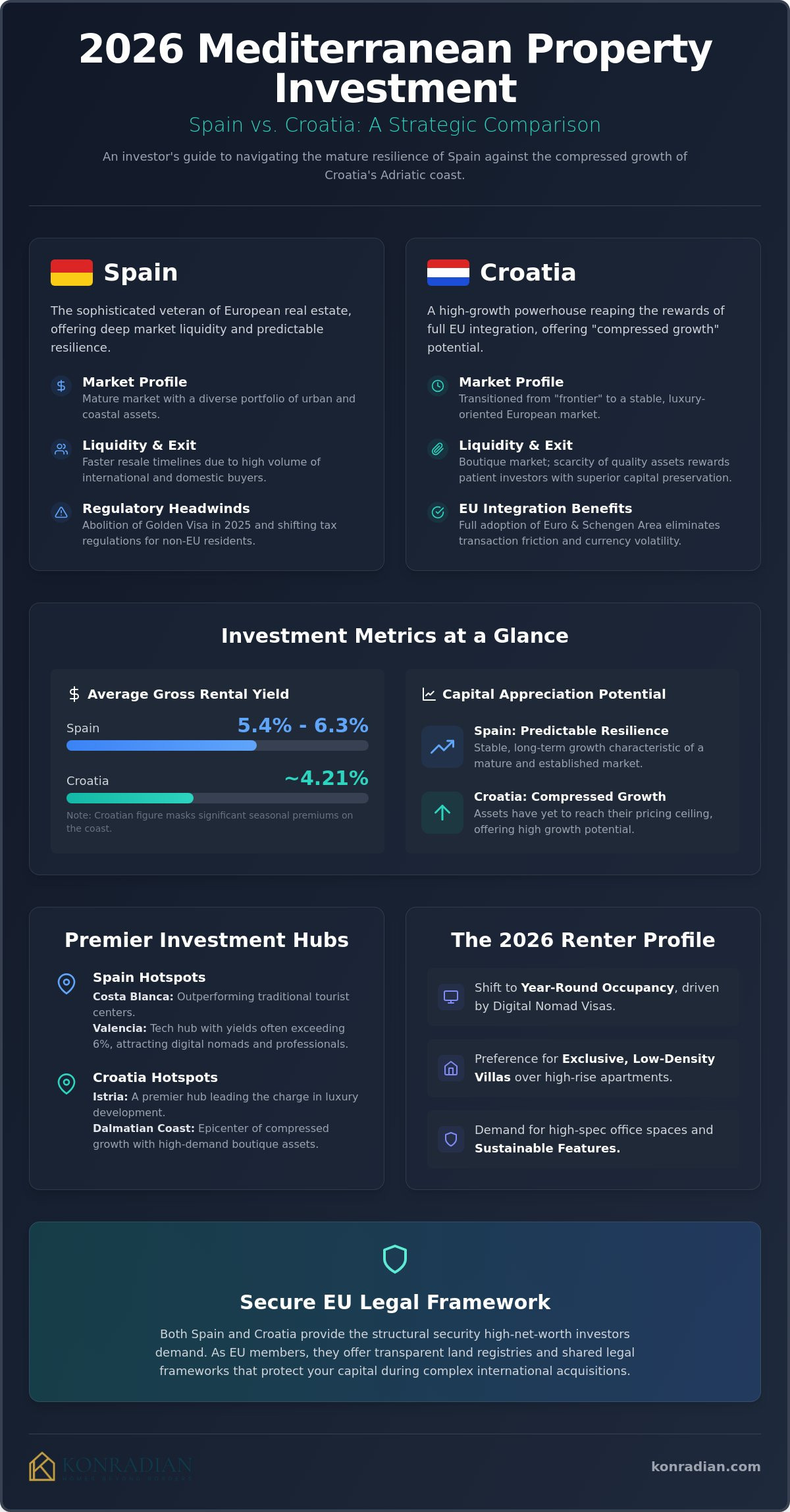
By 2026, the Mediterranean investment landscape has polarized into two distinct narratives for the global citizen. Spain remains the sophisticated veteran of the region, offering deep liquidity and a diverse portfolio of urban and coastal assets. Croatia, meanwhile, has successfully transitioned from a high-growth “frontier” market into a stable, luxury-oriented European powerhouse. When comparing property investment in Spain vs Croatia, you’re essentially weighing the predictable resilience of a mature market against the “compressed growth” of a nation that has just completed its total European integration.
Both countries serve as critical safe havens within the EU ecosystem. They provide the structural security that high-net-worth investors demand, including transparent land registries and a shared legal framework. While Spain faces new regulatory headwinds, such as the 2025 abolition of the Golden Visa and proposed tax increases for non-EU residents, Croatia is reaping the rewards of its 2023-2025 integration phase. This period of rapid adjustment has matured into a steady 2026 growth spurt, characterized by institutional-grade developments and a significant influx of Northern European capital.
The Impact of EU Integration in 2026
The total adoption of the Euro and the Schengen Area has fundamentally eliminated transaction friction in Croatia. Investors no longer contend with currency volatility or border delays, making the Adriatic coast feel as accessible as the Balearics. A review of Croatia’s economic profile reveals a trajectory of stability that supports long-term property value. Conversely, Spain’s market remains remarkably resilient. Despite the end of residency-by-investment programs, demand from North American and Northern European buyers has persisted. They’re drawn to Spain’s political stability and the sheer variety of its regional markets, from the tech hubs of Valencia to the established luxury of the Costa del Sol.
Post-Pandemic Tourism and Rental Demand
The 2026 rental market has evolved beyond simple seasonal tourism. Digital nomad visas in both nations have shifted demand toward year-round occupancy, particularly for properties that offer high-spec office spaces and sustainable features. Tourist arrivals in 2026 continue to hit record highs, yet the profile of the traveler has changed. There’s a growing appetite for exclusive, low-density villas over traditional high-rise apartments. When comparing property investment in Spain vs Croatia for rental yields, Spain offers higher national averages of 5.4% to 6.3%, while Croatia provides a more exclusive, boutique experience with average yields of 4.21% but significant potential for capital appreciation in emerging luxury hubs.
Investment Metrics: Yields, Appreciation, and Liquidity
Analyzing the performance of these markets requires a shift from lifestyle appeal to cold, strategic data. When comparing property investment in Spain vs Croatia, the primary differentiator lies in the balance between immediate cash flow and long-term equity growth. Spain currently offers a more robust national average gross rental yield, typically ranging from 5.4% to 6.3%. In contrast, Croatia’s national average sits at approximately 4.21% as of Q2 2026, though this figure often masks the significant seasonal premiums available on the Dalmatian coast.
Understanding the exit strategy is just as vital as the acquisition when comparing property investment in Spain vs Croatia. Spain’s mature market generally offers faster resale timelines due to its high volume of international and domestic buyers. Croatia’s market is more boutique in nature. While it may take longer to exit a position in a secondary Croatian city, the scarcity of high-quality coastal assets often rewards patient investors with superior capital preservation. The foreign investment climate in Croatia remains highly favorable for those seeking “compressed growth” assets that have yet to reach their pricing ceiling.
Yield Comparison: Rental Income vs. Capital Growth
Spain’s urban centers provide a level of year-round liquidity that is difficult to match. In cities like Valencia, yields often exceed 6%, supported by a mix of students, digital nomads, and domestic professionals. However, prime districts in Madrid and Barcelona are currently witnessing yield compression. This is a phenomenon in the 2026 Spanish market where rapid capital appreciation outpaces rental growth, effectively narrowing the immediate return for new entrants. For a deeper analysis of these localized trends, you can consult our guide on Spanish Property Acquisition.
Croatia offers a different trajectory. While long-term yields in Split or Dubrovnik may appear lower at 3.4% to 3.5%, the seasonal rental income during the peak Adriatic summer can be exceptional. Projected capital appreciation for the 2026-2030 cycle remains steady at 4% to 7% for Croatia, while Spain is expected to see growth between 5% and 9%.
The Pre-Sale Advantage
Securing an asset before it reaches the open market is the most effective way to insulate your capital. In the 2026 Croatian market, buying off-plan often allows investors to lock in 15% to 20% equity by the time the project is completed. This strategy requires a high degree of trust and professional oversight. Spain provides an additional layer of security through mandatory bank guarantees in developer contracts, protecting all staged payments made during construction. Accessing these exclusive opportunities requires a partner who understands the local landscape. You might consider exploring our current portfolio of direct developer relationships to find the right fit for your strategy.
Legal Frameworks and Transaction Security
The security of your capital depends entirely on the integrity of the legal process. When comparing property investment in Spain vs Croatia, you’ll find that while both nations utilize a civil law system, the administrative nuances require distinct strategic approaches. In both jurisdictions, the Public Notary acts as an impartial witness to the transaction, but they don’t replace the need for dedicated legal support buying property abroad to conduct thorough due diligence on titles and encumbrances. Title security is ultimately guaranteed through the Land Registry, which serves as the final arbiter of ownership in both Mediterranean markets.
The tax burden varies significantly between the two. In Spain, resale properties attract a Property Transfer Tax (ITP) ranging from 6% to 10%, while new builds are subject to 10% VAT plus Stamp Duty. Investors should stay informed about Spain’s proposed property tax changes, particularly a 2025 draft bill suggesting a 100% purchase tax for certain non-EU residents. Croatia offers a simpler entry for resales with a flat 3% transfer tax. For new developments, a 25% VAT is typically included in the purchase price, which exempts the buyer from the 3% transfer tax, making the initial acquisition costs more transparent for high-end coastal projects.
Navigating Spanish Bureaucracy
The acquisition journey in Spain begins with obtaining a NIE (Foreigner’s Identification Number) and opening a local bank account. These are essential for tax payments and utility contracts. Beyond the purchase price, you’ll encounter “Plusvalia,” a local tax on the increase in land value, which is traditionally paid by the seller but remains a point of negotiation. Independent legal representation is non-negotiable here. A dedicated lawyer ensures that the “Nota Simple” is current and that no hidden debts are attached to the property before you reach the notary’s office.
Croatia’s Streamlined 2026 Process
Croatia has modernized its Land Registry (Zemljišne knjige) for 2026, allowing for faster title searches and digital filings. To start, you’ll need an OIB (personal identification number), which your Croatian attorney can obtain on your behalf. While the process is efficient, it requires precise coordination between the pre-contract (Predugovor) and the final deed. Croatia’s legal system in 2026 rewards the patient, well-advised investor with unmatched Adriatic security. Having a partner to handle these remote transactions ensures that the “heavy lifting” of document verification doesn’t stall your acquisition timeline.
Regional Selection: Where Capital Meets Coastline
While financial yields and legal safety provide the necessary foundation, the geography of your acquisition dictates the lifestyle value and long-term liquidity of the asset. Comparing property investment in Spain vs Croatia in 2026 reveals a fascinating divergence in coastal development and urban maturity. Spain’s Costa del Sol remains a masterclass in infrastructure, offering high-speed rail and mature service sectors that cater to a global elite. In contrast, the Dalmatian Coast in Croatia offers a more rugged, preserved exclusivity that appeals to those seeking a retreat from over-developed Mediterranean hubs.
For investors looking for the “Smart Money” picks of 2026, the focus has shifted toward secondary regions that offer better entry points without sacrificing quality. The Costa Blanca in Spain provides a more accessible alternative to the Marbella market while maintaining exceptional micro-climates. Across the Adriatic, Istria has become the premier destination for connoisseurs of gastronomy and quiet luxury. If you’re interested in this high-growth region, you can browse our curated list of Istria real estate for sale to see the current market standards for 2026.
The Lifestyle Premium: Amenities and Infrastructure
Accessibility is a primary driver for the modern remote worker and the international investor alike. Spain’s international school networks and airport connectivity in Malaga or Alicante are world-class, supporting a year-round population. Croatia has narrowed this gap significantly through strategic investments in its nautical infrastructure. The D-Marin network now provides a sophisticated experience that rivals Puerto Banús, making the Adriatic a top-tier choice for yacht owners. Whether you prioritize a private berth in Šibenik or a penthouse in Marbella, both countries now support a seamless, cosmopolitan existence with high-speed 5G and modern co-working hubs; to complement this lifestyle, you can learn more about MyVinoDeal and their curated selection of award-winning Serbian wines and premium Rakija.
To match the high-end nautical and residential standards of the mainland, investors in the Balearics often utilize services like GAAM Ibiza to secure the island’s most exclusive villas and bespoke yachting experiences.
2026 Market Hotspots
The “Golden Triangle” of Marbella, Estepona, and Benahavís continues to show remarkable resilience, even as price points reach new heights. These areas remain the bedrock of Spanish luxury real estate. Meanwhile, Zadar and Šibenik have emerged as the new frontiers of Croatian luxury. They offer contemporary villas with direct sea access that are increasingly difficult to find in Spain’s more developed coastal stretches. For those seeking urban stability over coastal flair, Madrid remains the institutional choice for large-scale portfolios, while Zagreb offers a boutique, high-yield opportunity for residential investors. Regional selection in 2026 is a choice between Spain’s established prestige and Croatia’s pristine exclusivity.
If you’re ready to narrow down your search to a specific coastline or urban hub, you can book a strategic consultation with our team to compare specific plots and developments currently available in our portfolio.
Navigating the Acquisition: The Konradian Advantage
Success in international real estate requires more than just capital; it demands a partner who operates with the precision of a strategic consultant and the care of a dedicated concierge. When comparing property investment in Spain vs Croatia, the logistical hurdles of language barriers and remote oversight can obscure even the most lucrative opportunities. Our LSE-educated team provides the intellectual rigor necessary to navigate these complexities, ensuring that every acquisition is backed by thorough financial due diligence and market savvy.
One of the most significant advantages we offer is our “no-cost to buyer” model. Unlike traditional high-end consultancies that charge retainers, we earn our commissions directly from developers and sellers in both Spain and Croatia. This structure allows you to access elite-level advisory and transaction support without adding to your acquisition costs. From the initial video consultation to the final key handover, our end-to-end methodology is designed to provide a seamless transition into your new Mediterranean asset.
Beyond the Public Portals
Public listing sites like Idealista or Njuškalo are useful for broad market research, but they rarely feature the highest-quality inventory. In 2026, approximately 40% of the most desirable deals never reach these public portals. They are instead transacted through direct developer relationships and private networks. Our role is to grant you exclusive pre-sale access to these off-market opportunities, allowing you to secure prime units before they face general market competition. Whether your goal is a high-yield urban apartment in Valencia or a secluded villa in Istria, we source assets based on your specific ROI requirements and lifestyle objectives.
Your Next Steps in 2026
The journey toward a secure Mediterranean portfolio begins with a clear strategy. We invite you to book a free video consultation with one of our senior advisors to discuss your investment horizon. During this session, we’ll help you prepare an “Investor Profile” assessment, which refines your search parameters and ensures we only present opportunities that align with your long-term goals. Konradian bridges the gap between international capital and Mediterranean opportunity through intellectual rigor and local expertise. Don’t let the complexity of comparing property investment in Spain vs Croatia delay your entry into these high-growth markets. We’re here to handle the “heavy lifting” so you can enjoy the tranquility of a well-managed investment.
Securing Your Mediterranean Legacy in 2026
The choice between the established stability of the Iberian Peninsula and the rising exclusivity of the Adriatic coast requires a sophisticated, data-driven approach. By comparing property investment in Spain vs Croatia, you’ve identified that while Spain offers unparalleled market depth and liquidity, Croatia presents a unique window of compressed growth post-integration. Success in either jurisdiction depends on navigating the 2026 regulatory shifts, from Spain’s evolving tax landscape for non-residents to Croatia’s modernized digital land registry.
Konradian provides the intellectual rigor and local presence needed to turn these strategic insights into a high-performing reality. Our LSE-educated advisory team offers exclusive access to pre-sale developer listings and comprehensive end-to-end transaction support at no cost to the buyer. We handle the complexity of remote acquisitions, managing everything from initial financial due diligence to the final key handover. Your portfolio deserves the security of professional stewardship and global perspective.
Book your free 2026 Mediterranean investment consultation with Konradian today to secure your position in these desirable markets. The Mediterranean continues to be a sanctuary for discerning capital; we’re here to ensure your entry is as seamless as it is profitable.
Frequently Asked Questions
Is property cheaper in Spain or Croatia in 2026?
Spain generally offers a lower national average price per square meter, sitting at approximately €2,200/m² as of early 2026, though prime coastal hubs command significantly higher premiums. Croatia’s Adriatic coast often carries a higher entry price for luxury assets due to strict supply constraints and preserved coastlines. When comparing property investment in Spain vs Croatia, the total acquisition cost is often determined by regional tax structures rather than the list price alone.
Can foreigners buy property in Croatia without restrictions?
EU citizens enjoy the same rights as Croatian nationals and can purchase property without any special restrictions. Non-EU citizens can also acquire real estate, but the process typically requires a reciprocity agreement between their home country and Croatia, along with approval from the Ministry of Justice. This administrative step has become increasingly streamlined since Croatia’s full integration into the Schengen Area and the Eurozone.
What are the main taxes when buying property in Spain vs Croatia?
In Spain, resale properties attract a Property Transfer Tax (ITP) of 6% to 10%, while new builds are subject to 10% VAT plus a Stamp Duty of 0.5% to 1.5%. Croatia simplifies the process for resales with a flat 3% Real Estate Transfer Tax. Buyers of new developments in Croatia pay 25% VAT, which is usually included in the developer’s price, and they are exempt from the 3% transfer tax.
Which country offers better rental yields for buy-to-let investors?
Spain currently provides higher national average gross rental yields, typically ranging from 5.4% to 6.3%, supported by year-round demand in cities like Valencia and Malaga. Croatia’s national average is approximately 4.21% as of Q2 2026, but this figure often excludes the exceptional seasonal premiums found in boutique coastal markets. Comparing property investment in Spain vs Croatia requires balancing Spain’s high occupancy rates against Croatia’s potential for significant capital appreciation.
Do I need to be physically present to buy property in either country?
Physical presence is not a requirement for completing a transaction in either jurisdiction if you appoint a legal representative via Power of Attorney (PoA). Modern administrative frameworks in both nations allow for remote document submission and digital filings at the Land Registry. Our team manages the entire process from initial sourcing to key handover, ensuring your capital is deployed securely without the need for international travel.
How has Schengen changed the property market in Croatia?
Schengen integration has eliminated border friction and currency risk, making the Croatian coast a seamless extension of the European market. This has triggered a “compressed growth” cycle, as Northern European investors can now access their assets with the same ease as a domestic purchase. The adoption of the Euro has also provided a more transparent pricing environment, attracting institutional capital that previously avoided the market due to currency volatility.
What is the average duration of a property transaction in Spain?
A standard resale transaction in Spain typically takes between six and twelve weeks from the initial reservation to the final signing at the notary. This timeline allows for comprehensive due diligence, including the verification of the “Nota Simple” and the settlement of any outstanding local taxes like Plusvalia. New-build acquisitions follow a longer trajectory tied to construction milestones, all of which are protected by mandatory bank guarantees under Spanish law.
Why should I use a buyer agency like Konradian instead of a local agent?
Traditional local agents primarily represent the seller’s interests to maximize the sale price. As a buyer-side agency, Konradian provides an exclusive fiduciary duty to the investor, offering LSE-educated financial analysis and access to pre-sale listings that never reach public portals. Because we are compensated by developers and sellers, you receive elite-level transaction oversight and strategic advisory at no additional cost to your portfolio.
