


What if a Croatian property looks fairly priced only because you’re comparing it with the wrong market? The Croatia property price per square meter varies sharply by location and property type. In September 2026, nekretnine.hr reported a national average asking price of €3,940 per square meter, while coastal market data indicated averages rising above €4,150 per square meter for all property types. Both figures are asking-price averages, not records of completed sales.
A national average can be a useful starting point, but it may tell you little about a particular island apartment, inland house or coastal new build. To compare listings meaningfully, align the location, property type, condition and floor-area basis. Then distinguish the seller’s asking price from evidence of completed transactions.
This guide explains how Croatian prices differ by region and property type, what can make apparently similar homes vary in value, and what to review before making an offer. You’ll also learn how expert property selection and legal and financial guidance from Konradian can help bring clarity to the buying process, from comparing opportunities through to key handover.
Key Takeaways
- Use the Croatia property price per square meter as a starting point, then compare homes with similar locations, property types, sizes and condition.
- Understand why coastal, island, inland and city markets can differ, and how property type shapes the comparison.
- Separate listing prices from completed-sale evidence before deciding whether an asking price looks realistic.
- Build a focused shortlist by defining your search, gathering dated sources and comparing figures on a consistent basis.
- Learn how Konradian’s free initial video consultation and property-selection support can help turn regional research into a clear buying brief.
What Croatia Property Price per Square Meter Tells You, and What It Leaves Out
Price per square metre is a useful first filter, not a complete property valuation. It relates a property’s stated price to its stated floor area, giving you a basis for comparing similar homes. On its own, though, the figure can’t show whether the asking price is justified, whether the property’s condition suits your plans or whether its area has been calculated on the same basis as another listing.
For a useful 2026 comparison, note the source and publication date, the geography covered, the property categories included and whether the figure represents advertised asking prices or completed transactions. These distinctions matter in a market shaped by varied local conditions. Croatia’s wider economic picture, including tourism and foreign investment, can provide context. The Economy of Croatia overview is a broad starting point, not a substitute for local property evidence.
How to calculate a property’s price per square metre
Divide the property’s price by its stated floor area. For example, a hypothetical home priced at €240,000 with a stated area of 80 square metres works out to €3,000 per square metre. This is an illustration only, not Croatian market data.
Before comparing listings, record how each source defines area. If one listing uses a different floor-area basis from another, the resulting figures may not be directly comparable. Keep the original price and area beside your calculation so you can check the inputs rather than rely on a rounded figure alone.
Why Croatian price figures can be difficult to compare
Geography changes what an average tells you. A national figure can smooth over differences between counties, cities, neighbourhoods and islands. Even two properties in the same town may be in distinct micro-locations, so use a broad regional benchmark to guide research, not as a substitute for assessing an individual property.
Property type matters just as much. Compare apartments with apartments, houses with houses, and new builds with other new builds wherever the source allows. Differences in condition, layout, age and included land can make two homes with similar stated areas poor matches. Check which categories a reported figure covers before using it to judge an individual listing.
Asking prices and recorded sale prices describe different points in a transaction. An advertised figure reflects what a seller is seeking; a completed-sale figure records an agreed outcome. Neither should be treated as interchangeable. Note each figure’s date and data basis, and avoid drawing a firm conclusion from an average that hides variation between individual properties.
Used carefully, the Croatia property price per square meter can help you narrow a search and flag comparisons that need closer attention. Treat it as one piece of evidence, then assess the specific home, its location and the basis behind the number before deciding what it may be worth to you.
How Croatia Property Prices Differ Across Regions and Property Types
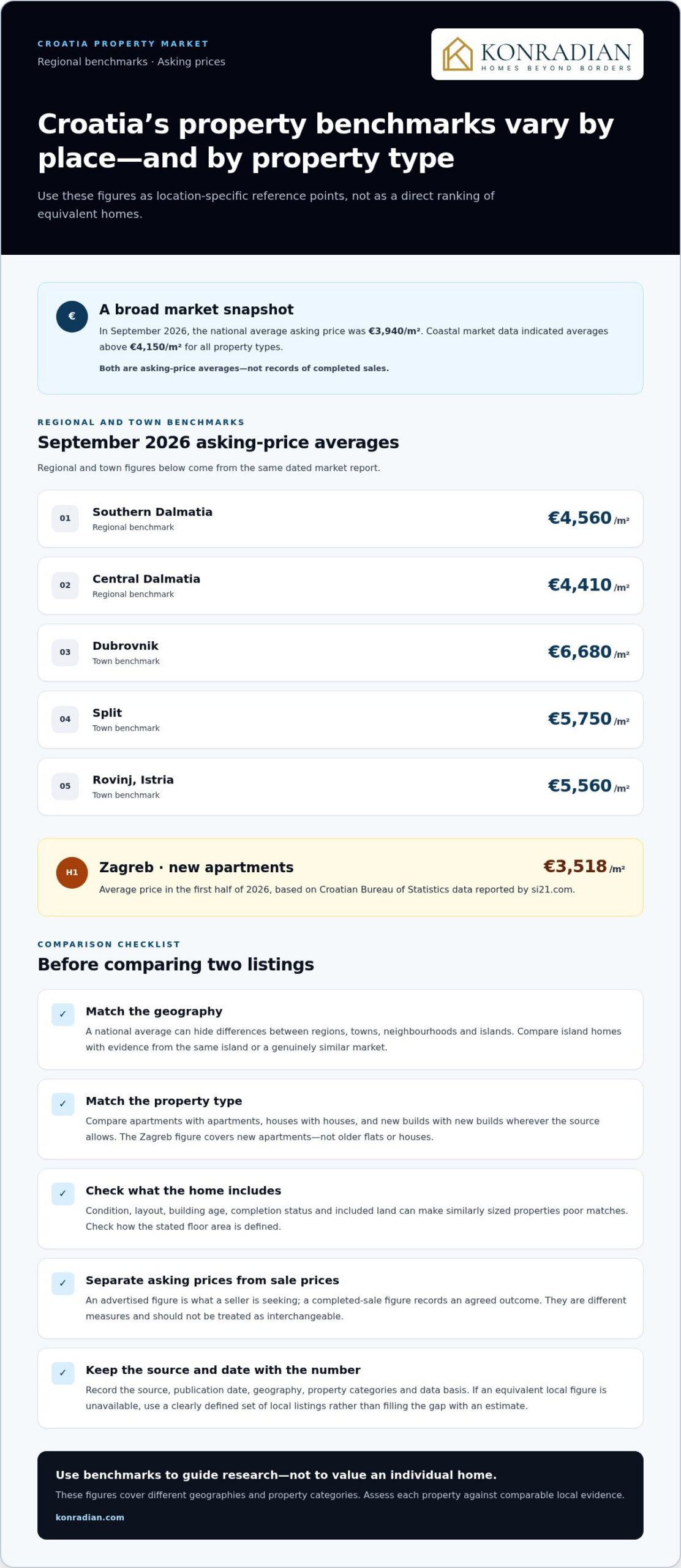
There isn’t one Croatian market price that applies equally to a central Zagreb apartment, a Dalmatian coastal home and an inland property. The figures below are useful reference points, but their categories differ. Keep each source definition beside its number, and don’t treat unlike averages as a direct ranking of equivalent homes.
- Southern Dalmatia: €4,560/m² average asking price in September 2026, reported for the region in a dated market report.
- Central Dalmatia: €4,410/m² average asking price in September 2026, reported for the region in the same market report.
- Dubrovnik: €6,680/m² average asking price in September 2026, reported for the town.
- Split: €5,750/m² average asking price in September 2026, reported for the town.
- Rovinj, Istria: €5,560/m² average asking price in September 2026, reported for the town.
- Zagreb: €3,518/m² average price for new apartments in the first half of 2026, based on Croatian Bureau of Statistics data reported by si21.com.
These figures don’t all measure the same thing. The regional and town figures are asking-price averages, while the Zagreb figure covers new apartments. They also don’t provide a complete comparison of every location named in the article. Without an equivalent, dated figure for islands or inland cities such as Osijek, don’t fill the gap with an estimate. Compare those areas using a clearly defined, local set of listings instead.
Coastal Croatia, islands and inland markets
Dalmatian regions and sought-after coastal towns have distinct asking-price benchmarks, but a regional average can conceal substantial variation between locations. Island homes shouldn’t be treated as interchangeable with mainland properties, either. Compare island listings with evidence from the same island or a genuinely similar market. Only draw conclusions about sea views when the data separates that feature.
Apartments, houses and new-build properties
Compare like property types wherever the source permits. The Zagreb figure above covers new apartments, so it shouldn’t be used as a benchmark for older flats or houses. For individual listings, record whether the stated area includes shared spaces or land, if the source explains this. Also note condition, building age and completion status. Renovation needs or unfinished construction can make two superficially similar homes poor matches.
The Croatia property price per square meter can help you identify locations and listings for closer review, but it can’t establish an individual home’s fair value. Before treating an apparent premium or discount as meaningful, check the source date and category, then compare the property’s location, condition, features and area basis. A broad average is a starting point, not a verdict.
For international buyers weighing several regions, a focused property brief makes comparisons more practical. Konradian’s free initial video consultation and property-selection support can help bring location preferences and property criteria into one shortlist. Explore Croatian property support.
How to Judge Whether a Croatian Property Asking Price Is Comparable
A lower price per square metre doesn’t automatically mean better value. It may reflect a different micro-location, a property needing substantial renovation, a different area calculation or an asking price that hasn’t been tested by a completed sale. The useful question isn’t which listing has the smallest figure, but whether the homes are similar enough for the comparison to tell you something.
Build your comparison around consistent details. If one candidate is a renovated apartment near the centre and another is a house outside town that needs work, their unit prices won’t tell you which is the stronger option. Treat the price as a prompt to investigate, then weigh the property’s features and supporting evidence separately.
A practical checklist for comparing Croatian listings
Use a simple table with one row per property. Capture the source and listing date as well as the figures, so you can distinguish current asking prices from older evidence. Keep the following fields consistent:
- Location: Record the town, neighbourhood or island, not just the wider region.
- Property type and area: Note whether it’s an apartment or house, and copy the stated floor area and its definition.
- Condition: Describe the visible state and likely renovation scope separately from the asking price.
- Features: Record outdoor space, sea views and access as property-specific details, not assumed premiums.
- Evidence: Label each figure as an advertised asking price or a completed-sale figure, with its source and date.
If a listing omits important information, mark it as unknown instead of filling the gap with an assumption. That keeps the comparison consistent and shows which details you need to clarify.
What price per square metre cannot tell you
The Croatia property price per square meter cannot establish legal status, construction quality or the likely cost of bringing a home up to your requirements. Nor does an asking-price figure demonstrate future appreciation, rental income or investment performance. Those conclusions need evidence beyond a listing and a basic unit-price calculation.
For investment research, keep regional context separate from property-level due diligence. Istria property market guidance can help frame questions about that region, but it can’t replace an assessment of a specific home’s condition, documentation and suitability for your objectives.
Compare asking prices with completed-sale evidence only when the data is sufficiently specific and comparable. A recorded transaction for a different property type or location may be less informative than a closely matched listing, even though it reflects a completed deal. Keep the source category visible in your table, and don’t treat either kind of evidence as a definitive valuation on its own.
A disciplined comparison won’t remove every uncertainty. It will show which listings deserve closer attention, which apparent bargains may have an explanation, and where you need better property-specific evidence before forming an offer.
How to Research Croatia Property Prices Before You Make a Shortlist
Good research starts with a defined comparison, not a collection of attractive headline figures. Decide which locations and property types fit your plans, then gather evidence that measures those markets on a consistent basis. A clear sequence helps you spot gaps, resolve conflicting benchmarks and avoid treating a broad average as a price guide for a specific home.
Which data sources can inform a 2026 comparison?
Start with dated publications from the Croatian Bureau of Statistics and check the precise measure each one reports. A published average for new apartments, for example, shouldn’t be treated as a benchmark for all homes or as proof of individual completed-sale prices. For transaction evidence, establish whether the source records completed deals, which geography and property types it covers, and how current the data is.
Market reports can add local detail when they state their publication date, geographic boundaries, property categories and methodology. If two reports disagree, compare those definitions before deciding that one is wrong. One may cover asking prices across a region, while another measures a narrower location or a different property group. Leave regional estimates out when the source or its coverage can’t be verified.
Turn market research into a useful shortlist
Set your priorities before headline figures shape your search. Define the location or acceptable area, property type, condition and essential features. Then collect relevant listings and record each source, date, area basis and whether the number is an asking price or completed-sale evidence.
- Define the search: Choose locations and property categories that match your intended use.
- Collect evidence: Save dated figures and note exactly what each source measures.
- Normalise comparisons: Separate unlike categories and check that floor-area definitions align.
- Shortlist deliberately: Rank homes by fit, condition and evidence quality alongside price per square metre.
If figures remain inconsistent after you check their definitions, don’t average them together. Keep each in its own category or leave it out of the comparison. The Croatia property price per square meter becomes more useful when every number in your working table has a clear date, location, property type and data basis.
Keep purchase-price research separate from legal, tax and transaction-cost research. These expenses affect the wider acquisition budget, but they aren’t part of a property’s per-square-metre price. Research them independently using current, authoritative information, and seek appropriate legal and financial guidance for your circumstances.
For Istria-specific context, Istria property market guidance can help frame regional questions without standing in for evidence on an individual home. Once your criteria and research are organised, Konradian’s free initial video consultation and property-selection support can help you develop a focused Croatian property brief. Arrange a buyer consultation.
Compare Croatian Property Opportunities with End-to-End Buyer Support
Regional averages can help define where to look, but the next step is translating broad research into criteria for a specific purchase. A clear property brief gives the search a purpose. Set out your budget, intended use, preferred regions, property type and essential features so you can compare relevant opportunities rather than chase the lowest headline figure.
From price research to a property brief
Konradian’s free initial video consultation helps international buyers discuss their priorities and shape a focused search. Location preferences and practical requirements can be turned into a shortlist brief. For example, an apartment for personal use and a house intended for another purpose may call for different locations, condition standards and property features.
Konradian has direct relationships with developers and agencies, providing access to their listings, including pre-sale opportunities. A coordinated search helps you assess options against the same brief instead of weighing unrelated listings. For wider transaction considerations, see this guide to legal support for buying property abroad.
- Budget: Set the amount you plan to allocate to the purchase, separately from other acquisition costs.
- Location: Prioritise preferred regions and identify how flexible you are on town, neighbourhood or island.
- Property type and use: Specify whether you’re seeking an apartment, house or another property type, and how you intend to use it.
- Condition and features: Note your expectations for renovation, outdoor space, access and other essentials.
With these criteria in place, a Croatia property price per square meter becomes one comparison point among several, rather than the sole basis for selecting a home. The brief also makes it easier to identify where two opportunities genuinely match and where differences in location, condition or features explain the gap.
What international buyers can expect from Konradian
Konradian’s support can extend from the initial consultation and property selection through legal and financial guidance to key handover. This end-to-end approach brings the search and transaction stages into a more coordinated process, particularly for buyers managing a purchase from abroad. In Croatia, Konradian’s buyer-facing services are generally paid through commission from sellers or developers, rather than a direct buyer fee for its support.
That commission arrangement doesn’t mean the purchase has no other costs. The property price and any applicable transaction, legal or other expenses remain separate considerations for your acquisition budget. Review those costs independently as you refine your shortlist.
If you’re weighing Croatian locations or property types, arrange a conversation about Croatian property options and share the priorities that matter most to you. It’s a practical way to turn market research into a next step.
Shape Your Next Step with Confidence
Your search can evolve as you learn more about the places and homes that feel right. Treat the Croatia property price per square meter as a reference point to revisit, not a fixed target that overrides what matters to you. Clear priorities can help you weigh trade-offs thoughtfully, stay open to suitable opportunities and recognise when a listing doesn’t fit your plans.
Before moving forward, write down the decisions you still need to make: which compromises are acceptable, what information would change your view of a property, and what conditions must be met before you proceed. This turns research into a more deliberate path and reduces the pressure to decide based on a headline number alone.
When you’re ready to explore options that fit your plans, discuss your Croatian property search with Konradian. A considered next step can bring your search into sharper focus and help you move forward with confidence.
Frequently Asked Questions
What is the average property price per square metre in Croatia in 2026?
The average asking price for residential properties for sale in Croatia was €3,940 per square metre in September 2026, according to nekretnine.hr. This is a national listing average, not a completed-sale figure or a benchmark for every property type. For context, si21.com reported a separate average of €2,994 per square metre for new apartments in the first half of 2026, based on Croatian Bureau of Statistics data. These measures aren’t interchangeable.
Which areas of Croatia have the highest property prices per square metre?
In September 2026, Panorama Scouting reported the highest regional asking-price averages in Southern Dalmatia (€4,560/m²) and Central Dalmatia (€4,410/m²). Its coastal-town figures for that month were Dubrovnik (€6,680/m²), Split (€5,750/m²) and Rovinj (€5,560/m²). Regional and town averages cover different geographic categories, so they aren’t a direct ranking of equivalent homes. Within any area, neighbourhood, views, condition and property type can substantially change an individual listing’s comparison.
Are Croatian coastal properties more expensive per square metre than inland properties?
The available September 2026 figures show a coastal average asking price of €4,180/m², reported by Panorama Scouting, and a national average asking price of €3,940/m², reported by nekretnine.hr. Because these come from different sources, their methods may not align, and the national figure includes coastal properties. They don’t prove that every coastal home costs more than an inland equivalent. Compare similar property types in defined locations, accounting for access, views and condition.
How do I calculate the price per square metre of a property in Croatia?
Divide the stated property price by the area used in the listing. For example, a hypothetical home priced at €180,000 with a stated area of 60 square metres works out to €3,000 per square metre. Before comparing it with another home, check that both figures use the same area basis and that the properties are reasonably similar. The calculation is a comparison aid, not a full valuation or evidence that an asking price is fair.
Do Croatian property listings show asking prices or completed sale prices?
Property portals generally display advertised asking prices, while transaction datasets may report completed sales. An asking price shows what the seller is seeking; it doesn’t confirm the amount ultimately agreed. For either figure, record the source, publication date, geographic coverage and property categories. If the methodology or transaction status isn’t clear, label the number as indicative rather than confirmed sale evidence. Avoid combining asking and sale figures into one average, as they describe different stages of a purchase.
What affects a Croatian property’s price per square metre besides its location?
Property type, building age, condition and renovation requirements all affect how useful a price-per-square-metre comparison is. Completion status can also matter: a finished home and a property still under construction aren’t necessarily comparable. Check whether the stated area uses the same measurement basis, and note features such as a terrace, garden or view separately. Their influence varies by property, so don’t apply an assumed premium without evidence from genuinely similar homes.
Is price per square metre enough to decide whether a Croatian property is a good investment?
No. The figure can help compare similar homes, but it doesn’t establish legal status, total purchase costs, rental demand, maintenance requirements or future returns. Assess those questions independently using current evidence and appropriate legal and financial guidance. Konradian supports property selection and provides legal and financial transaction guidance for Croatian purchases. Its buyer-facing support is generally paid through seller or developer commission, but that doesn’t remove other costs associated with buying a property.
