


Is the window for high-yield property investment closing, or has the market simply matured into a more sophisticated era of quality-first value? The Croatia real estate market forecast 2026 suggests that while the initial post-Schengen frenzy has stabilized, the opportunity for strategic acquisition has never been more refined. You likely recognize the inherent potential of the Adriatic, yet you might also feel the weight of bureaucratic complexity or fear overpaying in a market that saw prices rise by 14.3% in the first quarter of 2026 alone.
We understand that securing a premium asset requires more than just capital; it demands a blend of intellectual rigor and local market savvy. This guide provides the clarity you need to navigate these shifts with the precision of a seasoned global investor. We’ll explore emerging growth hotspots where inland prices are surging by 18.1%, analyze the implications of the new annual property tax, and reveal how to secure exclusive pre-sale developer deals that offer a protective edge in today’s selective landscape.
Key Takeaways
- Identify the transition to a “Quality-First” investment era where premium coastal assets decouple from general housing trends to provide long-term security.
- Pinpoint the specific regions, such as Istria and the Zadar Archipelago, that currently offer the most favorable value-to-growth ratios driven by infrastructure expansion.
- Use this Croatia real estate market forecast 2026 to interpret the latest municipal tax updates and the broader implications of the National Housing Policy Plan 2030.
- Learn how to capture 10–15% instant equity by prioritizing pre-sale developer access over the bureaucratic complexities of the secondary renovation market.
- Discover how a refined, concierge-level advisory service manages the heavy lifting of legal and financial oversight at no cost to the purchaser.
The 2026 Croatia Real Estate Landscape: Beyond the Post-Schengen Peak
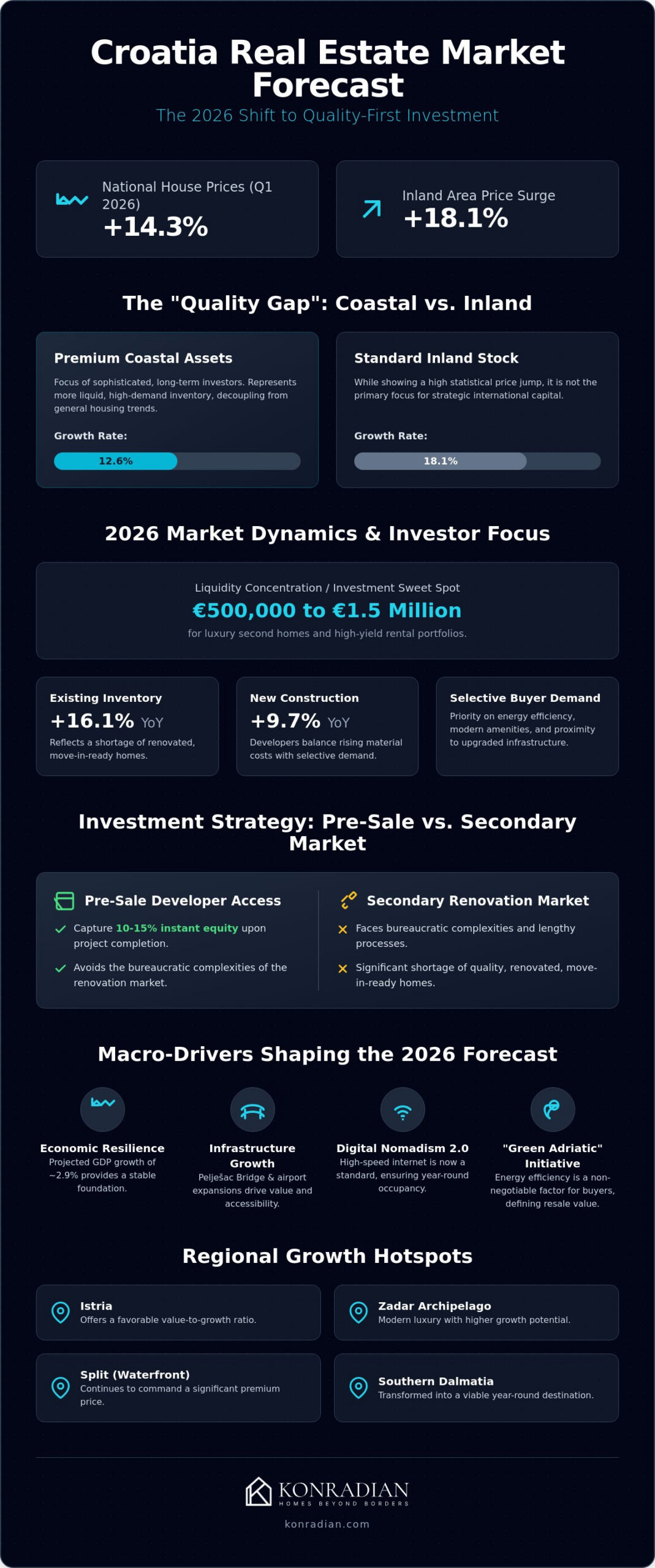
The period of speculative volatility that defined the immediate years after Eurozone entry has passed. In 2026, we see a market that has matured into a stable, value-driven environment. While the double-digit price increases of 2023 and 2024 felt like a gold rush, the Croatia real estate market forecast 2026 indicates a transition toward sustainable, quality-focused growth. National house prices rose by 14.3% in the first quarter of 2026, yet this growth isn’t driven by panic. It’s underpinned by robust Croatian economic fundamentals and a disciplined influx of international capital.
A distinct “Quality Gap” has emerged. Premium coastal assets along the Adriatic are now decoupling from standard inland residential stock. While inland areas saw a statistical price jump of 18.1% recently, the sophisticated investor’s focus remains on the coast, where the 12.6% growth represents more liquid, high-demand inventory. This moderating pace is a healthy signal. It suggests that the market is shedding speculative “flippers” and attracting long-term stewards of capital. Institutional funds are increasingly visible, financing large-scale luxury resorts and sustainable residential enclaves that are fundamentally reshaping the Adriatic coastline.
The “Euro Effect” Final Phase
Three years into the Eurozone era, price transparency is absolute. The ambiguity of dual currencies is a relic of the past. For US and UK investors, this stability has significantly lowered transaction friction, as currency risk is now centralized and predictable. Market data from early 2026 shows a clear divergence in entry points: prime waterfront locations in Split continue to command a significant premium, while the emerging, high-value developments in the Zadar region offer a strategic alternative for those seeking modern luxury with higher growth potential.
Investor Sentiment and Market Liquidity
Liquidity is currently concentrating in the €500,000 to €1.5 million segment, specifically for luxury second homes. Investors have shifted their focus from quick capital gains to building high-yield rental portfolios that capitalize on Croatia’s year-round appeal. Concerns about a price bubble are largely mitigated by severe supply constraints and the following market dynamics:
- Existing Inventory: Prices for existing residential properties rose by 16.1% year-on-year, reflecting a shortage of renovated, move-in-ready homes.
- New Construction: New properties saw a 9.7% increase, as developers balance rising material costs with more selective buyer demand.
- Selective Demand: Buyers are prioritizing energy efficiency, modern amenities, and proximity to upgraded infrastructure over sheer volume.
Construction costs remain high, and strict coastal zoning laws ensure that demand for premium property consistently outstrips new inventory. This scarcity creates a protective floor for your investment, ensuring that value is maintained even as broader European markets face headwinds.
Macro-Drivers Shaping the 2026 Forecast
The broader economic climate serves as the foundation for the Croatia real estate market forecast 2026. According to the European Commission 2026 economic forecast, the nation is maintaining a steady trajectory with a projected GDP growth of approximately 2.9%. This resilience isn’t accidental. It’s the result of a strategic shift toward infrastructure-led appreciation and a commitment to modernizing the transaction process, ensuring that the market remains attractive to sophisticated international capital.
The completion of the Pelješac Bridge has transitioned from a structural achievement to a fundamental driver of Southern Dalmatian property values. It effectively neutralized the seasonal isolation of the south, transforming it into a viable year-round destination for high-net-worth individuals. We’re also seeing the rise of Digital Nomadism 2.0. High-speed internet infrastructure is no longer a luxury; it’s a standard requirement that ensures year-round occupancy. Simultaneously, the “Green Adriatic” initiative is redefining resale value. Energy efficiency is now a non-negotiable factor for 2026 buyers, and properties that meet these modern sustainability standards are seeing significantly faster selling times.
Infrastructure and Accessibility
The expansion of Zadar and Split airports has created a direct correlation with property demand. New routes from major European hubs have simplified travel, making these regions more accessible than ever. Investors are increasingly looking toward planned marina developments as a way to future-proof their portfolios. These projects don’t just provide berths; they elevate the entire local ecosystem, attracting luxury retail and fine dining that support higher rental yields and long-term capital preservation.
Taxation and Legal Reforms
Understanding the 2026 fiscal environment is essential for accurate budgeting. The real estate transfer tax remains at 3% for resale properties, while new builds from developers within the VAT system attract a 25% VAT. A significant update for 2026 is the annual property tax on non-primary residences, with rates ranging from €0.60 to €8.00 per square meter depending on the municipality. This regulatory clarity is a central pillar of the Croatia real estate market forecast 2026, providing the transparency international buyers have long requested. For those seeking a secure entry, legal support buying property abroad is vital to navigate the digitalization of the land registry and the requirements of the National Housing Policy Plan 2030.
If you’re looking to align your portfolio with these macro-drivers, a tailored video consultation can provide the specific regional insights you need to make an informed decision.
Regional Growth Hotspots: Where the Smart Money is Moving
Istria: The Strategic Choice for European Buyers
Often referred to as the “New Tuscany,” Istria remains the dominant force in the luxury villa segment. Its geographic proximity to Central Europe—allowing for a five-hour drive from Munich or Vienna—secures its position as the premier weekend-home destination. We’ve observed a sophisticated shift in demand toward wine-and-olive-oil estates, where the land itself provides a secondary layer of value. If you are exploring this region, our curated list of Istria Real Estate for Sale highlights assets that combine traditional stone aesthetics with modern, energy-efficient infrastructure.
The Zadar-Šibenik Corridor
Split and Dubrovnik: The Blue-Chip Anchors
In Central Dalmatia, particularly Split and its surrounding islands, the narrative is one of extreme scarcity. Beachfront land is nearly exhausted, making any existing waterfront asset a “legacy property” with immense wealth preservation potential. Dubrovnik continues to operate in its own micro-market. It remains the most recession-proof region in the Adriatic, where international demand consistently outstrips the limited supply of high-end stone houses. Investors here aren’t just buying property; they’re securing a position in a globally recognized brand that maintains liquidity even during periods of market moderation. We provide the strategic oversight needed to identify these rare opportunities before they reach the public secondary market.
Investment Strategies: Pre-Sale vs. Secondary Market
Capital efficiency is the hallmark of the sophisticated investor. By entering a project during the pre-construction phase, you aren’t merely purchasing a residence; you’re securing a financial advantage that typically manifests as 10 to 15% instant equity upon the project’s completion. This tactical approach is a cornerstone of the Croatia real estate market forecast 2026, where the “Quality Gap” rewards those who prioritize modern construction over aging inventory. While others compete for visible secondary listings, the smart money moves into direct developer partnerships before the first stone is laid.
Our yield analysis for 2026 shows a significant shift in rental dynamics. While short-term holiday rentals remain lucrative in prime coastal hubs, we’re seeing increased stability in long-term executive lets. These tenancies, often driven by the growing community of international professionals, offer a more predictable cash flow with lower operational friction. When evaluating these yields against other Mediterranean options, such as those found in our guide to Spanish Property Acquisition, Croatia’s pre-sale model often presents a more compelling entry point for capital preservation and growth.
Off-Plan and Pre-Sale Mechanics
Staged payment plans are the primary tool for mitigating capital risk during the build phase. Typically, payments are tied to verified construction milestones, ensuring your capital is deployed only as value is created. Buying early also grants you the privilege of customization. From floor plans to high-end finishes, these adjustments don’t just suit your personal taste; they significantly increase final resale value. We provide our clients with direct access to “hidden” developer listings, ensuring you see the most promising opportunities before they reach the general market.
Renovation vs. New Build
The rising cost of construction materials in 2026 has made “fixer-uppers” a potential trap for the unwary. Older stone houses often carry hidden structural liabilities and complex legal titles that can delay your timeline by years. Additionally, new energy certification requirements for 2026 rentals mean that many secondary properties require expensive retrofitting to remain competitive. We apply the “Konradian Filter” to every opportunity, selecting only developers with proven delivery track records and financial stability. This rigorous oversight ensures your investment is protected from the start-to-finish of the acquisition process.
If you’re ready to secure a high-equity position in the Adriatic’s most promising developments, book a free video consultation with our LSE-educated advisory team today.
The Konradian Approach: Secure Acquisition in a Complex Market
Securing a premium asset in a foreign jurisdiction requires more than just capital; it demands a partnership built on intellectual rigor and local transparency. The Croatia real estate market forecast 2026 highlights a landscape that is increasingly rewarding for those with the right entry strategy, but it remains a complex environment for the uninitiated. At Konradian, we act as your sophisticated global guide, combining the financial precision of an LSE-educated team with the personalized care of a dedicated concierge. We don’t just find properties. We steward your investment from the initial strategy session to the final key handover, ensuring your peace of mind is never compromised.
One of the most significant advantages we offer is our “Free for Buyer” model. In the Croatian market, our advisory and brokerage services are typically compensated by the developer or seller, meaning your entire investment budget is directed toward the asset itself. This structure ensures that you receive elite-level market analysis, legal oversight, and transaction support without adding to your acquisition costs. By leveraging our deep-rooted developer relationships, we provide you with exclusive access to pre-sale opportunities that never reach public listings, positioning you at the forefront of the market’s most promising growth sectors.
Eliminating the “Foreigner Tax”
International investors often face an unspoken price premium, sometimes colloquially called a “foreigner tax,” when navigating the market alone. We neutralize this risk by negotiating with local market knowledge, ensuring you pay the same price as a domestic buyer. Our role as a professional intermediary is vital in a legal system that is currently undergoing rapid digitalization. We’ve managed numerous successful acquisitions where our clients secured sea-view investments without ever leaving their homes, relying on our comprehensive video tours and rigorous due diligence to finalize their portfolios remotely.
Your 2026 Action Plan
To capitalize on the current market cycle, we recommend a methodical three-step approach designed to maximize your ROI while minimizing exposure. This process is engineered to be seamless, professional, and entirely focused on your long-term objectives.
- Step 1: The Strategy Consultation. We begin with a free video call to align your financial goals with the specific regional opportunities identified in our Croatia real estate market forecast 2026.
- Step 2: Curated Shortlisting. Our team identifies a refined selection of properties, focusing on those with the highest value-to-growth ratios and proven developer track records.
- Step 3: Comprehensive Due Diligence. We manage the entire legal and financial verification process, ensuring that every title is clear and every transaction is secure.
If you’re ready to navigate the Adriatic coast with the confidence of a seasoned local expert, book your free consultation for Croatia real estate today and let us handle the heavy lifting of your next acquisition.
Navigating Your Adriatic Future with Strategic Precision
As the Croatian market transitions into a mature phase of stable growth, the distinction between speculative purchases and strategic investments has never been clearer. The Croatia real estate market forecast 2026 emphasizes that long-term value is now found in premium coastal assets and infrastructure-led hotspots like the Zadar archipelago. By prioritizing pre-sale opportunities and energy-efficient new builds, you aren’t just buying a second home; you’re securing a high-yield legacy asset in one of Europe’s most resilient economies.
We’re here to ensure your acquisition is seamless and secure. Our team provides LSE-educated market analysis and direct access to pre-sale developer prices, ensuring you enter the market with a competitive edge. We manage the heavy lifting of full legal oversight at no cost to the buyer, allowing you to focus on the lifestyle benefits of your new investment. Our start-to-finish stewardship is designed to provide the tranquility you deserve during high-stakes international transactions.
Secure your 2026 Croatian investment with a free expert consultation.
The Adriatic coast is ready for your next chapter. We look forward to helping you claim your place within it with confidence and ease.
Frequently Asked Questions
Is the Croatia real estate market expected to crash in 2026?
A market crash is not anticipated in the Croatia real estate market forecast 2026. While the frantic pace of the post-Eurozone entry has moderated, the 14.3% price increase recorded in early 2026 indicates a transition toward stable, sustainable growth. Severe supply constraints in premium coastal regions and robust economic fundamentals provide a protective floor, making a significant price decline unlikely for high-quality assets.
What are the main taxes for foreigners buying property in Croatia in 2026?
Foreigners should budget for a 3% Real Estate Transfer Tax on the market value of resale properties. If you purchase a newly built property from a developer within the VAT system, a 25% VAT applies instead of the transfer tax. You must also account for the new annual property tax on second homes, which ranges from €0.60 to €8.00 per square meter depending on the local municipality’s rates.
Which region of Croatia offers the highest rental yields in 2026?
The Zadar Archipelago currently offers the most favorable value-to-growth ratio for investors seeking high rental yields. While Istria dominates the luxury villa market with consistent demand from Central Europe, Zadar’s infrastructure expansions and tech-savvy demographic are driving strong year-round occupancy. These emerging corridors often outperform the more saturated markets in Split or Dubrovnik in terms of pure percentage returns.
Can US citizens buy property in Croatia without a local company?
Yes, US citizens can purchase residential property as individuals, provided reciprocity exists between the US and Croatia. You don’t need to form a local company, but the process requires obtaining consent from the Croatian Ministry of Justice. This administrative step involves securing a Personal Identification Number (OIB) and can take several months to finalize, though it remains a standard path for individual acquisition.
How does the “free for buyer” service work at Konradian?
Our professional advisory and transaction support services are compensated by the developer or seller, meaning you pay no commission to us as a buyer. This model ensures you receive elite financial rigor and full legal oversight without depleting your acquisition budget. We act as your dedicated concierge, managing everything from initial shortlisting to the final handover while maintaining a completely zero-cost structure for you.
What is the average time to complete a property purchase in Croatia?
A standard transaction typically takes between 45 and 90 days from the initial offer to the final registration. For non-EU citizens, this timeline is often extended by the several months required for Ministry of Justice consent. We mitigate these delays by handling the administrative heavy lifting and ensuring all documentation is precisely prepared before submission to the land registry.
Are there still “off-market” properties available in Dalmatia?
Off-market opportunities are a vital component of the Croatia real estate market forecast 2026, particularly in Dalmatia. Many premium waterfront assets and pre-sale developer units are secured through private networks before they are ever listed on public portals. Our direct relationships with the region’s top developers allow us to provide you with exclusive access to these high-equity listings early in the build cycle.
How do 2026 interest rates in Croatia compare to the rest of the EU?
Interest rates in Croatia remain competitive, with the national average for housing loans sitting around 3% in early 2026. For international investors, typical mortgage rates range from 3% to 4.5%, which aligns closely with broader Eurozone averages. This stability, combined with a projected GDP growth of 2.9%, makes the Croatian financial landscape an attractive environment for leveraged property acquisition.
